

Did you know that a single filing error now costs the average business over $845 per employee every year? According to 2026 data from IRIS Software Group, billions of dollars in penalties are assessed annually for inaccurate or late filings. If you feel overwhelmed by the complexity of managing multi-state payroll, you aren't alone. It's a heavy burden to track Georgia's 5.09% income tax rate while managing Texas SUI at 2.70% and new pay transparency laws in 17 different states. Are you the best employer you can be when you're buried in manual data entry and tax ID registrations?
We understand the fear of a surprise state-level audit. At Sullivan Group HR, our mission is to help you find, pay, and protect your people with total confidence. This article promises to reveal the hidden compliance traps of the "nexus" rule and show you how to protect your business from regulatory penalties. We'll debunk five dangerous myths that could jeopardize your company in 2026 and provide a roadmap to a streamlined, 100% compliant process that puts the human back in human resources.
Key Takeaways
- Learn why a single remote laptop creates a "Tax Nexus" and how to identify your hidden state obligations before regulatory agencies do.
- Understand the critical difference between "Worked-In" and "Lived-In" tax rules to ensure your withholding remains accurate regardless of your company headquarters.
- Discover why relying solely on basic software for managing multi-state payroll leaves you vulnerable to costly "garbage in, garbage out" data errors.
- See how a strategic HCM partnership protects your bottom line by replacing manual data reconciliation with a streamlined, automated workflow.
- Explore how Sullivan Group HR's advanced HCM solutions and "Find-Pay-Protect" approach provide the certainty you need to scale your business nationwide.
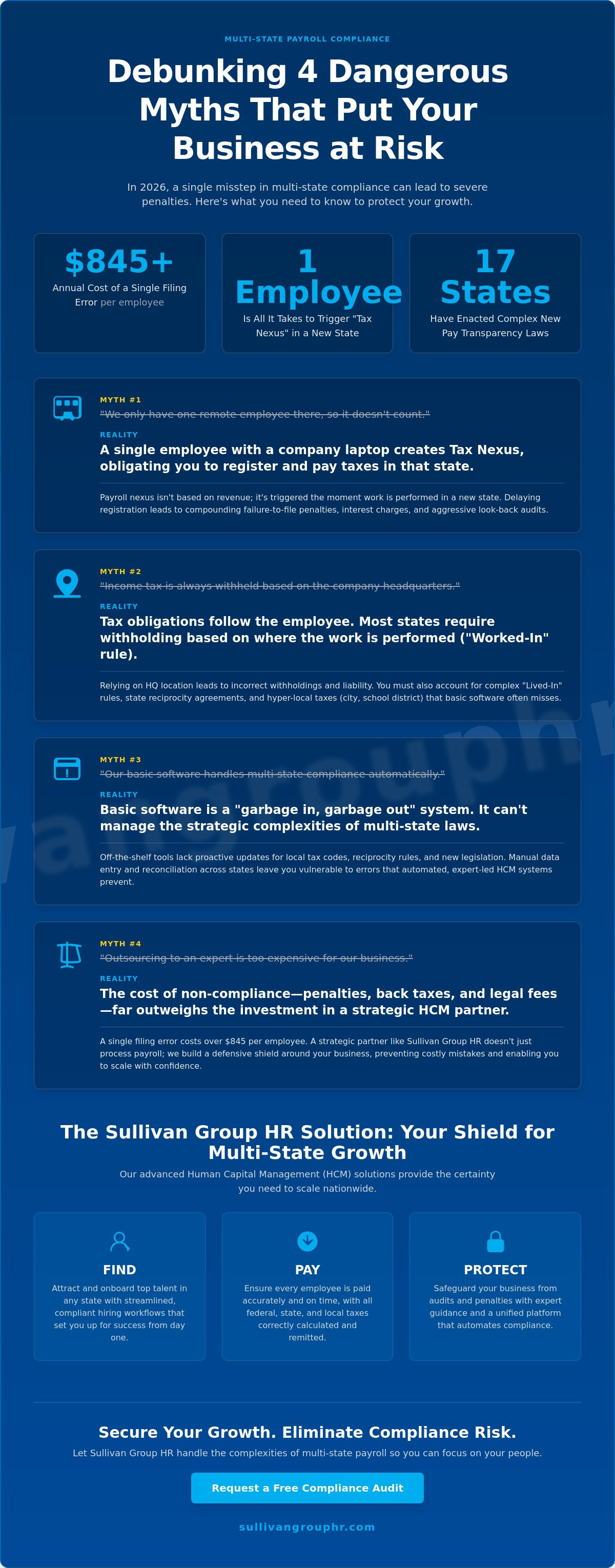
Myth 1: "We Only Have One Remote Employee There, So It Does Not Count"
Growth is the ultimate goal, but expanding your team across state lines shouldn't feel like walking through a regulatory minefield. A common trap for growing businesses is the belief that a single remote worker doesn't change their tax profile. In 2026, the reality is much sharper. Whether you have fifty employees in a satellite office or one designer working from their kitchen table in Florida, you've established a presence. This presence triggers a series of legal and financial obligations that you can't ignore without serious consequence. Managing multi-state payroll starts with acknowledging that every single employee creates a footprint.
When you hire across borders, you're entering the complex world of payroll tax at a local level. We often see "ghost employees" in our consulting work; these are staff members who live and work in one state but are accidentally paid through the payroll systems of another. This mistake doesn't just create messy books. It creates a liability. If you're paying a remote worker in South Carolina using Georgia tax rules, you're technically failing to report wages to the correct authorities. States are increasingly using AI-driven audit tools to find these discrepancies, and they don't offer much leniency for "honest mistakes."
Understanding the Threshold of Nexus
Tax Nexus is the legal link requiring a business to register for taxes in a state. While sales tax nexus often depends on revenue totals or transaction counts, payroll nexus is much simpler and more immediate. In most jurisdictions, "doing business" is defined by where the work is actually performed. If an employee opens a company-issued laptop in a new state, you have likely triggered nexus. You must distinguish this from sales tax thresholds; you don't need to hit a specific dollar amount in sales to owe payroll taxes. The moment that first hour of work is logged, the clock starts ticking on your compliance requirements.
The High Cost of Delayed Registration
Waiting to register for state-specific tax IDs is a gamble you won't win. Most states require you to register with their Department of Revenue and workforce agencies within weeks of hiring. If you delay, you face a cascade of issues:
- Failure-to-file penalties that compound monthly.
- Interest charges on unpaid unemployment insurance and withholding taxes.
- Aggressive look-back periods where states can audit your records years into the past to collect back taxes.
This proactive approach is a core part of what is human capital management in the modern era. It isn't just about processing checks. It's about building a defensive shield around your company's future. By securing your tax IDs immediately, you ensure that managing multi-state payroll remains a bridge to growth rather than a barrier to success. We help you find the right people, pay them accurately, and protect your business from these hidden traps.
Myth 2: "Income Tax Is Always Withheld Based on the Company Headquarters"
Many business owners assume that if their main office is located in one state, every employee follows only that specific state's rules. This is a dangerous mistake that can lead to massive back-tax liabilities. In reality, state income tax (SIT) is a moving target. It follows the employee, not your desk. Most states operate on a "Worked-In" basis, meaning you owe tax where the labor actually occurs. However, some jurisdictions also require withholding based on where the employee lives. Balancing these two sets of rules is a core challenge when managing multi-state payroll.
The complexity scales quickly when you factor in local jurisdictions. For instance, if you hire a remote worker in certain states, you aren't just dealing with state rates. You're dealing with municipal taxes, school district assessments, and local services taxes. These hyper-local fees are often invisible to basic, off-the-shelf payroll software. If you miss a 1% city tax, your business is the one on the hook for the unpaid balance and the associated penalties. You need a system that recognizes every boundary line.
State Reciprocity Agreements Explained
Reciprocity agreements are designed to prevent double taxation, but they add a heavy administrative layer to your plate. Some states have deals where an employee only pays income tax to their home state, regardless of where the office is located. To make this work, your staff must file a "Certificate of Non-Residency" with your HR department. If you don't collect and track these forms meticulously, you might withhold for the wrong state. This creates a nightmare for the employee's tax return and a compliance headache for you. Manually tracking these shifting agreements across dozens of states is a recipe for error.
Navigating "Convenience of the Employer" Rules
Some states use the "Convenience of the Employer" rule. This means if an employee works remotely for their own convenience rather than a business necessity, the state still demands its cut of the taxes. As of May 2026, regulations around these rules have tightened. States are hungry for revenue and are scrutinizing remote work arrangements more closely than ever. You must document exactly why an employee is remote. Proper documentation is your best defense against double-taxation claims. Our payroll administration services take the guesswork out of these complex tax codes. We help you find talent anywhere while ensuring you stay protected from local and state tax traps.
Myth 3: "Our Current Basic Software Handles Multi-State Compliance Automatically"
Automation is a powerful tool, but it isn't a substitute for a strategy. Many entrepreneurs believe that checking a box in a payroll app solves the riddle of managing multi-state payroll. It doesn't. Software is only as good as the data it receives and the logic that drives it. If your current system relies on "bolted-on" modules for different states, you're likely working with fragmented data. These silos don't always talk to each other, which leads to missed deadlines and filing errors.
We often see the "garbage in, garbage out" risk with self-service employee portals. When a new hire in Kentucky enters their own tax information without understanding reciprocity rules, the software simply processes what it's given. It won't flag the error until an auditor does. Managing multi-state payroll requires a unified HCM platform like isolved. This system links your time and attendance data directly to tax logic, ensuring that every hour worked is taxed according to the correct 2026 rates. It removes the guesswork that entry-level tools leave behind.
Don't forget about State Unemployment Insurance (SUI) rate management. SUI rates are not static; they change based on your claims history and annual state adjustments. If your software isn't updated with your specific 2026 experience rate, you'll either overpay or face underpayment penalties. A unified system tracks these shifts automatically, but it still requires a watchful eye to ensure the state's data matches your records.
The Limitations of Entry-Level Payroll Tools
Cheap software lacks the "last mile" of service. It won't help you register for a state tax ID or guide you through the nuances of Georgia's 2026 tax reductions. The biggest danger in these systems is the "manual override." When a user doesn't know how to handle a specific state requirement, they often force a number into the system. This creates a trail of breadcrumbs for the IRS. A truly unified system prevents these overrides by building compliance into the workflow from day one.
Why Human Expertise Must Back Your Technology
Technology is only one part of the "Protect" pillar in our Find-Pay-Protect approach. You need a Seasoned Local Guardian to interpret shifting 2026 laws and verify software outputs. At Sullivan Group HR, we don't just hand you a login and walk away. We partner with you to ensure your tech is performing exactly as it should. Are you the best employer you can be? You can't reach that goal if you're relying solely on an algorithm to keep your business safe from regulatory traps.
Myth 4: "Outsourcing Multi-State Payroll Is Too Expensive for Mid-Market Firms"
Budgeting for growth often leads business owners to cut corners in the back office. You might think that handling everything in-house saves money, but the math rarely adds up. When you're managing multi-state payroll, the "sticker price" of a partnership is only one part of the equation. You must weigh that cost against the $845 per employee in annual noncompliance fees identified by IRIS Software Group in February 2026. A single filing error in a new state can wipe out months of projected profits. Are you truly saving money if your team is spending 40 hours a month manually reconciling tax IDs across three different systems?
Hidden labor costs are the silent killers of mid-market efficiency. Manual data entry isn't just slow; it's a liability. Every time an HR manager manually keys in a shift differential for a remote worker in North Carolina, the risk of a typo increases. Unified platforms like isolved eliminate this friction. By automating the flow of data from time tracking to tax filing, you reduce the administrative headcount needed to keep the lights on. This efficiency extends to your "Pay-As-You-Go" workers' compensation insurance. Instead of paying massive upfront estimates for employees in multiple states, you pay based on actual real-time payroll data. This protects your cash flow and ensures you never overpay for coverage.
Calculating the Real ROI of Payroll Outsourcing
Think about the opportunity cost of your current HR leadership. If your best people are buried in state-specific tax forms and reciprocity filings, they aren't focusing on talent growth or culture building. In-house administration for a multi-state team often requires 15 to 20 hours of manual oversight per pay period. Outsourcing reduces that burden to mere minutes of review. The cost of one missed SUI filing often exceeds a year of service fees from a professional partner.
Reducing Risk Through Professional Employer Organizations (PEOs)
A PEO partnership changes the game through a co-employment model. This structure allows us to share the burden of compliance with you, shifting the heavy lifting of tax reporting and regulatory updates to our team. It also gives your small out-of-state teams access to national-scale benefits that usually belong to Fortune 500 companies. This level of support is essential to becoming the best employer you can be. By choosing payroll outsourcing, you gain a Seasoned Local Guardian who understands the regional landscape of Georgia and South Carolina while protecting your interests across the entire country. We find the talent, we pay the people, and we protect your business from the financial drain of administrative error.
How Sullivan Group HR Protects Your Multi-State Growth
Scaling your business across state lines is a major milestone, but it shouldn't come at the cost of your peace of mind. We've debunked the myths that lead to audits and overpayments. Now, it's time to build a foundation that supports your ambition. Managing multi-state payroll requires more than just a software login; it requires a strategic partnership that prioritizes your safety. Are you the best employer you can be? You can't answer "yes" if you're constantly looking over your shoulder for a surprise tax notice.
Our approach is built on a simple, powerful triad: Find, Pay, and Protect. We help you find people who perform, we ensure you pay them accurately, and we protect your business from the complex regulatory traps we've discussed. This isn't just about processing checks. It's about putting the human back in human resources. While national firms offer sterile, automated tickets, we offer a "neighborly" handshake backed by decades of regional expertise in Georgia and South Carolina. We act as your Seasoned Local Guardian, ensuring your growth remains profitable and compliant.
Unified HCM: The isolved Advantage
The engine behind our success is the isolved People Cloud. This unified human capital management platform eliminates the need for "bolted-on" state modules that don't communicate. When you use a single interface for managing multi-state payroll, the risk of data fragmentation disappears. isolved handles 2026 tax filing and reporting with precision, whether you're operating in two states or all fifty. By integrating time and attendance directly with payroll logic, the system automatically applies the correct labor laws and tax rates based on where the work actually happens. This scalability ensures that your back-office tech grows as fast as your team does.
Your Partner in Protection
We believe in a no-nonsense expert approach to HR. You don't need more jargon; you need solutions that work. As your coach and ally, we provide personalized consulting support to help you navigate shifting 2026 regulations, from pay transparency laws to new state-specific withholding rates. We don't just provide a platform; we provide certainty. We invite you to reach out for a comprehensive compliance "check-up." We'll help you identify hidden multi-state risks in your current process and build a roadmap for a streamlined, automated future. Protect your business and streamline your payroll with Sullivan Group HR. Let's ensure your expansion is built on solid ground.
Secure Your Growth with National Compliance
The landscape of 2026 demands more than just a basic payroll tool. We've seen how a single laptop can trigger a tax nexus and how "Worked-In" tax rules can quickly lead to double-taxation headaches. Managing multi-state payroll isn't a task you should tackle alone or leave to an unmonitored algorithm. You need a solution that scales with your ambition while keeping your business safe from the average $845 per employee noncompliance penalty. It's about protecting your bottom line and your reputation as you expand into new territories.
Since 1986, we've acted as a seasoned local guardian for businesses across Georgia and South Carolina. Our Find-Pay-Protect methodology ensures that your national expansion is built on a foundation of total security. With access to the industry-leading isolved HCM platform and over 30 years of HR and payroll expertise, we have your back. Don't let administrative burdens slow your momentum or expose you to risk. We provide the clarity you need to move forward with total confidence.
Are You The Best Employer You Can Be? Partner with Sullivan Group HR today.
Your journey to national growth should be exciting, not exhausting. We're here to put the human back in human resources and protect everything you've worked so hard to build. Let's build your future together.
Frequently Asked Questions
What is the "Convenience of the Employer" rule?
The "Convenience of the Employer" rule allows states like New York to tax remote workers if their work-from-home status is a personal choice rather than a business requirement. As of May 2026, tax authorities are scrutinizing these arrangements more closely to capture lost revenue. You must document specific business needs for remote roles to protect your staff from double taxation. This rule ensures the state where the office is located still receives its tax share.
Do I need to register for a tax ID in every state where I have a remote employee?
Yes, you generally must register for a state tax ID and a workforce account in every state where an employee performs work. Even one remote laptop triggers a "nexus," creating an immediate legal obligation to report wages. Failing to register can lead to aggressive look-back audits and compounding penalties. Managing multi-state payroll effectively requires securing these IDs before that first paycheck is ever issued to ensure you stay compliant.
How do reciprocity agreements affect multi-state payroll?
Reciprocity agreements allow employees who live in one state but work in another to pay income tax only to their state of residence. For example, a worker living in Kentucky but working in Illinois can avoid double withholding by filing a Certificate of Non-Residency. These agreements simplify the tax experience for your team but require your HR department to track and verify specific forms for every eligible employee to avoid filing errors.
What happens if I accidentally pay an employee in the wrong state?
Paying an employee in the wrong state creates a significant financial liability involving back taxes, interest, and late fees. According to February 2026 data from IRIS Software Group, the average cost of such noncompliance reaches $845 per employee per year. You'll need to amend previous quarterly filings and potentially reimburse the employee for tax discrepancies. It's a time-consuming process that highlights the need for professional payroll administration to prevent these manual entry mistakes.
Can isolved automatically handle different state overtime laws?
Yes, the isolved People Cloud is designed to automatically apply specific state and local overtime rules based on the employee's work location. Whether it's California's daily overtime requirements or standard federal limits, the unified system calculates pay accurately without manual intervention. This automation removes the "garbage in, garbage out" risk associated with basic software. It ensures your business complies with the Fair Labor Standards Act and varying state-level labor protections.
Is a PEO the best solution for managing payroll in 10+ states?
A PEO is often the most efficient solution for managing multi-state payroll across 10 or more jurisdictions because it shifts the compliance burden through co-employment. Instead of managing 10 different state tax IDs and unemployment accounts yourself, the PEO handles these filings under its own FEIN. This model provides a protective shield for mid-market firms. It allows you to focus on growth while we manage the complex administrative puzzles of national expansion.
How do I track which state unemployment insurance (SUI) I should pay?
You pay State Unemployment Insurance (SUI) to the state where the employee's work is localized. If an employee works in Texas, you'll likely pay the 2.70% new employer rate on the first $9,000 of wages as of May 2026. Tracking these payments requires a system that monitors the specific taxable wage bases and experience rates for every state. Our HCM solutions automate this tracking so you never miss a shifting deadline or rate change.
What are the most common multi-state payroll audit triggers in 2026?
The most common audit triggers in 2026 include discrepancies between federal W-2 data and state-level unemployment filings. Tax authorities now use AI-driven tools for automated cross-border data matching, which flags "ghost employees" paid in the wrong jurisdiction almost instantly. Another trigger is a sudden spike in unemployment claims in a state where you haven't registered a tax ID. Staying proactive with human capital management is your best defense against these digital enforcement tools.


