
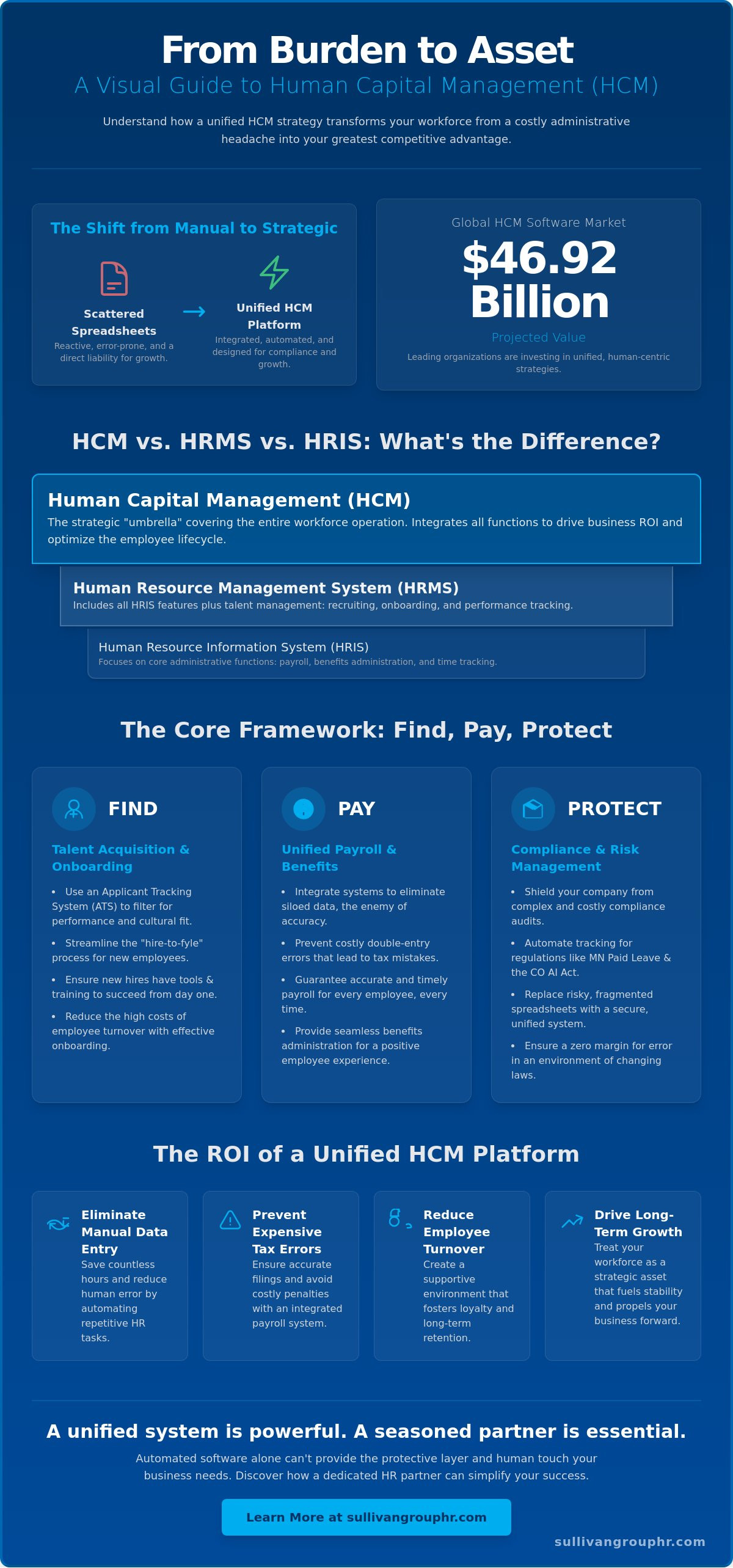
Your employees are either your company's greatest competitive advantage or its most expensive administrative headache. Most business owners feel the weight of the latter as they battle manual payroll cycles and the constant fear of a compliance lawsuit. If you are asking what is human capital management, you are really asking how to stop the burnout and start growing your business again. In a year where the global HCM software market is projected to reach up to $46.92 billion, it is clear that leading organizations are moving away from scattered spreadsheets and toward unified, human-centric strategies.
We understand the pressure of being a responsible employer in 2026. Between the new Minnesota Paid Leave requirements that started January 1 and the high-risk AI regulations taking effect in Colorado this June, staying compliant feels like a mountain of paperwork. This guide promises to show you how to transform your workforce from an administrative burden into your most valuable asset. We will preview our "Find, Pay, and Protect" framework, detail the latest regulatory shifts, and show you how a unified system reduces turnover while keeping your business safe from costly tax errors and compliance audits.
Key Takeaways
- Move beyond basic personnel management to treat your workforce as a strategic asset that drives long-term growth and stability.
- Clarify exactly what is human capital management by comparing it to HRIS and HRMS systems to find the right functional fit for your business.
- Apply the "Find - Pay - Protect" triad to streamline recruitment, guarantee payroll accuracy, and shield your company from complex compliance audits.
- Unlock the ROI of a unified HCM platform by eliminating manual data entry and preventing expensive tax filing mistakes.
- Understand why a seasoned local partner provides the protective layer and human touch that automated software alone cannot deliver.
What is Human Capital Management (HCM)?
Are you the best employer you can be? It is a question we ask every partner we work with. To truly answer it, you must move past the idea that HR is just a back-office function. To understand what is human capital management, you have to see it as the strategic "umbrella" that covers your entire workforce operation. HCM is a comprehensive set of practices and technologies designed to recruit, manage, and develop your team. It integrates payroll, benefits administration, and talent management into one cohesive system. The goal is simple. You want to transform your workforce from a line-item expense into a high-performing asset that drives business ROI.
In the past, businesses relied on "personnel management." This approach was purely administrative. It focused on filing forms, tracking hours, and reacting to problems as they appeared. Today, we view employees as Human capital. This economic principle suggests that the skills, training, and experience of your team are assets that grow in value over time. When you invest in an HCM strategy, you aren't just "managing" people. You are optimizing every stage of the employee lifecycle to ensure your company stays competitive and secure.
The Evolution of Modern HR
HR has changed drastically since we opened our doors in 1986. We have seen the industry move from overstuffed paper files to integrated digital platforms. By May 2026, this evolution has reached a critical point. Manual processes are no longer just slow; they are a direct liability for your growth. With the Colorado Artificial Intelligence Act taking effect on June 30, 2026, and new California pay equity laws already in place, the margin for error is zero. If you are still using spreadsheets to track complex requirements like Minnesota’s Paid Leave program, which started on January 1, 2026, you are inviting a compliance audit. Modern HCM systems replace these fragmented, risky methods with automated solutions that protect your business and your bottom line.
Putting the 'Human' Back in Resources
We believe in putting the "human" back in human resources. It is easy to get lost in the data, but your team is not a collection of rows on a spreadsheet. A true HCM strategy fosters a culture of support and professional growth. It ensures that your people feel valued from their first day of onboarding to their final day of retirement. When you use a unified system to Find people who perform, Pay them accurately, and Protect your business through compliance, you create an environment where employees can thrive. This approach reduces turnover and builds the kind of loyalty that money alone cannot buy. Human Capital Management is a holistic strategy that prioritizes people to drive peak organizational performance.
The 5 Pillars of a Strategic HCM Strategy
Managing a growing business is hard. It is even harder when your HR processes are scattered across different platforms, leaving you vulnerable to errors. When you evaluate what is human capital management for your specific needs, you will find it rests on five critical pillars. These pillars work together to transform your workforce from a series of tasks into a streamlined engine for growth. By focusing on talent acquisition, payroll, benefits, performance, and compliance, you create a foundation that supports both your people and your profit margins.
The U.S. government defines Strategic Human Capital Management as a system that aligns organization goals with employee performance. We take this a step further. We believe these pillars must be integrated to provide a true "Find, Pay, and Protect" solution. This strategy ensures you aren't just filling seats; you are building a legacy. If you feel overwhelmed by these moving parts, you might consider how a dedicated HR partner can simplify your daily operations.
Find: Talent Acquisition and Onboarding
Finding the right people is only half the battle. You need an Applicant Tracking System (ATS) that filters for performance and cultural fit before a candidate even walks through your door. Once they are hired, the first 90 days are critical. Statistics show that effective onboarding determines long-term retention. A strategic HCM approach streamlines the "hire-to-fyle" process, ensuring new hires have the tools and training they need to succeed from day one. This proactive stance prevents the high costs of employee turnover and keeps your team's momentum high.
Pay: Unified Payroll and Benefits
Siloed data is the enemy of accuracy. When your payroll and benefits systems don't talk to each other, you risk double-entry errors and frustrated employees. As of January 1, 2026, many states have introduced complex wage and leave requirements, such as Connecticut's $16.94 minimum wage or Minnesota's new paid leave program. An integrated HCM platform ensures that every deduction is correct and every paycheck is on time. You can learn more about managing these complexities in our guide to Mastering Employee Benefits Administration Services. Integrated systems improve employee satisfaction because they can access their data in one place.
Protect: Compliance and Safety
Compliance is your company's shield against the unexpected. With the Colorado Artificial Intelligence Act taking effect on June 30, 2026, and new California workplace notices required by February 1, 2026, the regulatory environment is more demanding than ever. A strategic HCM strategy automates the tracking of FMLA, COBRA, and FLSA requirements. It also prioritizes workplace safety and the management of Workers Comp Insurance for Small Business Success. By staying ahead of audits and lawsuits, you protect your capital and your reputation, allowing you to focus on being the best employer you can be.
HCM vs. HRIS vs. HRMS: What’s the Difference?
Are you drowning in an alphabet soup of HR acronyms? It is a common frustration for business owners across Georgia and South Carolina. To build a high-performing team, you must distinguish between the tools that store data and the strategy that drives growth. Understanding What is Human Capital Management (HCM)? starts with seeing how it differs from HRIS and HRMS. While these terms are often used interchangeably, they represent different levels of maturity in your HR operations. You don't just need a database; you need a roadmap.
Think of HRIS (Human Resource Information System) as your digital filing cabinet. It is the database that holds employee records, tax forms, and addresses. It is functional but largely static. HRMS (Human Resource Management System) goes a step further by adding functional tools like payroll and time tracking. It helps you "Pay" and "Protect" through basic automation. However, HCM is the total strategic approach. It encompasses both HRIS and HRMS while adding high-level talent development and performance analytics. When we discuss what is human capital management, we're talking about a mindset that views employees as assets to be grown rather than costs to be managed.
In 2026, businesses can't afford to treat these functions as separate silos. Scattered data leads to compliance gaps and administrative burnout. A unified HCM approach ensures that your data flows seamlessly from the moment you "Find" a candidate to their final performance review. This integration is what allows you to move from being a reactive manager to a proactive leader who puts the "human" back in human resources.
When to Upgrade Your System
Is your current software holding you back? If you're spending more than 10 hours a week manually syncing payroll data with your benefits provider, you've outgrown your system. Disconnected data is expensive. Industry reports from early 2026 show that manual data entry errors cost small businesses an average of $4,500 per year in avoidable tax penalties. Integration is the only way to get accurate, real-time reporting. You need to see your labor costs and turnover rates instantly to make informed leadership decisions that protect your bottom line.
The Power of a Unified Platform
A unified platform offers more than just convenience. It provides a single sign-on experience for your staff, which boosts engagement and reduces the frustration of managing multiple logins. Managers gain real-time visibility into attendance and performance goals without chasing down paper trails or checking three different apps. This unified platform serves as the single source of truth for all company data. It allows you to focus on being a coach and partner to your employees rather than a data entry clerk.
The Business ROI: Why HCM Matters in 2026
ROI is not just a buzzword; it is the difference between a business that scales and one that stagnates. When you analyze what is human capital management through a financial lens, you see a system designed to stop the bleeding of administrative waste. By early 2026, the global HCM market is projected to reach up to $46.92 billion because smart business owners realize that manual processes are a drain on capital. Automation reduces the labor hours your team spends on payroll administration and benefits tracking, allowing your leadership to focus on high-impact growth rather than paperwork.
Protecting your profit margins also means eliminating the threat of tax penalties and compliance fines. With Florida's minimum wage hitting $15.00 per hour on September 30, 2026, and Michigan reaching $13.73 on January 1, 2026, the cost of a single calculation error has never been higher. A unified HCM platform ensures your business stays compliant across state lines, protecting you from the expensive lawsuits and audits that often cripple small businesses. You aren't just buying software; you are investing in a shield for your company's bank account.
Data-Driven Decision Making
Stop guessing and start knowing. Labor analytics allow you to control overtime costs and identify exactly where your staffing budget is being wasted. If a specific department's turnover spikes by 12% in a single quarter, your HCM reporting will flag it before it becomes a full-blown crisis. These insights prepare you for executive-level strategy meetings by providing hard data on your company's most expensive investment: its people. Using these metrics allows you to pivot quickly, ensuring your staffing levels always match your current production needs.
Enhancing the Employee Experience
Modern employees expect more than just a paycheck. They want a digital-first experience where they can check their benefits or request time off from a mobile-first portal. Transparent performance tracking builds trust and fosters a culture of professional growth. By June 30, 2026, the Colorado Artificial Intelligence Act will require employers to use "reasonable care" in AI-driven employment decisions. A modern HCM platform helps you comply with these governance standards while providing a seamless experience for applicants. This is a core part of what is human capital management; it is about creating a supportive, high-tech environment that makes your company the best employer it can be.
Ready to see the numbers for yourself? Calculate your potential ROI with our HCM solutions.
Implementing HCM: Finding the Right Partner
Software is a tool, but it is not a strategy. Many business owners purchase a platform thinking it will solve their administrative headaches, only to find themselves buried in settings and support tickets. When you consider what is human capital management for your organization, you must look beyond the screen. You need a partner who understands the nuances of your business and the regional landscape of Georgia and South Carolina. A transactional vendor sells you a login; a strategic ally provides the wisdom and support to help you perform, comply, and grow. We have been this guardian for businesses since 1986, ensuring that technology serves the people, not the other way around.
Our approach is built on a simple, rhythmic triad: Find, Pay, and Protect. This framework simplifies the entire lifecycle of employment. We help you find people who perform, pay them accurately through streamlined payroll administration, and protect your business through rigorous compliance and workers' compensation management. This moves your HR department away from a sterile, bureaucratic feel and toward an empathetic partnership that has your back. By integrating these three pillars, you stop reacting to crises and start building a culture where employees feel secure and valued.
The isolved Advantage
To deliver on our promise of excellence, we leverage isolved, an industry-leading HCM platform designed for growing businesses. This unified system eliminates the need for multiple, disconnected apps that don't talk to each other. With isolved, you gain access to powerful features like a robust Applicant Tracking System (ATS), precise time and attendance tracking, and expert human resources consulting. It serves as your single source of truth, ensuring that data flows seamlessly from recruitment to retirement. You can see the full impact of this technology in our guide on How isolved HCM Streamlines Your Employee Lifecycle. This tool empowers your team with self-service options while giving you the high-level analytics needed for strategic decisions.
Your Path to Becoming the Best Employer
We believe in putting the "human" back in human resources. While we provide national-scale technology through isolved, we deliver it with the warmth and personalized touch of a local partner. This "neighborly" expertise means we understand the specific challenges you face in the Southeast. We don't just hand you a manual; we coach you through the complexities of the 2026 regulatory environment, from AI governance to new state leave laws. Our mission is to help you reach your full potential as an employer, creating an atmosphere of security for you and your staff. What is human capital management if not a commitment to your company's most valuable asset?
Are you ready to be the best employer you can be? Partner with Sullivan Group HR today.
Master Your Workforce Strategy Today
Are you ready to be the best employer you can be? We have explored what is human capital management as a total strategic approach rather than a simple software solution. By now, it's clear that moving from disconnected paper files to a unified platform like isolved is the only way to scale securely in 2026. A strategic HCM approach allows you to focus on your vision while your systems handle the heavy lifting of compliance and payroll administration.
Since 1986, Sullivan Group HR has served as a seasoned local guardian for business owners across Georgia and South Carolina. Our Find, Pay, and Protect framework is designed to give you peace of mind and a clear path to growth. You have the power to transform your workforce from an administrative burden into a high-performing asset. It starts with choosing a partner who puts the human back in human resources and treats your success as their primary metric. You don't have to navigate these complex regulatory changes alone.
Discover how Sullivan Group HR can protect your business and pay your people. We have your back every step of the way.
Frequently Asked Questions
What is the primary goal of human capital management?
The primary goal is to maximize the economic value of your workforce to drive business performance. By viewing employees as assets rather than expenses, you align their development with your 2026 growth targets. This ensures every hire contributes directly to your bottom line while reducing the administrative burden on your leadership team.
Is HCM only for large corporations, or can small businesses use it?
Small businesses benefit most from these systems because they often lack large internal HR departments. In 2026, firms with as few as 10 employees are using HCM to automate complex compliance tasks and compete with national brands for top talent. It provides the professional infrastructure needed to scale without adding significant overhead costs.
What is the difference between HCM and traditional HR?
Traditional HR focuses on reactive administrative tasks like filing paper records and tracking basic attendance. What is human capital management differs by being a strategic, data-driven approach that prioritizes long-term talent development and business ROI. It moves beyond simple record-keeping to optimize the entire employee lifecycle through integrated technology and expert consulting.
How does an HCM platform improve payroll accuracy?
Accuracy improves by using a single source of truth for all employee data. When time tracking, benefits, and payroll live in a unified system like isolved, you eliminate the manual entry errors that cost small businesses an average of $4,500 annually. Automation ensures that every deduction is correct and every paycheck is delivered on time.
Can HCM software help with workers' compensation and compliance?
Yes, a comprehensive system tracks safety incidents and automates compliance for FMLA, COBRA, and FLSA. This is critical for meeting new regulations, such as the California notice requirements effective February 1, 2026. Integrated systems also help manage workers' compensation insurance by providing accurate payroll data and historical safety records for audits.
What should I look for when choosing an HCM provider?
Prioritize a provider that offers both industry-leading technology and personalized, human support. You want a partner who understands the specific regional landscape of Georgia and South Carolina rather than a generic, automated help desk. Look for a "Seasoned Local Guardian" who has a proven track record of serving businesses since 1986.
How long does it take to implement a new HCM system?
A standard implementation typically takes between 60 and 90 days. This timeline allows for secure data migration, system configuration, and thorough staff training. A dedicated partner ensures the transition is smooth, so your team is ready to use the platform effectively without disrupting your daily business operations.
What is the 'Find - Pay - Protect' framework in HR?
This is our signature strategy for what is human capital management. It focuses on the three most critical stages of employment. We help you find people who perform, pay them accurately through automated payroll administration, and protect your business through expert compliance, safety management, and human resources consulting.


