

What if the most expensive tool in your HR tech stack is the one your team uses the least? With the employee self-service portal market expected to reach 6.94 billion dollars in 2026, the investment is clear, but the engagement often isn't. You likely see the potential for efficiency; yet, your HR team remains buried under manual how-to questions and outdated employee records. Implementing the right employee self-service adoption strategies is no longer just a technical task. It's a vital move to protect your team's time and your company's ROI.
We know how frustrating it feels to provide a solution that nobody touches. You deserve a system that works for you, not against you. In this guide, you'll learn how to turn your portal from a quiet corner of the internet into a high-utility hub that slashes administrative costs. We'll outline a roadmap to reduce your HR burden by over 40% and reach 90% adoption within six short months. From cultural alignment to internal marketing, you'll discover the exact steps to empower your workforce and secure your data for the long term.
Key Takeaways
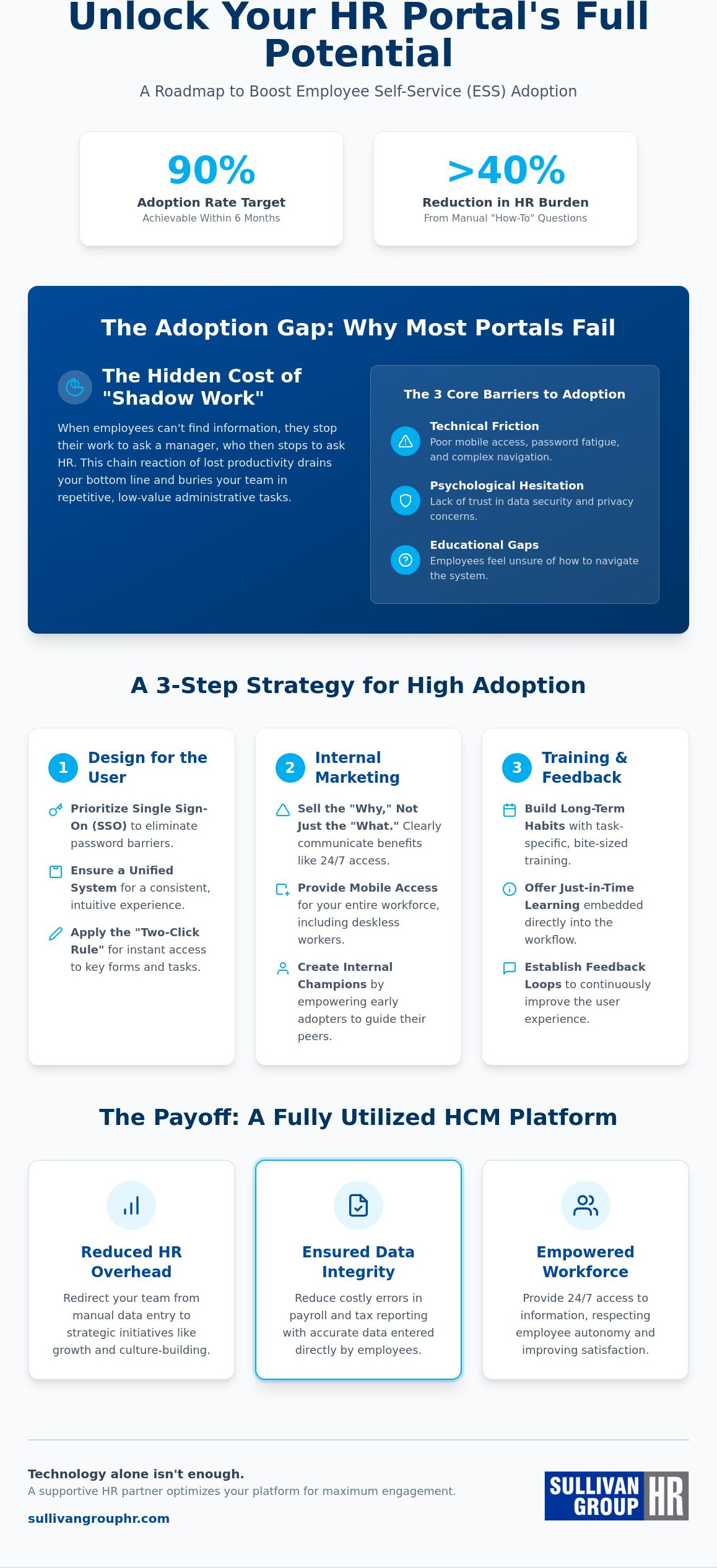
- Identify the hidden costs of manual "shadow work" and why most portals fail to solve daily employee problems.
- Remove technical friction by prioritizing mobile-first accessibility and Single Sign-On (SSO) to eliminate password fatigue.
- Deploy effective employee self-service adoption strategies that transform your workforce into internal champions for new HCM technology.
- Build long-term habit loops through task-specific, bite-sized training and just-in-time learning embedded directly in your workflow.
- Discover why technology alone isn't enough and how a supportive HR partner can optimize your isolved platform for maximum engagement.
The Adoption Gap: Why Most Employee Self-Service Portals Fail
Are your HR professionals still acting like human filing cabinets? If your team spends their afternoons answering "Where is my pay stub?" or "How do I update my address?", you have an adoption gap. Most businesses invest heavily in technology but forget the human element. Employee self-service (ESS) systems are designed to liberate your staff; yet, they often become digital ghost towns. This creates what we call "Shadow Work." It is the hidden administrative burden that occurs when employees cannot find what they need. They stop working to ask a manager, who then stops working to ask HR. It is a chain reaction of lost productivity that drains your bottom line.
In 2026, the "build it and they will come" mentality is a recipe for low ROI. Success requires intentional employee self-service adoption strategies that address three core barriers. First, technical barriers like poor mobile access frustrate users. Second, psychological barriers, such as a lack of trust in data security, create hesitation. Third, educational barriers leave employees feeling unsure of how to navigate the system. To turn the tide, you must move beyond just "having" a portal and start actively managing the experience.
Diagnosing Your Current Adoption Roadblocks
To fix the problem, you first have to find where the pipe is leaking. Start by evaluating your portal’s accessibility. Does it take three clicks to find a tax form, or ten? If the process is cumbersome, employees will always revert to the easiest path: sending an email to HR. You should also address the trust deficit. With new state privacy laws taking effect in 2026, employees are more sensitive about their personal data. They need to feel secure that their payroll and benefit choices are private and protected. Finally, analyze your usage data. If most users log in but drop off before completing an update, your internal workflow is the bottleneck.
The ROI of a Fully Utilized HCM Platform
When you bridge the adoption gap, the benefits are immediate and measurable. A high-functioning portal allows you to achieve three major goals:
- Reduce HR Overhead: Redirect your HR team from manual data entry to strategic growth and culture building.
- Ensure Data Integrity: Information is most accurate when it comes directly from the source. Direct employee input reduces errors in payroll and tax reporting; for instance, PS WebSolution specializes in automating these complex processes for enterprise environments like PeopleSoft.
- Empower Your Workforce: Providing 24/7 access to vital information respects your employees' time and autonomy, especially in hybrid work environments.
By implementing proactive employee self-service adoption strategies, you transform your HCM platform from a static storage bin into a high-utility hub that supports every member of your team.
Designing for the User: Accessibility and UX Strategies
Is your portal a maze or a map? If it takes more than a minute to log in, your employees have already given up. Successful employee self-service adoption strategies prioritize the path of least resistance. This starts with implementing Single Sign-On (SSO). Eliminating password fatigue removes the biggest psychological barrier to entry. When your team can access their data with one click, engagement naturally follows. You want the system to feel like a tool they use, not a chore they avoid.
Leveraging a unified system like the isolved People Cloud ensures that every function, from payroll to benefits, lives under one digital roof. This consistency reduces cognitive load. It makes the platform feel like a supportive partner. When every module looks and acts the same, the learning curve disappears. This is especially vital for the least tech-savvy members of your team who might feel intimidated by complex software.
Mobile Accessibility for the Modern Workforce
Does your strategy include your deskless workers? Many employee self-service adoption strategies fail because they assume everyone sits at a computer. In 2026, your workforce is mobile. A responsive app is no longer optional; it's the standard. Dedicated apps allow for push notifications, which are far more effective than emails for reaching staff in the field. You can support workers who don't have a company email address by providing secure, app-based access. This ensures that your entire team stays connected, regardless of where they work.
Simplifying the Path to Resolution
Apply the "Two-Click Rule." If an employee cannot find their W-2 or request time off in two clicks, the design is too complex. Use search-centric navigation to help people find answers instantly. High standards for employee accessibility and UX mean your platform should be usable for everyone, including those using assistive technologies. Visual aids and short "How-To" snippets should be embedded right where the action happens. This provides just-in-time learning that solves problems before they reach HR.
Finally, audit your knowledge base. Remove the dense HR jargon. Instead of "Direct Deposit Authorization," try "Where do you want your paycheck sent?" Simple language builds confidence. When employees feel confident in the tool, they stop calling HR with basic questions. If you need a hand optimizing your HR technology for better engagement, our team is here to guide you through the transition.
Internal Marketing: Selling the 'Why' to Your Workforce
Why do employees often treat new software like an unwanted houseguest? Usually, it's because they view the transition as a way to shift HR’s workload onto their own plates. To overcome this, your employee self-service adoption strategies must pivot. You aren't just installing a system; you're launching a benefit. Stop framing the portal as a tool for "HR efficiency." Instead, sell it as a platform for "Employee Empowerment." When people feel they have control over their own data, their resistance turns into ownership. It's about clarity, control, and convenience.
Peer influence is your strongest asset. Identify and leverage "Internal Champions" within different departments. These aren't necessarily managers; they are the tech-savvy influencers who others naturally go to for help. When a colleague shows a peer how to download a pay stub in ten seconds, it carries more weight than a generic email from the front office. Support these champions with a multi-channel launch campaign. Use Slack for quick wins, posters in the breakroom for visibility, and brief demos during town halls to build momentum.
Framing the Benefits for Different Personas
One size does not fit all when it comes to communication. To drive engagement, you must answer the "What's In It For Me?" (WIIFM) question for every level of the organization. Consider these three distinct viewpoints:
- For the busy parent: Focus on instant access. They can check dental coverage or PTO balances from a smartphone while sitting in a doctor's waiting room.
- For the new hire: Highlight the digital-first culture. A seamless onboarding experience proves that your company values modern, efficient workflows.
- For the manager: Emphasize autonomy. They can access real-time team insights and approve time-off requests without waiting for HR to pull a report.
Creative Campaigns to Boost Engagement
Engagement doesn't have to be dry. Use gamification to make the rollout interactive. Offer small incentives, like a coffee gift card, for the first twenty employees who complete their portal profiles or update their emergency contacts. Share success stories that highlight practical value. For instance, share a brief anecdote about how a colleague used the portal to quickly secure a mortgage verification during their lunch break. Use "Teaser" content to build anticipation before major updates. This creates a steady, reliable beat of communication that keeps the portal top-of-mind. By treating the rollout as a supportive partnership rather than a mandate, you ensure your workforce feels protected and prepared for the future.
Training and Feedback: Building Long-Term Habit Loops
Training should feel like a partner, not a lecture. If you hand your team a 40-page PDF manual, you’ve already lost their attention. Effective employee self-service adoption strategies rely on continuous, low-friction learning rather than one-time classroom events. You want to build habit loops where using the portal becomes the path of least resistance. This transition requires a structured, five-step approach to ensure no one feels left behind. It is about creating a culture of self-sufficiency that feels supportive rather than demanding.
- Step 1: Conduct bite-sized training sessions. Focus on one specific task, like "How to update your W-4," in under three minutes.
- Step 2: Embed "Help" links directly within the HCM workflow. This provides just-in-time learning exactly when the employee needs it.
- Step 3: Establish a "Super User" program. These localized office experts provide immediate, peer-to-peer support on the floor.
- Step 4: Create a recurring feedback loop. Regularly ask your team what is working and what is causing friction.
- Step 5: Celebrate adoption milestones. Recognize departments that reach 100% profile completion to maintain organizational momentum.
Moving Beyond Traditional Training Manuals
Traditional manuals are where information goes to die. Instead, use 60-second screen recordings to demonstrate common tasks. These "Loom" style videos are easy to digest and can be watched on a mobile device. Interactive walkthroughs that guide the user through their first login are also essential. If self-help is easier than emailing HR, your adoption rates will soar. You want to make the digital experience feel human, accessible, and intuitive.
Iterative Improvement Based on User Data
Listen, adapt, and improve. Use internal surveys to ask, "What is the most frustrating part of the portal?" When you act on this feedback quickly, you prove that employee input matters. This trust is the foundation for broader workforce management solutions that drive holistic growth. By linking portal usage to tangible improvements in their daily work life, you secure long-term engagement. If you’re ready to see how a professional HR partner can transform your portal engagement, reach out to Sullivan Group HR today. We specialize in making complex technology feel like a simple, supportive handshake.
Sullivan Group HR: Your Partner in HCM Success
Are you ready to unlock your company's true professional potential? Technology is a powerful engine, but it requires a skilled driver to reach the destination. At Sullivan Group HR, we believe that software alone cannot solve cultural challenges. While the right tools are essential, the human element is what transforms a system from a requirement into a resource. We don't just provide a platform; we provide a partnership. By combining robust technology with our "no-nonsense" approach to HR consulting, we help you implement employee self-service adoption strategies that actually stick. We've spent years helping businesses just like yours move away from sterile, bureaucratic processes toward a more human-centric model of management.
We move beyond the role of a transactional vendor to become a long-term ally. Our goal is to protect your time and secure your organizational stability. When you partner with us, you aren't just buying software; you're gaining a team of regional experts who understand the nuances of your local territory. When you focus on the right employee self-service adoption strategies, you stop fighting the system and start reaping the rewards of a truly empowered workforce. We handle the heavy lifting of administrative tasks so you can focus on leading your team. It's about movement, safety, and results. We believe your success is the only metric that truly matters.
The isolved Advantage: Built for Adoption
The isolved platform is designed with the end-user in mind. It provides a unified experience that eliminates the frustration of multiple logins and fragmented data. It's a scalable solution that grows alongside your business, whether you're managing ten employees or hundreds. The intuitive interface ensures that new hires feel comfortable from day one, which significantly reduces the learning curve. When the technology is this accessible, high engagement becomes the standard rather than the exception. We optimize this tool to fit your specific needs, ensuring it feels like a natural extension of your company culture.
Strategic Support Beyond the Software
True success comes from a balance of tech and talent. Our team provides professional HR consulting to guide your change management strategy from start to finish. We offer expert payroll administration outsourcing to ensure your data remains accurate and compliant. You get direct access to experts who understand your business lifecycle and the specific regulatory hurdles you face. We are here to simplify the complex, deliver results, and help you build a more resilient workforce. Let us handle the administrative burden so you can focus on the aspirational goals that drive your business forward. We're your coach, your ally, and your advocate in a rapidly changing professional world.
Secure Your Workforce's Digital Future
Transforming your HR portal from a quiet archive into a high-utility hub is a strategic necessity for 2026. You've seen how design simplicity, internal marketing, and continuous feedback loops form the foundation of successful employee self-service adoption strategies. It isn't just about the software; it's about the people you serve every day. By removing technical friction and framing the portal as a tool for empowerment, you protect your team's time and your company's bottom line. Is your current system helping your people grow, or is it holding them back?
You don't have to navigate this transition alone. Sullivan Group HR provides more than just access to the industry-leading isolved HCM platform. We offer authoritative HR consulting with a supportive, partner-first approach that mid-market firms trust to reduce administrative burdens. We act as your ally, ensuring your technology serves your talent. Our team understands the nuances of your territory and the lifecycle of your business.
Ready to empower your team? Discover how Sullivan Group HR simplifies HCM adoption.
Your professional potential is limitless when you have the right partner by your side. Let's build a more engaged, efficient, and secure workplace together.
Frequently Asked Questions
What is the industry average for employee self-service adoption?
Successful organizations typically aim for a 90% adoption rate within the first six months of a new rollout. While many mid-market firms struggle to break past 60% initially, using intentional employee self-service adoption strategies can bridge this gap. High engagement is usually a sign that the portal is solving daily problems for the workforce rather than just serving HR's needs.
How can I encourage older employees to use the HR portal?
Focus on supportive coaching and accessibility rather than just providing digital manuals. Use your "Internal Champions" to offer low-pressure, peer-to-peer demonstrations that highlight immediate personal wins, such as viewing retirement balances or PTO. Ensuring the interface is intuitive and accessible helps technology feel like a helpful partner rather than a daunting barrier.
Should I make employee self-service usage mandatory?
Making usage mandatory is often necessary for data integrity, but it works best when paired with deep organizational support. If you require the portal for time-tracking or tax updates, you must guarantee the system is reliable and easy to access. Frame the requirement as a way to protect employee data and ensure payroll accuracy rather than a simple administrative mandate.
How does high ESS adoption impact HR department costs?
High adoption can reduce HR administrative burdens by 40% or more by eliminating manual data entry. When employees manage their own updates, your HR team can pivot toward strategic growth and long-term organizational security. This shift slashes overhead costs and significantly improves the return on your HCM platform investment.
What are the most common security concerns with self-service portals?
Data privacy and unauthorized access are the primary concerns, especially with new state privacy laws in Indiana, Kentucky, and Rhode Island taking effect in 2026. Employees need to know their sensitive payroll and medical information is protected. Address this by implementing Single Sign-On and being transparent about your encryption and multi-factor authentication protocols; you can learn more about Carolina IT Group to see how managed IT services can help secure your organization's sensitive data.
How often should we update our portal's knowledge base?
You should audit your knowledge base at least quarterly or whenever major regulatory changes occur. For example, new California minimum wage rates and salary thresholds effective January 1, 2026, must be updated immediately to maintain trust. Frequent updates ensure that employees view the portal as a reliable, "no-nonsense" source of truth.
Can self-service portals help with benefits enrollment?
Yes, portals are the most efficient way to manage open enrollment and life event changes. They allow employees to compare plans and select coverage options at their own pace from any mobile device. This reduces the margin for error and eliminates the need for manual paper-based tracking during high-volume enrollment periods.
What should I do if an employee refuses to use the digital system?
Start by diagnosing the specific roadblock: is it a technical barrier, a lack of trust, or a simple misunderstanding? Offer one-on-one support to bridge the gap and demonstrate how the portal protects their personal information. In most cases, showing the employee how the system simplifies their own life will resolve the resistance.


