
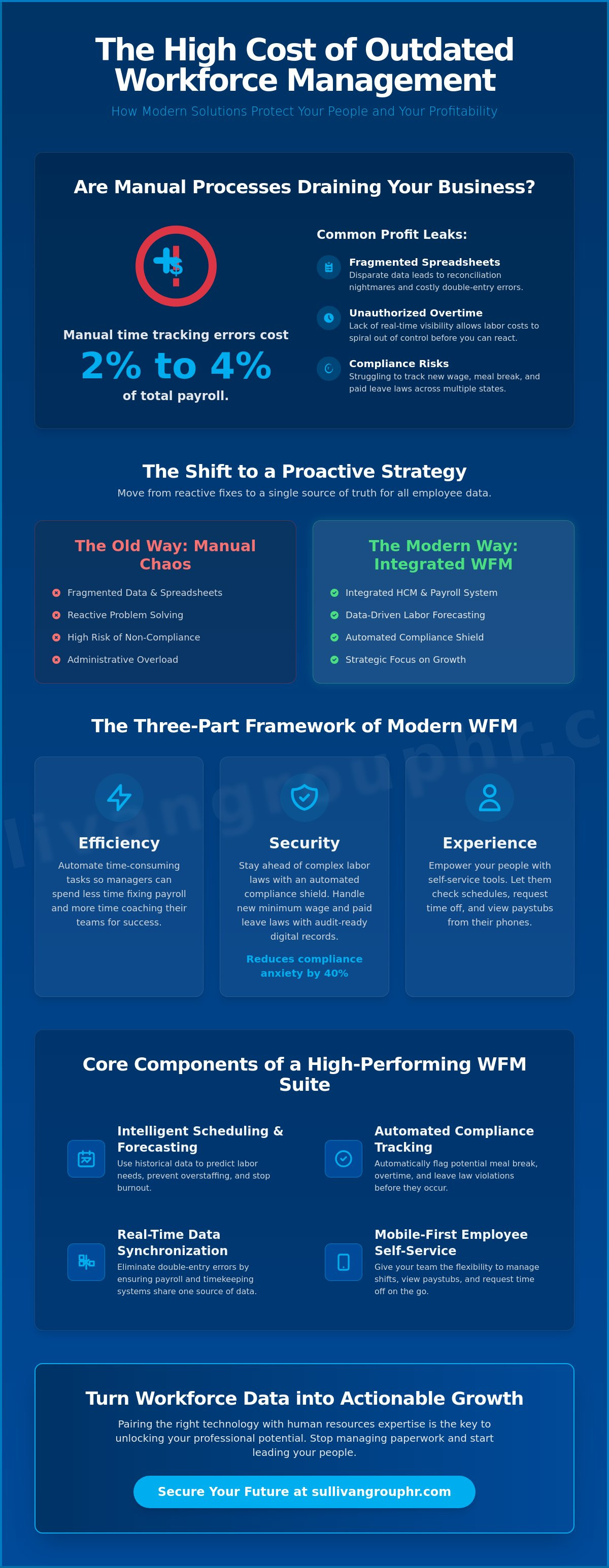
Did you know that manual time tracking errors cost the average business between 2% and 4% of their total payroll? For a growing company, that isn't just a minor mistake. It's a direct leak in your hard-earned profitability. You likely feel the weight of managing fragmented data while trying to stay ahead of the 2026 minimum wage increases in California and Connecticut. It's stressful to balance the books when manual scheduling leads to overtime leaks and anxiety over the new paid leave laws in Delaware and Minnesota.
We understand that you want to protect your people and your bottom line. This guide explores how modern workforce management solutions integrate smart technology with human expertise to drive efficiency, compliance, and growth. You'll learn how to move away from administrative burdens toward a single source of truth for all employee data. We will show you how to automate complex regulatory tasks and secure predictable labor costs, allowing you to focus on your professional potential instead of paperwork.
Key Takeaways
- Replace fragmented spreadsheets with integrated HCM and payroll systems to eliminate manual errors and streamline your employee data.
- Discover how modern workforce management solutions automate compliance and help you maintain predictable labor costs as your team grows.
- Evaluate the total impact of your technology by measuring both direct financial savings and the long-term value of employee engagement.
- Move beyond basic software by pairing the isolved platform with human resources consulting to turn workforce data into actionable growth.
Understanding Workforce Management Solutions in 2026
Does your current system feel like a burden or a bridge? In 2026, Workforce management (WFM) has evolved far beyond simple scheduling. It is an integrated set of processes designed to maximize employee productivity while protecting your bottom line. We have seen a massive transition from dusty manual spreadsheets to automated, cloud-based HCM environments. These modern workforce management solutions do more than just track hours; they align your labor strategy with your long-term business goals.
The landscape has shifted toward data-driven labor forecasting. Instead of guessing how many people you need for next Tuesday, your system predicts it based on historical trends and real-time demand. Meanwhile, employee self-service tools give your team the transparency they crave. They can check schedules, request time off, and view paystubs from their phones. This isn't just about software. It is about shifting from reactive tracking to a proactive human capital management strategy that puts people first.
The Three-Part Framework of Modern WFM
We look at WFM through a three-part lens: efficiency, security, and experience. Operational efficiency means your managers spend less time fixing payroll errors and more time coaching. Manual time tracking errors can cost businesses an average of 2% to 4% of total payroll, so automation is a financial necessity. Compliance security is your shield. With 19 states increasing minimum wages this year and new paid leave laws taking effect in Delaware and Minnesota, manual systems simply can't keep up. Finally, the employee experience focuses on empowering your people. When your workforce feels seen and respected, they stay.
Why 2026 Demands a Proactive Approach
Hybrid work models have made traditional time and attendance tracking nearly impossible without the right tools. You need real-time data to prevent "labor leaks" like unauthorized overtime before they hit your bank account. In a litigious environment, robust HR risk management is no longer optional. It is the difference between a thriving business and one buried in administrative audits. By choosing comprehensive workforce management solutions, you ensure that every hour worked is an hour that moves your company forward safely and efficiently.
Core Components of a High-Performing WFM Suite
How do you scale your business without losing control of your most expensive asset? Mid-market leaders often find themselves trapped between the excitement of growth and the chaos of administrative burden. To bridge this gap, your workforce management solutions must be more than just digital punch cards. They need to act as a central nervous system for your operations. The non-negotiable features for 2026 include real-time data synchronization, automated executive reporting, and a mobile-first interface. When your payroll and timekeeping systems share the same data, double-entry errors disappear. This integration protects your team from pay discrepancies and saves your administrative staff from hours of tedious reconciliation.
Intelligent Scheduling and Labor Forecasting
Static rosters are a relic of the past that often lead to overstaffing or service gaps. Today, successful managers optimize workloads by using demand-based scheduling. This proactive approach uses historical data to predict exactly how many people you need on the floor at any given time. It prevents burnout and stops labor leaks before they start. Features like employee-led shift swapping improve morale by offering flexibility while ensuring your coverage remains intact. By leveraging isolved time and attendance, you gain real-time visibility into your workforce. You can see who is on the clock and adjust resources instantly to meet shifting needs.
Automated Compliance and Regulatory Tracking
Staying ahead of shifting federal and state labor regulations is a monumental task for any business owner. In 2026, manual tracking of meal breaks and overtime is a recipe for a lawsuit. Automated systems handle these complexities for you by flagging potential violations before they occur. They monitor state-specific leave laws and ensure your records are always audit-ready. This creates a secure, digital paper trail that is vital for defending against Department of Labor inquiries. Research indicates that automated tracking reduces compliance anxiety by 40% for business owners. It provides a sense of security that allows you to focus on growth rather than red tape.
Executive decision-making relies on accurate, timely information. Automated reporting transforms raw attendance data into clear, actionable insights about your labor costs. You can identify which departments are hitting their targets and which ones need more support. At the same time, a mobile-first design is essential for your deskless and remote employees. They expect to view schedules and request time off from their smartphones. This transparency builds trust and improves the overall employee experience. If you want to see how these tools can transform your daily operations, our experts at Sullivan Group HR are here to guide your transition.
The ROI of Integrated Workforce Management
Is the investment worth it? This is the first question we hear from business owners considering a shift in their operations. While the upfront cost of technology is visible, the hidden costs of fragmented, manual systems are often much higher. Staying with outdated processes isn't just inefficient; it's expensive. When you implement modern workforce management solutions, you are doing more than buying software. You are securing a strategic insurance policy against human error and expensive regulatory fines. For smaller teams, the ROI is often even more immediate. Every hour saved for a lean staff is an hour redirected toward growth and revenue generation.
Think about the time your leadership spends on administrative tasks. Small businesses can waste 4 to 8 hours per week on manual scheduling and payroll preparation alone. Over a year, that is hundreds of hours lost to basic data entry. By automating these functions, you reclaim that time for high-value leadership. Integrated systems also act as a shield against the litigious environment of 2026. With complex laws like the EU Pay Transparency Directive and new state-level leave programs, a single oversight can lead to significant penalties. Automation ensures you stay compliant without having to become a legal expert yourself.
Eliminating Labor Leaks and Payroll Variance
Labor leaks often go unnoticed until they have already drained your profitability. "Time theft," such as buddy punching or unauthorized early clock-ins, can quietly inflate your labor costs. Biometric or geofenced clock-ins prevent this by ensuring employees are physically present when they log in. The savings continue through automated accrual tracking. When PTO and sick leave are managed manually, errors in balances are common. Automation ensures that every hour of leave is earned and tracked with 100% accuracy. When this data flows directly from your timekeeping to your payroll administration, you eliminate the human errors that typically plague manual data transfers.
Strengthening the Employer-Employee Bond
Beyond the spreadsheets, there is a powerful "soft ROI" in employee engagement. Trust is the foundation of a productive workplace. When employees have real-time visibility into their schedules and earnings through self-service portals, "HR friction" disappears. They don't have to wait for an email response to know if their vacation was approved. This culture of transparency begins the moment a candidate applies. Utilizing a strategic approach to applicant tracking and onboarding sets a professional, supportive tone from the very start. By empowering your workforce with the right tools, you improve retention and protect the human capital that drives your success.
How to Evaluate and Implement WFM Solutions
Are you looking for a software vendor or a long-term strategic partner? There is a significant difference. Many national firms offer shiny interfaces but leave you stranded when a complex regulatory question arises. When evaluating workforce management solutions, you must look beyond the features list. You need a system that scales with your headcount and a team that understands your local territory. A successful implementation isn't just about flipping a switch. It requires a thoughtful approach that balances technical precision with human support. By leading with clear goals, you turn a daunting transition into a manageable path toward growth.
The 5-Step Selection Checklist
- Assess current pain points: Identify exactly where you are losing money, whether through manual data entry errors or overtime leaks.
- Verify integration capabilities: Ensure the platform talks directly to your existing payroll administration and benefits management systems.
- Test the mobile user experience: Your deskless workers need a tool that is intuitive and accessible from their smartphones.
- Evaluate security and compliance: Check the provider's track record for data protection and their speed in pushing out federal labor law updates.
- Confirm US-based support: Ensure you can reach a human expert who understands the nuances of your specific region and industry.
Ensuring a Smooth Transition
Adoption is the true measure of success for any new technology. To achieve this, identify "internal champions" within your leadership team to help drive excitement and usage across the company. Clean data migration from your legacy spreadsheets is also non-negotiable. Bad data in always results in bad data out. Remember that post-launch training is actually more critical than the software itself. Your team needs to feel confident and supported as they learn new workflows. This human-centric approach minimizes frustration and maximizes your return on investment.
A typical implementation in 2026 takes between 8 and 12 weeks. This timeframe allows for thorough data auditing, system configuration, and personalized team training. Rushing this process often leads to long-term friction and missed opportunities for optimization. By taking a measured, proactive approach, you protect your investment and your people. If you are ready to move away from administrative burdens and secure your professional potential, Sullivan Group HR provides the expert guidance you need for a seamless transition.
Why a Managed Approach to WFM Secures Your Future
What if your technology did more than just store data? Many business owners feel that a platform alone is the answer to their administrative headaches. In reality, software is just a tool. It requires a steady hand and professional expertise to turn raw numbers into a strategic advantage. At Sullivan Group HR, we act as the vital bridge between the power of the isolved platform and your long-term business goals. By choosing managed workforce management solutions, you move from simply surviving the workday to actively building a legacy of success.
A managed approach offers a protective shield for your company. National labor laws and local regulations change at a dizzying pace. Having a dedicated ally ensures your compliance is always current. This partnership transforms your data into actionable growth plans. Instead of just seeing who worked when, you gain insights into labor efficiency and organizational health. Our team provides the human perspective that automated systems lack. We help you interpret trends, identify opportunities, and secure your professional potential.
The Power of the isolved Platform
We utilize isolved as our primary HCM engine because it is built for the complexities of mid-market businesses. It serves as a centralized hub, often called a "People Cloud," where payroll, benefits, and time tracking live in perfect harmony. This seamless integration means your data is always accurate and accessible. You don't have to jump between systems or worry about conflicting records. It provides the stability and scalability you need to grow with confidence. When your foundational tech is this reliable, you can focus on the people who make your business run.
Your Partner in Growth: Beyond the Software
True success comes from a balance of tech and talent. While the software handles the processing, our human resources consulting provides the wisdom. We help you navigate complex labor issues that a screen simply cannot solve. Integrating comprehensive benefits management solutions into your WFM strategy rounds out your protective framework. It shows your employees they are valued and protected. This people-first approach is what differentiates a thriving culture from a transactional one.
Your time is your most valuable asset. Reclaiming it allows you to focus on your core mission and the growth of your team. Our managed workforce management solutions are designed to give you that time back. You deserve a partner who values your success as much as you do. Together, we can build a business that is efficient, compliant, and ready for whatever 2026 brings. Let us handle the administrative burden so you can lead with clarity and purpose.
Securing Your Growth with a Human-Centric Strategy
Are you ready to move from managing spreadsheets to leading people? The future of your business depends on how well you balance technical precision with human expertise. By implementing modern workforce management solutions, you move beyond basic tracking and start building a resilient, scalable organization. We have explored how integrated data eliminates labor leaks and how automated compliance protects you from shifting federal regulations.
Sullivan Group HR stands as your dedicated ally in this journey. As an authorized isolved HCM provider with decades of HR outsourcing expertise, we bridge the gap between powerful software and actionable strategy. We provide the national compliance support you need to navigate 2026 with confidence. It is time to reclaim your focus and prioritize the human capital that drives your success.
Ready to streamline your workforce? Explore our HCM solutions today.
Your professional potential is waiting. Let's build a secure and efficient future for your team together.
Frequently Asked Questions
What are workforce management solutions exactly?
Workforce management solutions are integrated frameworks designed to optimize employee productivity while ensuring organizational safety. These tools combine time tracking, labor forecasting, and scheduling into a single hub. Unlike isolated software, they align your operational needs with your team's potential. This approach allows you to move away from administrative burdens and focus on strategic business growth. It is about protecting your bottom line while supporting your people.
How does workforce management software differ from traditional HRIS?
While a traditional HRIS manages static employee records, workforce management software focuses on active operations. It handles dynamic tasks like real-time attendance, complex shift scheduling, and labor cost forecasting. This distinction is vital for businesses that need to manage hourly workers or hybrid teams effectively. It turns raw data into a live roadmap for your daily management needs. It is the difference between a filing cabinet and a command center.
Can workforce management solutions help with federal labor law compliance?
Yes, these workforce management solutions provide a protective shield against evolving federal and state labor regulations. They automatically track meal breaks, overtime thresholds, and leave accruals to ensure you remain compliant. This automation creates a secure audit trail that is essential during Department of Labor inquiries. It reduces the anxiety of manual oversight and protects your company from expensive regulatory fines that could impact your future growth.
Is a WFM solution necessary for a small business with under 50 employees?
Small businesses often gain the most from these systems because they have the least time to waste. Even with fewer than 50 employees, manual scheduling and payroll preparation can drain hours of leadership time every week. Implementing a solution secures your professional potential by automating repetitive tasks. It allows you to prioritize your people and your bottom line without getting buried in paperwork. Efficiency is a necessity, not a luxury.
What is the typical implementation time for a new HCM platform?
A typical implementation for a comprehensive HCM platform generally takes between 8 and 12 weeks. This period includes vital steps like clean data migration, system configuration, and personalized team training. Rushing this timeline can lead to long-term friction and data errors. We focus on a measured, proactive approach to ensure your new system is stable and reliable from day one. This steady pace builds a foundation for long-term organizational security.
How do these solutions handle multi-state payroll and tax requirements?
Modern platforms manage multi-state requirements by automatically updating tax codes and local labor laws within the system. Whether you are dealing with new minimum wage increases or state-specific paid leave programs, the software handles the calculations for you. This integration ensures that your payroll administration remains accurate across different geographic territories. It provides peace of mind for expanding businesses and acts as a localized handshake for your specific regional needs.
Will employees find it difficult to use a new time-tracking system?
Employees generally find mobile-first systems much easier to use than traditional paper logs or punch clocks. These platforms offer intuitive self-service portals where staff can view schedules and request time off from their smartphones. This transparency builds trust and empowers your workforce. With proper post-launch training, adoption is typically swift because the tools make their daily work lives more organized. It replaces administrative friction with professional empowerment.
How does workforce management integrate with existing payroll services?
These solutions integrate by creating a direct, automated flow of data between timekeeping and payroll administration. This connection eliminates the need for manual double-entry, which is the primary cause of payroll errors. When your systems talk to each other, you secure a single source of truth for all employee data. It streamlines your entire back-office operation and ensures your team is paid accurately and on time. It is a reliable, no-nonsense approach to compensation.


