
Could your current HR files withstand the scrutiny of a 2026 Department of Labor audit without breaking a sweat? It's a heavy question for any business owner, especially as you juggle the June 2026 EU Pay Transparency Directive and the new contribution limits from the One Big Beautiful Bill Act. You likely feel the weight of administrative paperwork and the constant pressure to keep pace with evolving biometric data protections. We understand that burden, and we're here to help you carry it.
Mastering how to conduct an internal HR audit is the most effective way to replace that anxiety with a clean bill of health. This guide is your strategic shield, designed to protect your business from liability while finding new ways to grow. We will walk you through a clear process to organize your records, verify your pay equity, and secure your future using modern HCM technology. Let's move away from the fear of the unknown and toward a streamlined, compliant, and thriving organization.
Key Takeaways
- Transform your HR department from a source of administrative stress into a strategic shield that protects your reputation and assets.
- Identify the seven critical functional areas, including recruitment and payroll, that require immediate attention to ensure total regulatory compliance.
- Master the precise 5-step roadmap on how to conduct an internal HR audit to streamline your records and eliminate hidden liabilities.
- Stay ahead of 2026 mandates by auditing your pay transparency disclosures and ensuring your AI hiring tools remain free from algorithmic bias.
- Discover how leveraging a centralized HCM platform creates a "Single Source of Truth" that makes future audit readiness effortless and organized.
Why an Internal HR Audit is Your Business's Best Defense in 2026
An HR audit is an objective, comprehensive review of your entire organization’s policies and practices. It isn't just a look back at last year's files. It’s a proactive search for gaps, risks, and opportunities. Think of it as a protective shield for your assets, your reputation, and your talent. In 2026, the cost of inaction is too high to ignore. A single overlooked update to pay transparency laws or a missed dependent care contribution limit can lead to expensive lawsuits, high turnover, and crippling regulatory fines.
Effective Human Resource Management Overview requires moving away from the old model of "once-a-year" checkups. Today, business owners need continuous, tech-enabled oversight. Learning how to conduct an internal HR audit ensures you aren't just reacting to crises but preventing them before they start. By utilizing modern HCM technology, you can maintain a "Single Source of Truth" that keeps your business audit-ready every single day. This shift from manual paperwork to digital precision is what separates thriving companies from those buried under administrative debt.
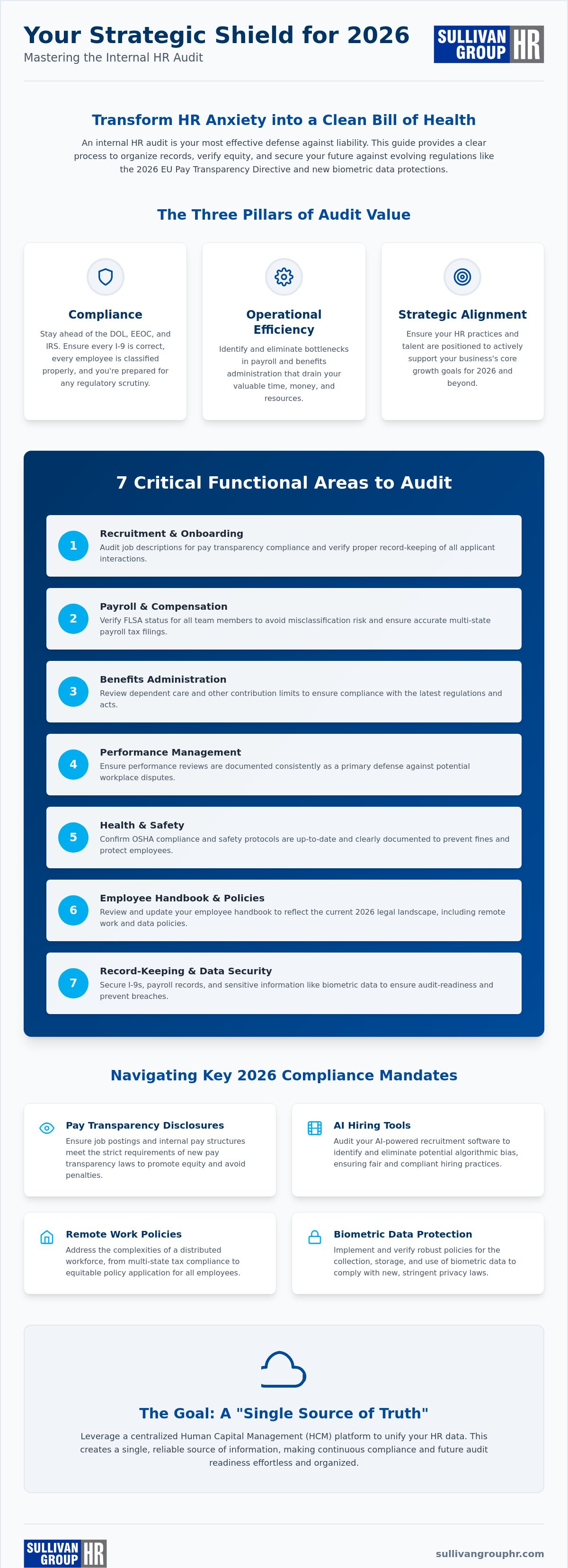
The Three Pillars of Audit Value
We view the audit process through three distinct lenses. First is compliance. This keeps you ahead of the DOL, EEOC, and IRS by ensuring every I-9 is correct and every employee is classified properly. Second is operational efficiency. We look for bottlenecks in your payroll and benefits that drain time and money. Third is strategic alignment. This ensures your team is actually positioned to support your 2026 growth goals. It’s about safety, speed, and success. These pillars provide the structure needed to turn a messy filing cabinet into a streamlined engine for growth.
Is Your Business Truly Protected?
Take a moment to look at your current systems. When was the last time you truly updated your employee handbook to reflect the 2026 legal landscape? Are your record-keeping practices ready for a surprise inspection from the Department of Labor? If these questions feel overwhelming, you aren't alone. We believe in the "Sullivan Handshake." This is our promise to be the partner who watches your back while you focus on your business. This proactive approach is the foundation of HR risk management. It transforms your HR department from a source of anxiety into a source of strength. Understanding how to conduct an internal HR audit is your first step toward that security.
Defining the Scope: 7 Critical Functional Areas to Audit
A successful audit isn't about looking at everything all at once. It's about looking at the right things with precision. To truly understand how to conduct an internal HR audit, you must narrow your focus to the areas that carry the highest risk and the highest reward. By segmenting your review into functional areas, you ensure that no detail slips through the cracks. This structured approach moves you from a state of constant worry to a state of organized control.
Start with your recruitment and onboarding journey. This is where your relationship with every employee begins. Are your job descriptions compliant with new pay transparency laws? Are you maintaining proper records of applicant interactions? Often, the data found within your applicant tracking and onboarding systems provides the best evidence of fair hiring practices. Beyond hiring, you must evaluate your performance management and safety protocols. Documented reviews and OSHA compliance aren't just "nice to haves." They are your primary defense against workplace disputes and safety fines.
The Payroll and Benefits Deep Dive
Payroll is the most frequent source of regulatory friction. During your audit, you must verify the FLSA status of every team member. Misclassifying an employee as an independent contractor can lead to years of back-pay liabilities. This risk is amplified for companies with remote workers. You must ensure your payroll tax filings are accurate across every state where your employees reside. Many growing businesses find that payroll administration outsourcing provides the expertise and technology needed to keep these complex records perfect. It allows you to focus on your people while we focus on the math.
Talent and Culture Documentation
Your documentation is the physical evidence of your company culture. It's time to audit your employee handbook for 2026-specific language, particularly regarding AI usage policies and data privacy. Are your I-9 files stored separately from general personnel files? Are your termination records detailed and objective? These files are the first things a regulator will ask to see. If your record-keeping feels like a mountain of paperwork, you might want to partner with a dedicated HR consultant to help you organize. Having a "Single Source of Truth" for your talent data makes knowing how to conduct an internal HR audit much simpler and far less stressful.
The 5-Step Roadmap to Conducting Your Internal HR Audit
Mastering how to conduct an internal HR audit requires a clear path forward. It's not enough to simply look for errors; you need a process that turns findings into protection. This roadmap is designed to move your business from uncertainty to total organizational security. By following these five stages, you ensure that your compliance efforts are both thorough and actionable.
- Step 1: Define the scope and secure stakeholder buy-in. You need the green light from leadership to ensure you have the resources and authority to make necessary changes.
- Step 2: Gather data. Utilize your HCM platform to pull centralized records. This stage is about collecting the evidence you will need for a deep review.
- Step 3: Analyze findings. Compare your current data against the latest federal and state regulations, including the 2026 mandates we've discussed.
- Step 4: Create a prioritized action plan. Identify the gaps and decide which leaks to plug first based on their potential impact on your business.
- Step 5: Implement changes and schedule a pulse check. Fix the issues, then set a date for your next review to ensure your systems remain healthy.
This structured roadmap simplifies how to conduct an internal HR audit into manageable stages. It prevents the process from becoming an overwhelming administrative burden. Instead, it becomes a predictable rhythm that supports your growth and shields your team.
Phase 1: Preparation and Data Collection
A Scope Document serves as the foundational anchor that prevents your audit from drifting into irrelevant data. It defines exactly what you are reviewing and why. With isolved, you can pull comprehensive reports in minutes, not days, transforming a week-long hunt for records into a quick digital export. While your internal team understands your culture, bringing in objective eyes from an external consulting partner can reveal blind spots that you might otherwise overlook.
Phase 2: Analysis and Remediation
Once you have your data, you must categorize your risks. We recommend labeling findings as "High" for immediate legal threats and "Low" for process improvements. When you communicate these findings to leadership, lead with solutions to avoid causing unnecessary panic. Always remember to document every step of your remediation process. This creates a paper trail that proves "good faith" efforts to regulators, showing that your business values compliance and takes its responsibilities seriously.
Navigating 2026 Compliance: Pay Transparency, AI, and Remote Work
The regulatory climate in 2026 is moving faster than ever. Are you prepared for the ripple effects of the June 2026 EU Pay Transparency Directive? Even if you only operate domestically, these global shifts are setting new standards for US-based talent expectations and state-level legislation. For organizations navigating complex European digital standards, 遠略速達 HRS offers specialized solutions for EU Cyber Resilience Act compliance. Learning how to conduct an internal HR audit in this environment means looking beyond standard tax forms. You must now account for pay equity, algorithmic bias, and the complex tax nexus of a remote workforce. It's a heavy lift. We're here to help you simplify the complex and keep your business moving forward.
Pay Equity and Transparency Auditing
Pay transparency is no longer optional in many jurisdictions. With Massachusetts' disclosure requirements in force since October 2025, and many other states following suit, your job postings must be accurate and honest. You need to review your stated salary ranges against the actual compensation your team receives. Are there unexplained gaps? Auditing these scales helps you prevent discrimination claims before they arise. By leveraging data from workforce management solutions, you can track equity in real-time. This ensures your internal scales stay balanced as your company grows.
Auditing AI and Automated Tools
Automated Decision-Making Technology (ADMT) is under the microscope. New California rules that took effect on January 1, 2026, require employers to provide notice and opt-out rights when using AI for significant employment decisions. You must review the logic behind your automated screening tools. Does your software inadvertently introduce bias against protected groups? This is where human oversight remains vital. You should also update your privacy notices to clearly explain how employee data is monitored. A modern audit ensures your tech serves your people without creating new legal vulnerabilities.
Remote work adds another layer of difficulty. Each new state where an employee logs in creates a potential tax nexus and a new set of labor laws to follow. Whether it's Colorado's biometric protections that took effect in July 2025 or varying minimum wage hikes, your "always-on" audit must monitor these changes constantly. Moving toward real-time monitoring transforms compliance from a stressful event into a quiet, background process. If you want to master how to conduct an internal HR audit that actually protects your future, you can partner with our expert HR team to build a custom compliance roadmap.
From Stress to Success: How Sullivan Group HR Simplifies Auditing
The road to compliance in 2026 is paved with complex regulations and digital shifts. You've seen the roadmap, the functional areas, and the new mandates. Does your current system feel like a collection of disconnected islands? We bridge that gap with a unified approach that replaces administrative stress with organizational strength. At Sullivan Group HR, we act as your no-nonsense authority and protective partner. We don't just hand you a checklist. We provide the tools and the wisdom to ensure you never have to worry about a surprise inspection again.
Our approach centers on the isolved platform, which creates a "Single Source of Truth" for your business. When you understand how to conduct an internal HR audit using integrated technology, the process changes from a manual headache into a streamlined verification. By housing your payroll, benefits, and compliance data in one secure location, you eliminate the risk of conflicting records. This integration ensures that every deduction, every I-9, and every pay rate is accurate and accessible. It transforms your HR department into a strategic shield that protects your assets and your reputation.
Integrated Tech, Human Expertise
A platform alone isn't enough to secure your future. You need the hard-earned wisdom of experienced consultants who understand the local territory and the nuances of your industry. We focus on "People, not Paperwork" by reducing your administrative burden through high-level automation and expert oversight. This allows you to spend your time growing your team rather than digging through filing cabinets. If you are looking for a more comprehensive way to manage these functions, you can explore what is HR outsourcing to see how a full-service partnership can protect your business. We move beyond the transactional vendor identity to become a long-term ally in your success.
Your Next Step Toward Security
Why wait for a regulator to knock on your door? A proactive "Pulse Check" today can save you thousands in potential fines and legal fees tomorrow. Mastering how to conduct an internal HR audit is about more than just checking boxes; it's about gaining the peace of mind that comes from knowing your business is healthy. We invite you to step into a more secure professional future. Contact Sullivan Group HR today for a consultation, and let’s work together to turn your compliance challenges into a competitive advantage.
Take the Lead on Your Organizational Security
Are you ready to trade administrative anxiety for a clear path to growth? We've explored the shifting 2026 landscape and the precise steps needed to keep your business safe. From mastering the 5-step roadmap to auditing the seven critical functional areas, you now have a blueprint for success. Understanding how to conduct an internal HR audit is the first step toward building a resilient, compliant, and thriving culture.
Your business deserves more than just a software vendor; it deserves a partner who understands the local landscape and values people over processes. By combining the power of the isolved HCM platform with our expert HR consulting, we provide a "Single Source of Truth" for your organization. This comprehensive payroll and benefits integration ensures that your records are always audit-ready and your talent is always protected. We are here to act as your coach, your ally, and your no-nonsense authority.
Don't wait for a regulatory challenge to find the gaps in your system. Take a proactive step toward long-term stability and peace of mind today. Ready to protect your business? Schedule your HR audit consultation with Sullivan Group HR today. We look forward to helping you unlock your full organizational potential.
Frequently Asked Questions
How often should my company conduct an internal HR audit?
Most companies should conduct a comprehensive review annually. However, performing quarterly "pulse checks" on high-risk areas like payroll and tax filings is a best practice for 2026. This regular rhythm ensures that you catch small administrative errors before they turn into expensive legal headaches. Consistency is your best defense against the fear of a surprise Department of Labor inspection.
What are the most common red flags in an HR compliance audit?
The most common red flags include missing I-9 signatures, misclassified employee statuses under the FLSA, and outdated employee handbooks. Regulators also look for inconsistencies between your job postings and actual internal pay scales. Incomplete records are a leading cause of failed employment disputes. Identifying these gaps early allows you to correct them before they become liabilities for your business.
Can we perform an HR audit ourselves, or do we need an external partner?
What is the difference between an HR audit and an HR self-assessment?
An HR audit is a formal, objective review of your policies against legal and regulatory requirements. In contrast, an HR self-assessment is a more subjective internal check-in on how well your team is meeting its own cultural goals. While both are valuable, only an audit acts as a strategic shield against lawsuits and fines. It provides a clean bill of health for your department.
How does pay transparency legislation change the audit process in 2026?
Pay transparency laws now require you to audit job postings for salary range disclosures and conduct regular pay equity reviews. With the EU Pay Transparency Directive taking effect in June 2026 and various state laws already in force, your audit must verify that internal pay scales match external promises. This ensures you remain compliant with the latest global and national trends toward greater wage clarity.
What documents are most critical to include in a records audit?
Critical documents include I-9 forms, payroll tax records, performance evaluations, and termination files. You should also include risk assessments for any automated decision-making technology used in hiring, as required by 2026 California updates. Keeping these files centralized within an HCM platform creates a "Single Source of Truth." This organization makes the process of how to conduct an internal HR audit much faster and more reliable.
How long does a comprehensive HR audit typically take?
A comprehensive review typically takes between two and four weeks to complete manually. The timeline depends heavily on the size of your workforce and the state of your current record-keeping. If you utilize modern HCM technology like isolved, you can pull reports in minutes rather than days. This significantly reduces the administrative burden and allows you to finish the process much sooner.
What happens if we find a major compliance violation during our audit?
Document the finding and implement a remediation plan immediately. Correcting the issue and showing a clear "good faith" effort to comply can significantly mitigate potential fines from regulators. Don't panic; instead, focus on implementing a solution and scheduling a follow-up check. This proactive approach proves that your business values integrity and safety.


