

Is your workforce data telling a story of growth, or is it just a spreadsheet gathering digital dust? Most leaders find themselves data-rich but insight-poor, staring at complex reports while turnover climbs and labor costs remain a mystery. Using HR data for business decisions shouldn't feel like decoding a foreign language. It should feel like having a clear, reliable roadmap for your company's future.
You know that your people are your greatest asset, yet justifying HR spend to the board often feels like an uphill battle without the right evidence. We are here to act as your coach and ally in this transition. This guide will show you how to transform workforce metrics into actionable strategies that protect your bottom line and drive measurable growth. We will explore the shift toward predictive analytics, the impact of the latest 2026 privacy regulations, and how to identify talent gaps, reduce turnover, and secure your organization's future.
Key Takeaways
- Trade intuition-based management for evidence-based leadership to ensure every workforce move supports your broader company goals.
- Discover how to use a three-part framework to acquire the best talent, compensate them competitively, and secure your organizational health.
- Follow a proven five-step roadmap for using HR data for business decisions to solve complex problems like high turnover and rising labor costs.
- Learn to transform raw metrics into predictive narratives that help you anticipate resignations and skill gaps before they happen.
- Explore how the isolved People Cloud platform turns workforce data into clear, visual stories that justify HR spend to your board.
What is Data-Driven HR Decision Making?
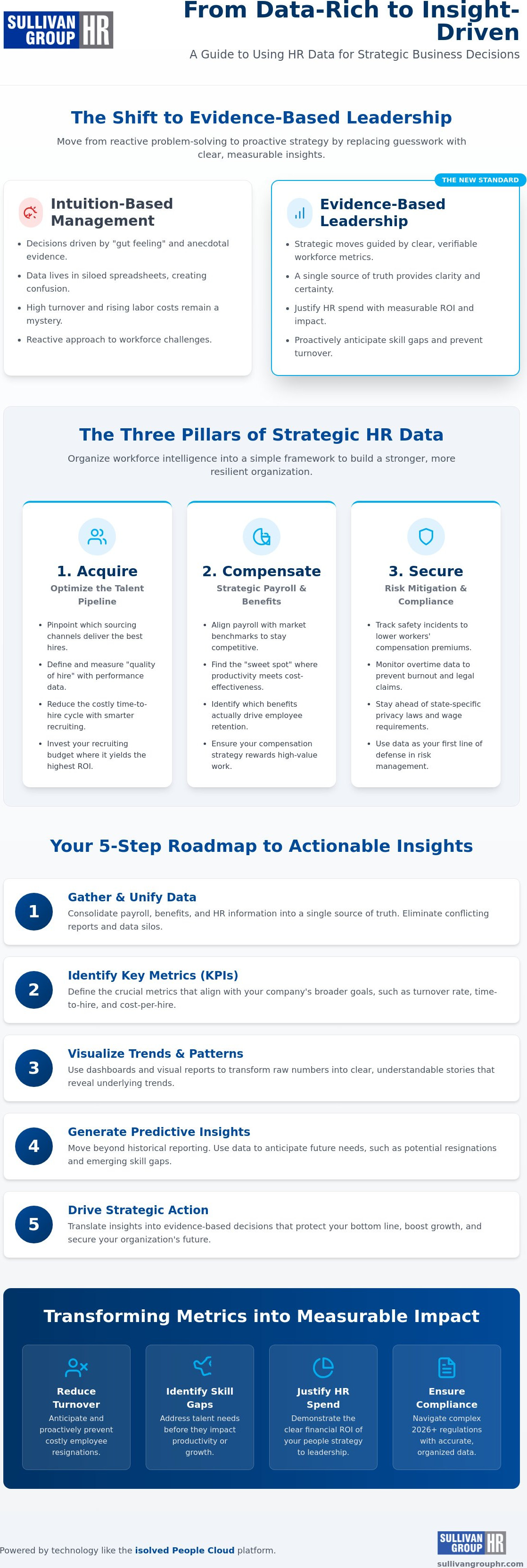
Are you leading your team based on a "gut feeling" or a "guaranteed fact"? Data-driven HR decision making is the practice of using workforce metrics to guide strategic business moves. It represents a fundamental shift from intuition-based management to evidence-based leadership. While experience and industry wisdom are valuable, the modern market demands a higher level of certainty. Using HR data for business decisions provides that certainty by replacing guesswork with clear, measurable insights.
The 2026 landscape is more complex than ever. With the Connecticut Data Privacy Act (CTDPA) amendments lowering thresholds on July 1 and new privacy laws taking effect in states like Indiana and Kentucky, the way you handle information matters. Precision isn't just a choice; it's a requirement. Think of your HR data as a protective shield. It helps you identify risks, anticipate labor costs, and ensure compliance before a small oversight turns into a major financial penalty. Using HR data for business decisions allows you to move with speed, safety, and results.
From Administrative Burden to Strategic Asset
How much time does your team spend chasing paper? Moving away from manual, siloed systems is the first step toward real-time intelligence. When your records are digitized and organized, they stop being a burden and start being an asset. A unified human capital management platform acts as the bridge between daily tasks and long-term strategy. Mid-market firms are the biggest beneficiaries of this shift. Data transparency gives you the power to compete with larger firms by optimizing your most expensive investment: your people.
The Single Source of Truth
Does your payroll data conflict with your benefits reports? Fragmented data creates conflicting narratives that confuse the board and stall growth. You need a single source of truth where payroll, benefits, and HR intersect. This integration is vital for maintaining data integrity in 2026. For example, the IRS now requires stricter separation of tips and service charges, and California healthcare workers have a new $24 minimum wage. Without one unified system, these regulatory changes are nearly impossible to track accurately. One system creates one clear story for your business.
The Three Pillars of Strategic HR Data
How do you turn a sea of numbers into a clear plan of action? We use a simple, three-part framework to organize your workforce intelligence: Acquire, Compensate, and Secure. This approach ensures that using HR data for business decisions isn't just a technical exercise but a strategic advantage. It moves you from reacting to problems to proactively building a stronger, more resilient organization. By focusing on these three pillars, you can simplify complex professional functions and deliver information quickly to your leadership team.
Acquire: Optimizing the Talent Pipeline
Your growth depends on the people you bring through the door. Are you finding the right fit, or just filling a seat? By analyzing applicant tracking and onboarding data, you can pinpoint exactly where your best hires come from. Do they arrive via social media, local job boards, or employee referrals? Measuring early performance metrics helps you define your "quality of hire" and reduces the costly time-to-hire cycle. This data allows you to invest your recruiting budget where it actually yields results.
Compensate: Strategic Payroll and Benefits
Are you paying for presence or for impact? This pillar focuses on aligning your payroll and benefits with market benchmarks to ensure you remain competitive. Using HR data for business decisions allows you to see the "sweet spot" where productivity meets cost-effectiveness. By reviewing benefits management solutions data, you can identify which perks actually drive employee retention and which ones are simply overhead. It is about making sure your compensation strategy rewards high-value work without draining your resources.
Secure: Risk Mitigation and Compliance
Your final pillar is about protection. Data serves as your first line of defense in a comprehensive HR risk management strategy. Tracking safety incidents helps lower workers' compensation premiums by identifying patterns before they become trends. Monitoring overtime data is equally vital. It helps you prevent the burnout that leads to legal claims or high turnover rates. In the 2026 regulatory environment, having this data organized is your best way to stay ahead of state-specific privacy laws and wage requirements. If you feel overwhelmed by these administrative burdens, our team can help you evaluate your current data strategy to ensure your business stays protected.
Turning Numbers into Narratives: Solving Real Challenges
Is your turnover rate a warning sign or a wake-up call? Numbers on a page are just data points, but when interpreted correctly, they tell the story of your company's health. Using HR data for business decisions allows you to distinguish between a management problem and a market problem. If turnover is high in one specific department, you might have a leadership friction point. If it's high across the board, your pay scales may have fallen behind the 2026 market benchmarks. Data gives you the clarity to act with confidence rather than reacting with haste.
What if your data could predict a resignation before it happens? This is the power of moving from descriptive analytics, which tell you what happened, to predictive analytics, which show you what will happen. By using tools like heat maps and trend lines, you can visualize organizational friction in real time. These visual stories help you see where burnout is brewing or where engagement is beginning to fade. The global data analytics market is projected to reach $68.09 billion in 2026, and this growth is driven by leaders who realize that foresight is their most valuable asset.
The High Cost of Silence: Identifying Retention Red Flags
A sudden drop in engagement scores is rarely a random event. It is often the first sign of a future resignation. By connecting workforce management solutions to employee satisfaction, you can see how scheduling and workload impact morale. Spotting absenteeism patterns through time and attendance data acts as a safety net. It allows you to intervene with support before a valuable team member walks out the door. This proactive approach protects your culture and your bottom line.
Justifying ROI to Stakeholders
Your board and your CFO speak the language of dollars and cents. To gain their support, you must present HR metrics in financial terms. Using HR data for business decisions means calculating the true cost-per-hire and the long-term financial impact of employee longevity. When you can show that reducing turnover by even 5% saves the company thousands in recruitment and training costs, the value of HR consulting becomes undeniable. You aren't just asking for a budget; you're presenting a strategy for organizational security and growth.
5 Steps for Using HR Data for Business Decisions
Are you ready to move from simply collecting information to actually commanding it? Transforming raw numbers into a strategic engine doesn't happen by accident. It requires a disciplined, logical approach that starts with your business goals rather than your software capabilities. By following these five steps, using HR data for business decisions becomes a repeatable process that delivers safety, results, and peace of mind.
- Step 1: Identify your core business question. Don't start with the data; start with the problem. Ask yourself: "How do we reduce labor costs without cutting staff?" or "Which department has the highest risk of non-compliance?"
- Step 2: Audit your current data quality. Is your information accurate? Review your HCM platform to ensure that payroll, attendance, and benefits data are clean and up to date. Bad data leads to bad decisions.
- Step 3: Centralize your metrics. Stop toggling between windows. Bring your key figures into a single dashboard to see the full picture of your organizational health at a glance.
- Step 4: Democratize data access. Empower your department heads. When managers can see their own team's turnover and productivity metrics, they can solve small problems before they reach your desk.
- Step 5: Act, measure, and refine. Data is a living thing. Implement a change based on your findings, track the results for 90 days, and adjust your strategy based on what the numbers tell you.
Defining Your Key Performance Indicators (KPIs)
Which 3-5 metrics actually move the needle for you? Avoid "vanity metrics" like total headcount, which look good on paper but tell you nothing about health. Instead, focus on "sanity metrics" like revenue per employee or the cost of voluntary turnover. For example, measuring the correlation between employee engagement scores and quarterly production errors links human sentiment directly to your financial output. This clarity allows you to focus on what matters most.
Building a Data-Literate Culture
A system is only as good as the people using it. You must move your leadership from a "culture of blame" to a "culture of inquiry." Instead of asking who failed, use data to ask why a process isn't working. This shift requires training leadership to look at the evidence before making gut-reaction decisions. If the trends feel too complex to navigate alone, professional HR consulting can provide the hard-earned wisdom needed to interpret these narratives. Ready to see what your numbers are really saying? Schedule a data audit with our team to start building your 2026 roadmap.
Isolved People Cloud: Your Partner in Data-Driven Growth
Are you tired of fighting with your software just to get a straight answer? You need a platform that works as hard as you do to turn your vision into a reality. isolved People Cloud is the industry-leading solution for unified workforce intelligence. It isn't just a database; it's a storytelling tool. The 'People Analytics' module is designed to transform raw metrics into visual narratives that anyone on your leadership team can understand. By using HR data for business decisions through a single portal, you remove the friction that slows down growth and creates administrative stress.
This platform provides the peace of mind that comes from data-backed security. In an era where 70% of small businesses are already exploring AI for HR tasks, having a system that handles the heavy lifting is vital. isolved's latest Release 12.11 even introduces autonomous AI agents to manage repetitive payroll and benefits tasks. This allows you to focus on the human side of your business while the system ensures your data is precise, compliant, and ready for analysis.
Why a Unified Platform Changes Everything
Fragmented systems are the enemy of accuracy. When your payroll, time tracking, and talent data live in separate silos, errors are inevitable. Automation removes the risk of human error from your data collection. It ensures that the numbers you see on your screen reflect the actual state of your workforce today, not last month. Real-time reporting allows you to pivot quickly. If a labor cost spike appears on Tuesday, you can address it by Wednesday. This level of agility is what separates thriving businesses from those just trying to keep up.
To complement your HR systems, you can explore Workflow Optimisation SaaS Solution from Charlie Helps Associates to ensure your broader administrative tasks are handled with the same precision and efficiency.
The Sullivan Group Advantage
Technology is a powerful tool, but it's only half of the equation. You also need the wisdom to know what those numbers are actually saying. We aren't just a transactional software vendor. We are your strategic HR partner and your local expert. Our team acts as a coach to help you navigate the nuance of your data. We help you understand why certain trends are emerging in your specific territory and how to respond with confidence. We provide the protective shield of compliance and the hard-earned wisdom of our long-standing legacy.
Using HR data for business decisions is about more than just efficiency. It's about the security that comes from knowing your business is protected. It's about having a reliable advocate in your corner who values people over systems. Are you ready to stop guessing and start growing? Let's transform your workforce metrics into your greatest competitive advantage. Contact us today to see how a partnership with Sullivan Group HR can secure your company's future.
Secure Your Future with Workforce Intelligence
Are you ready to turn your workforce into your strongest competitive advantage? We have explored how moving from intuition to evidence-based leadership can transform your organization. By focusing on the pillars of acquiring, compensating, and securing your talent, you build a foundation that is both resilient and profitable. Using HR data for business decisions is no longer a luxury for large corporations. It is a necessity for every mid-market leader who wants to protect their bottom line in a complex 2026 regulatory environment.
You don't have to navigate these numbers alone. With access to the industry-leading isolved platform and our no-nonsense HR consulting, you can unify your payroll, benefits, and risk management into one clear story. We act as your strategic partner, ensuring you have the clarity needed to justify every dollar spent to the board. Your journey from being data-rich to insight-driven starts with a single step toward better transparency.
Ready to lead with intelligence? Discover how our HCM solutions empower your decision-making.
We look forward to helping you grow with confidence and security. Let's start building your data-driven roadmap today.
Frequently Asked Questions
What are the most important HR metrics for a small business to track?
Focus on turnover rate, cost-per-hire, and revenue per employee. These metrics provide immediate insight into your financial health and operational efficiency. Small businesses should also track absenteeism and time-to-fill for open roles. These numbers help you identify bottlenecks in your growth strategy. By monitoring these key indicators, you can move from reactive management to proactive leadership that secures your organization's future.
Is HR data analytics only for large corporations with big budgets?
No, data analytics is accessible and vital for businesses of all sizes. Mid-market firms often see the fastest ROI because small optimizations in labor costs or retention have a massive impact on the bottom line. Modern cloud platforms like humae.io make these tools affordable and easy to manage without a massive IT department. Data is the great equalizer that allows smaller firms to compete with national giants by making smarter, faster moves.
How can HR data help improve employee retention?
Data helps you identify the "why" behind departures by correlating exit interview feedback with tenure and department trends. By using HR data for business decisions, you can spot patterns of burnout or uncompetitive pay before they lead to a mass exodus. Predictive analytics can even flag high-risk groups for proactive intervention. This approach protects your culture and prevents the high costs associated with constant recruiting and training.
What is the difference between HR metrics and HR analytics?
Metrics are the raw numbers that tell you what happened, while analytics explain why it happened and what might happen next. Think of metrics as your rearview mirror and analytics as your GPS. One tracks historical data like total headcount or monthly turnover. The other provides the strategic foresight needed to plan your next move. Both are necessary, but analytics is what drives actual business growth and long-term security.
Can using HR data help with legal compliance and audits?
Organized data acts as your first line of defense during regulatory audits. It provides a clear, verifiable paper trail for wage laws, tax filings, and safety records. In 2026, with shifting state privacy laws and new minimum wage requirements in places like California, having verifiable data ensures you stay on the right side of the law. It turns a daunting audit into a manageable, organized process that protects your business assets.
How do I ensure employee data privacy while using analytics?
Start by using an HCM platform that prioritizes security and complies with the latest regulations like the Connecticut Data Privacy Act. Anonymize data whenever possible for high-level reporting. Ensure that only authorized personnel have access to sensitive information through strict role-based permissions. Protecting your team's privacy isn't just a legal requirement; it's a vital part of maintaining trust and creating a safe, professional work environment for everyone.
What role does an HCM platform like isolved play in data-driven decisions?
An HCM platform like isolved acts as your single source of truth by centralizing payroll, benefits, and time tracking. It automates data collection, which removes human error and provides real-time reporting. This allows you to make decisions based on what is happening in your business right now rather than relying on last month's reports. It simplifies complex professional functions into a manageable dashboard designed for busy entrepreneurs and growing teams.
How do I get started with HR data if my records are currently fragmented?
Begin by auditing your current systems to see where information is stored and identifying gaps in your records. Consolidating your records into a unified platform is the most effective way to eliminate silos. Using HR data for business decisions is much easier when you have a strategic partner to help you clean, organize, and interpret your existing metrics. We help you transition from fragmented files to a strategic asset that drives results.


