
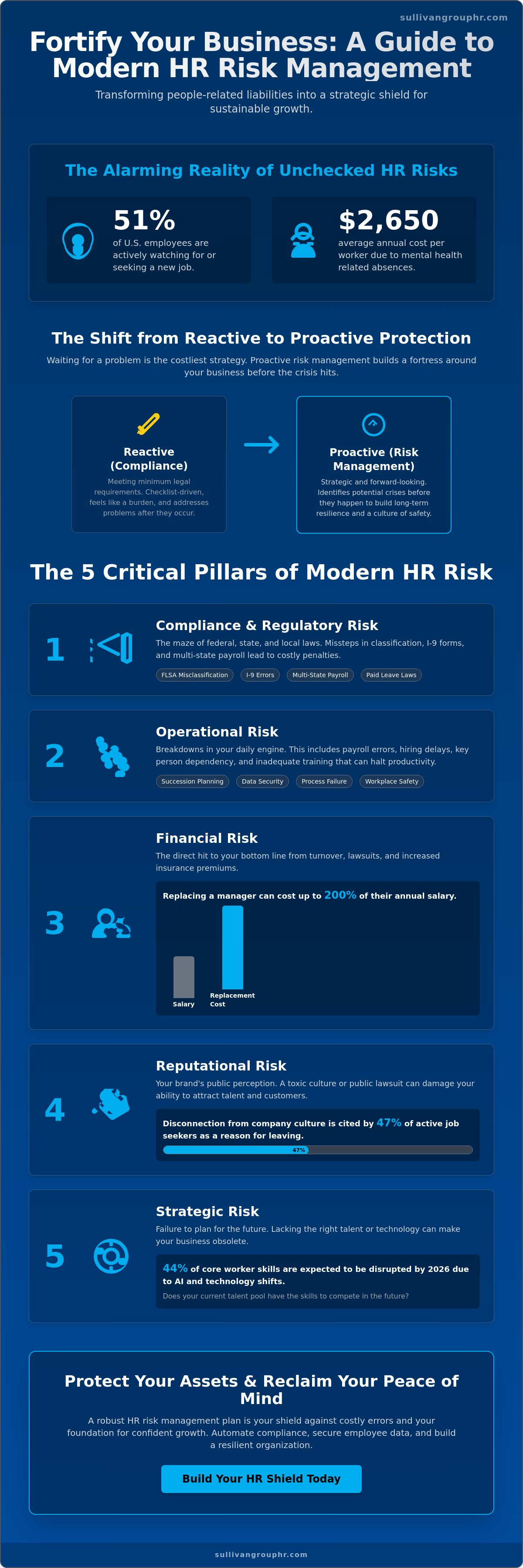
Did you know that 51% of U.S. employees are currently watching for their next exit, while mental health absences now cost organizations an average of $2,650 per worker annually? It's a staggering reality that proves your biggest liabilities aren't just in your ledgers; they're in your hallways. Effective HR risk management is no longer just a defensive tactic. It's the structural integrity that allows your business to scale without breaking under the weight of a Department of Labor audit or a costly workers' compensation claim.
You likely feel the pressure of keeping up with shifting laws, like Washington's $17.13 minimum wage or the new paid leave programs in Minnesota and Delaware. It's overwhelming to track every state-level change while trying to grow a culture that actually retains talent. We're here to help you simplify, secure, and succeed. This guide provides a clear roadmap to identify people-related risks and implement strategies that protect your assets. We'll explore the essential steps to lower your insurance premiums, safeguard employee data, and build the resilient, thriving organization you've always envisioned.
Key Takeaways
- Understand how to transform people-related liabilities into a strategic shield that protects your business and supports sustainable growth.
- Master the five pillars of HR risk management to navigate complex multi-state compliance and prevent costly operational breakdowns.
- Follow a clear, two-step roadmap to audit your current practices and rank risks by their potential financial impact on your bottom line.
- Discover how advanced HR technology automates critical compliance tasks to eliminate human error and secure sensitive employee data.
- Learn to apply avoidance and reduction frameworks to lower your insurance premiums and reclaim your professional peace of mind.
What is HR Risk Management? Defining Your Business Shield
What is the heartbeat of your company? It is your people. They drive your innovation, serve your customers, and build your culture. Yet, your greatest asset is also your most significant liability. HR risk management is the systematic identification, assessment, and mitigation of people-related liabilities that can threaten your organization's health. It isn't just about following rules; it's about building a fortress around your professional potential.
Many business owners confuse compliance with risk management. Compliance is simply meeting the minimum legal requirements. It is reactive, checklist-driven, and often feels like a burden. Risk management is a proactive strategy that applies Risk Management Principles to your workforce. It looks ahead to identify potential crises before they happen. In 2026, this means going beyond traditional safety to address digital-first challenges like AI governance, data privacy, and the mental health of a remote workforce. It moves your focus from basic survival to long-term resilience.
The Shift from Reactive to Proactive Protection
Waiting for a problem to surface is the costliest strategy you can employ. When you react to a crisis, you've already lost time, money, and morale. Proactive protection utilizes predictive HR to spot red flags early. Are turnover rates climbing in one department? Is there a spike in minor safety incidents? By identifying these trends, you can intervene with targeted training or policy changes. This approach builds a culture of safety and trust, proving to your team that you value their well-being as much as your bottom line. You aren't just fixing mistakes; you're preventing them.
Why Business Size Doesn't Protect You from Liability
Don't fall for the myth that small businesses fly under the radar of federal or state regulators. The Department of Labor doesn't care about your headcount when they find a wage violation or a safety breach. In fact, mid-market companies often face a disproportionate impact from legal issues. A single lawsuit that a large corporation might absorb can completely derail a growing firm's expansion plans. You need a shield that grows with you. HR risk management is the essential growth-enabling infrastructure that allows your business to scale with confidence and security.
The 5 Critical Pillars of Modern HR Risk
Think of your business as a structure. If one pillar crumbles, the entire roof is at risk. Modern HR risk management involves more than just avoiding lawsuits. It is about total organizational health. By utilizing a comprehensive HR Risk Management Checklist, you can evaluate your standing across these five critical areas:
- Compliance Risk: This is the maze of federal and state laws. Are you keeping up with California's $16.90 minimum wage or Washington's $80,168.40 exempt salary threshold?
- Operational Risk: These are breakdowns in your daily engine. It includes payroll errors, hiring delays, and management failures.
- Financial Risk: Consider the direct hit to your bank account. Replacing a manager can cost up to 200% of their annual salary.
- Reputational Risk: Your brand is your promise. Disconnection from company culture is cited by 47% of active job seekers as a reason for leaving.
- Strategic Risk: This is about your future. Does your current talent pool have the skills to handle the 44% skill disruption predicted by 2026?
Compliance and Regulatory Exposure
Are your employees classified correctly? FLSA misclassification and I-9 errors are silent killers for mid-market firms. The danger multiplies when you expand across state lines. Multi-state payroll is a notorious compliance trap. Each state has unique rules for overtime, sick leave, and tax withholding. For instance, Minnesota and Delaware are launching new paid family leave programs in 2026. Managing these manually is a recipe for disaster. Using robust Human Capital Management software ensures these regulations are tracked and applied automatically.
Workforce and Operational Stability
What happens if your top manager leaves tomorrow? Key person dependency is a massive operational risk. Without proper succession planning, your day-to-day functions can grind to a halt. Similarly, inadequate training leads to more than just mistakes; it leads to workplace safety violations and increased workers' compensation claims. In 2026, data security is also a primary concern. With AI integration, your employee data faces new threats. Protecting sensitive information requires more than just a password; it requires a culture of security. If you feel overwhelmed by these moving parts, partnering with an expert can provide the clarity you need.
Strategic Frameworks: How to Handle Inevitable Risks
How do you decide which threats to fight and which to simply avoid? Not every liability requires the same response. A sophisticated approach to HR risk management utilizes four distinct frameworks to protect your organization. By categorizing your challenges, you can allocate your resources where they'll have the greatest impact.
First, there's Avoidance. This means walking away from high-risk activities or policies entirely. If a specific hiring practice in a new state like Colorado or California creates too much legal exposure, you simply change the practice. You choose the path of least resistance to protect your capital and your reputation.
Second, we have Reduction. This involves implementing controls to minimize the frequency or severity of issues. Think of this as your safety net. It includes consistent training, clear protocols, and better communication. You aren't eliminating the risk, but you're making it much less likely to hurt you.
Third is Sharing or Transfer. You shift the burden to another party. This is often done through insurance or strategic outsourcing. It allows you to focus on your core business while experts handle the technical liabilities. Finally, there's Retention. Some risks are small, predictable, and manageable. You accept these and budget for them accordingly. It's about knowing your limits and choosing your battles wisely.
The Power of Risk Transference
Why carry the entire weight of your business on your own shoulders? Risk transference is one of the most effective tools in your arsenal. Workers' Compensation Insurance is the primary example. By paying a premium, you transfer the massive financial risk of workplace injuries to an insurance carrier. This protects your cash flow from the sudden shock of a major claim.
Partnering with an HR outsourcing expert takes this a step further. When you outsource payroll administration or benefits management, you shift the burden of administrative accuracy. You aren't just buying a service; you're buying peace of mind. This partnership significantly reduces the mental load for business owners. It allows you to lead with confidence, knowing that your compliance and payroll functions are in the hands of seasoned professionals who understand the regional nuances of your territory. HR risk management becomes a collaborative effort rather than a solitary burden.
Implementing Loss Prevention and Reduction
Prevention is always more cost-effective than a cure. Your first line of defense is a robust, up-to-date employee handbook. This document sets clear expectations and provides a legal shield when disputes arise. It isn't a task you finish and forget. You must treat it as a living document that evolves with your company and the law.
Regular internal audits for payroll and benefits are equally vital. These audits catch small errors before they snowball into Department of Labor nightmares. They ensure that you're meeting the new 2026 thresholds for exempt salaries and minimum wages across every location where you operate. Safe is not a state, but a process. It requires constant vigilance, regular refinement, and a commitment to excellence in every administrative function.
Building Your HR Risk Management Plan: A 2026 Checklist
Is your business truly prepared for a surprise Department of Labor audit today? Many owners treat risk as a one-time project, a static list of problems to fix and forget. This is a dangerous mistake. Effective HR risk management is a dynamic lifecycle that requires constant attention. To build a resilient organization, follow this four-step strategy for 2026.
- Step 1: Identify. Conduct a comprehensive audit of your current practices. Examine every stage of the employee journey, from initial recruitment to the final exit interview.
- Step 2: Assess. Rank your findings. Which risks have the highest probability of occurring? Which carry the heaviest financial penalties? Focus your energy where the stakes are highest.
- Step 3: Mitigate. Close the gaps. Develop specific policies and deploy technology, like the isolved platform, to automate compliance and reduce human error.
- Step 4: Monitor. Establish Key Performance Indicators (KPIs). Track your turnover rates, workers' comp claim frequency, and internal audit results to ensure your plan actually works.
Conducting a Gap Analysis
Where are the leaks in your organization? Start with your onboarding and termination processes. Inconsistent documentation during a firing is a common red flag that invites litigation. You should also scrutinize your employee benefits compliance to ensure you aren't missing new state-level requirements in Georgia or South Carolina. Finally, look at your historical data. Your past workers' comp claims are the best predictors of future incidents. Identifying these patterns allows you to fix the root cause before the next injury occurs.
Establishing a Governance Rhythm
A plan sitting in a drawer is useless. You must establish a quarterly governance rhythm. Annual reviews are too slow for the fast-moving legal landscape of 2026. Train your managers to be your eyes and ears on the ground; they're often the first to detect brewing conflicts or safety hazards. Don't ignore the value of employee feedback. Your team knows where the cultural risks are hiding. If you want a professional partner to help you master HR risk management and build this roadmap, reach out for a consultation today.
Partnering for Protection: How Sullivan Group HR Shields Your Business
How much more could you achieve if you weren't buried under administrative burdens? You've seen the complexity of the 2026 regulatory landscape. You understand the pillars of HR risk management. Now, it's time to choose a partner who transforms these daunting tasks into a streamlined engine for growth. The Sullivan Advantage combines nearly four decades of industry legacy with the cutting-edge power of modern technology. We don't just provide a service; we act as a protective shield for your professional potential.
Our approach is built on three essential strengths: in-depth expertise, automated precision, and human-centric coaching. We understand the specific nuances of employment laws and compliance challenges across diverse business environments, ensuring your operations remain compliant wherever you are. By integrating your payroll administration with workers' compensation insurance, we create a unified front against liability. This holistic strategy ensures that every dollar spent on your workforce is protected, tracked, and optimized for success.
The isolved Shield: Technology as a Risk Mitigator
Human error is the single greatest threat to your compliance. A simple typo in a tax filing or a missed I-9 certification can trigger thousands of dollars in penalties. This is where the isolved platform becomes your most valuable asset. It acts as a digital sentry, automating the functions that are most prone to mistakes. By moving away from manual spreadsheets, you close the "compliance trap" that often catches expanding companies.
- Automated Tax Filing: The system stays current with 2026 tax codes, ensuring your filings are accurate and on time.
- Centralized Document Management: Store I-9s, certifications, and handbooks in a secure, cloud-based hub for instant retrieval during audits.
- Real-Time Reporting: Receive proactive alerts that flag overtime issues or scheduling conflicts before they evolve into financial liabilities.
Your Dedicated Risk Management Ally
Do you have a coach in your corner for the tough decisions? Effective HR risk management requires more than just software; it requires wisdom. When you face a difficult termination or a complex cultural shift, you need a partner who understands the "people" side of the business. We move beyond the transactional vendor relationship to become your strategic ally. Our consulting team provides the clarity you need to lead with confidence, helping you build a culture of safety and trust that attracts top talent.
Success isn't just about avoiding a lawsuit; it's about building an organization that thrives under pressure. We provide the roadmap, the tools, and the advocacy to make that possible. You focus on your mission. We'll focus on your protection. Secure your business future with Sullivan Group HR and reclaim your peace of mind today.
Build Your Resilient Future Today
Are you ready to stop worrying about audits and start focusing on your legacy? You've seen how proactive HR risk management transforms your workforce from a source of liability into a foundation for growth. By applying the strategic frameworks and checklist we've discussed, you can secure your assets and protect your people with confidence. You don't have to carry this burden alone.
Sullivan Group HR offers the stability of expert HR consulting since 1998 and the precision of the industry-leading isolved HCM platform. Our integrated workers' compensation and payroll solutions provide a unified shield for your business operations. It's time to reclaim your peace of mind and lead with clarity. Protect your business with a comprehensive HR risk strategy. Your professional potential is limitless when your foundation is secure. Let's build that resilient future together.
Frequently Asked Questions
What is the most common HR risk for small businesses in 2026?
Compliance with rapidly shifting state-level employment laws is the top risk this year. With 52% of employees reporting burnout and 44% of worker skills predicted to face disruption by technological shifts, the pressure to adapt is immense. Failing to track specific updates, like the $17.13 minimum wage in Washington or the $16.90 rate in California, can lead to immediate legal and financial liabilities.
How does HR risk management impact workers' compensation premiums?
Effective HR risk management directly influences your experience modification factor by reducing the frequency and severity of workplace injuries. When you implement rigorous safety training and return-to-work programs, you prove to insurers that you are a lower risk. This proactive approach leads to lower premiums and long-term savings on your insurance costs.
Can technology really prevent a Department of Labor audit?
Technology cannot stop the DOL from selecting your business for review, but it makes the process defensible and stress-free. Using a platform like isolved ensures that your records for payroll, time, and attendance are accurate, timestamped, and easily accessible. It replaces messy paper trails with a digital "single source of truth" that satisfies auditors quickly.
What is the difference between HR compliance and HR risk management?
Compliance is a reactive process focused on meeting the minimum legal requirements to avoid penalties. HR risk management is a proactive, strategic framework that identifies potential threats before they manifest. While compliance tells you what the law is today, risk management builds a resilient infrastructure to protect your business from the uncertainties of tomorrow.
How often should our company update its HR risk management plan?
You should review and update your plan at least quarterly. State regulations are moving faster than federal ones; for instance, Connecticut expanded paid sick leave requirements for employers with 11 or more workers starting January 1, 2026. A quarterly "governance rhythm" ensures you aren't blindsided by new mandates in the middle of your fiscal year.
What are the financial consequences of poor HR risk management?
The costs go far beyond simple fines. Replacing a frontline employee can cost 40% of their salary, while losing a manager can cost up to 200%. Additionally, mental health-related absences now cost U.S. organizations an average of $2,650 per employee annually. Poor management drains your capital through turnover, lost productivity, and increased insurance costs.
How does an HCM platform like isolved help with risk mitigation?
An HCM platform mitigates risk by automating the most error-prone administrative tasks. It handles complex tax filings, tracks employee certifications, and ensures that overtime is calculated correctly across different jurisdictions. By removing manual data entry, you eliminate the human errors that typically trigger expensive wage and hour disputes or payroll audits.
Who is responsible for HR risk management in a mid-sized company?
Responsibility is a shared partnership between internal leadership and your external HR experts. While your executive team sets the cultural tone and safety priorities, a partner like Sullivan Group HR provides the technical infrastructure and consulting wisdom. This collaborative approach ensures that your risk strategy is both professionally rigorous and aligned with your specific business goals.


