
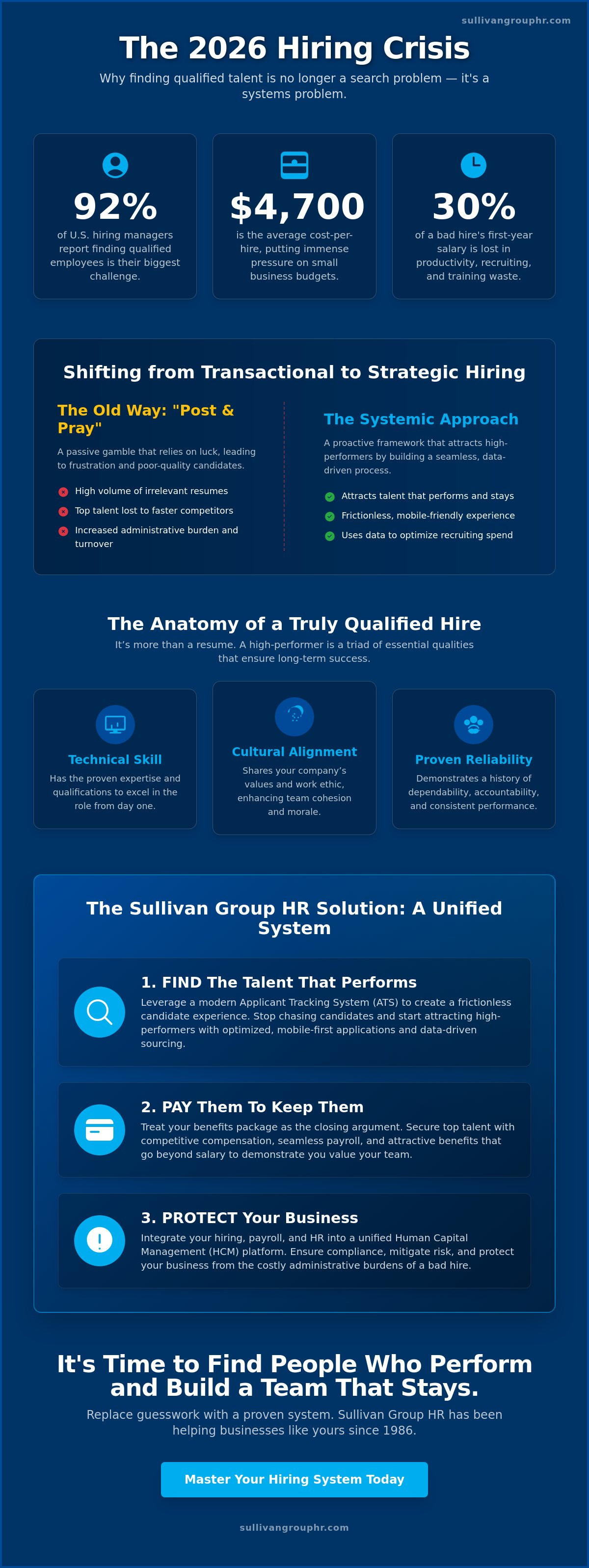
If you are struggling to hire, you aren't alone. 92% of U.S. hiring managers report that finding qualified employees is their biggest challenge in 2026. With the average cost-per-hire climbing to $4,700, a single bad hire can devastate a small business budget. You have likely spent hours sifting through irrelevant resumes or lost a great candidate to a larger competitor with a deeper benefits package. It feels like you are fighting an uphill battle, but the truth is that your hiring struggle isn't a search problem. It is a systems problem.
We understand the frustration of high turnover and the weight of administrative burdens. Since 1986, Sullivan Group HR has partnered with business owners nationwide to put the human back into human resources. This guide provides the exact roadmap you need to master the systems that attract and secure high-performing talent. We will explore how to implement a streamlined hiring process, navigate the 16 states now requiring salary transparency, and use integrated HCM tools to lower your cost-per-hire and protect your business. It is time to find people who perform and build a team that stays.
Key Takeaways
- Stop relying on "post and pray" and start using an Applicant Tracking System (ATS) to build a frictionless candidate experience that attracts high-performers.
- Master the strategy of finding qualified employees by prioritizing a blend of technical skill, cultural alignment, and proven reliability.
- Treat your benefits package as the closing argument; it’s the key to securing top talent when salary is just the entry price.
- Replace guesswork with structured behavioral interviews and skills testing to ensure every new hire is ready to perform from day one.
- Leverage a unified HCM platform to connect your hiring, payroll, and compliance into one seamless, protective system for your business.
Beyond the Job Board: Why Finding Qualified Employees in 2026 Requires a System
In 2026, simply listing a vacancy on a job board is a recipe for frustration. It's called "Post and Pray," and it's a passive gamble that rarely pays off in today's competitive market. Are you finding the right people, or are you just filling chairs? True success in finding qualified employees requires moving beyond the transaction. A "qualified" hire today isn't just someone with a certificate. They are a triad of technical skill, cultural alignment, and rock-solid reliability. If one piece is missing, the whole structure eventually collapses.
We've seen how the labor market in Georgia and South Carolina has shifted over the years. Candidates have more options and higher expectations than ever before. At Sullivan Group HR, we've spent decades perfecting a holistic approach to meet these challenges. We call it Find - Pay - Protect. This framework ensures your recruitment process isn't an isolated event. It's the start of a lifecycle. You find the talent that performs, you pay them accurately to keep them, and you protect your business through compliance and safety. When you treat hiring as a system rather than a chore, you stop chasing candidates and start attracting them.
The True Cost of a Bad Hire
A single hiring mistake typically costs a business 30% of that employee's first-year earnings in lost productivity, recruitment fees, and onboarding waste. It's a heavy price that most small businesses can't afford to pay twice. Beyond the dollars, low-quality hires create a massive administrative burden for your team. They spend more time on disciplinary issues and less time on growth. This creates a dangerous ripple effect. When your "A-players" have to pick up the slack for a bad hire, their own morale dips. This often leads to higher turnover across your entire team, leaving you back at square one.
Shifting from Transactional to Strategic Hiring
Stop thinking about "filling a gap" and start thinking about building a talent pipeline. Your hiring process is the first handshake a candidate has with your brand. If the experience is messy or slow, top-tier talent will move on to a competitor before you even finish the first interview. Strategic hiring uses data to see which sourcing channels actually work. Maybe your best leads come from specific regional referrals rather than national job sites. Identifying these patterns allows you to spend your recruiting budget where it actually delivers results. It's about being proactive rather than reactive, ensuring you are finding qualified employees who actually want to grow with your company.
Building Your Talent Magnet: Strategies to Attract High-Performers
High-performing employees don't just want a paycheck. They want a purpose. In a market where 92% of hiring managers struggle to find skilled talent, your business must stand out as a destination, not just a workplace. Finding qualified employees starts by removing every barrier between a great candidate and your "Apply" button. If your process is clunky or requires a desktop computer to navigate, the best people will simply move to the next tab. Top talent is usually "passive," meaning they are already employed and browsing for their next move during a quick lunch break on their phone. If you don't optimize for mobile, you are invisible to the best candidates.
Your current team is also your most powerful recruiting tool. High-performers tend to know other high-performers. Implementing a formal referral program can slash your cost-per-hire and improve long-term retention. Pair this internal strategy with a strong social media presence that acts as an authentic window into your company culture. Don't just post boring job openings. Share videos of your team in action or highlight a "day in the life" at your Georgia or South Carolina office. This builds trust and rapport before the first interview even begins. It shows that you value people over processes, which is the heart of putting the human back into HR.
Optimizing Your Applicant Tracking System (ATS)
A modern Applicant Tracking System like isolved is the backbone of a successful "Find" strategy. It automates the heavy lifting of sorting through resumes without losing the personal touch that defines your brand. By simplifying the application process, you drastically reduce "drop-off" rates. The system automatically ranks candidates by specific skills and experience, allowing you to focus your energy on the top 5% of applicants instead of drowning in hundreds of irrelevant resumes. This speed is critical; the best candidates are often off the market in less than ten days.
Developing a Compelling Employer Brand
Why should an A-player choose you over a larger competitor with a massive budget? This is your Employee Value Proposition (EVP). To succeed at finding qualified employees, your job descriptions must do more than list requirements. They need to sell a future. We believe in finding people who perform, which means targeting individuals who crave growth and results. Instead of a list of "must-haves," describe what they will achieve in their first year. Clearly outline career paths and development opportunities. When you lead with the "why" of your business, you attract people who align with your mission and stay for the long haul.
The Role of Competitive Benefits in Securing Qualified Talent
Salary is just the entry price. In 2026, benefits are your closing argument. While a competitive wage gets a candidate to read your job post, your benefits package is what convinces them to sign the offer letter. We call this the "Pay Paying People" philosophy. It's about aligning your total rewards with the performance you expect. If you want high-performers, you must offer a package that protects their health and their future. Finding qualified employees becomes significantly easier when your offer stands out against national firms that often lack a personal touch.
The Big Three, consisting of health, dental, and vision, remain the foundation of any serious offer. However, the stakes are rising. Employers expect the per-employee cost of benefits to increase by an average of 6.5% in 2026. With family health coverage premiums reaching nearly $27,000 per year, small businesses in Georgia and South Carolina must be strategic. Ancillary benefits like life insurance and 401(k) plans aren't just "nice-to-haves" anymore. They are essential tools for building long-term loyalty and showing your team that you have their back.
Moving Beyond the Basics: Modern Benefit Expectations
The 2026 labor market demands more than just insurance cards. Flexible work arrangements and mental health support have moved to the top of candidate wish lists. Our Employee Benefits Management services allow small businesses to offer "Fortune 500" level perks without the massive administrative overhead. You can include high-value options like the 2026 dependent care FSA, which has a $7,500 household limit. These modern perks act as a powerful differentiator, proving that you are an employer who understands the whole person, not just the worker.
Benefits Administration as a Recruiting Tool
Transparency is your best friend in the recruitment process. Don't wait until the final interview to discuss the package. Providing a total rewards statement early in the process sets you apart from 90% of your competitors. Using a unified HCM platform with an employee self-service portal also boosts candidate satisfaction. It reduces the friction of paperwork and lets new hires manage their own information. This efficiency allows you to focus on the "human" in human resources rather than getting buried in spreadsheets. By streamlining these systems, you protect your business from errors while securing the talent you need to grow.
Screening for Quality: Filtering Candidates Without Losing Momentum
Relying on a "gut feeling" is one of the most dangerous mistakes a small business owner can make. While a candidate might seem like a great fit over coffee, finding qualified employees requires an objective, data-driven approach to vetting. This is where the "Protect" pillar of our framework becomes essential. You aren't just looking for someone who can do the job; you are ensuring your next hire doesn't become a long-term liability for your team or your reputation. Speed is important, but accuracy is what saves your bottom line.
The vetting landscape is shifting rapidly in 2026. For example, as of April 18, 2026, New York state law prohibits most employers from using a candidate's credit history in hiring decisions. Similarly, Philadelphia amended its standards on January 6, 2026, to reduce the lookback period for felony convictions to seven years and misdemeanors to four years. If your screening process hasn't been updated to reflect these regional changes, you are at risk. We help our partners in Georgia and South Carolina stay ahead of these compliance curves, ensuring their human resources consulting and vetting processes are both rigorous and legal.
Behavioral Interviewing and Skills Assessment
Behavioral interviewing operates on one core principle: past behavior is the best predictor of future performance. Instead of asking "What would you do?", ask "What did you do?" when faced with a specific challenge. To keep things objective, use a scorecard to rank answers. This prevents personal bias from clouding your judgment. Pair these interviews with skills testing. Don't just take their word for it. Have them "show, don't tell" through a brief practical assessment. This identifies the soft skills, like problem-solving and communication, that lead to long-term retention.
Compliance-First Background Checks and Vetting
Managing background checks and drug screenings shouldn't grind your momentum to a halt. The key is to integrate these steps into your workflow so they trigger automatically after a conditional offer. This protects your business from discrimination claims while maintaining a professional pace. A thorough vetting process also intersects with your risk management strategy. By ensuring every hire is properly screened, you create a safer workplace and potentially lower your long-term costs for Workers' Compensation insurance. It's about building a team of "A-players" who perform safely and consistently. If you want to refine your vetting process, our team can help you implement a human capital management system that balances speed with absolute protection.
Finding and Retaining Your Best Team with Sullivan Group HR
Are you ready to be the best employer you can be? Success in finding qualified employees doesn't end when the offer letter is signed. True growth happens when your hiring strategy flows seamlessly into your payroll, benefits, and performance management. At Sullivan Group HR, we've served as a seasoned local guardian for businesses across Georgia and South Carolina since 1986. We understand that behind every data point is a person. Our mission is to put the human back into human resources by providing the professional rigor you need with the empathetic partnership you deserve.
Many small businesses struggle because they use disconnected tools for different HR tasks. You might have one system for tracking applicants and an entirely different one for payroll. This creates friction and increases the risk of costly errors. We solve this by providing a unified human capital management (HCM) platform. Our Find - Pay - Protect framework ensures that once you find people who perform, you have the systems in place to pay them accurately and protect your business through total compliance. We don't just offer a tech solution; we offer a long-term partnership.
The isolved Advantage for Growing Businesses
The isolved platform is a game-changer for entrepreneurs who feel overwhelmed by administrative burdens. It streamlines the entire employee lifecycle into one intuitive dashboard. When you use an integrated Applicant Tracking System, the data from a new hire's application flows directly into their onboarding and payroll profile. This automated onboarding ensures your new "A-players" hit the ground running on day one instead of spending their first week buried in paperwork. You gain real-time, data-driven insights that help you refine your strategies and lower your cost-per-hire over time.
Partnering for Long-Term Success
A tech-only solution can't understand the specific regional landscape of Savannah or the unique challenges of a South Carolina construction firm. That's where our "Seasoned Local Guardian" approach makes the difference. We provide the national expertise of a large firm with the neighborly touch of a local partner. Our human resources consulting helps you navigate complex regulations while building a culture that attracts and keeps top talent. We help you integrate time, attendance, and performance tracking so you can focus on leading your team rather than managing spreadsheets.
Ready to find people who perform? Contact Sullivan Group HR today.
Build a Team That Performs and Stays
Success in finding qualified employees isn't about luck. It's about the systems you build and the partners you choose. You've seen how a streamlined application process and a competitive benefits package can transform your recruiting results. Now, it's time to put those pieces together. By moving from "post and pray" to a strategic Find, Pay, and Protect framework, you ensure your business is ready for the 49,000 jobs economists expect to be added monthly across the U.S. in 2026. It's about creating a workspace where high-performers want to build their careers.
Since 1986, we've helped business owners in Georgia and South Carolina simplify their administrative burdens. Our industry-leading isolved HCM platform gives you the tools to manage the entire employee lifecycle in one place. You don't have to handle the complexities of compliance, payroll, and benefits administration alone. We have your back. Let us help you put the human back into your human resources strategy and give you the security you need to grow.
Are You The Best Employer You Can Be? Find Out with Sullivan Group HR
Your business deserves a team of A-players who are as committed to your success as you are. Let's start building that future together today. You have the vision, and we have the tools to protect it.
Frequently Asked Questions
What is the fastest way to find qualified employees?
The fastest way to secure talent is to use an automated Applicant Tracking System (ATS) that posts to multiple job boards simultaneously. This eliminates manual entry and puts your opening in front of candidates within minutes. In the 2026 labor market, top talent often leaves the market in fewer than 10 days. Speed is your greatest advantage when you have a system that ranks applicants by skill automatically.
How can small businesses compete with large corporations for talent?
Small businesses compete by offering personalized benefits and a faster path to professional impact. While you might not match a global giant's absolute salary, you can offer flexibility and high-level perks through a benefits management partner. Personalized growth opportunities and a direct connection to leadership often matter more to high-performers than a corporate name. You can be the best employer in your region by leading with culture.
What are the most important qualities to look for in a new hire?
You should prioritize a triad of technical proficiency, cultural alignment, and reliability. Technical skills are the baseline, but reliability and culture fit are what ensure long-term retention. Use structured behavioral interviews to identify these traits. These qualities ensure the employee will perform well and stay with your business. Finding the right person means looking for someone who shares your values and shows a history of consistent results.
Is an Applicant Tracking System (ATS) worth the investment for a small business?
Yes, an ATS is essential for finding qualified employees without wasting dozens of hours on manual resume screening. It automates the "Find" stage of our framework by ranking candidates based on their specific skills. This saves small business owners an average of 14 hours per week on administrative hiring tasks. This investment allows you to focus on the human side of your business while the software handles the heavy lifting.
How do I improve my company's employer brand?
Improve your brand by defining a clear Employee Value Proposition (EVP) and sharing it through social media. Be the best employer you can be by showcasing authentic stories from your Georgia or South Carolina team. High-performers are drawn to transparency and well-defined career paths. Every job posting should sell the future of the role. When you lead with your "why," you attract people who align with your mission.
What are the common mistakes to avoid when finding qualified employees?
The biggest mistake is "Post and Pray" hiring without a structured screening system. Relying on gut feelings instead of objective scorecards leads to bad hires and high turnover. Another common error is failing to disclose total rewards early in the recruitment process. Since 92% of hiring managers find it challenging to find skilled candidates, you can't afford a slow or opaque process that drives top talent toward your competitors.
How does integrated HCM improve the recruiting process?
Integrated HCM connects your recruitment data directly to payroll and benefits administration. This eliminates duplicate data entry and ensures a smooth transition for every new hire. When your ATS and payroll live in one platform like isolved, you reduce administrative friction. This allows you to protect your business through accurate compliance while focusing on the people who perform. It turns a series of disconnected tasks into one seamless lifecycle.
Can outsourcing HR help with finding better candidates?
Outsourcing HR gives you access to professional recruiters and advanced technology that most small businesses can't maintain alone. A partner like Sullivan Group HR uses a proven "Find - Pay - Protect" framework to secure talent. This level of expertise is especially helpful for finding qualified employees in specialized industries like construction or healthcare. You get the benefit of national expertise combined with a personalized, neighborly touch that understands the local landscape.


