
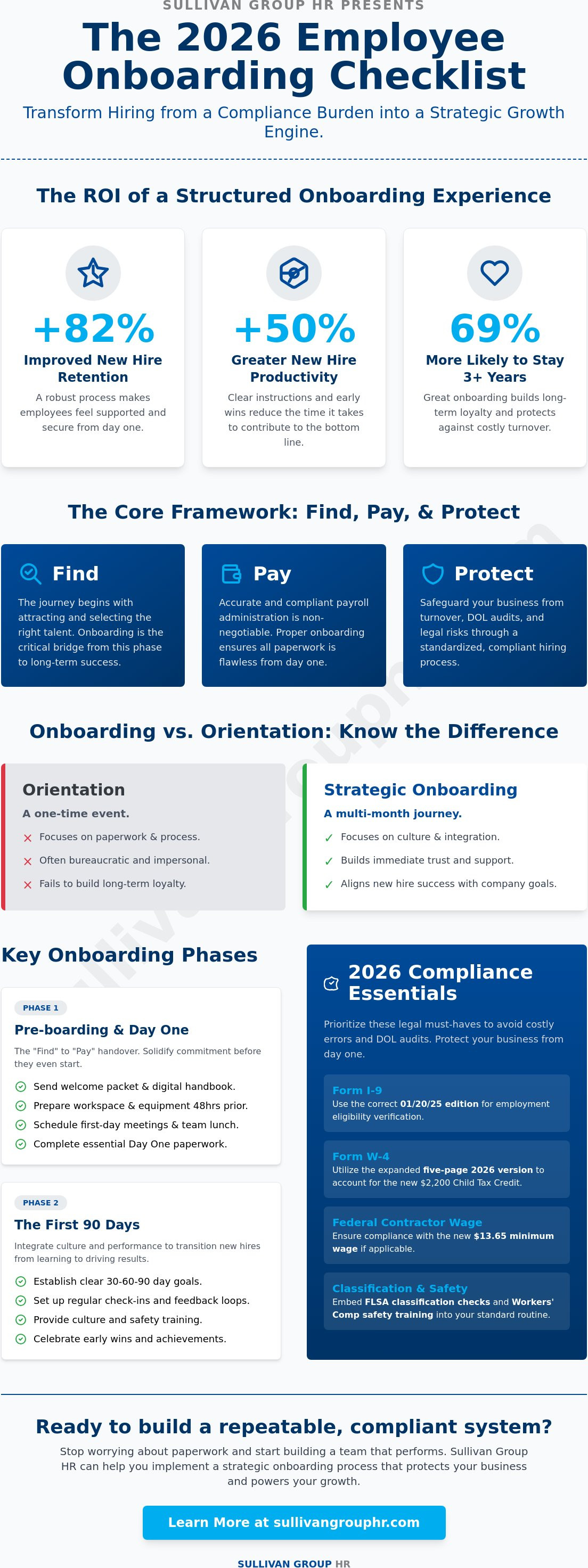
Did you know that a robust onboarding process can improve new hire retention by 82%? Even with that data in hand, many business owners nationwide feel the crushing weight of administrative burdens and the constant fear of a DOL audit. It's exhausting to worry if you've missed a detail on the 01/20/25 edition of Form I-9 or if you're prepared for the new $13.65 minimum wage for federal contractors. You want to focus on growth, but the paperwork keeps pulling you back. Sullivan Group HR's 2026 employee onboarding checklist is designed to help you find people who perform, pay them accurately, and protect your business from day one.
We believe HR should be human, not just a series of forms. Are you the best employer you can be? This guide will help you answer "yes" by transforming your hiring process from a paperwork headache into a strategic retention engine. We'll walk you through critical 2026 updates, including the expanded five page Form W-4 and the new $2,200 Child Tax Credit. You're about to learn how to build a repeatable, compliant system that boosts productivity by 50% and gives you the confidence to lead.
Key Takeaways
- Learn why a strategic approach transforms onboarding from a compliance burden into a vital tool for long-term growth and talent protection.
- Streamline your "Find" and "Pay" handover by using a comprehensive employee onboarding checklist that automates essential paperwork and prioritizes preboarding engagement.
- Master the critical first 90 days by establishing clear feedback loops that transition new hires from learning the ropes to driving results.
- Strengthen your "Protect" pillar by embedding FLSA classification checks and Workers' Compensation safety training into your standard hiring routine.
- Discover how modern HCM platforms help growing teams scale efficiently by connecting applicant tracking directly to payroll administration.
The Strategic Foundation: Why Your Onboarding Checklist is a Growth Tool
Your business success depends on more than just making a great hire. It's about what happens after the offer letter is signed. In the Sullivan Group HR framework, we view the employment lifecycle through three lenses: Find, Pay, and Protect. A strategic employee onboarding checklist serves as the essential bridge between finding the right talent and protecting your business from turnover or compliance errors. If you're "winging it" with your new hires, you're leaving your growth to chance. Poorly managed transitions drive up administrative costs and leave your business vulnerable to Department of Labor audits.
We believe in putting the "human" back into Human Resources. This means moving away from sterile, bureaucratic processes and toward a supportive partnership. A checklist isn't just a list of tasks for a manager to tick off; it's a safety net for your new team member. When you provide a clear path, you're telling your new hire that you've got their back. This builds immediate trust and sets the stage for them to perform at their highest level. A checklist that spans the first 90 days ensures that the initial excitement of a new job doesn't fade into the frustration of being unsupported.
Onboarding vs. Orientation: Knowing the Difference
Many business owners confuse orientation with onboarding. Orientation is a one-time event, usually involving a stack of forms and a quick tour of the office. While necessary, paperwork-only orientation fails to build long-term loyalty because it focuses on the business's needs rather than the employee's integration. True onboarding is a strategic journey of organizational socialization that helps a new hire understand your culture and their specific role in your success. Strategic onboarding is a deliberate, multi-month roadmap designed to align a new hire's personal success with the company's long-term growth goals.
The ROI of a Structured Onboarding Experience
The numbers don't lie. Organizations with a standard employee onboarding checklist experience 50% greater new hire productivity. By providing clear instructions and early wins, you reduce the time it takes for a new person to start contributing to your bottom line. This structure also lifts the administrative burden off your managers. Instead of answering the same basic questions for weeks, they can focus on coaching and development. The long-term impact is even more significant. SHRM reports that 69% of employees are more likely to stay with a company for three years if they experienced great onboarding. When you invest in a structured process today, you're protecting your business from the high cost of turnover tomorrow.
Phase 1: Preboarding and Day One-The 'Find' and 'Pay' Handover
The moment a candidate signs an offer letter, the "Find" phase ends and the "Pay" and "Protect" phases begin. This window, known as preboarding, is your best chance to solidify a new hire's commitment. Don't wait until Monday morning to start the process. Research from Harvard Business School suggests that focusing on an individual's identity during this early phase significantly boosts engagement. By reaching out early, you show that you're prepared and that you value their contribution. It's the first step in proving you're the best employer you can be.
Logistical readiness is the hallmark of a professional operation. Nothing kills first-day momentum like a missing laptop or a broken login. Ensure all equipment is ready and workspace preparation is complete 48 hours before they arrive. This shows you value their time and are ready for them to perform. When they walk through the door, your goal is to make a "Best Employer" first impression. It's about putting the human back in HR from the very first minute. You want your new hire to go home and tell their family they made the right choice.
The Essential Paperwork Checklist
Compliance shouldn't be a scramble. Your employee onboarding checklist must prioritize legal essentials to ensure your payroll administration is flawless. Use the 2026 version of Form W-4 to account for the $2,200 Child Tax Credit and the 01/20/25 edition of Form I-9 for eligibility verification. Missing these details can lead to costly errors and DOL audits. We recommend delivering your employee handbook digitally before day one. This allows the new hire to review policies at their own pace and provide a digital acknowledgment. If you find these administrative hurdles overwhelming, partnering with an HR expert can help you stay compliant without the stress.
Setting the Stage for Performance
Performance starts with connection. A "Welcome Kit" with company gear or a small gift from a local Georgia or South Carolina business goes a long way in making someone feel at home. Assigning an "Onboarding Buddy" is another high-impact move. This person isn't their manager; they're a peer who helps them navigate social norms and unwritten rules. Finally, set clear expectations. Define what success looks like for week one. Small, achievable goals build confidence and get your new team member performing quickly. This isn't just about tasks. It's about protecting their morale and your business's future.
Phase 2: The First 90 Days-Integrating Culture and Performance
The first day is just the handshake. The real work of protecting your new hire starts when the initial excitement fades. Most managers believe their job ends once the paperwork is filed. In reality, the first 90 days are the most critical period for long-term retention. According to SHRM, 69% of employees are more likely to stay with a company for three years if they experience a great onboarding process. This phase is where you transition from "Paying" to truly "Protecting" your talent investment. If you want to be the best employer you can be, your employee onboarding checklist must extend far beyond the first week. By viewing this period as a strategic bridge, you ensure that the people you worked so hard to find actually stay to perform.
Continuous feedback is the heartbeat of this period. Waiting for an annual review is a massive mistake that leads to early turnover. New hires need to know where they stand immediately. We recommend weekly check-ins during the first month to clear any hurdles. By the 30-day mark, the focus should shift from "how do I do this?" to "how am I performing?" These feedback loops ensure that small misunderstandings don't turn into reasons for a new hire to leave before their 90th day. It's about building a supportive partnership that makes them feel secure in their new role.
The 30/60/90 Day Framework
Week 4 is about identifying resource gaps. Does your new hire have the tools and access they need to perform? By Month 2, the focus moves to role-specific training. This is when you assess technical competency and social integration. Are they gelling with the team? Month 3 brings full autonomy. This milestone is the perfect time for long-term career pathing discussions. Celebrating the end of the introductory period shows your team that you value their growth and commitment. It marks the moment they stop being a "new hire" and start being a core part of your business's future.
Building Social Capital and Culture
Isolation is a major risk for new hires, especially in remote or hybrid roles. Introduce your new team member to cross-functional departments early on. This helps them understand how their work impacts the whole business. Encouraging participation in company-wide initiatives or local volunteerism in Georgia and South Carolina builds a sense of belonging. A strong, inclusive culture serves as a protective shield that prevents "quiet quitting" during those first six months. By putting the human back in HR, you create a workplace where people want to stay and perform. It is this social capital that turns a job into a career and a hire into a long-term partner.
The 'Protect' Pillar: Compliance and Legal Essentials for 2026
Compliance is often viewed as a burden, but we see it as your business's strongest shield. The "Protect" pillar of our framework ensures that the people you found and pay are working in a safe, legally sound environment. A single misstep in FLSA classification can trigger a Department of Labor audit that drains your time and resources. From day one, your employee onboarding checklist must clearly define whether a role is exempt or non-exempt. This isn't just about payroll accuracy; it's about protecting your company from back-pay claims and legal disputes. Are you certain your classifications meet the 2026 federal standards? If not, you're leaving your business exposed.
Your employee handbook is your first line of defense. It's more than a list of rules; it's a contract of expectations that protects both the staff and the business. In Georgia and South Carolina, having localized policies that address regional labor laws is vital. We recommend including EEO and harassment training as mandatory components of your initial training flow. By documenting these sessions, you demonstrate a good-faith effort to maintain a professional, compliant workplace. This proactive approach turns Human Resources into a strategic asset rather than a back-office headache. It puts the human back in the process by ensuring everyone knows their rights and responsibilities.
Audit-Proofing Your Onboarding Process
Paper files are a liability in the modern era. Digital record-keeping is now the standard for personnel files, ensuring that documents are searchable and secure. Your system should automatically track the completion of required training, such as HIPAA or industry-specific safety modules. This is especially critical if you're hiring remote workers across state lines. You must account for multi-state compliance, as different states have varying requirements for pay transparency and leave laws. Keeping these records organized allows you to breathe easy if an auditor ever knocks on your door. A centralized digital hub is the only way to scale this protection as your team grows.
Risk Management and Workers' Comp
Safety training shouldn't wait until a new hire is "settled in." Integrating Workers' Compensation reporting procedures into the onboarding flow reduces your risk from the very first hour. New hires are statistically more likely to experience a workplace injury during their training phase because they aren't yet familiar with your specific environment. Clearly communicate your drug-free workplace policy and testing protocols to set a standard of safety. Using role-specific safety checklists ensures that every team member knows the hazards unique to their position. If you need help building a safer, more compliant workplace, our human resources consulting services can help you identify and close your existing gaps.
From Checklist to Platform: How HCM Technology Scales Your Success
Manual checklists are a great starting point for a brand new business. However, once your team grows beyond 20 employees, a paper-based or spreadsheet-driven process becomes a liability. It's too easy for a manager to skip a step or for a critical compliance document to get lost in an inbox. This is where Human Capital Management (HCM) technology changes the game. By moving your employee onboarding checklist into a unified platform like isolved, you eliminate the friction between hiring and the first paycheck. You're no longer just managing tasks; you're scaling a repeatable system that protects your business while empowering your staff.
Employee Self-Service (ESS) is a core part of this transformation. It allows your new hires to own their personal data, from tax elections to benefits enrollment. This shift does more than just reduce the administrative burden on your HR team. It gives the employee a sense of autonomy from day one. When a new hire can log in and see their own progress, it reinforces that they've joined a professional, forward-thinking organization. It's about building a supportive environment where technology serves the person, not the other way around.
Automating the 'Find - Pay - Protect' Lifecycle
A unified HCM platform ensures data flows seamlessly from the initial job offer in the Applicant Tracking System directly to payroll administration. This eliminates the need for double data entry, which is the primary source of human error in tax elections and benefits setup. With isolved, you gain real-time compliance reporting through unified analytics. You can see at a glance who has completed their safety training and who still needs to sign the handbook. This level of visibility is essential for maintaining the "Protect" pillar of your business as you expand your team.
Choosing the Right Partner for Growth
Technology alone isn't a silver bullet. A tech-only vendor might give you a login, but they won't understand the specific regional landscape of Georgia and South Carolina. Since 1986, Sullivan Group HR has acted as a seasoned local guardian for business owners. We merge high-tech tools with high-touch consulting to help you navigate the complexities of payroll and compliance. We don't just give you a platform; we act as your partner to ensure you're using it to put the human back in your HR processes. Take the first step toward becoming the best employer you can be with our HCM solutions.
Build Your Strategic Retention Engine Today
You've seen how a structured employee onboarding checklist does more than just organize paperwork. It's the bridge between finding great talent and protecting your business's future. By focusing on the first 90 days and integrating culture with compliance, you transform a routine process into a powerful growth tool. Are you the best employer you can be? It starts with moving away from manual errors and toward a system that puts the human back into Human Resources.
Since 1986, Sullivan Group HR has helped business owners in Georgia and South Carolina navigate the complexities of payroll and employment law. Our Find - Pay - Protect framework provides the security you need to lead with confidence. By pairing our expert HR consulting with the industry-leading isolved HCM platform, you gain a partner that grows with you. Don't let administrative burdens slow down your momentum. You have the vision for your business, and we have the tools to protect it.
Ready to automate your onboarding? Explore our isolved HCM solutions today.
Frequently Asked Questions
What are the most important documents for a new hire checklist?
The essential documents include the 01/20/25 edition of Form I-9, the 2026 Form W-4, and a signed acknowledgment of your employee handbook. These forms are the bedrock of your "Protect" pillar. They ensure you comply with federal law and set clear expectations from day one. Using a digital employee onboarding checklist helps you track these items without losing paperwork in the shuffle.
How long should the employee onboarding process actually last?
A successful onboarding process should last at least 90 days, though many top organizations extend it to a full year. While orientation is a one day event, true integration takes time. Gallup research shows that new hires with a structured program reach 50% greater productivity much faster. We recommend consistent check-ins throughout the first three months to ensure your new partner feels secure and supported.
What is the difference between preboarding and onboarding?
Preboarding covers the period between the signed offer letter and the employee's first day, while onboarding is the ongoing integration process. Preboarding is about logistics like equipment setup and welcome emails. Onboarding focuses on performance and culture. By engaging hires early, you reduce the risk of "no-shows" and start building a supportive partnership before they even walk through the door.
Can an employee onboarding checklist help reduce turnover?
Yes, a structured employee onboarding checklist can improve new hire retention by 82% according to the Brandon Hall Group. When employees feel supported and have clear goals, they're far less likely to leave within the first 90 days. High turnover is expensive and disruptive. A great onboarding experience protects your investment in talent and builds a foundation for long term success.
What are the legal compliance risks of poor onboarding?
Poor onboarding risks include Department of Labor audits, heavy fines for I-9 errors, and lawsuits from wage misclassification. If your paperwork isn't audit-proof, you're leaving your business vulnerable. Compliance isn't just about forms; it's about protecting your company from the 69% of employees who might leave if their first experience is disorganized. We help you close these gaps to keep your business safe.
How does an HCM platform like isolved simplify the onboarding process?
An HCM platform like isolved automates the flow of data from applicant tracking directly into payroll and benefits. This eliminates double data entry and reduces human error in tax elections. New hires can use Employee Self-Service to own their information, which speeds up the "Pay" phase of their employment. It transforms a manual headache into a streamlined, professional experience for everyone involved.
Should remote employees have a different onboarding checklist?
Remote employees need a checklist that prioritizes digital connection, equipment logistics, and state-specific tax compliance. You must ensure they have the right tools delivered before day one and assign a virtual "buddy" to help them navigate social norms. If they work in Georgia or South Carolina, you also need to ensure your workers' compensation and local tax withholding align with their specific location.
What should be included in a 30-60-90 day onboarding plan?
A 30-60-90 day plan should include a week four performance check-in, month two role-specific training, and month three autonomy milestones. The first 30 days focus on "learning," while the next 30 shift toward "doing" with clear feedback loops. By the 90-day mark, the employee should be fully integrated into the culture and participating in long-term career pathing discussions with their manager.


