
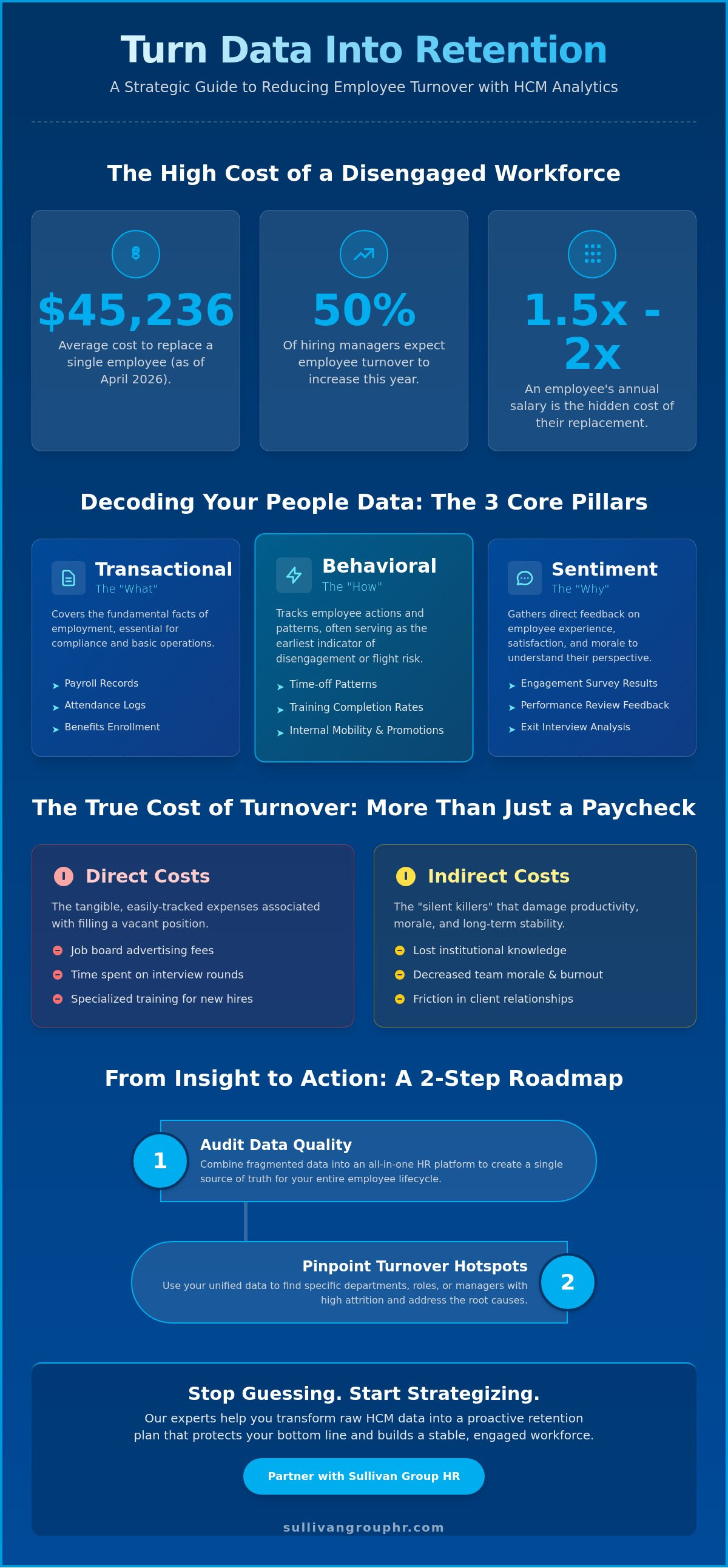
Did you know the average cost of losing a single employee has climbed to $45,236 as of April 2026? With 50% of hiring managers expecting turnover to rise this year, the pressure to keep your best people has never been higher. It's frustrating to feel "data rich but insight poor" while watching talent walk out the door. You likely have the numbers, but you need a way to make them talk.
We understand that manual tracking and reactive management are exhausting. This guide is your roadmap for using HCM data to improve retention by turning raw metrics into a proactive strategy. You'll discover a clear framework to lower turnover costs, address cultural red flags before they escalate, and create the stable, engaged workforce your business deserves. We will explore how to identify early attrition risks and shift toward a skills-based talent model that prioritizes your team's growth. Let's move beyond simple automation and start building long-term organizational security together.
Key Takeaways
- Identify the financial, cultural, and operational costs that make turnover a silent profit killer for your business.
- Categorize your workforce metrics into three core pillars: transactional, behavioral, and sentiment to see the full employee lifecycle.
- Master the process of using HCM data to improve retention by connecting onboarding success and performance metrics to long-term loyalty.
- Follow a practical two-step roadmap to audit your data quality and pinpoint specific turnover hotspots within your departments.
- Understand how combining powerful HCM platforms with expert human advocacy creates a more stable and engaged workforce.
The Invisible Cost of Employee Turnover in 2026
Is your bottom line leaking cash without you noticing? Employee turnover has become the silent profit killer of modern business. As of April 2026, the average cost of losing a single team member has surged to $45,236. This isn't just a line item on an expense report; it's a drain on your company's vitality. When a key player leaves, the impact ripples through your entire organization, affecting your finances, your culture, and your daily operations. It creates a cycle of disruption that can take months to stabilize.
Many business owners attempt to fix this with "blind" retention efforts. They offer random raises or generic perks, hoping something sticks. These reactive measures often fail because they don't address why people are actually leaving. Without a clear view of the problem, you're just throwing money at a symptom. By using HCM data to improve retention, you turn on the lights. Data acts as the lens that makes these invisible costs visible, allowing you to see disengagement before it turns into a resignation letter.
Why Traditional Retention Strategies Fall Short
Management by "gut feeling" is no longer enough to keep a team together in a competitive market. Are you relying on intuition or evidence? Broad-brush benefits packages often miss the mark because they ignore individual employee needs. What motivates a veteran manager might not matter to a new associate. In 2026, the workforce demands a personalized professional experience. If your strategy treats every employee the same, you'll likely lose your best talent to a competitor who listens better.
This shift requires a move away from static, once-a-year reviews toward real-time insights. Traditional methods are too slow. By the time you realize an employee is unhappy, they've likely already updated their resume. A proactive approach uses data to identify these shifts early, giving you the chance to act as a coach and ally rather than a reactive manager.
The Financial Reality of Replacing Top Talent
Replacing a mid-level manager can cost between 1.5 to 2.0 times their annual salary. These figures represent the true value of What is Human Capital? within your organization. When you lose an expert, you lose more than a salary; you lose years of built-up wisdom and efficiency. The direct costs are easy to track, but they're only the tip of the iceberg.
- Direct Costs: Job board advertising fees, time spent on multiple interview rounds, and specialized technical training for new hires.
- Indirect Costs: Lost institutional knowledge, decreased team morale leading to burnout, and friction in client relationships.
The "Retention Gap" is the distance between your current turnover rate and your industry's benchmarks. Closing this gap is the primary metric of your success as a stable, people-first employer.
Decoding Your People Data: The Foundations of HCM Analytics
How do you turn a sea of spreadsheets into a clear strategy? HCM data is the collection of every digital touchpoint in the employee lifecycle. It's the story of how a person moves through your company, from their first day to their last. To understand this story, we look at three core pillars: transactional, behavioral, and sentiment data. When these pillars stand together, they provide a complete picture of your workforce health.
A fragmented system keeps these insights locked in silos. Utilizing an all-in-one HR platform unifies these disparate data points into a single source of truth. However, data is only as good as your ability to visualize it. If you can't see the trends, you can't act on them. A powerful dashboard transforms raw numbers into actionable insights, making using HCM data to improve retention a reality rather than a goal. If you're feeling overwhelmed by these metrics, our team can help you simplify your human capital management strategy.
Transactional vs. Behavioral Data
Transactional data covers the "what" of employment. It includes payroll records, attendance logs, and benefits enrollment. While essential for compliance, it only tells half the story. Behavioral data focuses on the "how." It tracks time-off patterns, training completion rates, and internal mobility. Are employees seeking new skills? Are they taking their vacation time? Behavioral shifts are often the earliest leading indicators of a flight risk. A sudden change in attendance or a drop in training engagement can signal a problem long before an employee speaks up. By monitoring these patterns, you move from reactive fixes to proactive support.
The Role of Predictive Analytics in 2026
In 2026, we don't wait for the exit interview to learn why someone left. Predictive analytics uses past patterns to forecast future departures. Modern HCM systems flag "disengagement markers" before a resignation letter ever arrives. These markers might include a lack of internal mobility or a disconnect from company learning cultures. Organizations with strong learning cultures currently see a 57% retention rate, according to Paycor. By using HCM data to improve retention, you can identify which employees are missing out on these growth opportunities. This technology allows for proactive intervention, giving you the chance to address concerns and keep your best talent right where they belong.
Using HCM Data to Improve Retention: Three Critical Focus Areas
Where should you start your analysis? To keep your best talent, you need to look at specific milestones in the employee lifecycle. Focus your energy on onboarding, performance, and sentiment. These three areas provide the most actionable insights for using HCM data to improve retention. By mastering these focus areas, you move from guessing why people leave to knowing how to make them stay. It's about being proactive, protective, and precise.
The First 90 Days: Onboarding as a Data Goldmine
The foundation of loyalty is built early. Tracking "Time to Productivity" helps you measure how quickly a new hire feels competent and valued. If this metric lags, it often points to friction in your applicant tracking and onboarding process. Use 30, 60, and 90 day survey data to catch issues before they fester. A smooth, digital experience reduces "new hire ghosting" and sets a professional tone from day one. When employees feel supported during their first three months, they're far more likely to commit for the long haul.
Performance and Growth: Mapping the Internal Journey
Are your high-potentials feeling stagnant? Performance review data can reveal who is ready for a challenge but lacks a clear path forward. According to May 2026 research from Fuel50, employees at companies with high internal mobility stay 41% longer than those at companies with low mobility. Analyze your training and development data to ensure your team sees a future within your walls. Your "Internal Hire Rate" is a vital metric. It proves you value your people's growth as much as their output. Using HCM data to improve retention means identifying these stars early and giving them a reason to stay.
Employee Sentiment: Moving Beyond the Annual Survey
Annual surveys are often too late to save a team. Pulse surveys offer a real-time tool to gauge morale instantly. By correlating sentiment scores with actual turnover in specific departments, you can identify toxic pockets before they spread. This data helps you understand the "why" behind the numbers. The Employee Net Promoter Score (eNPS) serves as your primary metric for employee advocacy; it tells you exactly how likely your team is to recommend your company to others. Real-time feedback allows you to act as a coach and ally, addressing concerns before they lead to a resignation.
From Insight to Action: Building Your Retention Roadmap
Are you ready to stop guessing and start growing? Turning raw metrics into a culture of loyalty requires more than just a software login. It demands a structured plan that moves you from observation to intervention. Research suggests that as much as 75% of voluntary turnover can be avoided by addressing factors within your control. Using HCM data to improve retention is the most effective way to identify those factors before they cost you your best people. Follow this five-step roadmap to build a more stable, engaged workforce.
- Step 1: Audit your infrastructure. Ensure your payroll and HR systems are fully integrated to provide a single, clean source of truth.
- Step 2: Spot the danger zones. Use department-level reporting to identify "Turnover Hotspots" where attrition is higher than your company average.
- Step 3: Talk before they walk. Conduct "Stay Interviews" triggered by behavioral data, such as a sudden drop in training engagement or shifts in time-off patterns.
- Step 4: Personalize the perks. Use demographic usage data to tailor your benefits and compensation packages to what your employees actually value.
- Step 5: Keep the beat. Monitor your progress monthly, iterate based on feedback, and celebrate small wins as your turnover rates begin to drop.
If you're ready to build your own roadmap, our human resources consulting experts can help you bridge the gap between raw data and meaningful action.
Auditing Your Data Infrastructure
Is your data working for you, or are you working for your data? To make informed decisions, your payroll and HR systems must be in constant dialogue. If your records are siloed, inconsistent, or outdated, you're essentially flying blind. Clean, real-time data is the foundation of any successful strategy. Identifying these "Data Gaps" now prevents costly mistakes later. When your systems are unified, you gain the clarity needed to protect your team and your bottom line.
Tailoring the Employee Experience
In 2026, a "one size fits none" approach to management is a recipe for turnover. Are you offering perks that actually matter to your team? By analyzing benefits utilization data, you can stop wasting resources on unused programs and invest in what your employees truly need. Similarly, monitoring time and attendance data helps you spot signs of burnout before they lead to a resignation. Promoting a healthy work-life balance isn't just a nice sentiment; it's a data-driven strategy for long-term organizational security. Using HCM data to improve retention allows you to treat every employee as an individual, fostering the safety and results your business needs to thrive.
Beyond the Dashboard: The Power of a Human-Centric HCM Partner
Is a dashboard enough to save your company culture? While powerful platforms like isolved are essential for modern business, they're only half the battle. Data can show you where the fire is, but it can't tell you how to comfort the people standing in the smoke. Using HCM data to improve retention requires more than just high-tech tracking. It requires a partner who brings both the tech and the wisdom to the table. We provide a three-part value proposition: leading technology, expert consulting, and reliable advocacy.
At Sullivan Group HR, we believe that data shouldn't feel sterile or bureaucratic. It should be a tool for protection. We act as your coach and ally, ensuring you have the security needed to focus on your professional potential. By combining robust human capital management tools with personalized support, we help you build a legacy of stability. You don't just need a vendor. You need a long-term relationship built on results. Our team understands that behind every data point is a person who contributes to your success.
The Sullivan Group HR Difference: Advocacy over Automation
How do you turn a red flag into a coaching opportunity? Automated systems flag risks, but our human resources consulting team provides the nuance needed to handle them. We understand the specific business climate of our region, offering a localized handshake that national firms can't replicate. Our hard-earned wisdom allows us to see the story behind the statistics. We help you move from simple data management to true Human Capital Advocacy. This means looking past the numbers to see the people they represent. Every decision should support movement, safety, and results. When you partner with us, you gain a no-nonsense authority that values people over systems.
Getting Started with a Data-Driven Strategy
The transition to a proactive management style begins with a single step. Migrating to a unified isolved HCM platform is the first move toward total organizational security. Our team supports you throughout this transition, helping you clean your data and set up the reporting structures that matter most. We ensure your payroll administration and employee benefits management are perfectly aligned with your goals. We take the administrative burden off your shoulders so you can lead with confidence. This allows you to focus on growth while we handle the regulatory and administrative complexities. Ready to secure your workforce? Let’s talk about your HCM strategy.
Secure Your Future with Data and Advocacy
Are you ready to turn your workforce metrics into your greatest competitive advantage? We've explored how identifying the hidden costs of turnover and mastering the three pillars of people analytics can transform your company culture. By following a structured roadmap, you move from reactive management to proactive leadership. Start using HCM data to improve retention by looking beyond the numbers to the people they represent. Every data point is an opportunity to strengthen your team and protect your legacy.
At Sullivan Group HR, we provide the tools and the wisdom you need to succeed. With access to the industry-leading isolved HCM platform and our decades of professional HR consulting expertise, you gain a partner dedicated to your stability. We offer specialized solutions for payroll, benefits, and risk management that allow you to lead with confidence. Empower your team and protect your growth; partner with Sullivan Group HR today. Your team is your most valuable asset. Protecting them is the best investment you'll ever make for your business's future.
Frequently Asked Questions
What is the most important HCM metric for employee retention?
The voluntary turnover rate is the primary metric, but it only tells you what happened in the past. To look forward, you must track your Employee Net Promoter Score (eNPS) alongside internal mobility rates. These numbers reveal how your team feels about their future and whether they see a path for growth within your organization.
How often should I analyze my HCM data for turnover trends?
You should review your high level metrics monthly and conduct a deep dive analysis every quarter. Monthly checks allow you to spot sudden shifts in attendance or engagement. Quarterly reviews help you identify long term patterns across different departments, ensuring your strategy remains proactive rather than reactive.
Can HCM data really predict when an employee is about to quit?
Yes, modern systems flag disengagement markers that often precede a resignation. These markers include sudden changes in time off requests, a drop in training completion, or a lack of recent internal mobility. Using HCM data to improve retention means acting on these early warning signs to support your team before they decide to leave.
Is small business data enough to be statistically significant for retention?
Small business data is highly significant because every individual departure has a much larger impact on your total workforce and culture. While a large corporation looks at broad percentages, you can focus on specific behavioral shifts. This allows you to take a more personalized, human centric approach to keeping your best talent.
What are the ethical considerations of using AI to monitor employee behavior?
Transparency and trust are the foundations of ethical data use. You should always inform your team about what is being tracked and how it supports their professional growth. The goal of using HCM data to improve retention should be advocacy and coaching, not surveillance or punishment.
How does an integrated payroll system improve employee retention?
An integrated system eliminates pay errors and provides a seamless self service experience for your employees. Accuracy in payroll is a fundamental sign of respect and reliability. When employees can easily access their pay stubs and benefits information, it creates a sense of security and professional stability.
What is a "Stay Interview" and how do I use HCM data to conduct one?
A Stay Interview is a proactive conversation with a current employee to discover what keeps them at your company. You can use your HCM platform to identify high performers who haven't had a career development check in or a training update recently. This data gives you a clear starting point for a supportive, forward looking dialogue.
How can I lower my turnover costs using HR software?
HR software lowers costs by identifying turnover hotspots before they lead to expensive backfilling and training. Since the average cost of losing an employee has reached $45,236 as of April 2026, preventing even one departure provides a significant return on investment. It allows you to spend your resources on development rather than recruitment.


