

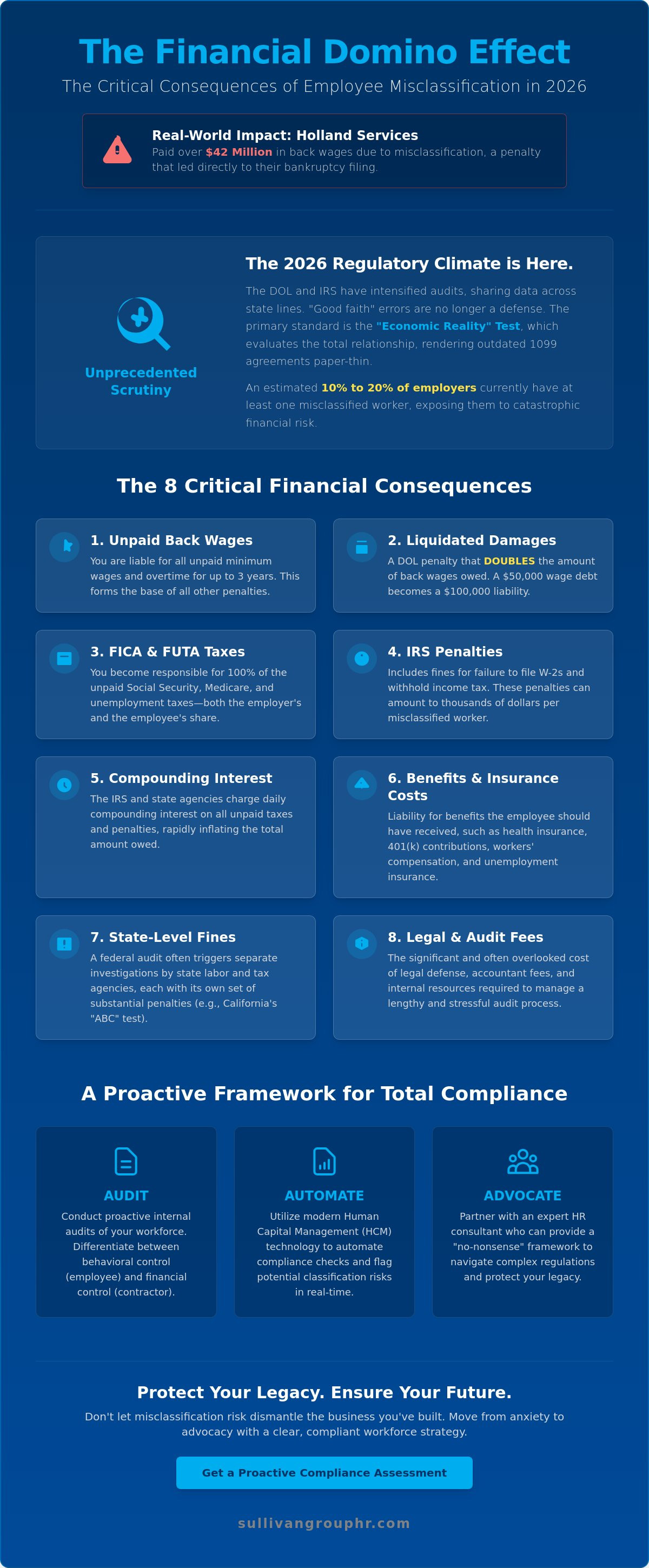
Could a single payroll mistake really push your business into bankruptcy? In 2021, Holland Services paid over $42 million in back wages after misclassifying workers, a move that ultimately led to their bankruptcy filing. As we move through 2026, the Department of Labor and the IRS have intensified their scrutiny. The consequences of misclassifying employees are now more severe and expensive than ever. If you've felt a knot in your stomach while reviewing your contractor list or trying to decipher the "Economic Reality" test, you're not alone. We understand the pressure of protecting the legacy you've built.
You've worked hard to create a stable, successful organization. It's only natural to feel overwhelmed by shifting regulations and the threat of multi-million dollar fines. We're here to help you move from anxiety to advocacy. In this guide, you'll gain a clear understanding of specific financial liabilities, including 100% FICA tax penalties and daily compounding interest. We'll provide a framework to audit your current workforce and show you how a modern HCM solution can automate your compliance. Let's ensure your business remains secure, protected, and ready for what's next.
Key Takeaways
- Master the "Economic Reality" test to understand why 2026 is a year of unprecedented regulatory scrutiny for the gig economy.
- Identify the eight specific financial and legal consequences of misclassifying employees, ranging from unpaid overtime to double liquidated damages.
- Learn how to differentiate between behavioral and financial control to ensure your independent contractor agreements actually hold up under a DOL audit.
- Discover a proactive framework for internal auditing and how the Voluntary Classification Settlement Program can help you self-correct past mistakes safely.
- See how integrated HCM technology automates compliance to protect your business's legacy and future stability.
Beyond the Fines: Why Employee Misclassification is a 2026 Strategic Risk
The landscape has shifted. In 2026, regulators aren't just looking for honest mistakes; they're looking for systemic patterns. The consequences of misclassifying employees now carry the weight of potential bankruptcy. We saw this with Holland Services, which faced a $42.3 million judgment that led to their total collapse. This isn't just about payroll. It's about the very survival of your organization. Are you confident your current workforce structure can withstand a federal audit?
The 2026 Regulatory Climate for US Businesses
The Department of Labor (DOL) has significantly increased its audit frequency for mid-market firms. Regulators are now sharing data across state lines with unprecedented efficiency. If you're managing a remote team, a single violation of a state-level "ABC" test can trigger a massive federal domino effect. "Good faith" errors no longer provide the shield they once did. In the eyes of the law today, unintentional mistakes are still costly violations that require immediate back-pay and liquidated damages.
Contract vs. Reality: The Legal Hierarchy
Many business owners believe a signed 1099 agreement is a legal safeguard. It isn't. For a broad employee misclassification overview, you'll find that the actual relationship always overrides the written word. If you dictate the "how," "when," and "where" of the work, the contract is essentially paper-thin in court. Using "legacy" agreements from three or four years ago is a major red flag. The DOL now focuses heavily on whether a worker is an "integral part" of your business. If your core services depend on their daily output, they are likely employees.
The consequences of misclassifying employees in 2026 are often triggered by the "Economic Reality" test. This modern standard looks at the total relationship, not just a single factor. If your workers don't have a genuine opportunity for profit or loss independently of your company, they don't qualify as contractors. It's a high-stakes environment where 10% to 20% of employers currently have at least one misclassified worker. You don't have to be part of that statistic.
To protect your legacy and maintain operational security, we recommend a three-part framework for 2026:
- Compliance: Constant monitoring of evolving DOL and IRS interpretations.
- Technology: Utilizing integrated human capital management tools to flag classification risks before they become liabilities.
- Partnership: Working with a "no-nonsense" HR expert who understands the nuances of your specific territory.
By shifting from a reactive "hope for the best" strategy to a proactive, tech-driven approach, you ensure your business remains a place of growth rather than a target for litigation. We're here to act as your ally, helping you navigate these complex administrative burdens so you can focus on your professional potential.
The Financial Domino Effect: 8 Critical Consequences of Misclassifying Employees
What happens when a single contractor is reclassified by the IRS? It's rarely an isolated incident. Instead, it triggers a financial domino effect that can dismantle years of hard-earned growth. The consequences of misclassifying employees often start with a single audit but quickly spiral into a multi-front crisis involving federal agencies, state boards, and private insurance carriers. We understand the anxiety this causes. Our goal is to act as your shield, helping you identify these risks before they become liabilities.
The Department of Labor (DOL) typically looks back two or even three years during an audit. If they find a violation, you aren't just responsible for the unpaid wages. You face liquidated damages, which effectively double the amount of back wages owed. For a single worker earning $50,000 per year, a two-year misclassification can trigger an IRS liability exceeding $15,000 before the DOL even adds their penalties. When you multiply this across a workforce, the numbers become staggering. If you're concerned about your current exposure, a proactive Human Resources consulting session can provide the clarity you need to move forward safely.
Tax Liabilities and IRS Penalties
The IRS doesn't just want the taxes you missed; they want penalties that discourage future errors. If the misclassification is deemed intentional, you may be required to pay 100% of the FICA taxes for both the employer and the employee share. You also face a fine equal to 20% of all wages paid to that worker. According to the Department of Labor on misclassification, these costs compound daily with interest rates between 3% and 8%. Perhaps most concerning is that business owners can be held personally responsible for unpaid payroll taxes, meaning your personal assets could be at risk for company-level mistakes.
The Workers' Compensation and Benefits Trap
Many firms overlook the systemic impact on insurance. When a contractor is reclassified as an employee, your Workers' Compensation carrier will likely perform a non-compliance audit. They'll demand back premiums for every misclassified worker. If an "independent contractor" gets injured on the job and is later deemed an employee, you could be left without coverage for a six-figure medical claim. The consequences of misclassifying employees also extend to the Affordable Care Act (ACA). You may face steep penalties for failing to offer health insurance to workers who should have been eligible for your group plan. This includes retroactive obligations for 401k contributions and accrued Paid Time Off (PTO), creating a massive "catch-up" cost that most budgets simply aren't prepared to handle.
Protecting your business requires a strategy built on three pillars: Audit, Align, and Protect. By addressing these financial risks now, you secure your legacy and ensure your professional potential isn't derailed by administrative oversight.
Behavioral vs. Financial Control: The Tests for Employment Relationships
How do you know if your workers are truly independent? The IRS and Department of Labor look past your signed contracts to see who really holds the reins. Understanding these control tests is the only way to avoid the devastating consequences of misclassifying employees. It isn't about what you call the relationship. It's about the reality of your day-to-day interactions. We're here to help you move from confusion to clarity by breaking down the three modern pillars of classification.
Modern Indicators of Behavioral Control
In 2026, the rise of remote work has changed how auditors view behavioral control. Do you require your contractors to use specific internal software for project management? Do they have mandatory daily "check-in" times or stand-up meetings? These are significant red flags. If you control the sequence of work rather than just the final result, you've likely crossed into an employment relationship. Process-based supervision is for employees. Project-based milestones are for contractors. Even requiring contractors to use your company's internal time and attendance system can signal to an auditor that you're managing their schedule too closely. Your role should be to define the "what," while they decide the "how."
Financial Independence: The 1099 Reality Check
True independence requires a worker to have "skin in the game." A worker is under financial control when they face a genuine risk of monetary loss through their own investment in equipment, facilities, and unreimbursed business expenses. Does your worker have other clients, or have they fallen into the "exclusivity" trap? If you're their only source of income, an auditor will argue they're economically dependent on you. Following the IRS classification guidelines means ensuring your contractors operate as distinct business entities. This means they should provide their own equipment. Issuing company laptops to contractors is a common mistake that often triggers a reclassification during a human capital management audit.
Finally, you must consider the relationship test. Is the position permanent or project-based? If the worker provides services that are integral to your core operations, the DOL will almost always view them as an employee. You can't outsource your primary business function to 1099s indefinitely without inviting scrutiny. By aligning your workforce with these three tests, you create an atmosphere of reliable advocacy for your business. We believe in a "no-nonsense" approach to compliance. It's about protecting your legacy through professional rigor and stable, long-term organizational security. Are you ready to audit your current roles before the IRS does it for you?
Audit and Align: A Proactive Framework for Workforce Reclassification
What if your current roster is already a liability? It is a question that keeps many business owners awake. You do not have to wait for a knock on the door to fix your workforce structure. A proactive approach is the only way to mitigate the consequences of misclassifying employees before they escalate into a crisis. By conducting a privileged internal audit, you can identify high-risk 1099 roles and align them with modern standards quietly. We're here to act as your coach and ally during this process.
One powerful tool for business security is the IRS Voluntary Classification Settlement Program (VCSP). This program allows businesses to self-report misclassification in exchange for significantly reduced tax liabilities. It is a "no-nonsense" way to clear the slate. You pay roughly 10% of the tax that would have been due for the most recent year, and in return, you receive protection from audits for prior years. However, it requires you to reclassify workers as employees for all future periods. We can help you weigh the pros and cons of this strategic move to ensure it fits your long-term goals.
The Internal Workforce Audit Checklist
To start, you need a clear-eyed view of your operations. Review every 1099 contract for "employee-like" requirements. Are you mandating specific hours? Are you providing the tools? Analyze the length of tenure for your contractors. Relationships that span several years often signal an employment bond. Finally, evaluate if the contractor performs a core function of your business. If their work is essential to your primary service, they belong on a W-2. This level of professional rigor protects your legacy.
Managing the Transition to W-2 Status
Moving a contractor to your payroll is a delicate human process. Frame the change around security and partnership. Highlight the value of employee benefits management and the stability of a long-term role. This transition is the perfect time to integrate workers into a unified platform. Using an integrated human capital management system ensures that payroll administration and tax withholding are automated from day one. This prevents the administrative burden from overwhelming your team. We focus on the client's success as the primary metric of our own.
Are you ready to secure your organization's future? We can help you navigate this transition with professional rigor and empathetic support. Schedule a workforce audit with our HR consulting team today to protect your legacy. Standardizing your onboarding for all future contingent labor is the final step. By establishing a clear framework now, you avoid the consequences of misclassifying employees in the future. It's about movement, safety, and results.
Protecting Your Legacy: Integrated HCM Solutions for Total Compliance
Are you still relying on manual spreadsheets to track your workforce? In an era where the Department of Labor uses advanced data sharing to catch errors, manual processes are a liability. The consequences of misclassifying employees often stem from fragmented systems that do not talk to each other. You need precision. You need a unified platform. By moving to an integrated system, you replace guesswork with automated rigor, ensuring your business remains a place of growth rather than a target for litigation.
A truly modern approach to human capital management does more than just cut checks. It creates a circle of protection around your organization. When your payroll administration, employee benefits management, and workers' compensation insurance live on a single platform, the data is consistent. This visibility is your best defense. It allows you to spot classification red flags before they trigger a multi-million dollar audit. We believe that professional HR consulting is the ultimate insurance for any growing business.
The Power of the isolved HCM Platform
The isolved People Cloud is designed to automate the distinction between your W-2 and 1099 workers. It provides real-time reporting and compliance dashboards that act as an early warning system. You can monitor your workforce with total clarity. From seamless onboarding that ensures the right tax forms are filed every time to automated time and attendance tracking that respects the 1099 boundary, the technology works to keep you safe. It minimizes cognitive load, making daunting regulatory tasks feel manageable and organized.
Why Sullivan Group HR is Your Compliance Ally
Technology is only half the battle. You need a partner who understands the specific nuances of regulatory compliance and workforce dynamics. We stand apart by combining industry-leading isolved technology with decades of hard-earned HR wisdom. We offer a "no-nonsense" approach to protecting your business from administrative burdens. We are established industry experts who value people over systems. This is why we view human capital management as a long-term strategic partnership rather than a transaction.
Your legacy is too important to risk on a payroll mistake. We are here to act as your coach, ally, and advocate. Our mission is to provide movement, safety, and results for every client we serve. Are you ready to move forward with confidence? Secure your business with a comprehensive HR audit today. We will help you audit your current workforce, automate your compliance, and protect the success you have worked so hard to build.
Secure Your Professional Potential through Proactive Compliance
Your business is more than just a balance sheet; it's a legacy built on hard work and vision. We've explored the shifting 2026 regulatory landscape and the rigorous "Economic Reality" test. You now understand that a signed contract is no shield against the high-stakes consequences of misclassifying employees. From back-pay liabilities under the FLSA to daily compounding interest from the IRS, the risks are real. However, these challenges are entirely manageable when you have the right framework and technology in place.
As an Authorized isolved HCM Provider and integrated payroll and workers' comp specialists, we offer the expert HR consulting mid-market businesses need to thrive. We combine decades of hard-earned wisdom with a "no-nonsense" approach to organizational security. Don't let administrative burdens or past payroll mistakes derail your future. We're here to act as your reliable advocate, ensuring your operations remain stable and secure.
Are you ready to move from anxiety to advocacy? Request an HR Compliance Consultation with Sullivan Group HR today. Let's work together to audit your workforce, automate your compliance, and protect everything you've built. Your success is our primary metric, and we're ready to help you reach your full professional potential.
Frequently Asked Questions
What is the most common reason the IRS investigates worker misclassification?
The most frequent trigger is an "independent contractor" filing for unemployment benefits or a workers' compensation claim. When a worker seeks these protections, state agencies notify the IRS to verify if payroll taxes were paid. This often leads to a full audit of your entire 1099 roster. It's a reactive situation that's best avoided with proactive human capital management and professional oversight.
Can a worker be both a contractor and an employee for the same company?
It's almost impossible to justify a worker holding both statuses for the same employer. Auditors view this as a major red flag. If a worker performs similar duties in both roles, the IRS will likely reclassify all their income as wages. This mistake often leads to the severe consequences of misclassifying employees, including back taxes and interest on the entire amount paid to the individual.
How far back can the Department of Labor go in a misclassification audit?
The Department of Labor (DOL) typically reviews the past two years of records during a standard audit. However, if they determine the violation was "willful," they can extend the look-back period to three years. This extra year significantly increases your liability for back wages and liquidated damages. Maintaining clean, long-term records in your isolved platform is essential for your organization's protection.
Do I still have to pay overtime to a misclassified contractor who is reclassified as an employee?
Yes, you're responsible for all unpaid overtime and minimum wage gaps for the entire look-back period. In many cases, the DOL applies liquidated damages, which automatically doubles the amount of back wages you owe. This means a single mistake can cost your business twice the original labor expense. We help you audit these roles now to prevent these compounding financial hits to your bottom line.
What is the difference between the IRS 'Three-Factor Test' and the DOL 'Economic Reality Test'?
The IRS Three-Factor Test focuses on control: behavioral, financial, and the type of relationship. The DOL "Economic Reality" test looks at whether the worker is economically dependent on your business. While they share similarities, the DOL test is often broader. It considers whether the work is an "integral part" of your core operations. Both tests are used to determine the legal consequences of misclassifying employees.
What happens if my contractor insists on being paid as a 1099?
A worker's preference has no legal weight in a classification audit. Even if they sign a contract stating they want to be an independent contractor, the IRS and DOL will ignore it if the working relationship functions like employment. You're the one responsible for the taxes and penalties. Protecting your legacy means making the right legal choice, even when a worker requests a different arrangement.
Are there criminal penalties for intentional misclassification of employees?
Yes, willful misclassification can lead to criminal charges under federal law. Employers may face up to $1,000 in fines and one year in prison per violation. These penalties are in addition to the massive civil fines, back taxes, and daily compounding interest you'll already owe. Taking a "no-nonsense" approach to compliance is the only way to safeguard your personal freedom and your business's future stability.
How does an HCM platform help prevent misclassification errors?
An integrated HCM platform like isolved automates the distinction between W-2 and 1099 workers during the onboarding process. It ensures the correct tax forms are collected and flags workers who may be crossing behavioral control boundaries. By linking time and attendance with payroll, the system provides real-time visibility. This allows us to act as your ally and spot potential red flags before they turn into a costly audit.


