

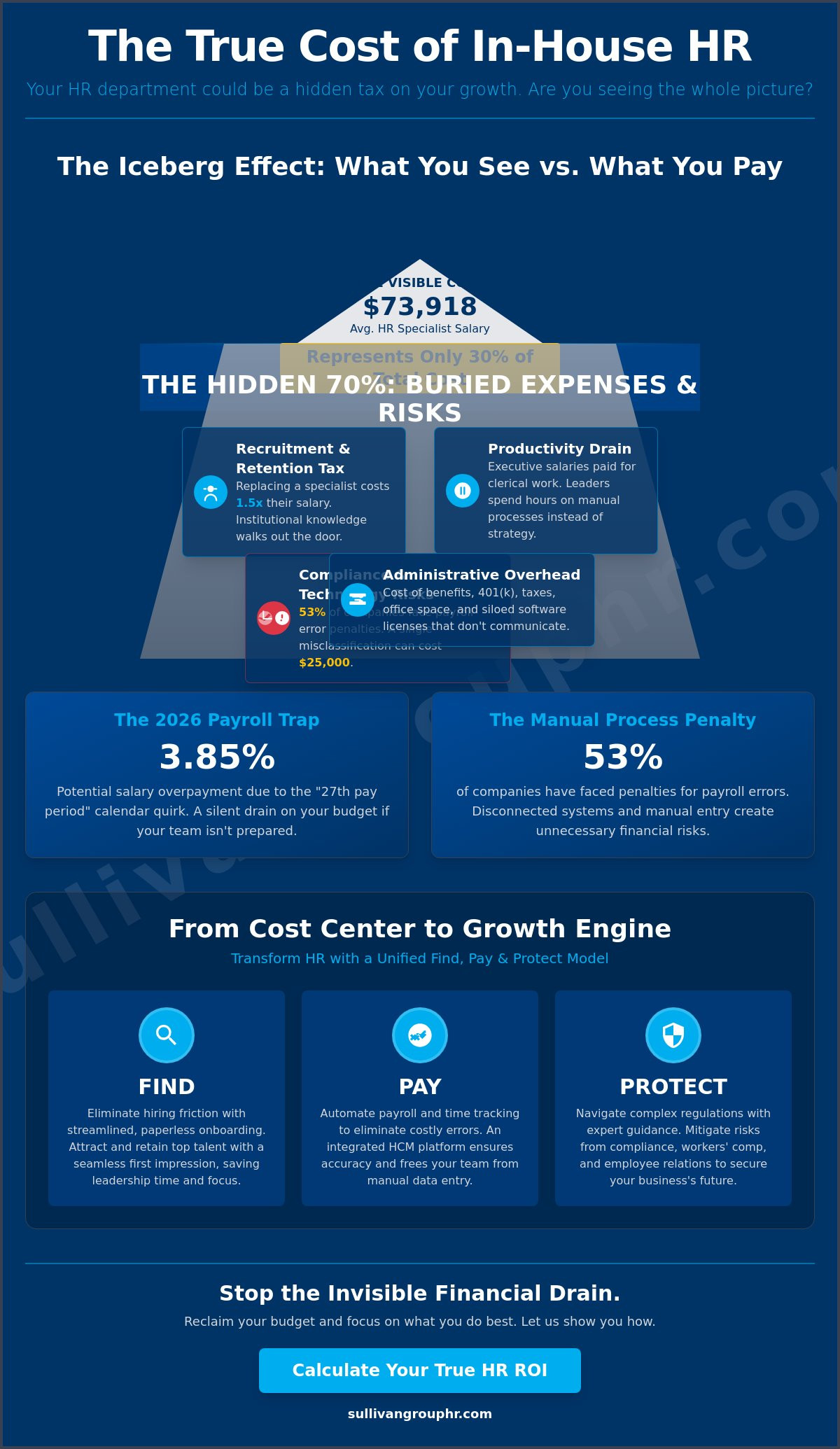
What if your internal HR department is actually an escalating tax on your ability to grow? Many business owners in Georgia and South Carolina assume keeping things internal saves money, but the hidden costs of managing HR in-house are often staggering. Between an average HR specialist salary of $73,918 and the risk of a $25,000 fine for a single misclassified worker, the "do it yourself" model is becoming a liability. In 2026, even a simple calendar quirk like the 27th pay period could lead to an accidental 3.85% overpayment in salaries if your team isn't careful.
It's frustrating when payroll errors and compliance anxiety keep you from being the best employer you can be. We understand that you want to Find, Pay, and Protect your people without the administrative friction that stalls momentum. This article reveals the true total cost of ownership for internal HR and provides a clear roadmap to reclaim your budget. You'll discover how to stop the invisible financial drain and turn your HR operations from a cost center into a powerful engine for growth.
Key Takeaways
- Look beyond base salaries to identify the "iceberg effect" of overhead and taxes that inflate your internal department's true cost.
- Pinpoint the administrative friction in your "Find" and "Pay" cycles that distracts your leadership from high-level strategy.
- Expose the hidden costs of managing HR in-house, including the high price of maintaining siloed technology and navigating 2026's complex regulations.
- Use our two-step ROI framework to audit your total HR spend and quantify the financial impact of your current risk exposure.
- See how a unified Find – Pay – Protect model can transform your HR operations into a supportive engine for business growth.
Beyond the Paycheck: The True Salary of In-House HR
Think about your current HR specialist. You likely see their annual salary as a fixed line item on your budget. However, that number is just the tip of the iceberg. In 2026, the average annual pay for a Human Resources Specialist in the United States reached approximately $73,918. While that figure is significant, it only represents about 30% of the total cost of ownership. The hidden costs of managing HR in-house lie beneath the surface, where benefits, taxes, and operational friction quietly drain your growth capital.
Effective Human resource management requires more than just a person in a seat. It demands a complex infrastructure that many small business owners in Georgia and South Carolina struggle to maintain alone. When you manage this function internally, you aren't just paying a salary. You're funding a mini-corporation within your own walls that requires constant feeding and protection.
The Recruitment and Retention Tax
Finding the right person to lead your HR efforts is expensive. You spend hours on job postings, screenings, and interviews. If that HR manager leaves, the financial hit is even harder. Industry data suggests replacing a departing employee can cost over $25,000, but replacing a specialized HR manager often costs 1.5 times their annual salary. The HR Turnover Tax is the specific cost of institutional knowledge loss that occurs when your compliance guardian walks out the door. High turnover in this department creates a ripple effect, destabilizing the culture for everyone else and leaving your business vulnerable.
Administrative Overhead and Benefits
Beyond the base pay, you've got to factor in the "burdened" cost of an internal department. This includes:
- Healthcare premiums and 401(k) matching contributions.
- Mandatory workers' compensation insurance and payroll taxes.
- Physical office space, furniture, and high-end hardware.
- Software licensing fees for individual, non-integrated tools.
These expenses add up quickly. By the time you provide professional development for 2026 compliance standards, such as new state-level privacy laws or AI-driven audit preparation, your "affordable" in-house hire has become a major investment. Are you getting a return on that investment, or is it just a growing expense? We believe your HR should protect your business, not tax your potential. Shifting away from the hidden costs of managing HR in-house allows you to reinvest those dollars back into the people who actually drive your revenue.
The Productivity Drain: How Administrative Friction Stalls Strategy
Productivity isn't just about effort. It's about focus. When you're managing HR in-house, your leadership team often becomes a high-priced administrative squad. This is a primary driver of the hidden costs of managing HR in-house. Every hour a CEO spends interpreting a policy or chasing down a missing timecard is an hour stolen from revenue-generating strategy. Are you the best leader you can be when you're stuck in a spreadsheet?
The High Price of Manual Processes
Manual processes carry a high price that often goes unmeasured. Paper-based onboarding and physical I-9 verification create "Find" friction that slows your hiring speed and creates a poor first impression for new talent. Chasing down timecards and manual attendance tracking wastes hours that your managers simply don't have. Disconnected systems lead to double-entry errors and data silos. Manual data entry is a liability. Recent research shows that 53% of companies have faced penalties for payroll errors. These aren't just minor mistakes. They're drains on your operational momentum that lead to real financial hits and employee frustration.
Strategic Opportunity Cost
There's a vital difference between Strategic HR and Administrative HR. Administrative HR is reactive. It's paper-heavy and focuses on the "now." Strategic HR uses an integrated HCM platform to automate the mundane. This shift allows you to focus on the "human" in human resources. When your leadership is bogged down in compliance and data entry, you lose the ability to scale. You're effectively paying executive salaries for clerical results. This is a tax on your growth that most business owners never see on a balance sheet.
Consider the "Executive HR" trap. If the CEO is the de facto HR Director, your growth is capped by your own bandwidth. You should be finding people who perform and protecting your business's future. You shouldn't be troubleshooting a broken attendance system or correcting a payroll run at 9:00 PM on a Friday. Shifting to a unified system allows you to reclaim your leadership time and put it back into your core mission. If you want to stop the drain on your productivity, partnering with a seasoned guardian can help you refocus on the activities that actually drive revenue.
Compliance and Technology: The High Price of "Doing it Yourself"
Protecting your business is the third pillar of our core mission. In 2026, regulatory compliance isn't a "set it and forget it" task. It's a full-time commitment that shifts by the day. If you're handling this internally, you're likely facing a massive technology integration gap. This technology debt is one of the most significant hidden costs of managing HR in-house. When your systems don't talk to each other, your data stays siloed, and your risk exposure grows.
Are you the best employer you can be when your data is scattered across five different platforms? Managing workers' compensation claims and improper termination risks requires a unified view of your workforce. Without it, you're prone to "leaks" where poor claims management leads to spiked premiums. We see many local businesses in Georgia and South Carolina struggle with this because they lack a single source of truth for their employee data.
The Compliance Penalty Landscape
The financial impact of a Department of Labor (DOL) audit can be devastating. In fiscal year 2025, the DOL collected $318 million in back pay and penalties, a 33% increase from the previous year. Tax and labor authorities now use AI-driven enforcement to spot errors instantly. Misclassification is a primary target. In 2026, fines for misclassifying an employee as a 1099 contractor instead of a W-2 worker can reach $25,000 per worker. Beyond federal rules, keeping employee handbooks updated across a patchwork of state-level privacy laws in 20 different states is a monumental task for a small internal team.
The Technology Integration Gap
Subscription fatigue is real. You might be paying for a separate applicant tracking system, a payroll platform, and a benefits portal. These individual licenses often cost between $164 and $625 per month for just 25 employees. Not only is this expensive, but it's also dangerous. Non-unified systems increase the risk of data breaches and security lapses. We solve this by leveraging the isolved People Cloud. This single, unified Human Capital Management (HCM) platform reduces your technology total cost of ownership (TCO) by putting everything in one place. It puts the "human" back into your resources by ensuring your data is secure, compliant, and ready to support your growth.
Calculating HR Outsourcing ROI: A Framework for Business Leaders
Understanding the hidden costs of managing HR in-house requires a shift from looking at line items to looking at your total cost of ownership. Many leaders in Georgia and South Carolina see HR as a sunken cost. We see it as an opportunity for recovery. To determine your true ROI, you must look beyond the base salary of an HR specialist and calculate the invisible drains on your growth capital.
Follow this four-step framework to audit your current operation:
- Step 1: Audit Total Spend. Combine the $73,918 average specialist salary with the "burdened" cost of benefits, taxes, and overhead. Don't forget to include the software licensing fees that can reach $625 per month for a small team.
- Step 2: Quantify Risk. The average cost of payroll noncompliance is over $845 per employee per year. If you have 50 employees, that's a $42,250 annual risk sitting on your books.
- Step 3: Measure Time Recovery. Estimate the hours your leadership team spends on "Executive HR." If your CEO spends five hours a week on policy interpretation or payroll troubleshooting, what is that time worth in lost sales?
- Step 4: Compare Models. Contrast your fluctuating and often unpredictable internal costs against a flat-fee or per-employee outsourcing model.
The ROI of "Find – Pay – Protect"
Our core framework turns HR into a growth driver. Professional recruiting (Find) reduces your cost-per-hire by streamlining the interview process and lowering the risk of a bad hire. Accurate payroll administration (Pay) eliminates the sting of IRS penalties, which can start at a minimum of $510 for late filings in 2026. Finally, proactive risk management (Protect) helps lower your workers' compensation insurance premiums by improving safety protocols and claims management. This isn't just about saving money. It's about protecting the business you've built.
Long-Term Scalability Benefits
Predictable budgeting allows you to plan for the future without worrying about the next HR crisis. When you partner with us, you can scale your workforce without scaling your internal HR headcount. This creates a "Peace of Mind" dividend that allows you to focus on your mission. We put the human back into your resources so you can be the best employer you can be. If you're ready to stop the drain on your budget, calculate your potential savings with Sullivan Group HR today.
Find, Pay, Protect: Eliminating Hidden Costs with Sullivan Group HR
Managing a business in Georgia or South Carolina is hard enough without the weight of administrative friction. You've seen how the hidden costs of managing HR in-house can tax your growth through turnover, manual errors, and technology debt. At Sullivan Group HR, we believe you shouldn't have to choose between professional rigor and a human touch. Since 1986, we've acted as a seasoned local guardian for business owners just like you. We don't just provide a service; we act as a partner to help you reclaim your focus.
Our mission is simple: we put the "human" back into human resources. While national firms often offer sterile, automated platforms, we provide an empathetic partnership backed by industry-leading technology. We help you transition your HR from a necessary cost center into a strategic growth engine. By streamlining your operations, you stop being a de facto HR director and start being the visionary leader your company needs. Are you the best employer you can be? It starts with having a team that has your back.
Our Unified HCM Advantage
We leverage the isolved People Cloud to eliminate the technology debt that plagues internal departments. This unified Human Capital Management (HCM) platform covers the entire employee lifecycle. You get one source of truth for everything from applicant tracking to payroll administration and benefits management. Real-time analytics allow you to identify and stop financial leaks before they become crises. You won't have to worry about the hidden costs of managing HR in-house when you have expert consulting ensuring you comply with every new 2026 regulation. We handle the "Protect" element so you can focus on the "Perform" element.
Your Next Steps to Efficiency
The first step toward reclaiming your budget is a clear understanding of where it's going. We offer a comprehensive HR cost audit to help you identify the direct and indirect drains on your capital. From there, we design a custom Find – Pay – Protect strategy tailored to your specific regional needs. This triad approach simplifies your complex HR functions into a manageable, organized system. Stop letting invisible taxes stall your momentum. It's time to build a culture where your people can thrive and your business is secure. Are You The Best Employer You Can Be? Partner with us today.
Stop the Tax on Your Growth
Your business deserves to move forward without the friction of administrative burdens. By identifying the hidden costs of managing HR in-house, you've already taken the first step toward reclaiming your budget. You now understand that salary is only a fraction of the total expense. The real cost lies in the productivity drain on your leadership and the constant risk of compliance penalties. It's time to shift your focus back to what you do best.
Sullivan Group HR acts as your seasoned local guardian. We provide access to the industry-leading isolved HCM platform to unify your workforce data. With decades of experience in payroll and compliance since 1986, we ensure you stay protected. From comprehensive workers' compensation to strategic risk management, we have your back. Are you ready to be the best employer you can be? Find, Pay, and Protect your business with Sullivan Group HR.
Building a legacy in Georgia or South Carolina requires a partner who understands your landscape. Let's turn your HR into an engine for success today. We're here to help you perform, comply, and grow with confidence.
Frequently Asked Questions
Is it always cheaper to outsource HR than to manage it in-house?
While every business is unique, outsourcing is typically more cost-effective when you factor in the total cost of ownership. An internal department requires a salary, benefits, office space, and specialized software. Outsourcing converts these fluctuating expenses into a predictable, flat-fee model. This approach allows you to scale your workforce in Georgia or South Carolina without the burden of hiring additional administrative staff. It's about trading high overhead for professional efficiency.
What are the most common hidden costs businesses miss in their HR budget?
Most leaders overlook the hidden costs of managing HR in-house like the "HR Turnover Tax" and leadership opportunity cost. When an internal HR manager leaves, you lose institutional knowledge and face a replacement cost often 1.5 times their salary. Additionally, subscription fatigue from paying for multiple unintegrated platforms drains your budget. These invisible leaks often exceed the visible costs of a standard HR salary and benefits package.
How does an integrated HCM platform like isolved save money?
An integrated platform eliminates the need to pay for separate, disconnected tools for payroll, time tracking, and benefits. It stops financial leaks by reducing manual data entry errors that lead to costly payroll corrections. Real-time analytics help you identify inefficiencies in your labor costs instantly. By unifying your data, you reduce technology debt and ensure your "Find, Pay, Protect" cycle runs on one secure source of truth.
Can outsourcing HR help lower my workers' compensation premiums?
Yes, professional HR partners help lower premiums through proactive risk management and better claims processing. We implement safety protocols that reduce the frequency and severity of workplace injuries. Over time, these improvements can lower your experience modification (E-Mod) rating. Protecting your business and your people directly impacts your bottom line by reducing the long-term cost of insurance and potential legal liabilities.
What happens to my current HR staff if I move to an outsourced model?
Your current staff can transition from being administrative "order takers" to strategic growth drivers. We handle the heavy lifting of payroll administration and compliance tasks. This shift allows your internal team to focus on high-impact areas like company culture, employee development, and talent strategy. It's not about replacement; it's about empowerment. You're giving your team the tools to focus on the human side of your resources.
How do HR outsourcing companies charge for their services?
Most providers use a transparent per-employee-per-month (PEPM) fee or a small percentage of your total payroll. This model provides budget certainty that you can't get with an internal department. You won't face surprise expenses for software updates or compliance training. Your costs scale naturally as your team grows. This makes it easier to manage your cash flow while accessing high-level expertise and technology.
Does outsourcing HR increase the risk of a compliance audit?
Actually, it significantly decreases your risk by ensuring your business is always audit-ready. We use automated validation tools to catch errors in tax filings and employee classifications before they trigger a Department of Labor inquiry. Professional guardians stay ahead of the patchwork of state and local laws. This protection helps you avoid the $25,000 penalties that often follow misclassification errors or late payroll deposits.
How much time can a business owner save by outsourcing HR functions?
Business owners typically reclaim several hours every week by offloading administrative tasks. Instead of troubleshooting a payroll error or interpreting a new labor regulation, you can spend that time on strategic growth. This time recovery is a major dividend of a professional partnership. You stop being the de facto HR director and return to being the visionary leader your company needs to perform at its best.


