

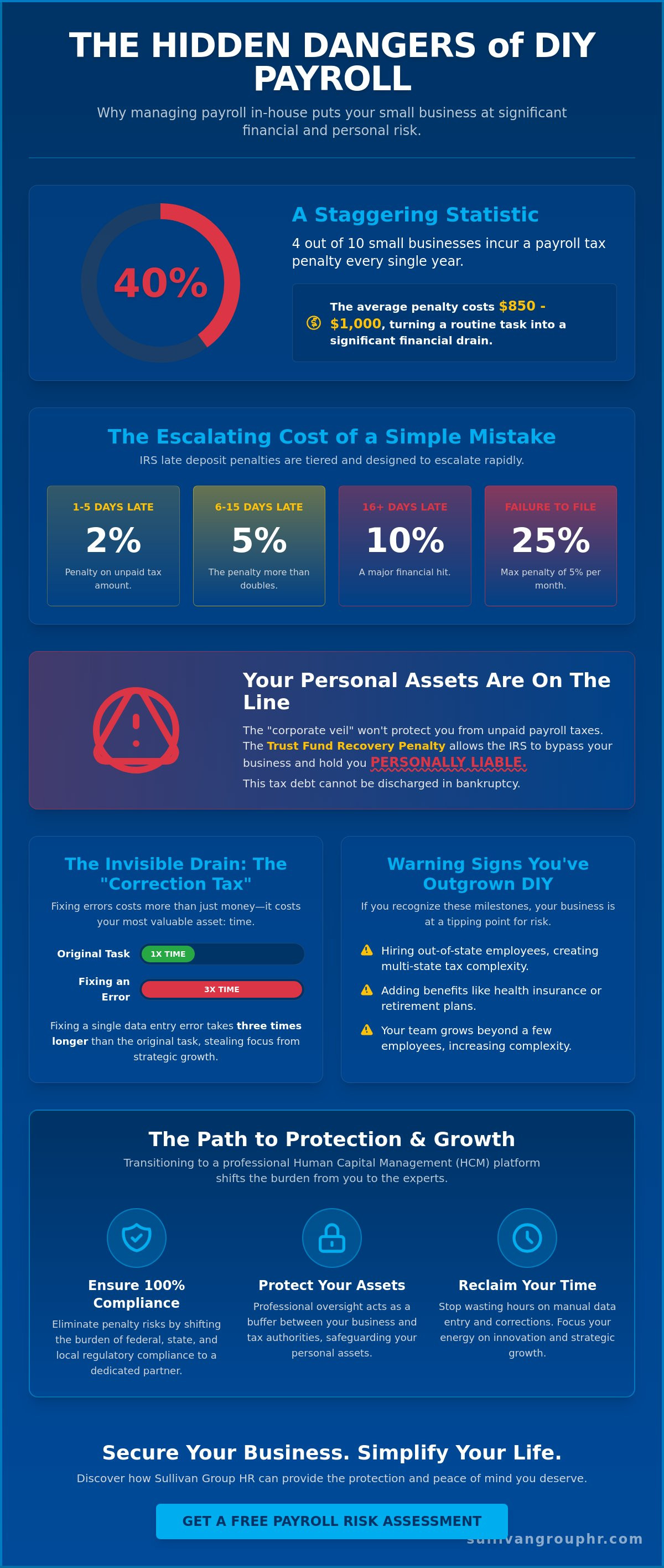
Did you know that 40% of small businesses incur a payroll tax penalty every single year? It's a staggering figure that shows how quickly a routine administrative task can turn into a financial crisis. You likely started your company to innovate and build a legacy, not to spend your nights buried in manual data entry or worrying about whether you've calculated the 15.3% FICA tax correctly for 2026. We understand that pressure, and we're here to act as your advocate and ally.
It's frustrating to feel like your time is being stolen by paperwork and the constant fear of an IRS notice. The hidden risks of DIY payroll for small business often outweigh the small savings of a "do-it-yourself" approach, especially when you consider that the average penalty costs between $850 and $1,000. This article will show you how to transition to a professional administration model that ensures 100% compliance and protects your personal assets from liability.
We'll break down the latest 2026 IRS penalty tiers, explain why the corporate veil won't protect you from unpaid tax debt, and outline a clear path to reclaiming your time for strategic growth.
Key Takeaways
- Realize why basic payroll software often creates a false sense of security and leaves your business exposed to regulatory gaps.
- Understand the serious risks of DIY payroll for small business, including personal liability for unpaid taxes that bankruptcy cannot discharge.
- Calculate the true cost of manual entry by accounting for the "Correction Tax," where fixing errors takes three times longer than the original task.
- Identify the specific growth milestones, such as hiring out-of-state employees or adding benefits, that signal you've outgrown in-house management.
- Discover how transitioning to a professional Human Capital Management (HCM) platform shifts the burden of compliance away from your desk.
The DIY Payroll Trap: Why Simple Math Isn’t Enough
Are you still treating your payroll like a simple math problem? Many entrepreneurs start out believing that as long as the checks clear and the hours are tracked, the job is done. This misconception is the primary catalyst for the risks of DIY payroll for small business. What begins as a quick administrative task quickly evolves into a high-stakes regulatory obligation. As you grow from your first hire to a team of five or more, the margin for error shrinks while the complexities of payroll grow significantly.
Manual entry errors aren't just one-time mistakes. They are seeds that grow into financial discrepancies over months or years. A small decimal error in a tax withholding today can snowball into thousands of dollars in back taxes, interest, and penalties by the time the IRS catches it. You need a system that offers protection, precision, and peace of mind. Without professional oversight, you're not just managing a spreadsheet; you're managing a liability.
The Illusion of Automation
Many business owners rely on basic software, thinking it provides a safety net. It doesn't. Software only processes the data you provide. It doesn't audit your logic or verify your compliance. If you enter the wrong tax rate or misclassify an employee, the system will happily process the error. Relying on a "set it and forget it" mentality is dangerous. Tax rates change, regulations shift, and software reminders are no substitute for professional oversight. You deserve a partner who watches your back, not just a tool that prints checks.
The Hidden Complexity of Local and Federal Interplay
Managing payroll requires balancing three distinct layers of regulation: federal, state, and local. DIY systems often fail to alert you to specific local ordinance changes or new reporting requirements that fall outside standard tax forms. Are you tracking:
- Updated state unemployment insurance rates?
- New local occupational taxes or school district withholdings?
- Mandatory reporting for new hires and benefits deductions?
These layers create a web of requirements that are easy to trip over. When you handle this in-house, you take on the full weight of these risks of DIY payroll for small business. Without a dedicated expert, you're essentially gambling with your company's financial security every pay period. True professional administration isn't just about execution. It's about strategic protection and long-term stability.
Compliance Penalties and the Reality of Regulatory Risk
Do you know how the IRS discovers payroll errors? In 2026, the agency uses advanced AI to cross-reference deposits with filings in near real-time. This isn't a manual review process anymore; it's an automated enforcement machine. When you handle payroll yourself, you're stepping into a minefield of IRS penalties for payroll errors that can quickly drain your operating capital. These fines aren't just suggestions. They are rigid, tiered, and designed to escalate rapidly.
Late deposits are the most common trap. If you're just one to five days late, the penalty is 2% of the unpaid amount. By day sixteen, that jumps to 10%. If you fail to file a return entirely, you face a 5% penalty for each month it's late, up to a maximum of 25%. These numbers might seem small on paper, but they compound. For many, the risks of DIY payroll for small business culminate in the Trust Fund Recovery Penalty. This allows the IRS to pursue your personal assets for unpaid withholdings. The "corporate veil" won't protect you here. You are personally liable.
The IRS Does Not Accept "Software Error" as an Excuse
Have you ever blamed a computer glitch for a late payment? The IRS won't hear it. As a business owner, you carry the legal burden of accuracy regardless of the tool you use. During an audit, agents look for patterns of misclassification and unpaid overtime first. Confusing a 1099 contractor with a W-2 employee is a mistake that often costs over $10,000 per worker in back taxes and fines. A professional partner acts as your shield, providing a buffer between your business and tax authorities while ensuring your logic holds up under scrutiny.
State and Multi-State Compliance Nightmares
Remote work has changed the game for local businesses. If you hire a worker in a different state, you've suddenly inherited a new set of labor laws and tax codes. DIY systems rarely alert you when a state changes its Unemployment Insurance (SUI) rates or introduces new local ordinances. Navigating multi-state payroll compliance requires constant vigilance that most busy owners simply can't afford. If you feel overwhelmed by these shifting regulations, it might be time to explore professional payroll administration to secure your company's future.
The Invisible Drain: Calculating the True Cost of Manual Payroll
How much is an hour of your time worth to the future of your company? While many owners focus on the monthly cost of a software subscription, the real risks of DIY payroll for small business often lie in the hours lost to administrative friction. This is the "invisible drain"-the steady leak of productivity that happens when a founder acts as a part-time clerk. You didn't build your business to master the nuances of tax tables; you built it to lead.
Accuracy is a promise you make to your team every pay period. When that promise is broken through a manual entry error, the cost isn't just financial. It's emotional. Late or incorrect checks erode trust faster than almost any other leadership failure, impacting your culture and retention. Understanding the hidden costs of handling payroll internally is essential for any owner who wants to move from surviving to thriving.
Errors also trigger what we call the "Correction Tax." Fixing a single payroll mistake usually takes three times longer than the original run. You have to reverse the entry, calculate the adjustment, issue a manual check, and often communicate with tax authorities to explain the discrepancy. It is a cycle of frustration that pulls you away from your most important work.
Opportunity Cost: What Are You Not Doing?
Every hour you spend reconciling bank statements or chasing down timecards is an hour you aren't closing a deal, coaching a team member, or refining your product. The mental load of "deadline anxiety" also takes a toll on your leadership performance. If you're constantly looking backward at administrative tasks, you can't look forward toward growth. Opportunity cost is the measurable loss of revenue-generating potential that occurs when a leader is forced to focus on administrative maintenance instead of strategic innovation.
Data Security and Privacy Vulnerabilities
Are you still storing sensitive employee data like Social Security numbers and bank details in a password protected spreadsheet or basic, non-encrypted software? This creates a massive target for phishing and payroll redirection scams. DIY systems often lack the robust defenses needed to protect against modern cyber threats. Professional Human Capital Management (HCM) platforms like isolved utilize SOC2 security standards to ensure your staff's most private information remains secure. Protecting your people is just as important as paying them, and a professional partner provides the high-level security your team deserves.
Warning Signs: When Your Business Has Outgrown DIY Payroll
Is your growth becoming a burden? Success brings complexity that manual systems simply can't handle. When you hire your first out-of-state worker, you've officially crossed into a new territory of compliance. The risks of DIY payroll for small business multiply the moment you move beyond a single local office. Managing a diverse team of hourly, salaried, and contract workers requires a level of precision that basic spreadsheets can't provide. You need a system that supports hiring, paying, and protecting your workforce without the constant threat of error.
Rapid scaling is a major red flag. Moving from 10 to 50 employees isn't just a change in headcount. It's a fundamental shift in your organizational structure. At this stage, manual entry is no longer just tedious; it's a liability. If you're spending more time chasing down timecards than you are developing your team, you've reached the tipping point. You deserve a partner who helps you scale with confidence.
The Benefits and Deductions Tipping Point
Are you still manually calculating health insurance deductions or 401(k) contributions? This is where the DIY model often breaks. Managing HSA, FSA, and COBRA requirements in a silo leads to expensive discrepancies. Integration is the only way to ensure accuracy. By utilizing integrated HR and payroll software benefits, you ensure that deductions are updated in real-time. This protects your business from liability and ensures your employees' coverage remains uninterrupted.
Workers Compensation and Payroll Alignment
Do you dread "audit season"? When your payroll data isn't synced with your workers' compensation insurance, you're likely overpaying or underpaying your premiums. This misalignment leads to massive surprise bills during annual audits. A professional approach allows for pay-as-you-go models. This aligns your premiums with your actual payroll, improving your cash flow and eliminating audit stress. If you're ready to stop guessing and start growing, it's time to partner with a professional payroll administration expert who understands your local territory.
Strategic Protection: Transitioning to Professional Payroll Administration
Are you ready to stop looking over your shoulder for the next IRS notice? We've explored the heavy risks of DIY payroll for small business, from cascading tax penalties to the "invisible drain" on your leadership productivity. The good news is that you don't have to carry this burden alone. Transitioning to professional payroll administration shifts the weight of accuracy and liability away from your desk. It replaces administrative anxiety with a clear strategy for protection, compliance, and scale.
Outsourcing isn't just a business expense. It's a strategic investment that typically pays for itself through risk mitigation and recovered time. When you move away from manual systems, you aren't just buying a tool. You are securing an advocate who understands the stakes of your success. Professional administration provides a protective shield, ensuring that you never have to face a regulatory audit without a partner by your side. You deserve to focus on the future of your company, not the paperwork of the past.
Unified Success: The isolved Advantage
Why settle for disconnected silos that create more work? The power of the isolved HCM platform lies in its ability to create a single source of truth for your payroll, time tracking, and employee benefits. This "People Cloud" moves your company far beyond simple check cutting. Real-time reporting empowers you to make better business decisions based on live data rather than outdated guesses. When your systems talk to each other, you eliminate the gaps where errors usually hide.
Employee self-service portals also dramatically reduce administrative friction. Your team can access their own pay stubs, update their tax forms, and manage their benefits without ever knocking on your door. This level of efficiency creates a professional environment that respects your time and theirs. It eliminates the risks of DIY payroll for small business by automating the flow of information from hire to retire. Efficiency, accuracy, and security are the hallmarks of a unified system.
Your Protective Advocate in Human Resources
Sullivan Group HR serves as an established regional expert. We provide the "no-nonsense" authority you need to navigate local nuances that national firms often miss. Our approach combines elite technology with human expertise to ensure your business remains stable, secure, and compliant. We believe in people over systems, even while providing the best systems in the industry. We act as your coach and ally, helping you navigate the complexities of human capital management.
Are you worried about a difficult transition? Moving from DIY to managed services is a streamlined, supportive process. We handle the heavy lifting of data migration and setup so you can focus on the strategic growth of your company. It's time to trade your administrative headaches for a partnership built on legacy and results. Let us protect what you've built.
Ready to secure your business? Let’s talk about professional payroll administration.
Reclaim Your Focus and Secure Your Company’s Future
Are you ready to stop managing spreadsheets and start leading your team? We've uncovered how the risks of DIY payroll for small business extend far beyond simple math. From the automated IRS penalty system to the hidden drain on your strategic focus, the DIY model often creates more liabilities than it solves. You didn't build your business to become a part-time clerk; you built it to innovate and grow.
You deserve a partner who provides more than just a tool. Sullivan Group HR offers decades of expertise in regional and national compliance. We provide access to the industry-leading isolved HCM platform, ensuring your payroll, workers' compensation, and benefits management are unified and secure. We bring precision, protection, and peace of mind to your administrative functions. It's time to trade your administrative headaches for a partnership built on stability and results.
Secure Your Payroll and Protect Your Growth with Sullivan Group HR
Your business has a bright future. Let's make sure it's built on a foundation of expert advocacy and reliable support.
Frequently Asked Questions
Is it legal to do your own payroll for a small business?
Yes, it is legal for a business owner to handle their own payroll. However, being legal does not mean it is without danger. You take on full responsibility for every calculation, deposit, and deadline. If a mistake occurs, the legal burden remains entirely with you, not the software you used. This is why many owners eventually seek a partner to mitigate the high stakes involved.
What are the most common payroll mistakes small businesses make?
Late tax deposits and employee misclassification are the most frequent errors we see. Many owners also struggle with complex overtime calculations for non-exempt staff. These oversights often trigger automated IRS audits. Small errors in manual data entry can snowball into thousands of dollars in back taxes. It is often these subtle, repetitive mistakes that define the primary risks of DIY payroll for small business.
How much are the penalties for late payroll tax filings?
IRS penalties are tiered based on how late the deposit is made. You will face a 2% penalty for being 1 to 5 days late, 5% for 6 to 15 days, and 10% if you are more than 15 days late. If you fail to file entirely, the penalty is 5% per month, capped at 25%. These costs add up quickly and can significantly damage your monthly cash flow.
Can I use Excel for payroll, or do I need software?
You can technically use Excel, but it is a high-risk strategy for any growing company. Spreadsheets lack the automated updates needed to track changing tax rates or local ordinances. Manual formulas are prone to breakage and human error. While a spreadsheet feels free, the cost of fixing one broken formula often exceeds the price of a professional, secure Human Capital Management platform.
How does payroll outsourcing help with workers compensation audits?
Outsourcing ensures your payroll data and workers' compensation premiums are perfectly aligned in real-time. This synchronization eliminates the common audit shock where business owners owe massive sums at year-end. By using a pay-as-you-go model, your premiums adjust automatically based on actual wages paid. This protects your cash flow and makes the annual audit process a non-event rather than a financial crisis.
What is the difference between a payroll processor and a professional HR partner?
A payroll processor is a transactional vendor that simply cuts checks and files basic forms. In contrast, a professional HR partner like Sullivan Group HR acts as a strategic advocate. We provide comprehensive support, including benefits management, compliance consulting, and workers' compensation. We don't just process data; we protect your entire organizational lifecycle while helping you navigate the complex nuances of your specific territory.
What happens if I misclassify an employee as an independent contractor?
Misclassifying a worker can lead to devastating financial consequences, including liability for unpaid federal and state taxes. The IRS and Department of Labor may assess heavy fines and require you to pay back-wages or unpaid overtime. This is one of the most expensive risks of DIY payroll for small business. It often costs over $10,000 per worker once interest and penalties are factored in.
How long does it take to switch from DIY payroll to a professional service?
Switching to a professional service typically takes between two to four weeks. The timeline depends on the cleanliness of your current records and the complexity of your benefits. Our team handles the heavy lifting of data migration and system setup to ensure a seamless transition. We act as your coach throughout the process, allowing you to move from administrative chaos to secure, professional administration quickly.


