

Is your "simple" payroll service actually making your business life more complicated? You likely chose a basic provider because it felt easy and efficient during your early days. It served its purpose when your team was small and your needs were straightforward. Today, that simplicity might be holding you back. If you find yourself buried in manual data entry, losing sleep over tax compliance, or managing employee requests by hand, it's time to ask when to switch from a simple payroll service to a more robust model.
Transitioning to a strategic HCM solution allows you to recruit, compensate, and secure your workforce within a single, unified framework. This article identifies the critical signs that your business has outgrown its current tools and provides a roadmap for a protective transition. We will explore how to reduce your administrative burden, stay ahead of DOL audits, and implement self-service tools that empower your team. Let's move beyond basic processing and toward a partnership that scales with your ambition and restores your peace of mind.
Key Takeaways
- Spot the "spreadsheet trap" and manual workarounds that signal your current system is failing to support your business growth.
- Evaluate the compliance risks of basic payroll apps, including their inability to protect you from DOL audits or multi-state complexities.
- Discover exactly when to switch from a simple payroll service to an integrated HCM model to create a single source of truth for your team.
- Learn why January 1st is the ideal time to transition and how quarterly switches can help you avoid year-end administrative rushes.
- Explore how a partnership combining isolved technology with expert HR consulting provides the stability and protection your legacy deserves.
The Tipping Point: Signs You’ve Outgrown Your Simple Payroll Service
How much of your day is spent managing people instead of growing your business? For many entrepreneurs, there comes a moment where the tools that fueled their start begin to choke their progress. This is the tipping point. You aren't just processing checks; you're fighting a system that wasn't built for your current scale. You need a solution that helps you recruit, compensate, and secure your workforce without the constant friction of manual workarounds.
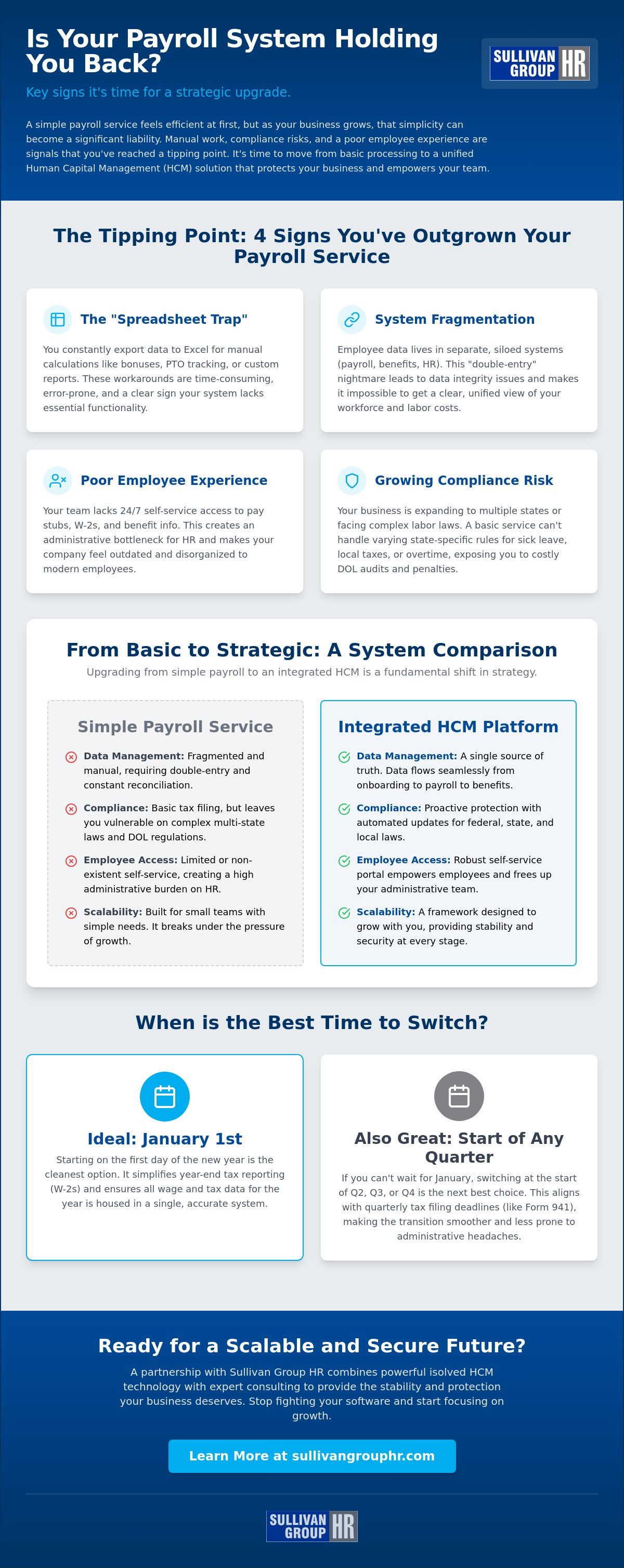
When you find yourself exporting data to Excel just to calculate a bonus or track a PTO balance, you've entered the "spreadsheet trap." These manual workarounds are more than just a nuisance. They are flashing red lights. Knowing when to switch from a simple payroll service is about recognizing when these "quick fixes" consume your strategic time and introduce unnecessary risk to your operations. If your administrative tasks are growing faster than your revenue, your foundation is beginning to crack.
Manual Data Entry and System Fragmentation
Operating with siloed systems creates a dangerous cycle of "double-entry." You update an address in your payroll app, then manually update it in your benefits portal. This fragmentation is the primary source of human error. It's nearly impossible to get a clear picture of your labor costs when your data lives in separate islands. Transitioning to a unified Human Resource Management System (HRMS) eliminates these gaps. It creates one source of truth, ensuring that every change flows through your entire organization automatically. This move protects your data integrity and your sanity.
The Breakdown of Employee Experience
Your team's expectations have changed. Modern employees want 24/7 access to their pay stubs, W-2s, and benefit elections without having to email HR. When a "simple" service lacks a robust self-service portal, it creates an administrative bottleneck. It makes your company feel small, outdated, and disorganized. A professional onboarding experience shouldn't involve a stack of paper and three different login credentials. If your current setup makes it hard for employees to manage their own lives, you've outgrown it. Moving to a strategic solution shows your team that you value their time as much as your own.
The hidden cost of basic services isn't the monthly fee. It's the friction. Every minute spent fixing a data mismatch or answering a routine question is a minute lost to strategy. When your payroll service stops being a tool and starts being a task, you've reached the point where a switch is necessary for your long-term security. It's time to trade manual headaches for a protective, scalable framework that lets you focus on your professional potential.
The Risk of Stagnation: Compliance and Efficiency Gaps
Are you certain your current payroll provider is actually protecting you? Many business owners assume that "cutting a check" is the same as being compliant. It isn't. Simple payroll services often leave you vulnerable to Department of Labor (DOL) audits because they lack the deep, protective framework needed to manage complex labor laws. When you consider when to switch from a simple payroll service, you must weigh the cost of a basic subscription against the potential price of a regulatory penalty.
Multi-state operations add another layer of danger. Basic apps frequently fall short when tracking state-specific sick leave, local tax nexus, or varying overtime rules. If your team is growing across state lines, you need a system that adapts automatically. Without this integration, you aren't just managing payroll; you're managing a growing list of liabilities. A strategic human capital management approach ensures that your growth doesn't outpace your safety. You need a partner that helps you identify, rectify, and fortify your business against these threats.
Navigating the Regulatory Minefield
The regulatory landscape is shifting rapidly. In 2026, the Social Security wage base has reached $184,500. New rules regarding mandatory Roth catch-up contributions for employees earning over $150,000 have also taken effect. Simple services often struggle to implement these nuances accurately. Misclassifying employees as independent contractors remains a top priority for auditors. A strategic HCM solution provides the rigor needed to handle payroll tax filing and classification with precision, acting as a reliable advocate for your organizational security.
The High Cost of 'Cheap' Payroll
The ROI of switching to an integrated platform is found in the risks you avoid and the efficiency you gain. Automated time and attendance tracking is a perfect example. It prevents "wage theft" and accidental overpayment by syncing hours directly to your payroll database. This eliminates the manual entry errors that cause nearly half of employees to look for new work after just two pay mistakes. HR risk management acts as a proactive shield for business assets by identifying and neutralizing potential liabilities before they escalate. By integrating your Workers' Compensation Insurance with your payroll data, you avoid painful year-end audit surprises and keep your cash flow predictable.
Simple Payroll vs. Integrated HCM: A Strategic Comparison
Are you just cutting checks, or are you building a culture? Many business owners view payroll as a isolated transaction. It is the simple act of calculating net pay and withholding taxes. While this works for a startup, it creates a ceiling for a growing company. Strategic Human Capital Management (HCM) is transformational. It moves your focus from the "what" of a paycheck to the "who" and the "how" of your entire workforce. Deciding when to switch from a simple payroll service is a choice to move from a siloed task to a unified, protective strategy.
A unified database serves as the single source of truth for the entire employee lifecycle. Imagine a system where data flows seamlessly from a job application to a retirement plan without a single manual entry. This connectivity eliminates the friction of reconciliation. It provides the clarity you need to make fast, informed decisions. When your data is organized, your business feels manageable. You gain the freedom to focus on your professional potential rather than your administrative pile.
Feature Breakdown: Tools vs. Strategy
Basic payroll services are limited tools. They focus strictly on the mechanics of compensation. In contrast, modern workforce management solutions bridge the gap between technology and talent. Strategic HCM includes integrated applicant tracking, automated onboarding, and comprehensive benefits management. It transforms HR from a reactive cost center into a proactive growth engine. This integrated approach ensures your business remains secure while your team remains engaged.
The Role of the isolved HCM Platform
Why do modern, mid-market teams rely on isolved? It is an industry-leading cloud platform that centralizes performance management and employee engagement in one place. It offers the stability and scalability that growing businesses require. However, even the best technology needs a human touch. Basic software-only packages often leave you to figure out the hard parts alone. By combining the power of isolved with high-touch Human Resources Consulting, you get a partner who understands your local territory and your specific goals. You receive the legacy, stability, and hard-earned wisdom of a dedicated ally.
Knowing when to switch from a simple payroll service means recognizing that your business has earned a more sophisticated level of support. You are no longer just managing a list of names; you are leading a professional organization. You deserve a system that protects your assets and a partner who advocates for your success. It is time to trade transactional processing for a transformational relationship.
When is the Best Time to Switch Payroll Providers?
Timing is everything when it comes to your company's financial security. Is there ever a perfect moment to overhaul your administrative foundation? While you can technically migrate at any time, certain dates offer a smoother path toward stability. January 1st remains the gold standard for a "Clean Slate" transition. Starting on the first day of the new year eliminates the need to move historical wage data for the current tax year. This reduces the risk of reporting errors and ensures your year-end W-2 process is seamless.
If you cannot wait for the new year, quarterly transitions are your next best option. Moving on April 1, July 1, or October 1 allows you to sync your switch with federal and state tax filing deadlines. This strategy keeps your tax balances clean and prevents the "double-running" of mid-quarter reports. However, an HCM migration is more intensive than a basic software swap. You need a lead time of 30 to 60 days to ensure your data is accurately mapped and your team is fully prepared. Knowing when to switch from a simple payroll service also means knowing when to start the planning process.
The Ideal Migration Timeline
Success requires a disciplined approach. Follow these three phases to ensure a protective transition:
- Step 1: Audit and Identify. Review your current employee data, benefit structures, and specific reporting requirements to ensure nothing is missed.
- Step 2: Secure and Setup. Partner with a strategic ally and begin your payroll administration outsourcing configuration to mirror your unique workflows.
- Step 3: Notify and Extract. Formally alert your current provider and manage the data extraction process to maintain your historical records.
Avoiding Common Migration Pitfalls
The most common mistake in a mid-year switch is the inaccurate mapping of year-to-date (YTD) totals. If these numbers are off by even a cent, your quarterly filings will trigger red flags with the IRS. To prevent this, insist on parallel testing. This involves running one final payroll in both your old and new systems simultaneously to verify that every calculation matches perfectly. Finally, remember that your employees are the heartbeat of your business. Communicate the change early. Provide clear instructions for accessing their new portals to ensure a smooth adoption and maintain your company culture.
Ready to move toward a more secure and scalable future? You don't have to manage this transition alone. Contact our team of regional experts to begin planning your move to a strategic HCM solution today.
Unified Success: Moving Forward with Sullivan Group HR
What does true organizational security look like for your business? It starts with moving beyond a transactional relationship and toward a partner who understands your professional potential. Sullivan Group HR is that partner. We don't just process checks; we provide a protective framework that allows you to scale with confidence. By choosing a regional expert with a long-standing history, you gain an ally who knows the specific nuances of your territory and your industry. We help you recruit, compensate, and secure your workforce through a single, reliable point of contact.
The decision regarding when to switch from a simple payroll service is often driven by a need for better technology, but the real value lies in the human expertise behind the screen. While national, tech-only competitors offer automated responses, we offer a handshake and hard-earned wisdom. We are the human in Human Resources. We combine the power of the isolved platform with high-touch consulting to ensure your business remains compliant, efficient, and resilient. Our "no-nonsense" authority simplifies the most daunting administrative tasks, making them manageable and organized.
The Sullivan Group HR Advantage
Our clients gain access to the isolved People Cloud, a unified management system that brings your entire employee lifecycle into focus. This isn't just about payroll; it's an integrated suite that includes Employee Benefits Management, Workers' Compensation Insurance, and proactive Human Resources Consulting. We value people over automated-only processes. This human-centric approach ensures that when complex regulatory questions arise, you have a reliable advocate to guide you. We provide the stability of a legacy firm with the agility of a modern HCM provider.
Ready to Scale? Your Next Steps
Securing your future begins with a clear understanding of your current gaps. We offer a diagnostic review of your existing payroll and HR processes to identify where fragmentation is costing you time and money. During your first 90 days with Sullivan Group HR, we focus on data integrity, system training, and establishing a steady communication beat. We handle the heavy lifting of migration so you can return your focus to your primary mission. Our goal is to minimize your cognitive load and deliver concrete results from day one.
Stop fighting a system that limits your growth and heightens your risk. Your business deserves a foundation built on expertise and advocacy. Contact Sullivan Group HR today to secure your growth with unified HCM.
Elevate Your Workforce Strategy Today
You've built your business on hard work and a clear vision for the future. Don't let outdated administrative tools cap your professional potential or create unnecessary risk for your organization. We've explored the critical signs of the "spreadsheet trap," the rising dangers of regulatory non-compliance, and the strategic advantages of a unified database. Understanding exactly when to switch from a simple payroll service is the first step toward reclaiming your strategic focus and protecting the legacy you've worked so hard to create.
Sullivan Group HR has served as an established expert authority since 1998. As an authorized isolved HCM platform provider, we offer a comprehensive integrated suite for HR, payroll, and benefits that moves your business forward. We combine high-tech efficiency with the high-touch, supportive care only a regional ally can provide. Our "no-nonsense" approach simplifies the complex, ensuring your organizational security is never in doubt. You deserve a partner who values your people as much as your processes.
Secure Your Business Growth with a Strategic HCM Review
Your team is your greatest asset. It's time to give them the security of a professional partnership that scales with your ambition. Let's build something lasting together.
Frequently Asked Questions
Is switching payroll providers mid-year actually possible?
Yes, you can absolutely switch mid-year. While starting on January 1st is the simplest path, many businesses choose to transition at the end of a quarter to keep their tax balances clean. The key to a successful mid-year move is ensuring your year-to-date wage totals are mapped with 100% accuracy to prevent filing discrepancies. Knowing when to switch from a simple payroll service often depends more on your internal capacity for data migration than the calendar date.
How much does it cost to switch from a simple payroll service to a full HCM?
Total costs depend on your employee count and the specific modules you choose to implement. Generally, you'll encounter a one-time setup fee followed by a recurring per-employee-per-month service fee. This investment provides a protective framework that reduces manual labor and mitigates the high cost of compliance errors. We focus on delivering a transparent, no-nonsense pricing model that aligns with your long-term organizational security.
What data do I need to gather before making the switch?
You should organize your data into three primary groups: employee records, company tax information, and historical wage data. This includes active W-4s, direct deposit authorizations, federal and state tax IDs, and your current year-to-date payroll registers. Having these documents ready ensures a steady, reliable beat during the implementation process. Our team guides you through this audit to ensure no detail is overlooked before your first live run.
Will switching payroll providers trigger a tax audit?
No, changing your service provider does not trigger a tax audit. Regulatory agencies are accustomed to businesses upgrading their administrative systems as they grow. Audits are typically triggered by inconsistent data or late filings, not by the act of switching partners. By using a unified HCM platform, you actually decrease your audit risk by ensuring your tax calculations and filings are handled with professional rigor and precision.
How long does the implementation of an HCM platform like isolved take?
A professional implementation typically takes between 30 and 60 days. This timeframe allows us to configure the isolved People Cloud to your specific workflows, migrate your historical data, and conduct parallel testing. We don't rush this process because your organizational security depends on accuracy. This transition period ensures your team is fully trained and your first payroll run is seamless and stress-free.
Can an HCM partner help with multi-state payroll compliance?
Yes, managing multi-state requirements is a core benefit of a strategic HCM partnership. We handle the complexities of varying state tax nexus, local labor laws, and diverse sick leave mandates. This removes the burden of tracking 50 different sets of regulations from your desk. Our system automatically updates to reflect new state-specific rules, ensuring you remain a compliant and reliable employer regardless of where your team works.
What happens to my historical payroll data when I switch?
You are responsible for archiving your records from your previous provider before your contract ends. We recommend downloading all prior-year tax filings, W-2s, and payroll registers for your permanent files. For the current calendar year, we migrate your data into the new HCM system to ensure your year-end reporting is unified. This creates a single source of truth for your current year's financial and employee records.
Do I need to change my bank account for payroll when I switch services?
No, you do not need to open a new bank account to switch services. You simply provide your current business account and routing numbers to your new partner. We then establish a secure ACH authorization that allows us to pull funds for payroll and tax payments. This setup is straightforward and ensures your cash flow remains predictable while your administrative tasks feel more manageable and organized.


