

What if you could transform the administrative weight of ADA compliance for employers into a strategic advantage for your workforce? It is a question many leaders ask as they face an increasingly complex regulatory environment. You likely feel the pressure of the 25,000 disability discrimination charges filed annually. It's natural to worry about the fine line between a reasonable accommodation and an undue hardship. We know that coordinating these requirements with FMLA and Workers' Comp can feel like a puzzle with missing pieces.
This guide promises to simplify that burden. You'll learn to master the interactive process, understand the latest digital accessibility standards, and protect your business with proven HR strategies. We provide the clarity, security, and results you need to lead with confidence. We will preview a structured compliance roadmap that reduces legal risk and utilizes the isolved platform to document every step. By the end, you will have the tools to turn complex regulations into a manageable, human-centric system for 2026 and beyond.
Key Takeaways
- Confirm your 2026 obligations by verifying the 15-employee threshold and aligning your policies with the core mission of equal workplace access.
- Master the interactive process to ensure ADA compliance for employers by recognizing informal requests and maintaining an open, supportive dialogue with your team.
- Learn to navigate the intersection of ADA, FMLA, and Workers’ Comp to protect your business and provide the most comprehensive coverage for your employees.
- Audit your digital accessibility to remove "digital walls" in your application portals and hiring processes, ensuring compliance in a tech-driven landscape.
- Shift from high-risk manual tracking to a centralized system using isolved to securely store accommodation history and simplify administrative burdens.
Understanding ADA Compliance for Employers in 2026
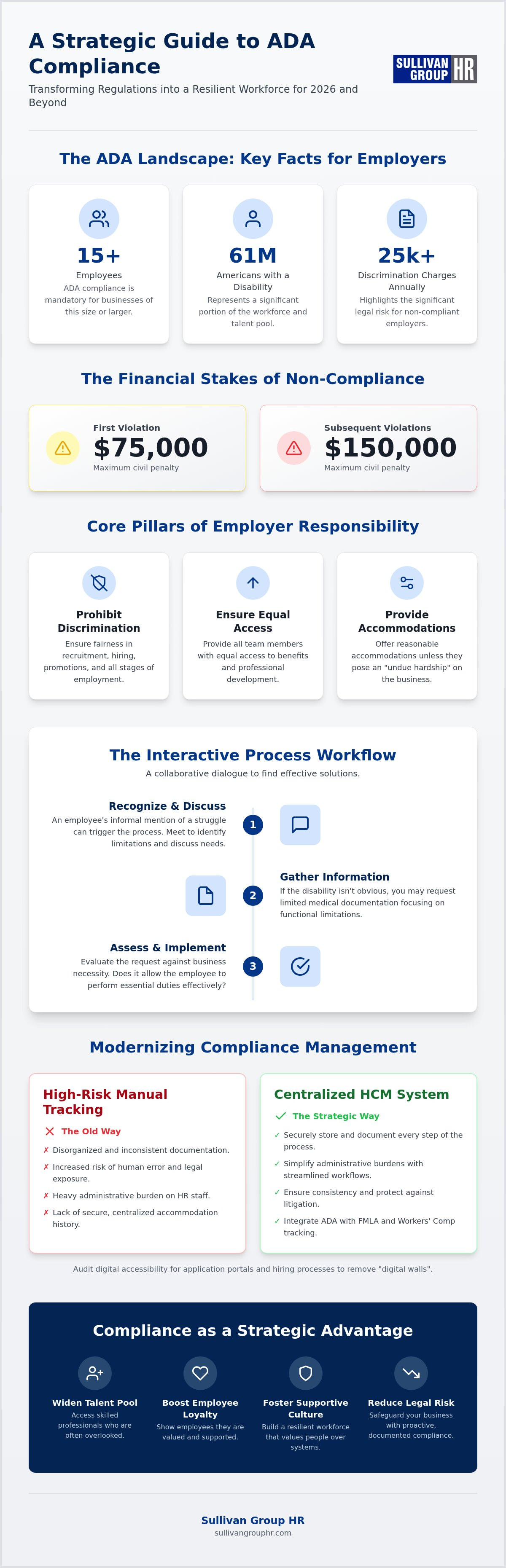
Do you know if your business is truly accessible to the 61 million Americans living with a disability? The Americans with Disabilities Act of 1990 is more than a legal mandate. It is a commitment to protecting talent and ensuring equal access. For 2026, the federal threshold remains steady. If you have 15 or more employees, ADA compliance for employers is a mandatory part of your professional safety net. It protects your team, your reputation, and your bottom line.
To stay protected, you must understand two foundational concepts. A "qualified individual" is someone who possesses the necessary skills and experience to perform "essential job functions," either with or without a reasonable accommodation. These functions are the fundamental duties that the position exists to fulfill. Defining these clearly in your job descriptions isn't just good HR; it's a vital shield against litigation. It provides the clarity your employees need and the legal documentation your business requires.
The cost of overlooking these details is rising. The EEOC currently receives over 25,000 disability discrimination charges every year. If your business is found non-compliant, the financial impact is immediate. Civil penalties for a first violation can reach $75,000, while subsequent violations can climb to $150,000. We view compliance as a form of insurance that safeguards your hard-earned wisdom and local legacy.
Core Pillars of Employer Responsibility
Your role as a protective leader involves three critical areas of focus. First, you must prohibit discrimination during every stage of employment, including recruitment, hiring, and promotion. Second, you must ensure all team members have equal access to benefits and professional development opportunities. Finally, you are required to provide "Reasonable Accommodations" for employees who need them, provided these changes don't cause your business an undue hardship. This creates an atmosphere of reliable advocacy where every employee can thrive.
Why Compliance is a Strategic Advantage
Compliance shouldn't feel like a bureaucratic burden. It is a tool for expansion. By removing unnecessary barriers, you immediately widen your talent pool to include skilled professionals who are often overlooked. This inclusivity boosts employee loyalty and fosters a supportive culture that values people over systems. To further enhance your team's unity and engagement, you can find out more about resources for building a genuine sense of community. ADA compliance for employers serves as a framework for inclusive growth. It allows you to build a resilient workforce while reducing your long-term legal risk.
The Interactive Process: Navigating Reasonable Accommodations
Do you know how to respond when an employee mentions they are struggling with their workstation setup? You don't have to wait for a formal legal letter to begin the interactive process. This ongoing dialogue is the heart of ADA compliance for employers. It's a collaborative effort to find a solution that works for both the individual and your business. By leading with empathy, you position yourself as a coach and ally rather than just a manager.
Recognizing a request is the first hurdle for many leaders. An employee might simply say, "I'm having trouble getting to work on time because of my medical treatments." They don't need to mention the ADA or use the phrase "reasonable accommodation" for the process to trigger. Once a need is identified, you must evaluate it against the essential functions of their specific role. The goal is to find effective solutions that maintain productivity without disrupting your daily operations. If you feel overwhelmed by these conversations, our HR consulting experts can act as your protective partner through each step.
Step-by-Step Workflow for HR Managers
A structured approach minimizes cognitive load and ensures consistency across your organization. Start with these three steps:
- Initial conversation: Meet with the employee to identify the specific limitation and their desired accommodation.
- Information gathering: If the disability isn't obvious, you can request limited medical documentation. Focus only on the functional limitations as outlined in the EEOC guidance on Reasonable Accommodation and Undue Hardship.
- The "Reasonable" test: Compare the request against business necessity. Does the solution allow the employee to perform their essential duties effectively?
Defining and Documenting Undue Hardship
What happens when a request is too difficult to fulfill? This is known as undue hardship. It refers to significant difficulty or expense based on your business's resources and operations. It's vital to remember that mere "inconvenience" doesn't meet this legal standard. The EEOC looks for high-impact operational disruptions or costs that would fundamentally alter your business. To protect your company, you must document the specific reasons why an accommodation was denied. Using a centralized system like isolved ensures that your documentation is secure, chronological, and ready for review if a claim ever arises. This structured process turns a daunting task into a manageable part of your long-term organizational security.
ADA, FMLA, and Workers’ Comp: Managing the Compliance Intersection
Have you ever felt lost in the "Bermuda Triangle" of HR? This occurs when the Americans with Disabilities Act, the Family and Medical Leave Act, and Workers' Compensation all apply to a single employee claim. It's a complex intersection where one wrong turn leads to legal exposure. For 2026, ADA compliance for employers demands a holistic view of these regulations. You must determine which law offers the most protection to the employee and apply those standards first. It is about being a proactive coach who ensures no one falls through the cracks.
Managing "Light Duty" requests is a common flashpoint. Under Workers' Comp, light duty is often used to reduce insurance costs by getting an injured worker back to the office quickly. However, the ADA views light duty through the lens of reasonable accommodation. If an employee has a disability, you may be required to modify their duties even if the injury didn't happen on the job. Balancing these needs requires a clear understanding of your operational limits and a commitment to fair treatment. We help you identify and implement these solutions without disrupting your business flow.
Comparing Leave Obligations
FMLA provides a set period of leave, typically 12 weeks, for serious health conditions. Once that time expires, your obligations don't necessarily end. The ADA may require additional leave as a reasonable accommodation if it helps the employee eventually return to their essential functions. You must manage reinstatement rights carefully. An employee returning from FMLA has a right to nearly the same position. ADA reinstatement focuses on whether the position is still available or if a suitable vacancy exists. Clear, empathetic communication prevents conflicting messages and keeps your business secure.
Risk Management Strategies
Consistency is your best defense against discrimination claims. Start by reviewing your employee handbook for compliance red flags, such as "no-fault" attendance policies that might penalize employees for ADA-protected leave. For broader context on staying safe, see our HR Risk Management Guide. Applying policies uniformly ensures that your ADA compliance for employers remains a stable foundation for your company's growth. This transition from reactive fixes to long-term organizational security is what allows your business to thrive. We stand by you as a reliable advocate, ensuring your administrative tasks feel manageable and organized.
Modernizing Compliance: Digital Accessibility and AI in Hiring
Is your digital front door locked to a significant portion of your talent pool? In 2026, ADA compliance for employers extends far beyond physical ramps and accessible restrooms. It now lives within your website code, mobile apps, and application portals. If your digital platforms aren't optimized, you are inadvertently building "digital walls" that block qualified candidates before they can even submit a resume. This creates an immediate barrier to growth and a significant legal vulnerability.
The Department of Justice and the EEOC have made digital accessibility a top priority for the coming year. This focus includes how you use Artificial Intelligence (AI) to screen applicants. While automated tools offer efficiency, they often carry hidden algorithmic bias. These systems can unintentionally penalize candidates with speech impairments or different neurological patterns during video interviews or cognitive tests. Training your hiring managers to spot these biases is essential for maintaining an inclusive, secure, and legally protected recruitment process. We view this as a vital part of your professional safety net.
Auditing Your Talent Acquisition Tech
Your software providers should be your partners in protection. When reviewing your tech stack, ask direct questions about their adherence to WCAG 2.1 standards. These guidelines ensure that individuals using screen readers or alternative input devices can navigate your site with ease. It's critical to verify that your applicant tracking and onboarding process is fully inclusive from the first click. Regular testing for screen-reader compatibility and keyboard-only navigation will help you identify gaps before they become liabilities. This proactive approach fosters a sense of security for your business and your future hires.
Managing AI and Disability Bias
Standardized AI testing often relies on "normal" data sets that don't account for neurodivergent candidates. For example, an AI tool analyzing eye contact or speech patterns in a video interview might unfairly score someone with autism or a stutter. To mitigate this risk, you should implement human oversight in every automated screening process. You must include a clear, accessible link for accommodation requests on every digital job advertisement. This simple step ensures that technology serves your mission rather than hindering it. If you need a partner to audit your hiring technology, our human resources consulting team can provide the expert advocacy you need to stay ahead of these modern challenges.
Partnering for Protection: How HCM Technology Simplifies ADA Management
Are you still relying on scattered spreadsheets to track accommodation requests? Manual tracking is a liability waiting to happen. In the eyes of the EEOC, if a process isn't documented in a secure, centralized way, it effectively didn't happen. ADA compliance for employers requires a level of precision that manual entry simply cannot provide. We help you move beyond administrative chaos into a structured, reliable system. This transition protects your business, your reputation, and your people.
Unified technology serves as the backbone of modern risk management. By utilizing isolved, you centralize every step of the interactive process in one secure location. This platform links performance data, leave requests, and accommodation history. It gives you a 360-degree view of your workforce and creates a steady, reliable beat for your administrative functions. Why risk a lawsuit because a paper file was misplaced or an email was deleted? A unified platform ensures your compliance efforts are backed by data that is accurate, accessible, and audit-ready at a moment's notice.
Leveraging isolved for Compliance
The isolved platform offers more than just storage; it provides movement, safety, and results. You can set automated reminders to follow up on temporary accommodations, ensuring no deadline is missed. Medical documentation is stored securely and separately from general personnel files. This maintains the strict confidentiality required by federal law. When an EEOC inquiry arrives, you won't scramble for papers. You will simply pull a reporting tool that provides a clear, chronological audit trail of your good-faith efforts. This structure minimizes cognitive load and makes daunting regulatory tasks feel manageable.
The Sullivan Group HR Advantage
Technology is a powerful tool, but it needs the wisdom of an established expert to guide it. We act as your fractional HR partner for the most complex ADA cases. Whether you are navigating a difficult "undue hardship" determination or coordinating overlapping leave laws, we provide the "no-nonsense" authority you need. Our comprehensive support integrates your payroll administration and HR consulting into one seamless experience. You gain the peace of mind that comes from having a coach and ally who understands your local territory. We stand by you as a reliable advocate, ensuring your success is the primary metric of our own. This partnership allows you to focus on your professional potential while we handle the administrative burden.
Securing Your Future with Proactive Inclusion
Will you be ready when the next accommodation request reaches your desk? ADA compliance for employers is not just a regulatory hurdle; it is a vital part of your professional potential. By mastering the interactive process and auditing your digital front door, you protect your business from the rising tide of litigation. You also build a more resilient and loyal workforce. Remember that documentation is your best defense. Moving away from scattered spreadsheets to a unified system ensures that no detail is lost and every good-faith effort is recorded.
We are here to act as your coach and ally in this journey. Our team provides national compliance expertise and specialized HR risk management consulting to help you navigate the most complex cases. With access to the industry-leading isolved HCM platform, you can centralize your administrative tasks and focus on growth. Protect your business with expert HR consulting and isolved HCM technology. You don't have to handle these burdens alone. Together, we can turn compliance into a strategic advantage that honors your legacy and supports your team.
Frequently Asked Questions
How many employees do I need to have to be covered by the ADA?
Private employers with 15 or more employees must follow the Americans with Disabilities Act. This threshold remains the same for 2026. If your team reaches this size, ADA compliance for employers becomes a mandatory part of your operations. We recommend auditing your headcount regularly to ensure you're prepared for these responsibilities. Our team helps you manage these transitions smoothly as your business grows and evolves.
What is considered a "reasonable accommodation" for a small business?
A reasonable accommodation is any change in the work environment or the way things are usually done that helps an individual with a disability perform their duties. Examples include modified schedules, specialized equipment, or job restructuring. The key is that it must be effective without causing significant difficulty or expense for your specific operations. It's about finding a balance that supports the employee while maintaining your business results.
Can an employer ask for medical proof of a disability?
Yes, you can request limited medical documentation if the disability or the need for accommodation isn't obvious. You should only ask for information necessary to verify the disability and identify functional limitations. It's vital to keep this information confidential and stored separately from general personnel files. Using a secure platform like isolved ensures these sensitive records are protected and easily accessible if you ever face an audit.
What happens if an employee refuses an accommodation that is offered?
If an employee refuses a reasonable accommodation that is necessary to perform essential job functions, they may no longer be considered a "qualified individual" under the law. You aren't required to provide the specific accommodation the employee prefers if a different, effective option exists. We suggest documenting the interactive process thoroughly to show you made a good-faith effort to find a solution. This protects your professional reputation and security.
Is an employer required to pay for an accommodation?
Most accommodations are low-cost, but the employer is generally responsible for the expense. You only have a "way out" if the cost creates an undue hardship, meaning it's significantly difficult or expensive given your company's size and financial resources. Small businesses can often utilize the Disabled Access Tax Credit to offset these costs. We can help you evaluate these financial impacts as part of our human resources consulting services.
How does the ADA apply to remote or hybrid workers?
ADA compliance for employers applies equally to remote and hybrid workers. If an employee needs an accommodation to perform essential functions from home, you must engage in the interactive process. This might include providing accessible software or modified communication tools. It's important to remember that the physical location of the worker doesn't change your legal obligations. Clear policies in your employee handbook help set expectations for these modern work arrangements.
Can I terminate an employee who has an ADA accommodation?
Yes, you can terminate an employee who has an ADA accommodation if the reason is unrelated to their disability. Performance issues, policy violations, or company layoffs are valid reasons for termination. However, you must ensure that you apply your standards consistently across the entire workforce. Documenting performance and the history of accommodations in a unified platform helps protect your business from potential claims of retaliation or discrimination, especially as services like ADA Help - NY disability discrimination claims help individuals identify and act on potential workplace violations.
One major mistake is failing to recognize informal requests for help. Another is maintaining "no-fault" attendance policies that don't account for ADA-protected leave. Many businesses also struggle with a lack of documentation during the interactive process. To stay safe, you should treat every request as an opportunity for dialogue. Our experts act as your ally to help you avoid these pitfalls and maintain a high standard of workplace inclusion for your team.


