

What if a workplace safety program were judged not by the policies in a binder, but by what employees do when they spot a hazard? That’s the real challenge in developing a workplace safety program: turning good intentions into clear, everyday actions.
If you’re unsure where to start, what to document, or who should follow up, you’re not alone. Written rules matter, but they work best when employees understand their responsibilities and feel able to raise concerns. A practical program connects hazard controls with employee participation and consistent follow-through.
This guide will help you build that connection. You’ll learn how to identify and address hazards, assign responsibilities, document key processes, and involve employees in safety conversations. You’ll also see how to review the program as work changes, so it stays useful instead of gathering dust. Clear HR processes can support responsibilities and documentation, while workers’ compensation insurance complements an employer-led safety effort. The goal is a program people can understand, use, and improve together.
Key Takeaways
- When developing a workplace safety program, turn each step into a practical output, from a named owner to a prioritized hazard list.
- Understand why policies and training support safety but may need to be paired with physical or process controls to address hazards.
- Use a corrective-action log to track hazards, assigned owners, due dates, planned actions, and completion status.
- Build safety into consistent HR processes, while treating workers’ compensation insurance as a complement to prevention, not a substitute.
What Is a Workplace Safety Program, and Why Does Your Business Need One?
A workplace safety program is a coordinated set of policies, responsibilities, practices, and reviews designed to help prevent work-related harm. It connects what an organization expects people to do with how hazards are identified, addressed, and revisited as work changes.
A written policy matters, but it’s only one piece. A safety manual describes expectations; a safety program puts those expectations into practice and checks whether they’re working. A document can explain how to report a hazard, for example. An active program also identifies who receives the report, who assesses and addresses it, and how the team confirms the issue has been handled.
That structure has practical benefits: employees know what safe work looks like, hazards can receive attention before they become incidents, and follow-through doesn’t depend on one person remembering every detail. A shared process can also help leaders spot gaps, such as a procedure that no longer matches the task employees actually perform.
Occupational safety and health covers the prevention of work-related harm and the conditions that support safer work. The overview of Occupational Safety and Health (OSH) provides broader context. At the organization level, the essential idea is to make safety part of how work is planned, performed, and improved. Developing a workplace safety program gives that effort a clear structure without treating a binder of rules as the finish line.
What belongs in a workplace safety program?
Start with connected components: management commitment, worker participation, hazard assessment, and prevention. Leaders set expectations and provide support. Workers contribute firsthand knowledge of tasks and risks. Hazard assessments identify what needs attention, and prevention measures address those risks.
Training, communication, and evaluation keep the components active. They should be ongoing practices, not one-time checkboxes. For instance, a new process may introduce a hazard that calls for updated instructions or training. Program details should reflect the organization’s actual work, hazards, and applicable requirements.
Who is responsible for workplace safety?
Leadership sets direction and remains accountable for supporting the program. Responsibilities can be assigned, but managers can’t simply hand off their accountability. Supervisors turn expectations into daily routines: explaining procedures, checking that employees understand them, and identifying where to raise concerns or escalate unresolved hazards.
Employees are essential participants, too. They can report hazards, explain when a procedure doesn’t fit the task, and follow established safe practices. Make reporting straightforward and explain what happens after a concern is raised. Clear roles help everyone contribute without leaving ownership of the overall effort unclear.
How to Develop a Workplace Safety Program: Build Its Core Elements
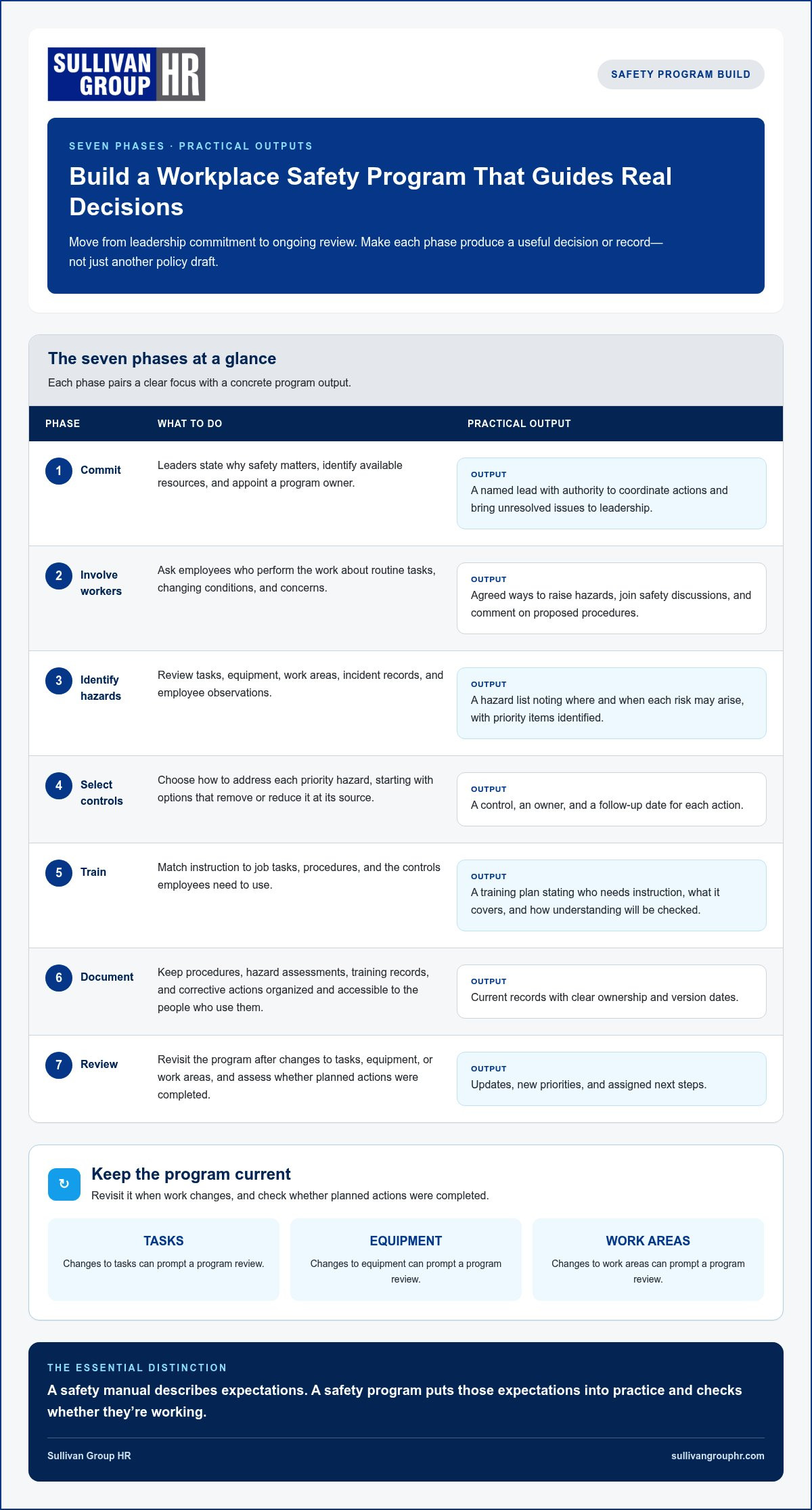
Developing a workplace safety program is easier when each phase ends with a decision or useful record, not just another policy draft. OSHA’s recommended practices connect management leadership, worker participation, hazard identification, prevention and control, training, program evaluation, and communication for multi-employer worksites. Use the OSHA Safety and Health Program Management Guidelines as a starting point, then verify current federal, state-plan, and industry-specific requirements that apply to your work.
Move through these steps in order. Keep the outputs practical so the program can guide real decisions.
- Commit. Leaders state why safety matters, identify available resources, and appoint a program owner. Output: a named lead with authority to coordinate actions and bring unresolved issues to leadership.
- Involve workers. Ask employees who perform the work to describe routine tasks, changing conditions, and concerns. Output: agreed ways to raise hazards, join safety discussions, and comment on proposed procedures.
- Identify hazards. Review tasks, equipment, work areas, incident records, and employee observations. Output: a hazard list that notes where and when each risk may arise, with priority items identified for attention.
- Select controls. Decide how to address each priority hazard, starting with options that remove or reduce the hazard at its source. Output: a control, an owner, and a follow-up date for each action.
- Train. Match instruction to job tasks, procedures, and the controls employees need to use. Output: a training plan that states who needs instruction, what it covers, and how understanding will be checked.
- Document. Keep procedures, hazard assessments, training records, and corrective actions organized and accessible to the people who use them. Output: current records with clear ownership and version dates.
- Review. Revisit the program after changes to tasks, equipment, or work areas, and assess whether planned actions were completed. Output: updates, new priorities, and assigned next steps.
Set leadership responsibilities and involve employees
Leadership makes safety a working priority by communicating expectations, providing resources, and assigning accountable owners. Participation needs more than an open-door promise: schedule brief safety discussions, make reporting channels clear, and invite employees to review proposed procedures. Then close the loop. Share what was decided, who will follow up, and when employees can expect an update, even if an issue needs more investigation.
Worker input turns hazard identification from a desk exercise into a clearer picture of how work is actually done. It can also help leaders choose controls employees can apply consistently.
Identify hazards and choose controls
Look beyond formal inspections. Employees may notice risks during setup, cleanup, maintenance, or less frequent tasks. For each hazard, consider the hierarchy of controls: elimination, substitution, engineering controls, administrative controls, and personal protective equipment. Eliminating a hazard is preferable when feasible because it removes the exposure rather than relying on reminders or individual actions. Check relevant OSHA guidance and industry-specific obligations before making compliance claims or finalizing controls.
Consistent HR processes can help keep responsibilities and employee records organized alongside the employer-led safety effort. Sullivan Group HR provides HR consulting and administration to support related people processes without replacing hazard prevention or the employer’s safety responsibilities.
Workplace Safety Policies, Training, and Controls: What Actually Prevents Harm?
A signed policy doesn’t make a hazard disappear. A completed course doesn’t prove that a risky task is now safe. Both can support prevention, but neither should be mistaken for a control by itself. Developing a workplace safety program means matching each hazard with measures that address it, then checking whether those measures work in practice.
Policies, training, and controls have different jobs. Policies set expectations. Training builds knowledge and task skills. Physical or process controls change the conditions of work or reduce exposure. Each has limits, so employers need to assess whether their chosen measures are effective and adjust them when they aren’t.
Policies
What they help address: Clarify rules, roles, and required steps.
What they cannot do alone: Remove a hazard or ensure procedures are followed.
Employee training
What it helps address: Builds understanding of hazards, tasks, and safe procedures.
What it cannot do alone: Make an unsafe work area or process safe.
Physical or process controls
What they help address: Remove hazards or reduce employees’ exposure to them.
What they cannot do alone: Guarantee that all risk is eliminated or that controls remain effective without review.
How do policies and training support safer work?
Procedures turn expectations into usable instructions: what to do before a task, how to operate equipment, and how to respond if conditions change. Training helps employees understand the hazards and apply those instructions to their work. Keep it relevant to each role, and revisit it when job duties, equipment, or procedures change. A general overview may not prepare someone for a specific task.
Supervisors help make learning stick. They can observe work, answer questions, and offer timely feedback when a step is missed or unclear. If employees repeatedly struggle with a procedure, treat that as a signal to review the instruction or work process, not only as a reason to repeat the same training.
How does the hierarchy of controls guide decisions?
The hierarchy helps employers compare ways to address a hazard, from measures that rely less on individual action to those that rely more on it:
- Elimination: Remove the hazard.
- Substitution: Replace it with a less hazardous option.
- Engineering controls: Isolate people from the hazard through a physical change.
- Administrative controls: Change work practices, schedules, or procedures.
- Personal protective equipment: Use protective gear to reduce exposure.
Higher-level controls generally reduce reliance on employees remembering or choosing the right action every time. For example, in an illustrative workplace scenario, a team handling a material may first consider whether it can be removed from the process. If not, it could assess a less hazardous substitute, then consider equipment or procedures that reduce exposure. This is not a universal prescription; the right approach depends on the hazard and work conditions. Assess controls after implementation, and revise them if they don’t adequately address the risk.
How to Put a Workplace Safety Program into Practice and Measure Progress
A safety program becomes useful when employees can find the procedures, understand who owns each action, and see concerns move toward resolution. Set it up for everyday use: name a coordinator, assign owners for specific tasks, make current procedures easy to access, and tell employees how to report issues. Introduce the process in team communications and explain what happens after a concern is raised.
Choose a review cadence that fits the work and the pace of change. Revisit the program when tasks, equipment, work areas, or staffing change, and verify applicable requirements before setting review deadlines. Aim for a rhythm the organization can maintain, with extra attention when new risks or unresolved issues call for it.
Make hazard reporting and corrective actions easy to follow
Employees should know where to report a hazard, a near miss, or a change in working conditions. Keep the channel straightforward, and make clear that concerns can be raised with a supervisor or through the organization’s established reporting process. A report should lead to an assessment, an assigned response, and communication back to the person who raised it.
Track follow-through in a simple corrective-action log. Include:
- Hazard: What was reported and where it occurred.
- Assigned owner: Who is responsible for the response.
- Due date: When the next action is expected.
- Action: What will be done to address the concern.
- Completion status: Whether the action is open, in progress, or complete.
Assess urgency first, then assign an owner with the authority and resources to act. If the planned action can’t be completed by its due date, record the reason, communicate any interim steps, and set a new follow-up date. Close the loop with employees; silence can make reporting feel pointless.
Review results and update the program
Measure activity as well as outcomes. Leading indicators show whether preventive work is happening, such as hazard reports received, training completed, and corrective actions closed on time. Lagging indicators look back at incidents, injuries, or illness records. Both matter, but they answer different questions.
Incident counts show what happened; reporting trends and completed actions add context about what the organization noticed and did next. A rise in reports, for example, may reflect stronger participation rather than worsening conditions, so review the details before drawing conclusions.
During each review, look for recurring incident patterns, training gaps, overdue actions, and changes in how work is done. Turn findings into specific program updates, name an owner for each revision, and set a follow-up date to check progress. Developing a workplace safety program is an ongoing cycle, not a one-time launch. Clear HR processes can help organize responsibilities and records alongside the employer-led effort. Learn about Sullivan Group HR’s HR support and administration for related people processes.
Keep Your Workplace Safety Program Sustainable with Strong HR Processes
A safety program is easier to maintain when its people-related processes are clear and consistent. HR administration can help employers communicate roles, organize records, and keep routine workforce information current. These processes support the structure around safety, but they don’t replace hazard assessment, prevention, or the employer’s responsibility to protect employees.
Safety also connects to broader business risk. Looking at how workplace policies, employee practices, and records fit together can help organizations spot process gaps. Sullivan Group HR’s HR risk management guide explores that wider context.
Connect safety responsibilities with everyday HR administration
Use onboarding and role communication to help employees understand where to find procedures relevant to their work, who to approach with questions, and how responsibilities may differ by role. When duties change, update the information employees rely on so instructions don’t lag behind the work. This makes safety expectations easier to find and reinforces that they’re part of how the organization operates.
Consistent time and attendance administration and organized HR records can support workforce administration, but they aren’t safety measures and shouldn’t be treated as evidence that hazards are controlled. Keep records accurate, accessible to appropriate personnel, and aligned with established processes. For organizations considering ongoing administrative support, the HR outsourcing guide explains how HR support can fit into broader operations.
Workers’ compensation insurance is another related process. It supports compensation coverage, while hazard prevention remains a separate, essential part of the employer-led safety effort. Clear procedures and organized records can help employers manage these responsibilities without confusing workers’ compensation matters with preventing workplace harm.
Build a sustainable partnership around your people processes
Employers retain responsibility for workplace safety. HR partners can support related administration, such as maintaining consistent people processes, but they don’t take the place of employer decisions about hazards, controls, or safe work. That distinction helps everyone understand where accountability sits and how administrative support fits around the program.
As work changes, check that role information, onboarding materials, and relevant records still reflect current practice. Make updates part of normal HR administration rather than a one-off project. Developing a workplace safety program becomes more sustainable when responsibilities stay clear and supporting processes keep pace with the workforce.
Sullivan Group HR provides HR consulting, payroll administration, employee benefits management, and access to the isolved HCM platform to support workforce processes. Explore Sullivan Group HR’s HR support for your organization.
Make Your Next Safety Step Count
A stronger safety culture doesn’t need to begin with a major overhaul. Choose one practical next step: make a procedure easier to find, clarify who receives employee concerns, or review whether an existing control still fits the work. Then follow through and learn from what employees tell you. That steady attention helps turn developing a workplace safety program into an ongoing commitment, not a document that sits untouched.
Clear people processes can support the work around safety while employers remain responsible for hazard prevention. Since 1998, Sullivan Group HR has supported businesses with HR consulting, workers’ compensation insurance, and access to the isolved HCM platform. These services can complement your organization’s broader workforce administration without replacing its safety responsibilities.
Ready to strengthen the HR processes that support your people? Explore HR support for your business and take the next step with confidence.
Frequently Asked Questions
What is a workplace safety program?
A workplace safety program is a coordinated way to manage how an organization identifies and addresses hazards. It gives employees and managers a shared approach for raising concerns and responding to changing conditions. For example, if a work task changes, the organization can determine whether existing instructions still fit and whether employees need updated guidance. A written policy can support the program, but the process must also be usable during everyday work.
Is a workplace safety program required for every business?
Requirements depend on the work being performed and the federal, state, and industry-specific rules that apply. A small workforce or few past incidents doesn’t automatically mean an employer has no obligations. Review current OSHA guidance and applicable requirements for your operations, especially when introducing unfamiliar tasks, equipment, or materials. A practical program can also help a business spot unclear procedures and address concerns before they contribute to an injury or work disruption.
How do you start developing a workplace safety program?
Start by choosing a leader to coordinate the effort and inviting employees to describe how work is actually performed. Then focus on one task or work area: observe the process, ask what can go wrong, and record concerns that need attention. Assign someone to assess each priority and track the response. This manageable first pass can reveal gaps in instructions or communication. Check applicable requirements before treating a checklist or template as complete.
What should a workplace safety program include?
A workplace safety program should address leadership responsibility, employee involvement, hazard identification, prevention, training, communication, and evaluation. It should also fit the organization’s real work rather than rely on a generic template without review. For example, a procedure for one work area may not address a different task or piece of equipment. Make sure employees know how to raise concerns and that someone is responsible for tracking the response through completion.
Can employee safety training replace hazard controls?
No. Training can help employees recognize risks and follow instructions, but it doesn’t physically change a hazardous condition. If a task exposes workers to a moving part, for example, explaining safe behavior may not be enough; the employer should assess whether the hazard can be removed or reduced through appropriate controls. Training should support those controls, not stand in for them. Revisit instruction when a task, tool, or procedure changes.
How often should a workplace safety program be reviewed?
Review the program when work changes, an incident or near miss reveals a possible gap, or employees raise concerns that suggest a procedure needs attention. A regular review schedule can help keep routine checks from slipping, but the right cadence depends on the operation and applicable requirements. During each review, look for unresolved actions, changes in training needs, and repeated issues. Verify current federal and state requirements instead of assuming one review interval applies to every business.


