

What if your HR goals could show leadership exactly how people initiatives support the business? Aligning HR goals with business objectives starts by connecting workforce priorities to the outcomes leaders are working toward, not simply counting HR activities.
If HR initiatives feel disconnected from leadership priorities, you’re not alone. Choosing people-related measures that show progress can be difficult when teams are balancing hiring, retention, development, and daily operations. The answer isn’t more metrics. It’s a clearer link between business needs, HR actions, and meaningful results.
This guide explains how to turn business priorities into actionable HR goals, connect each goal to workforce initiatives, and choose measures that distinguish activity from impact. You’ll also learn how to create a repeatable review process with shared ownership, so HR and business leaders can assess progress, adjust when priorities shift, and make informed decisions. The result is a practical framework for keeping people plans focused on the work that matters most.
Key Takeaways
- Aligning HR goals with business objectives connects people priorities to leadership’s direction and clarifies who owns progress.
- Start with a small number of business priorities, then turn each into a measurable HR goal with a clear owner.
- Choose measures that fit the goal and the decision at hand, distinguishing HR activity from workforce and business outcomes.
- Set a regular review rhythm so HR, executives, managers, and finance can assess progress and adjust actions together.
- HR consulting can help clarify priorities and practical processes, while HCM supports coordinated administration rather than replacing strategy.
Why Aligning HR Goals With Business Objectives Matters
HR work can be busy and useful while still being disconnected from the organization’s most pressing needs. A recruitment campaign, training program, or new review process becomes strategically meaningful when it responds to a business priority and addresses a workforce need. Aligning HR goals with business objectives gives people initiatives a clear purpose, helps teams make trade-offs, and makes progress easier to discuss with leadership.
This connection matters because HR does not control business outcomes alone. Retention, productivity, and growth are shaped by leadership decisions, manager practices, employee experience, and market conditions, as well as HR programs. The aim isn’t to claim credit for every result. It’s to make HR’s contribution visible and work with other leaders to address barriers.
What does HR and business alignment look like?
HR and business alignment connects a business priority to a workforce need, an HR action, and a measure of progress. It creates a clear line from organizational direction to people-related work, rather than treating completed projects as proof of impact. This strategic role sits within the broader practice of Human Resource Management, which includes how organizations manage and develop their workforce.
For example, if a company plans to expand into new markets, leaders may need teams with specific customer, operational, or technical skills. HR can work with department heads to identify skill gaps, plan hiring or development, and track whether critical roles are filled in time to support the expansion. The shared outcome is readiness to serve new markets. HR-owned deliverables might include completing a skills assessment or coordinating recruitment. Those deliverables support the outcome, but they don’t guarantee it.
This distinction keeps accountability fair. HR can own the quality and timing of its processes; executives set direction, managers shape day-to-day conditions, and teams deliver the work. Shared outcomes need shared attention.
Why does misalignment happen?
Misalignment often starts with timing. Business plans may be set before HR is involved, or workforce planning may follow a separate calendar. A broad ambition such as “grow faster” also leaves important questions unanswered: Which teams need to grow? What capabilities are missing? What should change first? Without those details, HR may launch worthwhile initiatives that don’t address the most urgent workforce need.
Siloed decisions create more friction. Leaders may set priorities without input from managers closest to the work, while HR may design programs without knowing how departments will use them. Neither side has to be at fault. Alignment is a partnership that depends on regular communication about priorities, capacity, and trade-offs.
Measurement can hide the gap, too. Counting training sessions, job postings, or completed reviews shows activity, not whether a business priority is advancing. Pair those figures with a relevant workforce or operational measure to give leaders better visibility and a stronger basis for decisions. The next step is to turn shared direction into a focused set of measurable HR goals.
How to Translate Business Priorities Into Measurable HR Goals
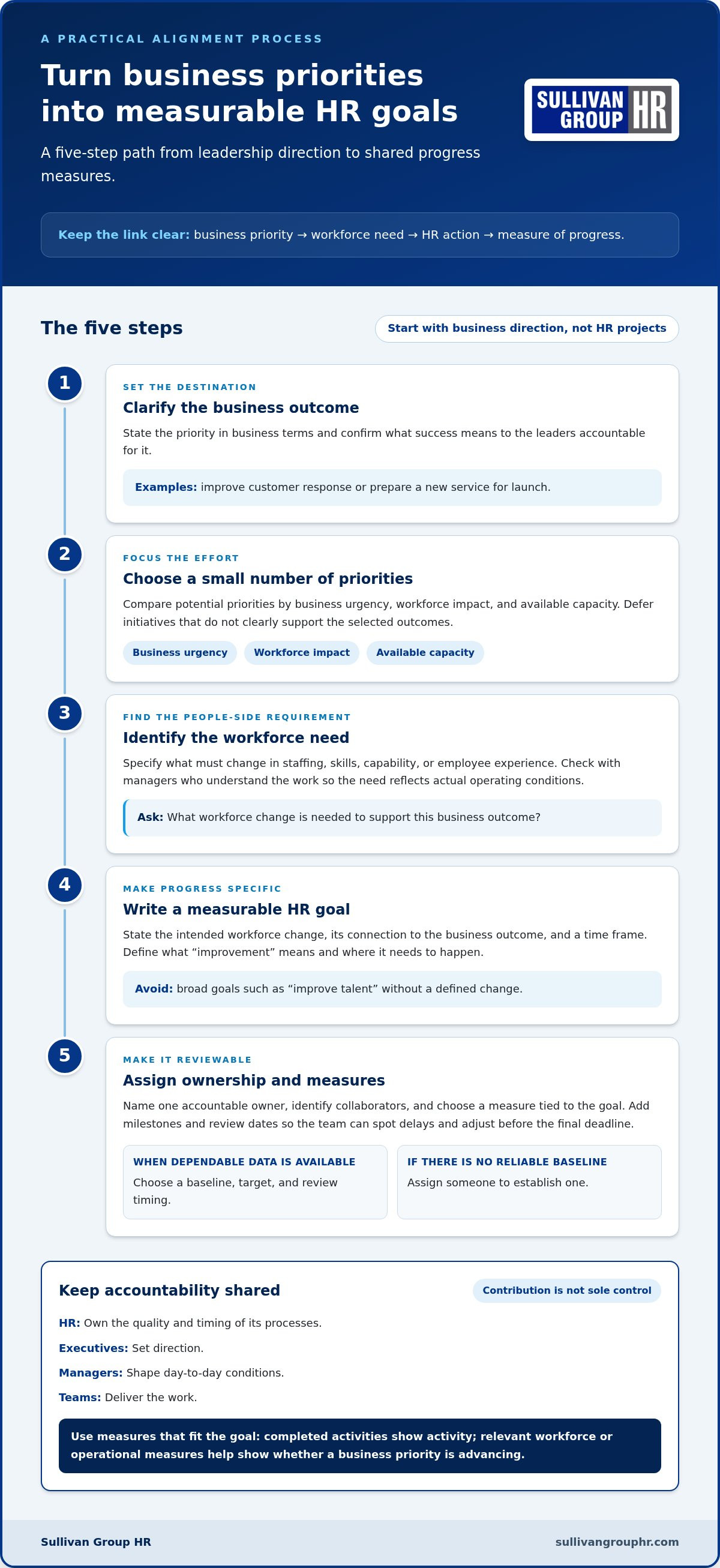
Start with business direction, not a list of HR projects. A focused process helps leadership and HR agree on what matters, identify the workforce change required, and decide how they’ll recognize progress. Keep the initial priorities limited. A short, shared list is easier to resource and review than a long set of disconnected initiatives.
Start with the business outcome and workforce need
Ask leaders which outcomes matter most, what’s changing, and what constraints could affect the plan. Then identify the skills, capacity, or employee experience needed to support each outcome. Separate agreed priorities from assumptions. If leaders haven’t decided which teams or capabilities matter, make that a discussion point before HR builds a goal around it.
- Clarify the outcome. State the priority in business terms, such as improving customer response or preparing a new service for launch. Confirm what success means to the leaders accountable for it.
- Choose a small number of priorities. Compare potential priorities based on business urgency, workforce impact, and available capacity. Defer initiatives that don’t clearly support the selected outcomes.
- Identify the workforce need. Specify what must change in staffing, skills, capability, or employee experience. Check with managers who understand the work so the need reflects actual operating conditions.
- Write a measurable HR goal. State the intended workforce change, its connection to the business outcome, and a time frame. Avoid broad wording such as “improve talent” unless you define what improvement means and where it needs to happen.
- Assign ownership and measures. Name one accountable owner, identify collaborators, and choose a measure tied to the goal. Add milestones and review dates so the team can spot delays and adjust before the final deadline.
Write goals with owners, measures, and milestones
A strong goal clarifies responsibilities without suggesting HR controls every result. HR might own a hiring process or skills assessment, while department leaders and managers help define role needs and put new capabilities to work. Choose a baseline, target, and review timing when dependable data is available. If there’s no reliable baseline, first assign someone to establish one.
Illustrative example: A company wants to improve customer support. Leaders confirm that teams need stronger product knowledge, and managers identify a training gap for a particular service. An HR goal could be: “By the end of Q4, coordinate role-specific training for the affected support team and track completion and a relevant service measure against an agreed baseline.” HR owns coordinating the training; support leaders own applying it. The measure and target should reflect reliable data and leadership agreement, not guesswork.
HR consulting support can help clarify priorities, roles, and practical people processes when teams need a partner to shape their goal-setting approach. With the goal agreed, the next step is choosing measures that show whether business priorities are advancing.
Which HR Measures Show Whether Business Goals Are Advancing?
A useful measure helps people make a decision. It shows whether an HR action is happening, whether the workforce is changing, or whether a business result is moving. These are related but different signals. Aligning HR goals with business objectives means choosing measures that clarify progress, not claiming every HR metric directly proves financial impact.
Use three levels to distinguish activity from outcomes:
| Measure type | What it shows | Illustrative example |
|---|---|---|
| Activity | Whether an HR task is being completed | Number of interviews completed for priority roles |
| Workforce outcome | Whether a people-related condition is changing | Share of priority roles filled by the agreed date |
| Business outcome | Whether the operational or organizational result is advancing | Team readiness to support a planned expansion |
Activity measures help manage delivery, but they don’t show impact on their own. A high number of interviews, for instance, doesn’t establish that the right roles were filled or that the organization is ready to grow. Choose measures based on the goal, the data you can reliably access, and the decision leaders need to make. Not every people measure needs to be turned into a financial calculation.
Choose leading and lagging indicators for the goal
Leading measures signal progress toward a result, such as completing role-specific training before a new team takes on work. Lagging measures show results already observed, such as whether the team met its readiness milestone. For a retention goal, manager check-ins may be an early signal, while retention data shows a later outcome. Set targets in context; no universal benchmark fits every role or business.
Build a balanced HR and business scorecard
Pair an HR measure with a related operational outcome, then document who owns the data and how often it will be reviewed. A simple scorecard keeps measures interpretable and helps teams spot gaps:
| Measure pair | Data source | Owner | Review and interpretation |
|---|---|---|---|
| Priority-role hiring progress and team staffing readiness | Recruiting records and manager assessment | HR and department manager | Review at agreed milestones; investigate delays or changed role needs |
| Training completion and demonstrated workforce readiness | Training records and role-based assessment | HR and team lead | Review after training; check whether employees can apply the skill |
Interpret patterns carefully. A change in retention alongside a new HR initiative doesn’t prove that the initiative caused the change. Workload, leadership changes, hiring conditions, and other factors may also matter. Handle workforce data with appropriate privacy safeguards, share it only with people who need it, and consider it in context. A balanced scorecard supports better questions and decisions, not simplistic attribution.
How to Put HR and Business Goals Into a Review Rhythm
Goals need more than a launch meeting. They need a routine for checking what’s changing, deciding what to do next, and keeping the right people informed. A steady review rhythm makes aligning HR goals with business objectives part of how leaders manage work, rather than a separate HR exercise.
Bring leaders and managers into the planning process
Before launch, agree on the priority, decision rights, accountable owner, collaborators, and how updates will be shared. Executives clarify direction and resolve trade-offs. HR coordinates people processes and tracks agreed measures. Managers surface capacity, skills, and workflow realities. Finance can help assess resource implications and interpret relevant business measures. For a broader view of how workforce planning supports organizational direction, read this human capital management strategic guide.
Keep accountability specific. One person should own moving each goal forward, even when several functions contribute. Document who can approve a change, who supplies updates, and who needs to act on a decision. This prevents shared ownership from turning into unclear responsibility. Ask managers to flag practical constraints before plans are finalized, such as competing deadlines or limited time for training.
Review progress and adapt without losing focus
Choose a review frequency based on when decisions are needed and how quickly the underlying work changes. A hiring plan tied to an upcoming launch may need closer checks than a longer-term development goal. Use the same update format each time: current measure, movement since the last review, risks, next action, owner, and decisions required. For more on workforce capacity, see this workforce management solutions guide.
- Launch: Confirm the goal, owner, collaborators, baseline, data source, and first review date.
- Check: Compare progress with the agreed measure and ask managers what’s happening in day-to-day operations.
- Decide: Record any needed support, resource change, or adjustment, along with who will act and by when.
- Revisit: Confirm the priority still matters and update the plan when business conditions or evidence change.
If progress stalls, first identify the cause. Is the business priority still current, is execution blocked, or has the data become unreliable? A changed priority calls for leadership to reset the goal. An execution problem may need clearer ownership, added support, or a revised milestone. If data can’t be trusted, pause conclusions and assign someone to validate or rebuild the measure. Don’t disguise uncertainty as progress.
For example, HR consulting support can help connect people priorities with a workable review process, workforce planning, and ongoing business needs.
How HR Consulting and HCM Support Ongoing Business Alignment
A clear goal can still lose momentum if the people processes behind it are fragmented or no one has time to coordinate them. HR consulting and human capital management (HCM) can support execution by helping organizations connect business needs with practical HR work. They don’t set business strategy or replace leadership decisions. They help make agreed priorities workable across people, processes, and administration.
When outside HR support can help sustain alignment
Consider additional HR guidance when ownership remains unclear, processes vary across teams, or internal HR capacity is stretched. These conditions can make it harder to turn a business priority into consistent hiring, development, or workforce practices. HR consulting can help leaders clarify responsibilities, identify process gaps, and shape practical next steps for the organization.
Risk-related workforce planning also benefits from a deliberate process. If a business change could affect staffing, employee processes, or operational continuity, identify the people-related risks, assign responsibility for addressing them, and include relevant actions in regular planning. The HR risk management guide offers more context for considering workforce risks as part of business planning.
Use HR technology to support the process
HCM can support coordinated HR administration by bringing workforce processes into a more consistent operating structure. Dependable records and clearly managed workflows can make it easier for teams to carry out agreed responsibilities. Technology alone won’t determine which skills a growth plan requires, set a retention priority, or decide whether a business objective is still relevant. Those choices require people, context, and leadership judgment.
Consider how day-to-day functions connect to workforce plans. Applicant tracking supports recruiting as teams work to fill needed roles. Payroll administration, benefits management, and time and attendance support ongoing workforce operations. Coordinating these processes can reduce administrative fragmentation, while leaders remain responsible for setting priorities and evaluating outcomes. System activity is not proof that a strategic goal has been achieved.
Sullivan Group HR provides HR outsourcing and consulting, along with access to the isolved HCM platform. Its services support organizations carrying agreed people priorities into HR administration and workforce processes, without confusing tools with strategy. The sequence is straightforward: clarify the business need, define the people work, assign ownership, and review progress together. That’s the practical foundation of aligning HR goals with business objectives.
To connect HR processes with your organization’s priorities, explore Sullivan Group HR’s HR support.
Take One Practical Step Toward Stronger Alignment
Your next step can be modest: choose one business priority that needs people support and use it to test how clearly the organization shares decisions. A focused pilot gives leaders and HR a chance to identify where information, ownership, or coordination needs attention before expanding the approach.
Treat the first review as a learning point, not a verdict. Ask what changed, what remains uncertain, and which decision would help the work move forward. That habit keeps aligning HR goals with business objectives responsive as plans evolve, while making room for candid input from the people closest to the work. The aim isn’t a perfect scorecard on day one; it’s a better conversation and a clear next action.
To strengthen the connection between workforce plans and business direction, explore Sullivan Group HR’s HR support. Start with one priority, build shared understanding, and use each review to clarify the next step.
Frequently Asked Questions
Is aligning HR goals with business objectives only the HR department's responsibility?
No. Aligning HR goals with business objectives takes shared effort because business outcomes depend on decisions and work across the organization. HR can coordinate people processes, while executives clarify direction, managers identify team needs, and finance helps assess resource implications. For example, if a company needs to shorten customer response times, service leaders must define coverage needs and workflow changes alongside HR’s staffing support.
How often should a company review its HR goals?
Review goals often enough to make timely decisions, but not so often that teams spend more time reporting than acting. A goal affected by seasonal staffing or a near-term product launch may need frequent check-ins; a longer-term skills initiative may need milestone-based reviews. Revisit the cadence if conditions shift, a decision is overdue, or available information shows a new risk.
What is the difference between an HR goal and an HR metric?
An HR goal describes the change the organization wants; a metric is a measure used to assess progress toward it. For example, a goal might be to make onboarding more consistent across departments. A metric could track whether new employees complete a defined set of onboarding steps. The metric doesn’t replace the goal, and completion alone may not show whether employees feel prepared for their roles.
Can a small business align HR goals with business objectives without a large HR team?
Yes. A small business can keep the process lean by assigning a business leader to sponsor one priority, asking a manager closest to the work for input, and having the person responsible for HR coordinate the people-related actions. Use information the business already maintains when it’s reliable. A focused goal with clear ownership is more useful than a complex scorecard nobody has time to maintain.
What should a company do when business priorities change midyear?
Reassess the affected HR goals rather than carrying them forward automatically. Confirm the new business direction with leadership, identify which workforce plans still support it, and decide whether to revise, pause, or close goals that no longer fit. Document the reason and communicate any changes to affected managers and employees. This helps prevent outdated targets from consuming time or sending teams mixed signals.
Does HR software automatically align HR goals with business objectives?
No. HR software can support the administration of workforce processes and keep relevant information organized, but it can’t decide which business outcomes matter or whether a people initiative is the right response. Leaders and HR still need to define priorities, assign responsibility, and interpret results in context. Treat technology as a tool for carrying out an agreed approach, not a substitute for judgment or collaboration.


