

What if the best way to improve employee retention isn’t another broad perk, but a closer look at why people leave? Turnover disrupts team continuity and takes time away from recruiting, training, and the work already on your team’s plate. When departures keep happening, it’s frustrating, especially because the reasons can differ across roles, managers, and teams.
You don’t have to rely on guesswork or try every retention idea at once. Start by listening to employees and looking for patterns in departures. Then match practical actions to the issues you uncover. Compensation matters, but management, career growth, workload, flexibility, and the day-to-day employee experience can matter too.
This guide offers a practical framework for 2026. Learn how to identify workplace factors connected to employees leaving, choose role-relevant steps managers can carry out, and track retention signals to see what’s changing. You’ll also find ways to use employee feedback and people data to adjust your approach over time, keeping your efforts grounded in what employees actually need.
Key Takeaways
- Separate retention from engagement, then assess how avoidable departures affect team continuity, workload, and customer relationships.
- Build a clearer picture of why people leave by combining exit feedback, stay conversations, manager observations, and workforce trends.
- To improve employee retention, match each response to a diagnosed cause; pay matters, but it isn’t the only lever.
- Turn one priority into a manageable pilot with a clear owner, action, and review point before expanding it to other teams.
- Track retention alongside voluntary turnover, internal movement, and feedback themes, comparing results carefully while protecting confidentiality.
Why improving employee retention starts with understanding its business impact
To improve employee retention, first define what you’re trying to protect. Retention is an organization’s ability to keep employees over time. It’s related to employee engagement, but the two aren’t interchangeable: engagement describes how employees feel about and connect with their work, while retention describes whether they remain employed. An engaged employee may still leave, and an employee who stays may not feel engaged.
Retention isn’t about keeping every employee indefinitely. A useful goal is to support valued employees who choose to stay, while recognizing that some departures are expected or may be right for both the person and the organization. A clear definition of understanding employee retention can help frame the issue, but your own workforce patterns show what matters in your organization.
What employee retention measures, and what it cannot explain alone
Retention rate is the share of a defined employee group that remains employed over a stated period. To interpret it, decide which employees count and set a consistent time window. For example, specify whether you’re tracking employees who were on staff at the beginning of the period and whether new hires are included. Without consistent definitions, comparisons between teams or reporting periods can mislead.
Turnover measures departures rather than employees who remain. Organizations may define the employee population and time window differently, so document your method and apply it consistently. Treat the rate as a starting signal, not an explanation. An overall figure can’t show whether people left because of workload, role fit, manager support, or another factor. It also can’t tell you whether employees who stayed feel heard, supported, or able to grow. Those questions require other evidence, such as feedback and conversations.
How turnover affects teams beyond recruiting and training
A departure can disrupt more than hiring. Work may need to be redistributed, deadlines adjusted, or decisions delayed while a replacement learns the role. The remaining team may take on extra responsibilities, and practical knowledge about systems, customers, or past decisions can leave with the employee. When someone leaves a relationship-based role, customers may also need to build trust with someone new.
The effects vary from one departure to another. A vacancy in a specialized role may create a different knowledge gap from one in a position with readily shared responsibilities. Tenure, team capacity, documentation, timing, and whether a handoff is possible all shape what happens next. Avoid assuming every exit has the same impact or assigning a universal cost to turnover. Instead, use your workforce data to look for patterns: which roles see repeated departures, how long vacancies affect teams, and where work or customer relationships are most disrupted.
This context gives retention work a practical starting point. It helps leaders distinguish a number that signals change from the underlying experience that may be driving it, so actions focus on the teams and issues that need attention.
How to diagnose why employees leave before choosing retention strategies
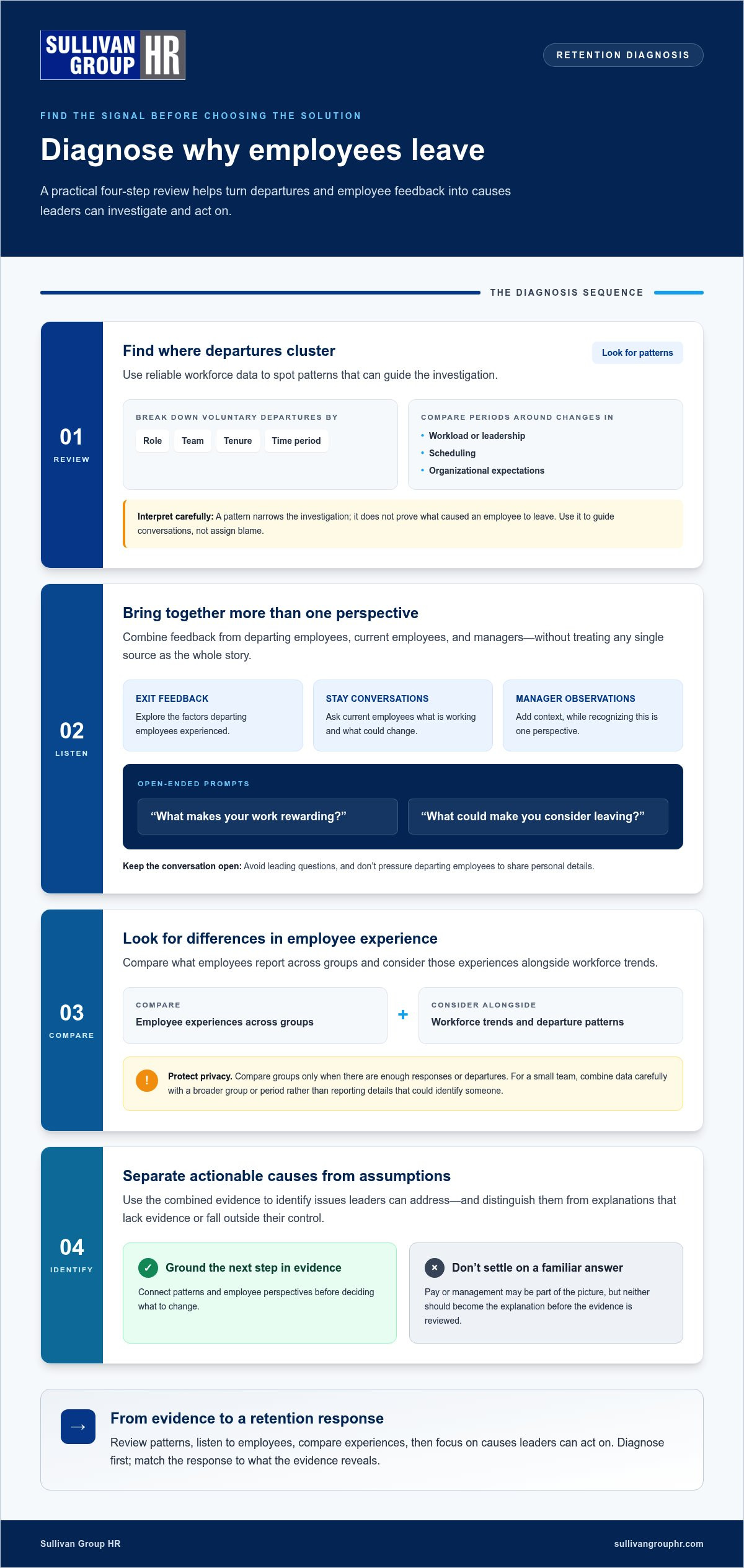
Before deciding what to change, find out where departures cluster and what employees say about their experience. A practical diagnosis combines four steps: review patterns, listen to employees, compare experiences, and identify causes leaders can act on. This keeps a familiar explanation, such as pay or management, from becoming the answer before you have evidence.
- Review patterns: Examine voluntary departures by role, team, tenure, and time period, using reliable data.
- Listen: Bring together exit feedback, stay conversations, and observations from managers.
- Compare: Look for differences in employee experiences across groups and alongside workforce trends.
- Identify actionable causes: Separate issues leaders can address from assumptions or factors outside their control.
Use turnover patterns to find where investigation should start
Start with questions your data can answer. Are departures concentrated in one role, among newer employees, or within a particular team? Compare periods before and after changes in workload, leadership, scheduling, or organizational expectations. Patterns can narrow the investigation, but they don’t prove what caused someone to leave. Use them to guide conversations, not assign blame.
Compare groups only when there are enough responses or departures to protect individual privacy. If a team is small, combine data carefully with a broader group or period rather than reporting details that could identify someone. The aim is to find a useful signal without turning an individual’s experience into a public case study.
Ask better questions through stay conversations and exit feedback
Current employees can reveal what may not appear in departure records. In stay conversations, ask open questions such as, “What makes your work rewarding?” and “What could make you consider leaving?” Avoid leading questions that steer people toward a preferred answer. Exit conversations can explore decision factors, but don’t pressure departing employees to share personal details. Manager observations add context, but they’re one perspective, not a substitute for employee feedback.
Exit feedback shows what departing employees experienced; current employees’ perspectives help reveal whether the same conditions are still present. Compare these sources, then check whether manager observations and workforce trends support or challenge the emerging picture. For example, comments about unpredictable schedules are more useful as a pattern when current employees raise the same concern and scheduling changes align with increased departures.
Close the loop. Share the themes employees raised, explain what leaders will address, and be honest about what may take longer or remain unchanged. Human resources consulting can help translate feedback into workable people practices, while managers remain essential to everyday follow-through. This evidence-first approach helps organizations improve employee retention with focused responses instead of generic fixes. HR consulting support can help turn employee feedback into practical next steps.
Which employee retention strategies fit the causes you uncover?
Once you’ve identified likely reasons employees leave, choose a response that addresses those conditions directly. Pay is important, but it isn’t the only factor. Raising compensation won’t automatically resolve unclear expectations, excessive workload, or weak manager communication. To improve employee retention, prioritize the issue employees actually experience, then watch for signs that the change is helping.
Use this comparison as a starting point, not a one-size-fits-all checklist. Select a signal you can observe and compare over time.
| Diagnosed cause | Potential response | Signal to monitor |
|---|---|---|
| Unclear growth paths | Clarify role expectations and development steps; discuss mentoring or internal opportunities. | Development conversations, internal movement, and feedback about growth. |
| Heavy workload or scheduling concerns | Review staffing, priorities, and whether workable flexibility is possible. | Workload feedback, schedule concerns, and departures in affected roles. |
| Inconsistent manager support | Set regular check-ins and clear expectations for timely communication. | Employee feedback about manager access and follow-through. |
| Recognition feels uneven | Make recognition timely, specific, and connected to meaningful contributions. | Feedback about whether contributions are noticed and valued. |
| Compensation concerns | Review pay practices for fairness and competitiveness across comparable roles. | Pay-related feedback and departures by role or team. |
| Benefits feel hard to use or understand | Review whether offerings are relevant and clearly communicated. | Questions, feedback, and themes raised about benefits. |
Match the response to the employee experience
Specific concerns call for specific changes. If employees can’t see how to advance, clarify role expectations and build development conversations into manager routines. If schedules or workloads are recurring concerns, review staffing and priorities before assuming employees simply need to work harder. Where communication or recognition feels inconsistent, establish dependable check-in and feedback practices. Keep the action manageable, name an owner, and explain what employees should expect to change.
Balance compensation, benefits, and nonfinancial improvements
Fair, competitive compensation matters, but it can’t automatically repair poor management or unsustainable workloads. Benefits deserve the same thoughtful review: consider whether offerings suit employee needs and whether people understand how to access them. For practical ideas on aligning benefits with employee experience, explore this strategic employee benefits management guide.
Retention actions also depend on connected people practices, from hiring and onboarding to time and attendance and benefits administration. Technology can support consistent processes, but it doesn’t replace manager relationships. The human capital management strategic guide offers a broader look at how these parts fit together. Start with the cause that matters most, test a focused response, and use employee feedback to decide whether to adjust or expand it.
How to put employee retention improvements into practice
A useful finding only matters if it leads to a change employees can see. Keep the first effort focused: choose one priority, assign someone to move it forward, explain the plan, and set a date to review progress. A manageable pilot can reveal practical issues before you expand a change across teams or roles.
Turn priorities into specific actions and ownership
Translate a broad concern into a clear workplace action. If employees say expectations shift without warning, for example, a team might establish a consistent process for communicating priority changes. Then make the work visible and accountable:
- Select one priority: Choose a cause that matters to employees and that leaders can influence.
- Name an owner: Assign an accountable leader or team, not just a general department.
- Define the action: State what will change, who will carry it out, and how employees should experience the difference.
- Set a review date: Choose a realistic point to gather feedback and decide whether to adjust, continue, or expand the pilot.
- Communicate clearly: Explain what will change, what isn’t changing yet, and how employees can share feedback.
Be specific without promising an outcome you can’t guarantee. If the first step is a trial on one team, say so. Employees are more likely to understand the effort when leaders explain its scope, timing, and next check-in. Use what you learn to refine the approach before applying it elsewhere.
Equip managers to make retention practices consistent
Managers turn workplace priorities into everyday experiences. Give them practical guidance for setting expectations, recognizing contributions, sharing timely feedback, and holding useful development conversations. Regular check-ins can surface concerns early, but they aren’t a substitute for fixing systemic issues such as unclear policies, overloaded teams, or inconsistent scheduling.
Where scheduling or workforce processes affect employees’ day-to-day experience, review the process as well as the conversation. A workforce management solutions guide can help frame how workforce practices and technology support the people doing the work. Use tools to support consistency, not to replace a manager’s judgment or relationship with employees.
Retention efforts also begin before an employee settles into the role. Clear expectations during hiring, structured onboarding, and early manager check-ins can help new employees understand their responsibilities and where to get support. Explore the applicant tracking and onboarding guide for more on the employee journey before and during onboarding.
Consistent follow-through turns a good intention into a practice employees can recognize. To build a practical plan to improve employee retention, connect with Sullivan Group HR for HR consulting support.
How to measure employee retention and keep improving over time
Measurement turns retention efforts into a learning cycle. Track whether employees are staying and whether the changes you put in place are reaching them as intended. A single rate can show movement, but it can’t explain the whole story. Pair workforce measures with employee feedback, then review the evidence before deciding what to keep, change, or test next.
Choose measures that reveal progress without oversimplifying
Before comparing results, document the retention measure, the employee population it covers, and the reporting period. Keep those definitions consistent so a change in the calculation doesn’t look like a change in employee behavior. Pair retention with voluntary turnover, internal movement, and recurring feedback themes. Together, these measures can show whether people are leaving, finding opportunities inside the organization, or raising similar concerns.
Compare results over periods that make sense for the action you’re evaluating. Look at relevant roles or teams when the group is large enough to protect confidentiality. For smaller groups, combine data across a broader period or population rather than exposing individual experiences. Numerical patterns can point to questions, while employee comments help explain context and may reveal unintended effects.
Be cautious about cause and effect. If retention improves after a new manager check-in routine, that alone doesn’t prove the routine caused the change. Other conditions may have shifted too. Consider the timing, employee feedback, and whether the action was carried out consistently before drawing conclusions.
Build a repeatable review cycle with HR support
Set a recurring leadership review to keep the work moving. Use each review to answer a few practical questions:
- Was the planned action completed, and did employees experience it as intended?
- What changed in retention, voluntary turnover, internal movement, and feedback themes?
- What else may have influenced those results, and is more evidence needed?
- Should the organization continue, adjust, expand, or pause the action?
Check implementation before judging effectiveness. If managers haven’t had the guidance or time to follow a new practice, limited progress may reflect an execution gap rather than a poor idea. Capture decisions, owners, and next review points so leaders can follow through and employees can see that feedback led to thoughtful action.
HR consulting can help employers interpret feedback and strengthen consistent people processes. Support for payroll administration, employee benefits management, and workers’ compensation insurance can also help employers manage connected HR responsibilities. These services can support a considered strategy to improve employee retention, without treating any single change as a guaranteed fix.
For practical HR partnership, benefits management, and payroll administration, explore Sullivan Group HR support.
Build a workplace people can choose to stay in
Retention is shaped by the gap between what an organization promises and what employees experience day to day. Keep closing that gap, one thoughtful improvement at a time. Invite employees into the process, make progress visible, and let what you learn guide the next decision. Steady follow-through can help improve employee retention while building a workplace where people feel their contributions and needs are taken seriously.
Making that work takes both strong relationships and dependable people processes. Sullivan Group HR supports employers with HR outsourcing and human resources consulting, alongside benefits management, payroll administration, and access to isolved HCM capabilities such as applicant tracking and time and attendance. These resources can support consistent practices while managers focus on the human conversations that shape employee experience.
Ready to turn your priorities into practical next steps? Talk with Sullivan Group HR about practical HR support. A clearer path forward starts with one useful conversation, and your organization can build from there.
Frequently Asked Questions
How can a small business improve employee retention?
A small business can improve employee retention by making everyday expectations clear and consistently addressing a few high-impact employee concerns. Start with a simple review of recent departures and conversations with current staff. Then choose a practical change, such as clarifying who approves schedule changes or documenting how employees can take on new responsibilities. Assign an owner and revisit the change with employees to learn whether it’s helping.
Is compensation the most important factor in employee retention?
Compensation matters, but it isn’t automatically the most important factor for every employee or role. Someone who believes their pay is unfair may not be reassured by extra recognition, while a pay increase may not resolve chronic scheduling problems or a lack of trust in a manager. Consider pay alongside employees’ specific concerns. For example, review compensation feedback by comparable roles instead of assuming one organization-wide change will address every issue.
What are the most common reasons employees leave a company?
Common reasons include limited career progression, below-market compensation, poor management, and concerns about work-life balance. These issues can show up in different ways: an employee may see no path beyond their current role, feel unable to raise a concern with a supervisor, or struggle with competing work demands. Treat these as possibilities to investigate, not a diagnosis. Ask employees what influenced their decisions and compare themes across roles.
How do you calculate an employee retention rate?
Divide the number of employees from your starting workforce who remain employed at the end of the period by the number in that starting workforce, then multiply by 100. For example, if 40 of the 50 employees counted at the start are still employed at the end, the rate is 80%. Define how you handle transfers, leaves, and other workforce changes before calculating so future comparisons use the same rules.
Can employee benefits improve retention?
Yes, benefits can contribute to retention when employees find them relevant, understandable, and accessible. A benefit may have little practical value if employees don’t know it exists or find it difficult to use. Gather feedback about which offerings employees value and where communication is unclear. Then review how benefits are explained and administered. Benefits are one part of the employee experience, so consider them alongside compensation, management, and working conditions.
How often should managers conduct stay interviews?
There’s no single schedule that fits every workplace. Set a recurring cadence managers can maintain, then add conversations at meaningful moments, such as after a role change or when responsibilities shift. Keep stay interviews separate from performance reviews so employees can focus on what supports or challenges their decision to remain. Ask open questions, listen without rushing to defend a decision, and follow up on concerns that need attention.
What should an employer do after employee feedback identifies a retention problem?
First, acknowledge the feedback and determine whether it reflects an isolated experience or a broader workplace issue. Protect confidentiality when sharing themes, especially in small teams. Choose a response that addresses the underlying concern, assign responsibility, and explain what employees can expect next. If a requested change isn’t possible, say why and describe any alternative steps. Follow up with employees to check whether the response addressed the problem.


