

What if the strongest response to an employee concern is to pause before you act? A manager facing a complaint, conflict, leave request, or performance issue must balance empathy, consistency, and workplace risk, often without an HR professional nearby. On-demand HR advice for managers offers a practical way to think through the situation while leaving people decisions in your hands.
Employees expect fair treatment and clear answers. The challenge is knowing when to follow a familiar process and when to seek experienced HR guidance. A rushed response can create confusion; waiting too long can leave a concern unresolved.
This guide explains which employee matters call for HR input, what to prepare before seeking it, and how professional advice differs from HR software and internal procedures. It also looks at how consulting can connect with workforce information such as payroll, benefits, and time records. Sullivan Group HR provides human resources consulting alongside the isolved HCM platform, payroll administration, employee benefits management, and other HR services.
Key Takeaways
- Use on-demand HR advice for managers when an employee concern calls for judgment, not just a form or standard process.
- Improve the quality of HR guidance by separating what you observed from what you assume and organizing the key facts before you consult.
- Match the support to the need: software and manager self-service can support routine tasks, while sensitive situations may call for human judgment.
- Prepare for an HR conversation by noting the urgency, relevant policies, actions already taken, and when a decision is needed.
- HR consulting can work alongside HCM and HR administration, connecting manager guidance with workforce information and operations.
When Managers Need On-Demand HR Advice for Employee Decisions
An employee raises a concern just before a meeting. A pattern of missed shifts is affecting the team. A performance conversation that seemed straightforward suddenly becomes sensitive. Managers are expected to respond thoughtfully, but acting without enough context can lead to uneven treatment or avoidable workplace risk.
On-demand HR advice for managers provides practical, situation-specific guidance for a workplace decision. It is more than access to a library of forms. A manager can explain what happened, identify the decision ahead, and get help considering the facts, relevant processes, and reasonable next steps. A routine coaching question may fit an established process. A sensitive complaint or serious employee concern calls for closer professional input.
Which manager decisions benefit from HR guidance?
Consider seeking guidance when addressing performance concerns, recurring attendance patterns, conflict between coworkers, or an employee complaint. These situations can involve competing accounts, team dynamics, and policies that need to be applied consistently. Early input can help you decide what to document, who needs to be involved, and what you should avoid promising before you understand the facts.
For example, an employee says a colleague’s comments have made work uncomfortable. Rather than immediately confronting the colleague or dismissing the concern as a misunderstanding, acknowledge the report, make a factual note of what the employee shared, and seek HR guidance on an appropriate next step. This response takes the employee seriously without jumping to conclusions. Routine coaching about setting expectations may need less support; a complaint that raises substantial employee or business risk deserves careful assessment.
What on-demand HR advice is, and what it is not
Useful consultation is grounded in context. It helps a manager think through the situation, relevant workplace processes, possible options, and information that may still be needed. A form or HR platform can organize records and make information easier to find, but it cannot weigh the details of a specific conversation or replace professional judgment. For a broad introduction to HR’s role and functions, see this Human Resources Overview.
HR information explains the process; professional judgment helps apply it to the people and facts in front of you. That distinction matters when a manager’s question does not fit neatly into a template. Advice can support a fair, consistent workplace response, but it is not a substitute for legal counsel when legal advice is needed.
A useful test: if you can resolve the matter through a clear, established coaching process, follow it and keep an appropriate record. If the facts are unclear, the concern is sensitive, or the potential impact feels serious, pause and seek HR input before deciding what to say or do. Asking early is a responsible way to manage the situation with care and sound judgment.
How HR Advice Helps Managers Assess Sensitive Workplace Situations
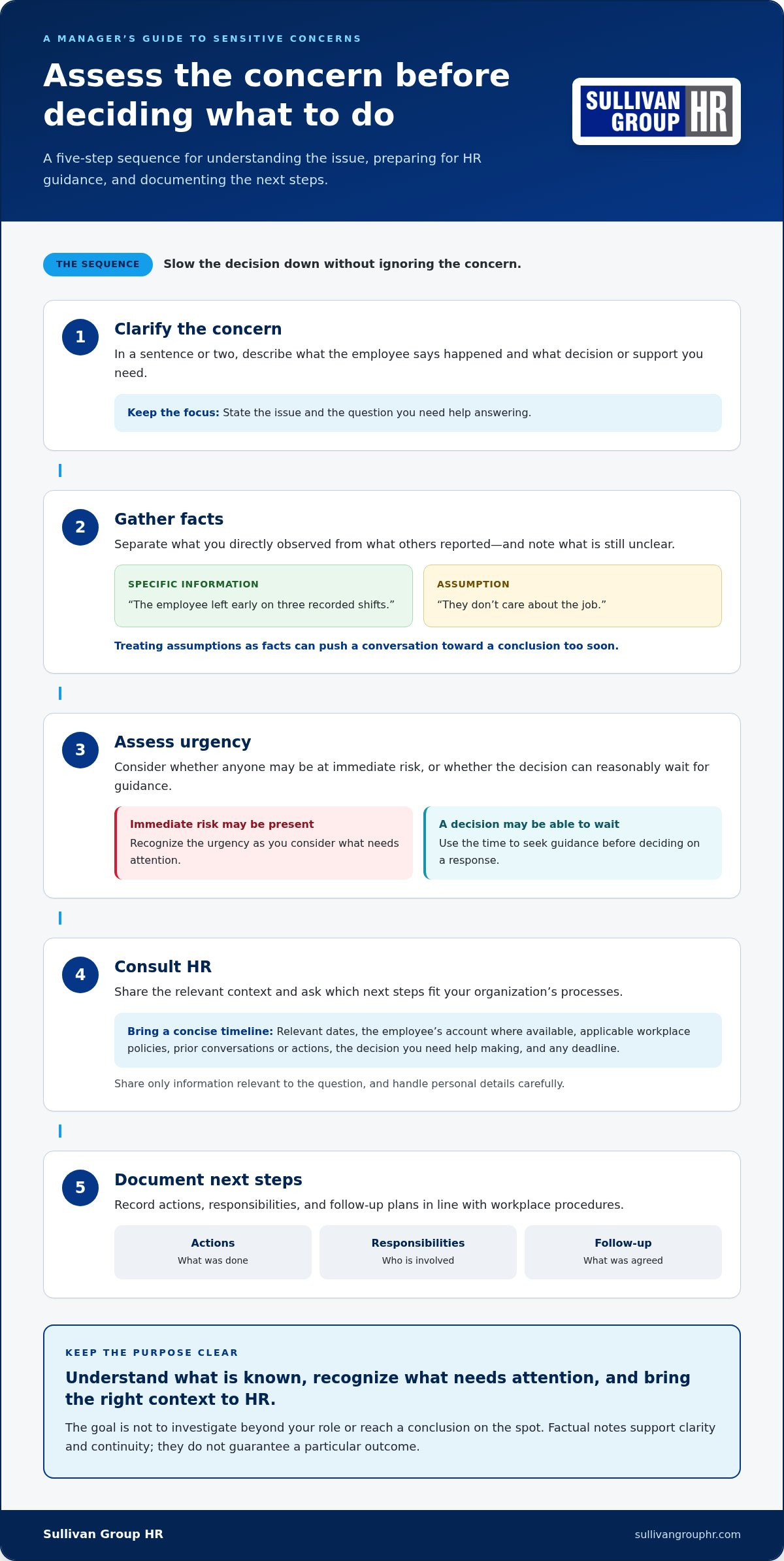
A sensitive employee concern can arrive with missing details, strong emotions, and pressure to respond quickly. A clear assessment process helps you slow down the decision without ignoring the issue. The goal is not to investigate beyond your role or reach a conclusion on the spot. It is to understand what is known, recognize what needs attention, and bring the right context to an HR consultation.
Use this sequence to prepare:
- Clarify the concern. In a sentence or two, identify what the employee says happened and what decision or support you need.
- Gather facts. Note what you directly observed, what others reported, and what remains unclear. Keep assumptions separate from firsthand information.
- Assess urgency. Consider whether anyone may be at immediate risk or whether a decision can reasonably wait for guidance.
- Consult. Share the relevant context and ask what next steps fit your organization’s processes.
- Document next steps. Record actions, responsibilities, and follow-up plans in line with workplace procedures.
Separating fact from interpretation makes advice more useful. “The employee left early on three recorded shifts” is specific information. “They don’t care about the job” is an assumption. Treating assumptions as facts can steer a conversation toward a conclusion before all sides are understood. Seek guidance before acting on incomplete information, so your next step responds to what you know rather than what you suspect.
What information should a manager prepare?
Bring a concise timeline: relevant dates, the employee’s account where available, applicable workplace policies, and prior conversations or actions. Include the decision you need help making and any deadline. Share only information relevant to the question, and handle personal details carefully. A short, factual summary helps an HR professional understand the sequence without burying the key issue in unrelated background.
Consistent notes can help managers treat similar situations with care and apply workplace processes more evenly. Record what was reported, what you observed, when conversations occurred, and what follow-up was agreed. Avoid loaded descriptions or speculation. Documentation supports clarity and continuity; it does not guarantee a particular outcome or replace a thoughtful review of the circumstances.
When should a manager escalate rather than act alone?
Seek HR input promptly when a concern involves safety, discrimination, harassment, possible retaliation, or conduct that is recurring or serious. For example, if an employee says their schedule changed after they raised a concern, do not assume the reason or make a unilateral decision. Preserve relevant facts and ask HR how to handle the matter appropriately. Applicable federal and state requirements can vary and change, so verify current rules with qualified HR or legal professionals when they may apply.
For managers who need help turning sensitive workplace questions into practical next steps, human resources consulting provides professional guidance. Keep the focus on listening, facts, and a clear record. That steady approach helps employees feel heard and gives the organization a more consistent way to respond.
HR Advice, Internal HR, and Software: Which Support Fits the Need?
Different workplace questions call for different kinds of support. A clear procedure or HR system can make routine tasks easier, while a situation with sensitive details may need a person who can interpret context. The question is not whether software or people are better. It is which support fits the decision in front of you, and whether several types should work together.
| Support model | Human judgment | Process consistency | Administrative support | Fit for sensitive matters |
|---|---|---|---|---|
| Internal HR | Can consider employee and workplace context | Can align advice with internal policies | May coordinate HR processes and records | Useful when the issue needs context-specific guidance and internal knowledge |
| External HR consulting | Offers an experienced outside perspective | Can help managers apply a considered approach | May connect advice with broader HR administration | Useful when internal HR support is limited or a situation needs careful discussion |
| HR software | Does not independently interpret a person’s circumstances | Supports repeatable workflows and recordkeeping | Can organize information and routine tasks | Helpful for records and processes, but not a substitute for judgment |
| Manager self-service | Relies on the manager to interpret available guidance | Works best with clear procedures and familiar tasks | Can make policy or process information accessible | Less suited to complex or fact-specific concerns without HR input |
Sullivan Group HR combines human resources consulting with HCM supported by isolved. For managers who need practical guidance alongside connected HR administration, Sullivan Group HR consulting brings those needs together.
When software or internal processes may be enough
For routine recordkeeping, time tracking, policy access, or repeatable administrative workflows, software and established internal procedures provide useful structure. A manager handling a familiar time-entry question, for instance, can follow the documented process and record the outcome consistently. These tools reduce friction and support reliable administration. They do not assess every sensitive, fact-specific employee situation.
When professional HR consulting adds value
Consulting is useful when you need to talk through context, weigh possible next steps, or plan how to document and communicate a decision. On-demand HR advice for managers adds a human perspective when a standard workflow leaves important questions unanswered. If the issue touches payroll, benefits, or another workforce process, HR guidance can connect the people question with the relevant administration.
Think of these support models as partners, not substitutes. Software can surface records and keep workflows organized. Internal procedures can establish a consistent starting point. HR professionals can help managers interpret circumstances and choose a thoughtful path. A sensitive concern may involve all three: use the system for relevant information, follow the appropriate process, and consult a professional before deciding how to proceed.
A Manager’s Practical Checklist for Getting Useful HR Advice
A useful HR conversation starts with a clear question. Before seeking on-demand HR advice for managers, identify the decision ahead, what information you have, and what you still need to understand. This preparation keeps the discussion focused and gives the HR professional a more accurate picture of the situation.
A clear question and factual timeline turn a complicated concern into a more useful conversation. Use this checklist before, during, and after seeking guidance:
- Urgency: Is anyone’s immediate safety or well-being at risk? Does the matter require prompt attention?
- Decision: What do you need to decide, communicate, or do next? When is that decision due?
- Facts: What happened, when, and who was involved? Separate what you observed from what someone else reported.
- Policies: Which workplace policy or established process may apply?
- Prior actions: What conversations, follow-up, or steps have already taken place?
Before the conversation: organize facts and the decision needed
Start with a short summary of the issue and the outcome you are trying to support, such as deciding how to respond to a concern or what information to gather next. Then make a factual timeline. Include relevant dates, prior communications, policy references, and the employee’s account where available. Mark secondhand information as such. Avoid deciding what the facts mean before you have discussed them.
Share only details that help answer the question, and use appropriate care with confidential employee information. A concise summary is often more useful than a large file of unrelated records. If you are assessing broader workplace risk, a structured review of relevant policies, processes, and records can help identify where additional attention is needed.
After the conversation: communicate, document, and follow up
Before wrapping up, make sure you understand the recommended next steps and any open questions. Note who is responsible for each action, what needs to be communicated, and when to follow up. If guidance depends on a detail you have not confirmed, clarify how to handle that gap before moving ahead. A short written recap can help you and HR stay aligned.
Keep the record factual, secure, and limited to information relevant to the workplace matter. Document the decision process, agreed actions, and follow-up, but do not create unnecessary copies of sensitive details or add speculation. Use your organization’s recordkeeping practices. Then revisit unresolved concerns at the agreed point; one conversation does not automatically mean the issue is closed.
Managers looking for a practical partner on employee questions can explore Sullivan Group HR consulting. Bringing a clear question, relevant facts, and a defined decision deadline helps make guidance more focused and actionable.
How Sullivan Group HR Connects Manager Guidance with HR Operations
A manager’s question may touch more than one part of the employee experience. An attendance concern, for example, can involve a conversation with an employee as well as time records and established workplace processes. Sullivan Group HR brings human resources consulting together with HCM and HR administration, helping organizations connect people-focused guidance with the operations that support it.
A human partner supported by connected HR capabilities
Consulting can sit alongside practical administration across the employee lifecycle. Recruiting needs can involve applicant tracking; scheduling questions can connect to time and attendance; pay concerns may call for payroll administration; and employee questions about workplace benefits can involve benefits management. Workers’ compensation is another related capability. Each area has its own processes, but managers benefit from understanding how a people issue connects with the broader operation.
Sullivan Group HR provides access to isolved for human capital management. The platform helps organize workforce information and administrative processes. It does not replace a conversation with an HR professional when a manager needs to understand the context of an employee concern. The platform supports operations; human judgment helps make sense of the situation.
These capabilities fit within outsourced HR and human resources management, where HR support connects with day-to-day business operations.
What managers can expect from a considered HR partnership
A supportive HR partnership starts with listening to the manager’s question and understanding the relevant context. Consulting can then help clarify options, consider appropriate communication, and connect the issue with applicable HR processes. The aim is practical guidance that respects the people involved and helps managers approach similar situations consistently, not a software prompt or a one-size-fits-all answer.
Sullivan Group HR combines HR consulting with integrated people-operation capabilities. For managers, that means employee questions can be considered alongside relevant workforce processes, whether the topic relates to recruiting, time records, payroll, or benefits. Each situation still calls for attention to its own facts; connected operations provide useful context, not an automatic decision.
On-demand HR advice for managers offers a professional perspective for thinking through the next step, supported by HR administration and HCM tools where relevant. Sullivan Group HR provides human resources consulting, payroll administration, employee benefits management, workers’ compensation insurance, applicant tracking, and time and attendance support.
Make Confident People Decisions Part of How You Lead
Every employee conversation shapes more than one moment. It can influence trust, team communication, and how confidently managers handle the next concern. Make thoughtful decision-making part of your leadership practice: create room to pause, ask for perspective, and follow through with care.
Accessible on-demand HR advice for managers can help turn that practice into a steady habit. Managers do not have to carry every difficult decision alone, and asking for guidance is a responsible step toward stronger leadership. The goal is not to remove your judgment from the process. It is to help you use it with greater clarity and support.
If your managers would benefit from a practical partner as they handle employee matters, explore how Sullivan Group HR can support your managers. With the right partnership, your team can approach people decisions with greater confidence and treat employees thoughtfully.
Frequently Asked Questions
What does on-demand HR advice for managers include?
It includes practical HR guidance when a manager needs help thinking through an employee-related decision. A manager might ask how to approach a difficult performance conversation, what workplace process may apply, or how to coordinate an issue that affects payroll or attendance. The goal is to clarify considerations and possible next steps. The advice supports managerial judgment; it does not make the decision for you.
When should a manager contact HR about an employee issue?
Contact HR when the concern feels sensitive, the facts are disputed, or a decision could affect an employee’s well-being or the organization. For example, pause before changing an employee’s duties after they raise a complaint, especially if the reason for the change is unclear. HR can help you consider the context and appropriate process. If safety or possible legal concerns arise, seek qualified guidance promptly rather than relying on guesswork.
Can small businesses get HR advice without hiring a full-time HR manager?
Yes. A small business can use external human resources consulting or HR outsourcing to access professional support without adding a full-time HR manager. The right arrangement depends on the organization’s needs and which HR responsibilities it wants support with. For example, a business might use consulting for manager questions while relying on outsourced administration for payroll or benefits. This can add expertise while keeping internal roles and decision-making clear.
How should managers prepare for an HR consultation?
Write down the decision you need to make and what makes it difficult. Bring the relevant policy or process, key communications, and dates that explain the sequence. If different people describe an event differently, label each account rather than blending them into one version. A concise, neutral summary helps the HR professional focus on the issue and identify useful follow-up questions without sorting through unrelated employee information.
Is HR software enough to handle employee questions?
HR software can help managers find policies, maintain records, and complete routine workflows, but it cannot reliably interpret every employee’s circumstances. A system may show attendance entries, for example, while a manager still needs to understand the context behind a pattern and decide whether to seek guidance. Use technology to organize information and support consistent administration. Bring in a person when judgment, communication, or competing accounts matter.
What is the difference between HR consulting and HR outsourcing?
HR consulting provides professional input on a particular question or workplace need. HR outsourcing involves having an external firm handle or support designated HR functions, such as payroll administration or benefits management. The approaches can work together: a manager may need guidance on an employee matter while the organization also relies on outside administrative support. Sullivan Group HR provides consulting and outsourcing supported by access to the isolved HCM platform.
How can managers handle confidential employee information when seeking HR advice?
Share only details needed to understand and address the workplace question, and use the organization’s approved channels and recordkeeping practices. Avoid forwarding unrelated messages or including personal details that do not affect the issue. Keep notes factual, limit access appropriately, and do not promise absolute confidentiality before understanding the applicable process. If you are unsure what information to share, ask HR how to provide the relevant context responsibly.


