

What if the hardest part of FMLA compliance isn’t understanding one rule, but applying the right process every time an employee needs leave? Coverage and eligibility involve separate tests, and inconsistent notices, records, or leave tracking can leave HR teams unsure what to do next. FMLA compliance consulting can help turn those moving parts into a clearer, repeatable process, with practical support for the decisions and administration behind each request.
A policy on paper is only a starting point. Employers also need a consistent way to respond to requests, document decisions, track leave, consider overlapping obligations, and plan for an employee’s return to work. This guide explains the core federal FMLA rules employers need to understand, including employer coverage, employee eligibility, notices, and leave administration. It also shows how to organize a dependable process and how coordinated HR guidance, payroll administration, time and attendance capabilities, and workforce systems can support it. The goal is a process your team can follow with greater clarity and care, not a promise that one tool or checklist can resolve every situation.
Key Takeaways
- Learn how employer coverage and employee eligibility tests shape FMLA responsibilities.
- Follow a clear leave-administration sequence, from recognizing a request to planning for an employee’s return.
- Understand why forms or HR platforms alone can’t replace consistent decisions, documentation, and manager handoffs.
- Use a practical checklist to review policy, ownership, request intake, notices, records, and training.
- Explore how FMLA compliance consulting and coordinated HR resources can help organize a more dependable process.
FMLA Compliance Consulting: Which Employers and Employees Does the Law Cover?
FMLA compliance consulting helps employers organize how they assess federal leave coverage and employee eligibility. These are separate questions, and confusing them can lead to missed obligations or incorrect decisions about an employee’s request. Human resources guidance can help establish a consistent review process; specific legal interpretations may require qualified legal counsel.
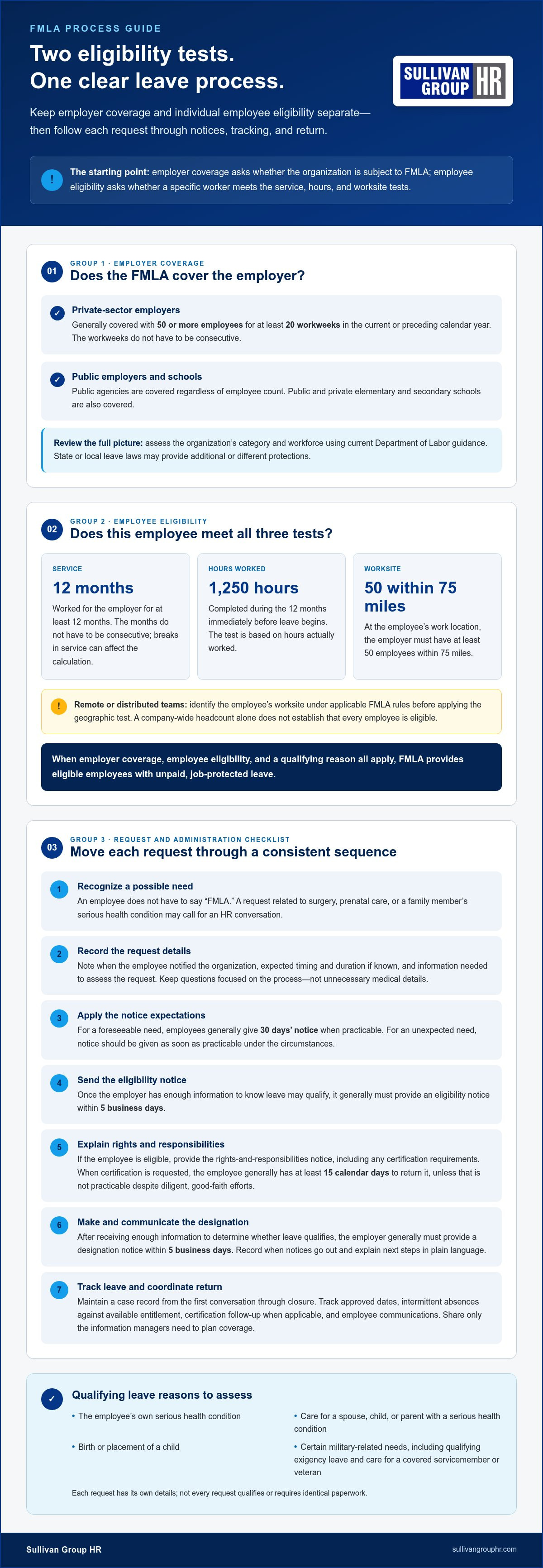
Employer coverage asks whether the organization is subject to the FMLA; individual eligibility asks whether a particular employee meets the law’s service, hours, and worksite tests. If both apply and the reason for leave qualifies, the FMLA provides eligible employees with unpaid, job-protected leave. The Family and Medical Leave Act of 1993 offers historical background on the law and its central protections.
How do employers determine whether FMLA applies?
For a private-sector employer, federal FMLA coverage generally applies when the employer had 50 or more employees for at least 20 workweeks in the current or preceding calendar year. The workweeks do not have to be consecutive. Public agencies are covered regardless of employee count, as are public and private elementary and secondary schools. Assess the organization’s category and workforce against current Department of Labor guidance rather than relying on a headcount snapshot alone.
Federal coverage isn’t the whole picture. State or local leave laws may provide additional or different protections, so include applicable rules when shaping policies and evaluating requests. A clear coverage review gives HR a sound starting point. Revisiting it as headcount or operations change helps keep the assessment current.
Which employees may qualify for FMLA leave?
At a covered employer, an employee generally must have worked for the employer for at least 12 months and completed at least 1,250 hours of service during the 12 months immediately before leave begins. The 12 months of service don’t have to be consecutive, although breaks in service can affect how the requirement is calculated. The hours test is based on hours actually worked, so HR should use reliable time and attendance records.
The employee must also work at a location where the employer has at least 50 employees within 75 miles. For remote or distributed teams, identify the employee’s worksite under the applicable FMLA rules before applying that geographic test. Don’t assume that a company-wide headcount automatically makes every employee eligible.
For example, a private employer that meets the 50-employee, 20-workweek coverage threshold may be covered. But an employee at a particular worksite could still fail the individual eligibility test if fewer than 50 employees are employed within 75 miles, even if the employee meets the tenure and hours criteria. Conversely, meeting the employee tests doesn’t by itself establish that an employer is covered. Reviewing both questions separately helps HR make a consistent initial assessment.
How FMLA Leave Moves from Employee Request to Return
A dependable leave process gives each request a clear path: recognize a possible need, assess eligibility, explain next steps, track the leave, and coordinate the return. Employees don’t have to say “FMLA” for an employer to learn of a potentially qualifying need. A request for time off for surgery, prenatal care, or a family member’s serious health condition, for example, may call for a prompt HR conversation.
FMLA may cover an employee’s own serious health condition, care for a spouse, child, or parent with a serious health condition, birth or placement of a child, and certain military-related needs. Military leave includes qualifying exigency leave and leave to care for a covered servicemember or veteran. The details matter, so don’t assume every request qualifies or requires identical paperwork. The U.S. Department of Labor’s The Employer's Guide to the Family and Medical Leave Act explains employer responsibilities and the federal process.
What should happen after an employee raises a possible leave need?
Start by recording when the employee notified the organization, the expected timing and duration if known, and the information needed to assess the request. Keep questions focused on the leave process, not unnecessary medical details. If the need is foreseeable, employees generally should provide 30 days’ notice when practicable. For an unexpected need, notice should be given as soon as practicable under the circumstances.
Once the employer has enough information to know leave may qualify, it generally must provide an eligibility notice within five business days. If the employee is eligible, provide the rights-and-responsibilities notice, including any certification requirements. When certification is requested, the employee generally has at least 15 calendar days to return it, unless that isn’t practicable despite diligent, good-faith efforts. After receiving enough information to determine whether leave qualifies, the employer generally must provide a designation notice within five business days. Record when notices go out and explain each next step in plain language.
How should HR track leave through return to work?
Build a case record that follows the leave from the first conversation through closure. Track approved dates, intermittent absences against the employee’s available entitlement, notices, certification follow-up when applicable, and communications with the employee. Use a consistent method to share only the information managers need to plan coverage. Keep medical information confidential and separate from ordinary personnel records, consistent with applicable requirements.
Before the expected return, confirm the date and explain any applicable return-to-work steps. A fitness-for-duty certification may be required for an employee returning from leave for their own serious health condition if the employer has a uniformly applied policy or practice and has provided the required notice. Apply that requirement consistently and handle any restrictions or changed circumstances carefully. Eligible employees generally have restoration rights to the same or an equivalent position, subject to FMLA rules.
Timely, consistent documentation creates a clear record of what was communicated, considered, and done. FMLA compliance consulting can help HR teams shape a repeatable workflow, while human resources consulting can support clear ownership and employee communication throughout the process.
FMLA Compliance Risks: Where Good Intentions Become Process Gaps
A completed form or an HCM platform can support leave administration, but neither makes decisions for HR. A system may store dates and records; people still need to recognize a possible FMLA request, apply the right rules, and respond consistently. FMLA compliance consulting can help employers examine how responsibilities, tools, and human judgment work together, without treating software as a substitute for case-specific review.
Small gaps can have practical consequences. A delayed notice may leave an employee unsure of next steps. Inconsistent tracking can make intermittent absences hard to reconcile with available leave. Incomplete records or a weak handoff between HR and a supervisor can also lead to conflicting messages. Employers should take care not to discourage an employee from using protected leave or retaliate for requesting or exercising FMLA rights. A concern should prompt a careful, documented review, not assumptions about intent or outcome.
Which FMLA administration mistakes deserve an immediate review?
Look for missed notice timelines, inconsistent decisions about whether leave is designated as FMLA, intermittent absences that aren’t captured reliably, and manager communications that conflict with HR guidance. Similar requests may have different facts, but unexplained differences in how they’re handled can undermine employee trust and create avoidable employee-relations risk. Use a documented escalation path when facts are unclear: preserve the timeline, identify the open question, assign an HR owner, and seek qualified legal interpretation when needed.
| Process gap | Operational impact | Corrective control |
|---|---|---|
| Late or missing notices | Employees may not understand their status or responsibilities. | Assign notice ownership and review dated case records. |
| Inconsistent leave tracking | Intermittent time away may be recorded unevenly. | Set a consistent method for recording and reconciling absences. |
| Incomplete records or handoffs | HR and managers may act on different information. | Document decisions and clarify what managers need to know. |
| Unreviewed requests or comments | Possible interference or retaliation concerns may go unnoticed. | Escalate concerns promptly for impartial review. |
How do FMLA, ADA, and other leave rules intersect?
One absence can raise questions under more than one law, but the tests aren’t interchangeable. The Americans with Disabilities Act may require an individualized reasonable-accommodation review, which can include considering leave in some circumstances. State or local leave laws may also offer separate protections. Military-related situations can involve FMLA provisions and, depending on the facts, USERRA rights concerning military service and reemployment. Assess each applicable rule on its own terms rather than assuming one decision resolves them all.
For broader prevention practices, employers can connect leave administration to their wider HR risk management guide. Clear ownership, consistent records, and thoughtful escalation help teams spot process gaps while leaving complex legal interpretations to qualified counsel.
A Practical FMLA Compliance Checklist for HR Teams
A useful review tests whether your written policy matches what actually happens when an employee needs leave. Start with the routine process, then examine how individual cases are handled. FMLA compliance consulting can help employers clarify ownership, spot handoff gaps, and build a repeatable review without treating every employee’s circumstances as identical.
What belongs in an employer's FMLA process review?
Review the process at regular intervals and when responsibilities or systems change. Confirm that policies and employee communications are current, forms are accessible, and everyone knows who handles intake, eligibility review, notices, records, and escalation. Check that managers know how to route a possible leave request promptly instead of making decisions on their own.
Use this audit sequence to make the review practical:
- Policy and communication: Compare written policies, employee-facing explanations, and forms with the organization’s current process.
- Ownership and escalation: Name the HR contact responsible for each step and establish where uncertain or sensitive cases go for review.
- Request intake and notices: Check that the process captures key dates, assigns follow-up, and records required communications.
- Records and confidentiality: Review where leave records are stored, who can access them, and how medical information is kept confidential and separate from ordinary personnel records.
- Manager readiness: Train supervisors to recognize possible leave needs, share them with HR, and avoid discouraging or penalizing protected leave.
A useful FMLA file brings together the request timeline, eligibility and designation records, notices, certification and follow-up when applicable, leave usage, and return-to-work communications. For recurring process reviews, look for patterns such as missed handoffs or inconsistent time entry. For an individual case, assess its specific facts and refer questions requiring legal interpretation to qualified counsel.
How can HR systems support consistent administration?
Systems can help organize workforce records and support consistent coordination, but they don’t determine whether a request qualifies or replace HR judgment. Review how approved dates and intermittent absences move from HR to timekeeping, and how relevant information reaches payroll so records and pay practices can be handled consistently. Keep access limited to appropriate roles, especially for sensitive medical information.
Payroll administration and HR processes work best when responsibilities and information handoffs are clear. Employers reviewing those connections can explore payroll administration outsourcing as part of broader workforce administration planning. Access to an HCM platform, payroll administration, and time and attendance capabilities can complement HR guidance, with people responsible for applying the process to each case.
Use this checklist to guide a practical process review with Sullivan Group HR’s human resources consulting, focused on clarifying responsibilities and coordinating workforce administration.
How FMLA Compliance Consulting Supports a More Dependable HR Process
A dependable leave process needs more than a policy document. It takes clear ownership, practical workflows, and communication employees and managers can follow. FMLA compliance consulting can help employers review how those pieces fit together, identify where responsibilities are unclear, and organize HR administration around the organization’s operating needs.
The goal is a process people can use consistently, not a promise that every case will be simple. HR guidance can help clarify who receives requests, coordinates notices and records, communicates with managers, and routes complex questions for further review. Clear roles also help prevent leave details from being lost between HR, payroll, and supervisors.
What should an employer expect from a consulting relationship?
A practical relationship starts with listening. An HR consultant can work with the employer to understand current leave procedures, administrative responsibilities, existing systems, and operational priorities. Recommendations can then focus on useful improvements, such as clarifying case ownership, improving employee communications, or tightening a handoff between HR and timekeeping.
That guidance should fit the organization’s existing HR and payroll workflows where possible. HCM access, payroll administration, and time and attendance capabilities can serve as coordinated workforce resources, while people remain responsible for reviewing circumstances and making appropriate decisions. Systems can support organized administration, but employers should not treat them as a substitute for HR judgment.
Support can also help teams distinguish routine process improvements from questions that depend on a particular employee’s circumstances or legal interpretation. HR consulting can help organize responsibilities and administration; it isn’t legal representation or a guarantee of compliance. The right approach combines useful structure with careful human judgment.
If your current process feels fragmented, start with a practical conversation about how leave requests move through your organization. A review of existing roles, handoffs, and workforce administration priorities can help identify where clearer coordination may make the process easier to manage.
How can an employer take the next step?
Bring a simple picture of your current process: who receives a leave request, how information moves between HR and payroll, and where managers need clearer guidance. You don’t need to have every answer before beginning. A focused discussion can help surface the administrative questions that matter most and identify where HR consulting and coordinated workforce resources may fit.
For practical guidance and coordinated support to strengthen your HR process, Explore Sullivan Group HR support.
Build a Leave Process Your Team Can Rely On
A leave process becomes more dependable when responsibilities are clear and the people managing them have practical support. Use your next review to identify one handoff, communication, or recordkeeping step that could be easier for employees and managers to follow. Then decide who will own the improvement and how your team will keep the process current.
FMLA compliance consulting can help turn that intention into coordinated HR practices. Sullivan Group HR brings together human resources consulting and HR outsourcing with payroll administration, employee benefits management, and access to the isolved HCM platform. These resources can support workforce administration while leaving case-specific judgment where it belongs: with informed people and, when needed, qualified legal counsel.
You don’t need to redesign everything at once. A focused conversation about your leave workflow and broader HR priorities can help clarify a practical next step. Explore HR consulting and workforce support.
Frequently Asked Questions
Is every employer required to provide FMLA leave?
No. Federal FMLA coverage generally applies to private employers that meet the law’s employee-count and workweek tests, while public agencies and elementary and secondary schools are covered regardless of size. An employee must also meet individual eligibility requirements before taking FMLA leave. Employers outside federal coverage may still have responsibilities under state or local leave laws, so account for applicable rules when responding to a request.
Can an employee take intermittent FMLA leave?
Yes. When medically necessary for a qualifying reason, eligible employees may generally take leave in separate blocks or on a reduced schedule, such as time away for recurring treatment. Leave to bond with a new child has different rules and may be taken intermittently only if the employer agrees. HR should record each qualifying absence consistently and follow the applicable certification and notice process.
How many employees must a business have for FMLA to apply?
A private-sector employer generally must have at least 50 employees for 20 workweeks in the current or preceding calendar year to be covered. Public agencies and elementary and secondary schools are covered regardless of headcount. An individual employee’s eligibility has a separate worksite test: at least 50 employees must work within 75 miles of the employee’s worksite. Company-wide headcount alone doesn’t answer both questions.
How long does an employee need to work before qualifying for FMLA?
Generally, the employee must have worked for the employer for at least 12 months and completed 1,250 hours of service during the 12 months immediately before leave begins. The 12 months of service need not be consecutive, but breaks may affect the calculation. The employee must also meet the worksite-based employee-count test and work for an employer covered by the FMLA.
What happens if an employer misses an FMLA notice deadline?
A missed deadline calls for prompt review and corrective action, not an automatic assumption that the request can be denied. Send any required notice as soon as practicable, document the reason for the delay, and assess whether it affected the employee’s ability to understand or use FMLA rights. FMLA compliance consulting can help identify workflow causes, while case-specific legal questions should go to qualified counsel.
Does FMLA leave have to be paid?
FMLA leave is generally unpaid, but an employee may choose, or an employer may require, available accrued paid leave to run concurrently with FMLA leave, subject to applicable rules. For example, an employee might use accrued vacation during an otherwise qualifying FMLA absence. State law, employer policy, or a collective bargaining agreement may affect how paid time interacts with protected leave.
Can FMLA leave run at the same time as ADA or state leave?
Sometimes. If an absence qualifies under FMLA and another applicable leave law, the periods may overlap, but each law has its own eligibility and protection tests. The ADA may require a separate reasonable-accommodation review, including consideration of additional leave in some circumstances. State and local rules also vary, so document the analysis for each law rather than treating one designation as a decision under every law.
What records should an employer keep for FMLA leave?
Keep a clear record of the employee’s leave dates and hours, notices sent and received, eligibility and designation decisions, and relevant communications. Track intermittent absences in a way that can be reconciled with timekeeping and payroll records. Store medical certifications and related information confidentially, with access limited to appropriate personnel. A consistent file helps HR explain what was decided and what follow-up remains.


