
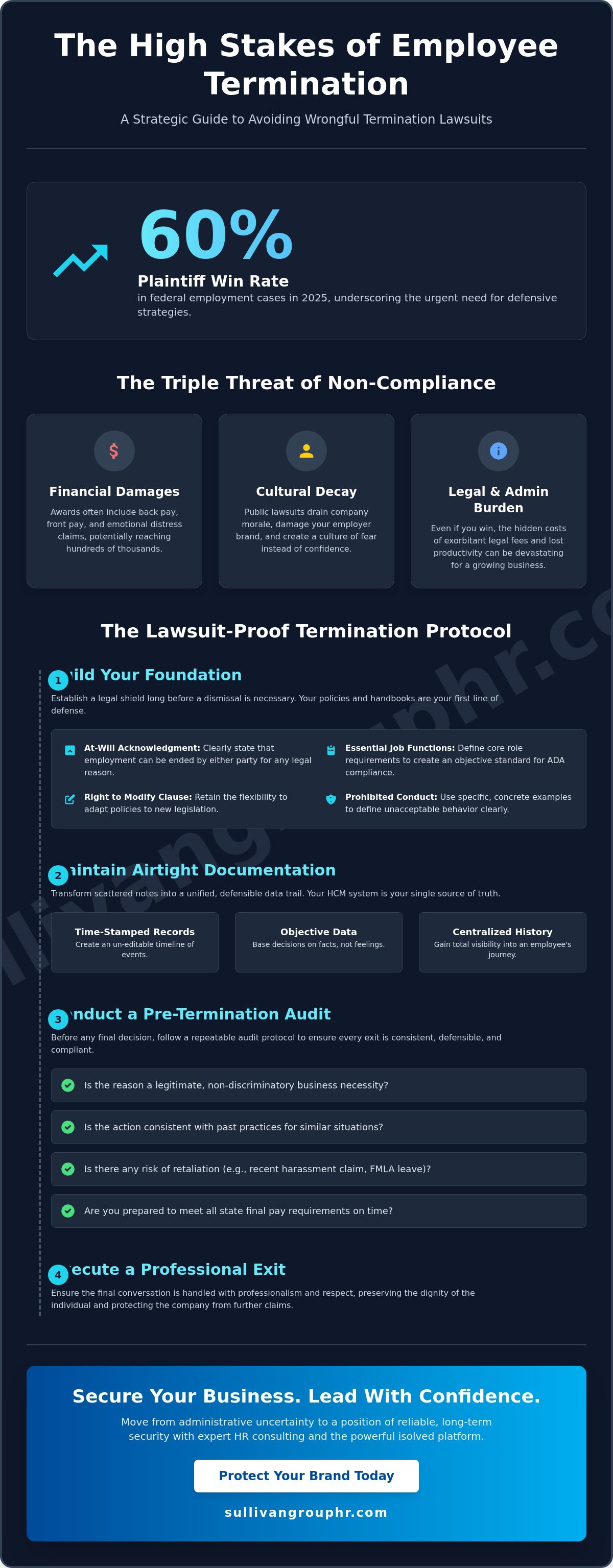
Did you know that the plaintiff win rate in federal employment cases climbed to 60% in 2025? It's a sobering statistic that underscores the urgency of avoiding wrongful termination lawsuits in an increasingly litigious environment. You likely feel the pressure of rising legal fees, complex new state mandates, and the constant fear that one inconsistent file could damage your brand. We believe you deserve to lead your team with confidence rather than caution.
This guide provides the strategic roadmap and HCM tools necessary to protect your business while maintaining a professional, supportive culture. You'll learn how to transform scattered notes into a unified, defensible data trail that proves legitimate business reasons for every exit. We'll explore how to build a repeatable process, integrate HR data for total visibility, and secure your organizational legacy. It's time to move from administrative uncertainty to a position of reliable, long-term security.
Key Takeaways
- Identify the specific EEOC protected classes and illegal termination triggers that often lead to costly, avoidable litigation.
- Learn how to transform your employee handbook into a legal shield by incorporating clear at-will agreements and essential job functions.
- Master the art of avoiding wrongful termination lawsuits by using integrated HCM technology to maintain time-stamped, objective documentation.
- Follow a repeatable pre-termination audit protocol to ensure every exit is consistent, defensible, and compliant with state final pay requirements.
- Discover how a professional partnership for HR consulting and isolved platform access simplifies risk management and protects your brand.
Understanding Wrongful Termination Risks in 2026
Do you feel confident that every termination in your company is legally sound? For many business owners, the fear of a single administrative mistake keeps them up at night. To succeed in avoiding wrongful termination lawsuits, you must understand that "at-will" employment isn't a blank check. It's a professional framework built on fairness, documentation, and compliance. Wrongful termination happens when an employer fires an individual for an illegal reason or violates a specific company policy during the exit process.
If you've ever asked, what is wrongful dismissal? it's helpful to view it through the lens of civil rights and contract law. The EEOC protects employees from being fired based on race, religion, sex, age, or disability. These "Protected Classes" are the bedrock of federal labor law. However, the most dangerous pitfall is often the "Retaliation Trap." This occurs when an employee is let go after participating in a protected activity, like reporting harassment or filing for workers' compensation. Even if the termination was planned for months, the timing can make it look like a retaliatory strike. It's a situation where the sequence of events matters as much as the reason itself.
We often see businesses stumble over the "Implied Contract" exception. You might tell a new hire, "As long as you do your job, you'll have a home here." While that sounds supportive, a court might view it as a verbal contract that overrides your at-will status. Your words, your handbook, and your actions must remain consistent. When these three elements align, you create a culture of security and clarity.
The High Cost of Non-Compliance
The price of a mistake is rarely just a settlement. You must account for three distinct burdens: financial damages, cultural decay, and legal defense. Financial awards often include back pay and front pay, but "emotional distress" claims can drive totals into the hundreds of thousands. Beyond the checkbook, a public lawsuit drains company morale and tarnishes your employer brand. Even if you win the case, the hidden cost of legal fees and lost productivity can be devastating for a growing business. Protective measures aren't just about law; they're about your company's survival.
Common Triggers for Litigation
What turns a routine exit into a legal battle? Usually, it's a lack of predictability. Sudden firings without prior performance warnings create a sense of injustice that leads employees to seek legal counsel. Inconsistent application of rules is another major trigger. If one manager ignores tardiness while another uses it as grounds for dismissal, you've created an opening for a discrimination claim. Finally, firing an employee while they are on FMLA or workers' compensation leave is a high-risk move that requires ironclad evidence. Understanding these patterns is the first step toward avoiding wrongful termination lawsuits and building a more resilient organization.
The Foundation of Defense: Policies and At-Will Agreements
Is your employee handbook a dynamic legal shield or a dusty relic sitting on a shelf? Building a strategy for avoiding wrongful termination lawsuits begins long before a dismissal meeting occurs. It starts with the three pillars of organizational safety: clarity, consistency, and communication. Without these, even the most justified termination can look like a violation of federal wrongful termination laws in the eyes of a jury. You need a framework that protects your legacy while supporting your people.
Every professional relationship should begin with an explicit "At-Will" acknowledgment. This document confirms that either party can end the employment relationship at any time, for any legal reason. While this doesn't grant permission to discriminate, it establishes the baseline for your defense. Similarly, your job descriptions must do more than list daily tasks. By clearly defining "Essential Functions," you create a vital record for ADA compliance. This ensures that if an employee can no longer perform the core requirements of their role, you have a documented, objective standard to reference. Our experts at the Sullivan Group can help you refine these critical documents to ensure they meet the highest standards of professional rigor.
Crafting a Compliant Employee Handbook
Your handbook serves as the "constitution" of your workplace. It should include a "Right to Modify" clause, allowing you to adapt to legislative changes without being locked into outdated procedures. Be specific when defining "Prohibited Conduct." Instead of vague terms, use concrete examples like "unauthorized disclosure of trade secrets" or "violation of safety protocols." A comprehensive yearly audit of your employee handbook ensures your policies remain aligned with evolving state and federal regulations. This proactive step transforms a simple document into a powerful tool for avoiding wrongful termination lawsuits.
Training Managers for Compliance
Your front-line supervisors are your greatest asset, but they are also your biggest liability risk. A single "off-the-cuff" remark during a performance review can be twisted into evidence of bias later. Managers must be coached to avoid making promises of "permanent employment" or "guaranteed raises." Instead, foster a "Culture of Consistency" where rules are applied the same way in every department. When your leadership team speaks with one voice, you eliminate the contradictions that plaintiff attorneys love to exploit. This alignment creates an atmosphere of reliable advocacy for both the company and the employee.
Leveraging HCM Technology for Airtight Documentation
Are you still relying on manila folders and handwritten notes to defend your business decisions? In a courtroom, a paper file is often seen as a collection of after-the-fact justifications. Digital HCM platforms like isolved change the narrative entirely. They provide a chronological, unalterable record of every interaction. This level of precision is your most effective weapon for avoiding wrongful termination lawsuits. When every disciplinary action and performance review is time-stamped, you remove the "he-said, she-said" dynamic that fuels litigation. Facts don't forget; people do.
Consider the impact of integrated data on your risk profile. By using "Time and Attendance" tools, you can prove attendance-based terminations with mathematical certainty. There's no room for debate when digital logs show a pattern of tardiness that violates clear company policy. Additionally, integrated payroll data ensures that all final wages, including accrued PTO, are calculated and paid correctly. This prevents the "Wage Theft" claims that often follow a dismissal. Understanding the federal laws on wrongful termination is essential, but having the data to back up your compliance is what wins cases. Precision, objectivity, and transparency are the three pillars of a modern defense.
Centralizing Employee Records with isolved
A "Single Source of Truth" ensures that everyone from HR to department heads sees the same data. This centralization is a core component of Human Capital Management. From the moment an employee is onboarded to their final exit interview, every document is stored in one secure location. This digital paper trail is searchable, organized, and ready for review at a moment's notice. It creates an atmosphere of reliable advocacy where facts take precedence over memory, protecting your business from the $528 million in pre-litigation recoveries the EEOC secured in 2025.
Performance Management and PIPs
How do you prove a "Legitimate Business Reason" for a termination? You do it through objective, ongoing performance management. Modern HCM tools allow you to track Performance Improvement Plans (PIPs) with granular detail. You can automate reminders for follow-up meetings, ensuring that no step in your progressive discipline policy is missed. This automation removes the administrative burden from your managers while building a defensible case. When you can show a consistent pattern of support and feedback that failed to produce results, you demonstrate that the termination was a last resort. This is the ultimate strategy for avoiding wrongful termination lawsuits and protecting your professional culture.
A Step-by-Step Protocol for Lawsuit-Proof Terminations
The moment of termination is the most vulnerable point in the employer-employee relationship. While your HCM data provides the foundation, the execution of the meeting determines your legal exposure. A disciplined, repeatable protocol is your best defense in avoiding wrongful termination lawsuits. Before the meeting begins, you must perform a final audit of the employee's file. Is the documentation consistent across all departments? Does the evidence support a legitimate business reason? With the EEOC securing $660 million for victims in fiscal year 2025, you cannot afford to overlook a single detail.
One of the most common legal tripwires is the "Final Pay" requirement. Many states require that an employee receives their final paycheck immediately upon termination. Failing to meet these deadlines, or miscalculating accrued benefits, can trigger wage and hour litigation that complicates an already sensitive situation. For example, as of January 1, 2026, California employers must include specific service coordination information in mass layoff notices. Professional rigor in these final moments ensures you remain a protective ally to your business's bottom line. If you need help managing these complex details, our experts at Sullivan Group provide the HR consulting necessary to navigate these high-stakes transitions.
The Termination Meeting Checklist
How you conduct the meeting is just as important as the reason for the firing. Always have a neutral witness present, preferably from HR, to document the conversation and provide a second perspective. Keep the meeting brief, factual, and neutral. This isn't the time for a performance review; it's a time for a final decision. You should never argue or debate the merits of the termination with the employee, as this only provides them with potential ammunition for a future claim. Focus on the logistics of the exit and remain a steady, professional presence.
Post-Termination Compliance
The work doesn't end once the employee leaves the building. You must immediately manage COBRA notifications and the cessation of benefits to stay compliant with federal regulations. Accuracy is paramount, especially regarding final compensation. You can find more details on managing these complexities in The Guide to Payroll Administration Outsourcing. Finally, ensure that all company property is returned and digital access is revoked across all platforms. This protects your data and brings a clean, professional close to the relationship.
Partnering with Sullivan Group for Long-Term Compliance
How much time do you spend worrying about legal fine print instead of growing your business? We believe your focus should stay on your team's potential and your company's vision. Partnering with an established regional expert is the most effective strategy for avoiding wrongful termination lawsuits. We provide the legacy of wisdom and the modern tools needed to navigate the complexities of 2026. This isn't just a service; it's an empathetic partnership designed to protect your professional legacy.
Our partnership grants you access to the isolved platform, a unified HCM solution that serves as your digital fortress. It integrates payroll administration, time tracking, and performance logs into one seamless record. This isn't just about automation; it's about total accuracy. When your data is unified, your risk is minimized. You gain the peace of mind that comes with knowing your payroll and benefits are handled with professional rigor, leaving no room for the administrative errors that often spark litigation. We focus on the safety of your systems so you can focus on the movement of your business.
We go beyond software to provide strategic risk management. This includes deep dives into workers' compensation insurance and thorough compliance audits that identify vulnerabilities before they become liabilities. We look for the gaps in your documentation and policies before a disgruntled employee does. This protective style of advocacy ensures your business remains a safe, professional, and profitable environment. By securing your organizational lifecycle, we help you maintain a culture of reliable advocacy for every member of your team.
Proactive vs. Reactive HR Management
Why wait for a summons to seek professional help? Many firms offer legal defense after the damage is done, but we focus on prevention. An "Expert Second Opinion" before you take a major disciplinary step can save you thousands in legal fees and months of stress. For a deeper look at our approach to safety, explore our HR Risk Management Guide. Outsourcing these burdens allows you to focus on growth while we focus on safety. It's a proactive shift from damage control to long-term security.
Ready to Secure Your Business?
Are you ready to trade administrative anxiety for professional peace of mind? We combine national-level technology with the personalized touch of a regional partner. Our team understands the specific nuances of our territory, offering a localized handshake that national firms simply can't replicate. We are approachable, community-oriented, and value your people over automated processes. Take the first step toward avoiding wrongful termination lawsuits by scheduling a compliance audit today. It's time to protect your legacy and your future. Protect your business with Sullivan Group HR.
Securing Your Organizational Future
Are you ready to move from a place of administrative anxiety to a position of long-term security? Protecting your business is about more than just reacting to conflict; it's about building a culture of clarity and consistency from day one. By prioritizing airtight documentation, leveraging unified technology like isolved, and following a disciplined termination protocol, you transform your HR department into a strategic shield. Avoiding wrongful termination lawsuits is a continuous journey that requires professional rigor and the right tools.
We provide the specialized HR consulting and risk management services you need to navigate the complexities of modern labor law. You gain the advantage of our national reach combined with a personalized, support-focused touch that values your people over automated systems. Let us handle the administrative burdens so you can focus on your company's growth and professional potential. Protect your business with Sullivan Group HR today. Your success is our primary metric, and we are honored to stand with you as a reliable ally.
Frequently Asked Questions
Is it possible to be sued for wrongful termination in an at-will state?
Yes, you can absolutely be sued in an at-will state if the termination violates federal or state laws. While at-will employment allows you to end a relationship for any legal reason, it doesn't protect you from claims of discrimination or retaliation. Most legal battles center on whether the real reason for firing was an illegal one. Maintaining a strategy for avoiding wrongful termination lawsuits requires understanding these specific legal boundaries.
What are the most common illegal reasons for termination?
The most frequent illegal triggers involve discrimination based on protected classes like race, age, disability, or religion. Retaliation is another major risk, occurring when an employee is fired for reporting harassment or filing for workers' compensation. Finally, you cannot fire someone for refusing to perform an illegal act or for exercising a legal right, such as voting or taking jury duty. These categories form the basis of most EEOC charges and litigation.
How long should I keep documentation after an employee is fired?
While federal laws like the FLSA require you to keep certain records for three years, many experts recommend maintaining termination files for up to seven years. This longer window protects you against various statutes of limitations for different types of legal claims. Digital storage makes this extended retention simple and organized. Keeping a complete history of performance reviews and disciplinary logs ensures you have a defensible record if a claim arises years later.
Do I need a Performance Improvement Plan (PIP) before firing someone?
A PIP isn't a legal requirement for at-will employees, but it's one of your strongest tools for avoiding wrongful termination lawsuits. It provides objective evidence that you gave the employee a fair chance to succeed and clearly documented their failure to meet standards. Without a PIP or similar progressive discipline, a sudden firing often looks like a pretext for discrimination. This structured approach demonstrates professional rigor and fairness to any reviewing body.
Can an employee sue for wrongful termination if they quit?
Yes, this is known as "constructive discharge." It occurs when an employee argues that the workplace was so hostile or intolerable that they had no choice but to resign. If a court agrees that a reasonable person would have felt forced to quit, the resignation is legally treated as a termination. This highlights the importance of maintaining a professional culture and addressing internal complaints immediately through your established HR consulting channels before they escalate.
What is the "implied contract" exception in employment law?
The implied contract exception happens when an employer's words or written policies create a reasonable expectation of job security. For example, telling an employee they'll "always have a job here" or having a handbook that suggests firing only occurs for "just cause" can override at-will status. Courts may view these as binding agreements. To protect yourself, ensure your handbook and offer letters contain explicit at-will disclaimers that cannot be modified by oral promises.
How can an HCM platform help defend against a lawsuit?
An HCM platform like isolved serves as your "Single Source of Truth" by providing a time-stamped, unalterable digital paper trail. It centralizes performance notes, training records, and disciplinary actions in one secure location. This objectivity is vital because it proves that your decisions were based on long-term data rather than a sudden, biased impulse. When you can present a chronological history of facts, you move from administrative uncertainty to a position of reliable advocacy.
What should I do if I receive an EEOC notice of a claim?
First, remain calm and avoid any direct contact with the former employee regarding the claim. You should immediately gather all relevant documentation, including the termination file, performance reviews, and any related logs from your HCM system. Notify your HR consulting partner or legal counsel to begin drafting a professional response. It's crucial to meet all EEOC deadlines and provide a factual, evidence-based narrative that explains the legitimate business reasons for the termination.


