
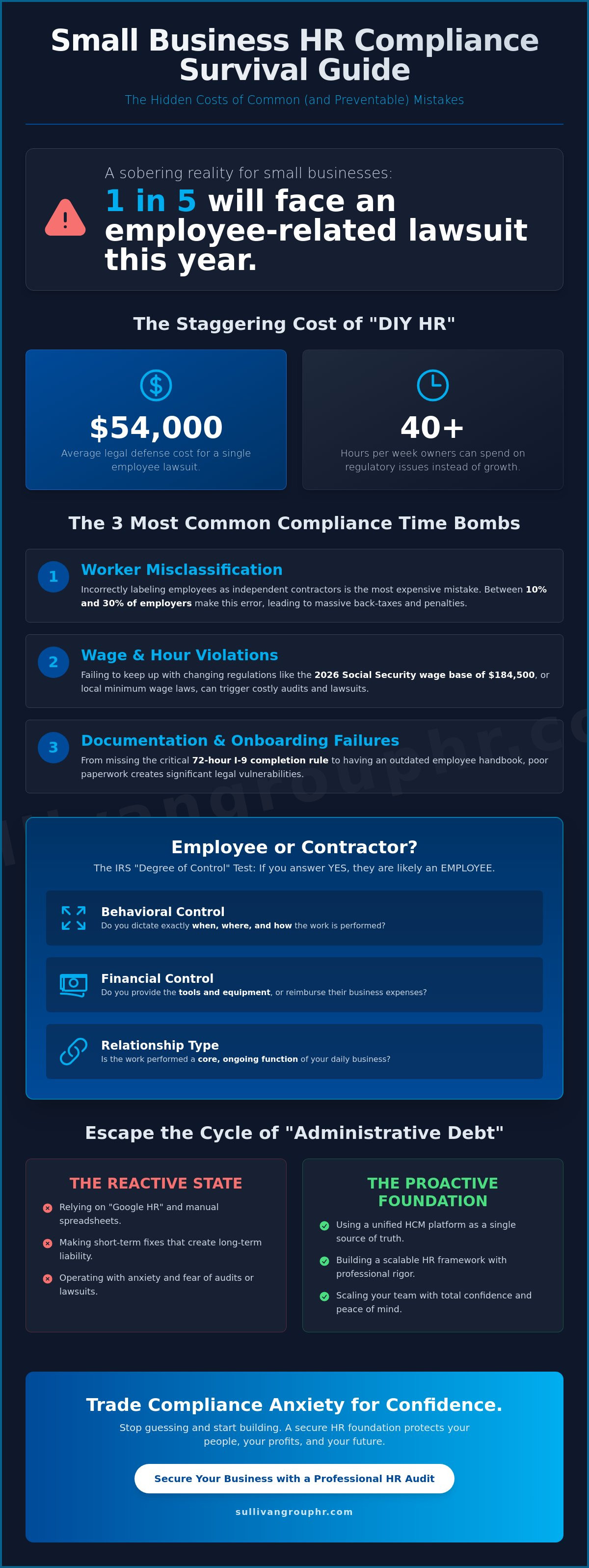
Did you know that one in five small businesses will face an employee-related lawsuit this year? It is a sobering reality for any owner trying to build a legacy in our community. Most of these legal headaches are not caused by bad intentions, but by common HR compliance mistakes by small businesses that fly under the radar. From missing the March 2nd OSHA electronic submission deadline to miscalculating the 2026 Social Security wage base of $184,500, the margin for error has never been thinner. A single oversight can lead to a $54,000 legal defense bill, draining the resources you worked so hard to earn.
You started your business to serve your clients and support your team, not to spend forty hours a week acting as a regulatory detective. We understand the weight of that responsibility. This survival guide will help you identify high-risk errors and fix them before they trigger an audit or a lawsuit. We will walk through a practical checklist to secure your payroll, update your documentation, and build a scalable HR foundation that protects your bottom line. It's time to trade your compliance anxiety for the peace of mind that comes with professional rigor.
Key Takeaways
- Identify and rectify common HR compliance mistakes by small businesses, specifically regarding the high-stakes risks of worker misclassification and salary thresholds.
- Learn how to transform your employee handbook from a dusty file into a protective "living document" that reflects current 2026 regulations and local laws.
- Master the critical 72-hour onboarding rule for I-9 and E-Verify to ensure every new hire is documented with precision and legal safety.
- Discover how a unified HCM platform replaces the vulnerability of manual spreadsheets with a single, secure source of truth for all your employee data.
- Move from a reactive state of "fear of the unknown" to a proactive structural foundation that allows you to scale your team with total confidence.
The Hidden Cost of DIY HR: Why Small Businesses Struggle in 2026
Many entrepreneurs believe they are flying under the radar. They assume that federal regulations only apply to the giants with thousands of employees and glass-walled headquarters. This is a dangerous myth. Whether you have five employees or fifty, the law does not offer a "small business pass" for common HR compliance mistakes by small businesses. In reality, the Department of Labor and the IRS are increasingly focused on the small business sector because that is where the most frequent errors occur.
The financial impact of a "do it yourself" approach is staggering. According to 2026 data from Keka, non-compliance costs organizations an average of $14.8 million annually when you factor in fines, lost productivity, and reputational damage. For a small firm, a single employee-related lawsuit costs an average of $54,000 just to defend, according to WifiTalents. That doesn't include the actual settlement or the back-taxes you might owe if your payroll wasn't handled with professional rigor. Relying on "Google HR" is equally risky; a search engine doesn't know your specific state laws or the 50 new employment laws that took effect at the start of 2026. To stay safe, you need a framework built on three pillars: People, Process, and Platform.
The Compounding Risk of Administrative Debt
Small business owners often cut corners to save time, promising to "fix the paperwork later." This creates administrative debt. Administrative debt is the long-term cost of short-term HR shortcuts. It starts with one misclassified independent contractor. Before you know it, that single error triggers a full-scale Department of Labor audit that scrutinizes every record you have. These small gaps in your documentation don't just stay small; they compound over time, gathering interest in the form of potential legal liability and government penalties.
Rhetorical Reality Check: Is Your Business Actually Protected?
If an auditor walked in today, could you produce an I-9 for every employee in 10 minutes? It's a simple question with heavy implications. Most owners operate with an "I think we're okay" mindset, but in the eyes of the law, "thinking" isn't a defense. There is a massive gap between feeling confident and being compliant. We see this daily at Sullivan Group HR. We act as your protective ally, moving you from the anxiety of the unknown to the security of the "I know." We replace manual spreadsheets and guesswork with a reliable, no-nonsense strategy that values your people as much as your systems. You deserve to focus on your professional potential, not your administrative burdens.
The Big Three: Misclassification, Wage, and Hour Pitfalls
Payroll is more than just a transaction; it is a complex legal commitment. Many owners treat it as a back-office chore, but this is where the most dangerous common HR compliance mistakes by small businesses often hide. For 2026, the Social Security wage base has increased to $184,500. If your systems are still calibrated to last year's numbers, you are already out of compliance. With nearly 50 new employment laws taking effect at the start of 2026, the margin for error has vanished. Are you confident your team is classified correctly, or are you sitting on a ticking financial time bomb?
The "Big Three" risks—misclassification, wage errors, and hour violations—account for the bulk of Department of Labor audits. Research shows that between 10% and 30% of employers misclassify at least some of their workers. This is not a minor clerical error. It is a fundamental legal failure that can lead to years of back-taxes and unpaid benefits. Whether you are navigating the federal minimum wage of $7.25 or managing higher local rates, your payroll must be precise, documented, and defensible.
The Independent Contractor Litmus Test
Misclassifying an employee as an independent contractor is the most expensive mistake you can make. The IRS and Department of Labor use a "degree of control" test to determine a worker's status. To protect your business, you must ask three critical questions:
- Behavioral Control: Do you dictate exactly when, where, and how the work is performed?
- Financial Control: Do you provide the tools and equipment, or do you reimburse all business expenses?
- Relationship Type: Is the work performed a core, ongoing function of your daily business operations?
Managing Remote and Multi-State Payroll
The rise of remote work has turned local businesses into multi-state employers overnight. This creates a "nexus" in every state where an employee resides. You cannot simply apply your local rules to an out-of-state hire. You must comply with the minimum wage, overtime thresholds, and sick leave laws of the employee's home state. Managing this complexity manually is a recipe for disaster. Many growing firms find that payroll administration outsourcing is the most scalable way to maintain accuracy across borders. Partnering with an expert for human capital management ensures these geographic nuances never impact your bottom line.
Finally, beware of the "off-the-clock" trap. Allowing a non-exempt employee to answer "just one email" after hours or skip a mandatory break might seem like a small favor for the business. It isn't. Under the law, if they are working, they must be paid. These "few extra minutes" can accumulate into massive class-action wage claims that threaten the very existence of your company. Precision is your best protection.
Documentation and the Employee Handbook: Your First Line of Defense
Is your employee handbook a shield or a target? Many owners view the handbook as a "one and done" project, often letting it gather dust for years. Neglecting the employee handbook is one of the most common HR compliance mistakes by small businesses. If your manual hasn't been updated since 2020, it is no longer a tool for protection; it is a significant liability. The legal landscape has shifted dramatically, especially with nearly 50 new employment laws taking effect at the start of 2026. A policy that was compliant four years ago could be an "implied contract" today that prevents you from managing your team effectively.
The danger of silence is real. When you lack clear, written policies on harassment, leave, or technology usage, you leave a vacuum. In the eyes of a judge or an auditor, that vacuum is almost always filled in favor of the employee. You need essential policies that reflect the modern workplace, including remote work expectations and digital privacy. Consistency is the final piece of the puzzle. Selective enforcement of your rules creates a trail of perceived discrimination. If you have a policy, you must follow it every time, for every person, without exception.
5 Compliance Red Flags in Your Current Handbook
Does your handbook still reference outdated FMLA language or lack a modern social media policy? These are red flags that attract regulatory scrutiny. You must also ensure your "at-will" status is clear and prominent. An explicit at-will employment disclaimer is a non-negotiable legal necessity that preserves your right to terminate the employment relationship for any lawful reason. Once your manual is updated, your work isn't finished. You must secure a signed acknowledgment from every employee for the latest version. Without a signature, you cannot prove they were ever aware of the rules they are expected to follow.
The Paper Trail: Why Documentation Trumps Memory
In the world of HR, if it isn't written down, it didn't happen. Relying on memory during a performance dispute is a recipe for a $54,000 legal defense bill. You need a standardized way to document performance issues, coaching sessions, and disciplinary actions. This isn't about creating "legal ammunition" against your team; it's about creating a fair, transparent record of the professional relationship. We recommend using a centralized system for human capital management to keep these records secure and accessible. Moving your documentation from scattered files to a unified platform ensures that your "paper trail" is always audit-ready and organized. It's about moving from reactive chaos to a culture of stable, reliable advocacy for your business.
Beyond the Basics: Benefits and Onboarding Compliance
Does your onboarding process build a bridge or a barrier? Most entrepreneurs view a new hire's first day as a celebration, but it's actually a high-stakes legal event. Falling behind on administrative tasks during that first week is one of the most common HR compliance mistakes by small businesses. Specifically, the I-9 "72-hour rule" is a frequent tripwire. For 2026, the current Form I-9 is the 01/20/25 edition, valid through May 31, 2027. However, you must ensure you're using the version with the 05/31/2027 expiration date for all new hires after July 31, 2026. Failing to verify employment eligibility within three business days isn't just a clerical lapse; it's a federal violation that can trigger heavy penalties.
Benefits compliance adds another layer of professional rigor. Between the Affordable Care Act (ACA) and ERISA reporting, the paperwork can feel overwhelming for a growing team. Missing a COBRA notification deadline by even a few days can cost thousands in excise taxes and potential medical claims. This is where the gap between a "DIY" approach and expert advocacy becomes clear. You need a partner who understands that benefits are about more than just insurance; they're about the long-term organizational security of your company and the well-being of your people.
Onboarding as a Compliance Engine
A structured applicant tracking and onboarding process does more than just fill seats. It automates the collection of essential data and ensures every checkbox is marked from day one. In a digital-first world, verifying eligibility through E-Verify is becoming a standard necessity. Using this initial phase to set a tone of professional rigor shows your new hires they're joining a secure, well-managed team. It builds trust by proving you value accuracy as much as you value their talent.
Benefits Compliance: More Than Just Health Insurance
Are you distributing the Summary of Benefits and Coverage (SBC) to your team as required? Small businesses often stumble here, or in the complex administration of 401(k) and HSA/FSA plans. These errors don't just upset employees; they invite federal audits. For deeper insights into protecting your team, explore our strategic benefits management solutions. We help you navigate these eligibility rules so you can focus on being a coach and ally to your workforce.
Finally, don't overlook the "Ghost Employee" risk. When an employee leaves, your compliance duties continue. You must remove system access immediately to protect company data and ensure all final pay and COBRA notices meet strict deadlines. A clean termination process is just as important as a warm welcome. If you're ready to professionalize your team management, our experts can help you implement a robust human capital management strategy today.
From Reactive to Proactive: The Integrated HCM Advantage
Manual spreadsheets are the enemy of growth. They invite human error and create fragmented data silos that hide common HR compliance mistakes by small businesses. In 2026, where regulatory complexity is at an all-time high, relying on manual entry is no longer just inefficient; it's a liability. A unified human capital management platform eliminates these risks by creating a single source of truth for your entire organization. When your payroll, benefits, and time tracking are integrated, you remove the double-entry errors that often lead to costly audits and missed deadlines.
The power of one cannot be overstated. By centralizing your data, you effectively close the gaps where common HR compliance mistakes by small businesses tend to occur. This transition allows you to identify risks before they impact your bottom line. You deserve a system that works as hard as you do, providing a structural foundation that enables you to scale with confidence and trust. It's time to trade the chaos of fragmented files for the clarity of an integrated solution that values people over processes.
Leveraging the isolved Platform for 2026
We provide more than just software; we provide a foundation for your professional potential. The isolved platform offers automated tax filing, real-time reporting, and employee self-service tools that empower your team. These features aren't just conveniences; they are essential safeguards for 2026 compliance. Whether you have 5 employees or are scaling toward 500, the platform grows with you seamlessly. We act as your navigator for the isolved technology suite, ensuring you leverage every tool to maintain professional rigor and organizational security.
Partnering for Success: The Professional HR Consultant
Technology is only half of the equation. You also need a no-nonsense expert who understands the nuances of your local territory and industry. Sullivan Group HR serves as your fractional HR department, offering the hard-earned wisdom of an established regional leader. We provide the human-centric touch that automated, tech-only competitors simply cannot replicate. Our partnership moves you away from the anxiety of administrative burdens toward a future of reliable advocacy. This is the ROI of peace of mind. You can finally stop fixing errors and start growing your legacy. Protect your business today with Sullivan Group HR and experience the security of a truly integrated partnership.
Secure Your Legacy with Professional Rigor
Compliance is not a legal burden to be feared; it is the structural foundation that allows your company to scale with confidence. We've seen how administrative debt accumulates through misclassification, outdated handbooks, and onboarding oversights. These common HR compliance mistakes by small businesses can be eliminated when you trade manual spreadsheets for an integrated strategy. You deserve to focus on your team's professional potential rather than worrying about the next audit or lawsuit. Furthermore, securing your personal legacy and family's future through the comprehensive estate planning resources provided by Natalie Green, P.C. provides the ultimate peace of mind for any entrepreneur.
Sullivan Group HR offers decades of regional expertise and a legacy of reliable, no-nonsense advocacy. As an authorized isolved HCM platform provider, we deliver a comprehensive suite of payroll, benefits, and risk management solutions tailored to your specific needs. We act as your coach and ally, ensuring your business remains protected in an ever-changing regulatory environment. It's time to move from a reactive mindset to a proactive partnership that values people over systems.
Secure Your Business Growth with Sullivan Group HR. Your vision deserves a secure foundation, and we're here to help you build it. Let's work together to protect your bottom line and empower your people for the long term.
Frequently Asked Questions
What are the most common HR compliance mistakes for small businesses?
The most frequent errors involve worker misclassification, improper overtime calculation, and failing to maintain an updated employee handbook. These common HR compliance mistakes by small businesses often stem from a lack of specialized knowledge. By neglecting the nuances of the "degree of control" test or local minimum wage hikes, owners inadvertently expose themselves to significant legal risk.
How much can HR compliance violations cost a small business in 2026?
Violations can be devastating, with the average small business facing $54,000 in costs just to defend a tort liability claim. Beyond legal fees, organizations lose an average of $14.8 million annually to fines and lost productivity. OSHA penalties as of January 15, 2026, can reach $16,550 per individual serious violation. These numbers prove that cutting corners on professional administration is a high-risk gamble.
Is an employee handbook legally required for small businesses?
While no federal law explicitly requires a written handbook, it is your most powerful tool for defending against lawsuits and audits. A handbook establishes clear expectations and ensures consistent policy enforcement across your team. Without these written guidelines, courts often interpret administrative silence in favor of the employee. It's the primary document used to prove you provided mandatory notices regarding harassment and leave.
What is the difference between an independent contractor and an employee?
The distinction depends on the degree of control you exert over how, when, and where the work is performed. If you provide the equipment and dictate the specific work methods, the individual is likely an employee. Misclassifying workers is one of the most expensive common HR compliance mistakes by small businesses. It leads to unpaid payroll taxes and potential back-pay for overtime hours worked.
How often should a small business update its HR policies?
You should review and update your policies at least once a year to keep pace with shifting regulations. Nearly 50 new employment laws took effect at the beginning of 2026 alone. Relying on a manual from several years ago leaves you vulnerable to outdated standards. Regular audits ensure your documentation reflects current federal, state, and local requirements.
Can I outsource HR compliance to a professional firm?
Yes, you can partner with an expert firm for human resources consulting and payroll administration. This approach provides a fractional HR department without the overhead of hiring multiple full-time experts. It allows you to focus on your professional potential while a dedicated ally handles the administrative rigor. Outsourcing ensures your business benefits from established regional wisdom and stable, no-nonsense advocacy.
What happens if a small business fails an I-9 audit?
Failing an I-9 audit can result in substantial fines for every missing or incorrect form. You must verify employment eligibility within 72 hours of a new hire's start date to remain compliant. For 2026, ensure you are using the I-9 version with a 05/31/2027 expiration date for all hires after July 31. Consistent errors suggest a pattern of negligence that investigators rarely overlook.
How does an HCM platform like isolved help with HR compliance?
An HCM platform like isolved centralizes your employee data to eliminate the risks associated with manual entry and spreadsheets. It automates tax filing, handles real-time reporting, and ensures benefits eligibility is tracked with precision. By creating a single source of truth, the platform removes the data silos that often hide compliance gaps. It's a scalable way to maintain professional rigor as your team grows.


