
Could a single administrative oversight or a $145-per-violation HIPAA error derail your growth plans this year? It's a question many business owners face as they struggle to keep pace with shifting federal mandates. Maintaining employee benefits compliance shouldn't feel like a constant battle against the clock. You've worked hard to build your legacy, and you deserve to focus on your people, your profit, and your future rather than drowning in manual tracking and complex paperwork.
We understand the burnout that comes with managing the new 9.96% ACA affordability threshold or the mandatory Roth catch-up rules for high earners. This article provides a clear, actionable roadmap to protect your business in 2026. We'll walk through essential retirement plan updates, health and welfare requirements, and the specific filings needed to stay audit-ready. You'll gain a streamlined way to manage your reporting and the peace of mind that comes from knowing your organization is secure. Let's look at the specific requirements you need to meet to stay protected and prepared.
Key Takeaways
- Learn how to transform federal mandates from a legal liability into a protective shield for your company’s long-term growth.
- Master the core frameworks of ERISA and the ACA to ensure your reporting remains accurate and timely throughout 2026.
- Safeguard your organization by navigating the latest HIPAA privacy standards and FMLA benefit coordination requirements with confidence.
- Audit-proof your documentation with a simple two-step process designed to keep your records organized and ready for any federal inspection.
- Discover how to streamline employee benefits compliance using automated tools that eliminate manual tracking and administrative burnout.
Why Employee Benefits Compliance is Your Business’s Silent Shield
Is your current benefits package a bridge to growth or a legal liability? This question often haunts business owners as they scale their teams. Employee benefits compliance is the diligent adherence to federal reporting, disclosure, and operational mandates. It's not just a set of rules; it's a protective framework. When you prioritize compliance, you're building a fortress around your company's assets and your professional reputation. This proactive approach ensures you're ready for the unexpected while proving to your team that you value their security as much as your own.
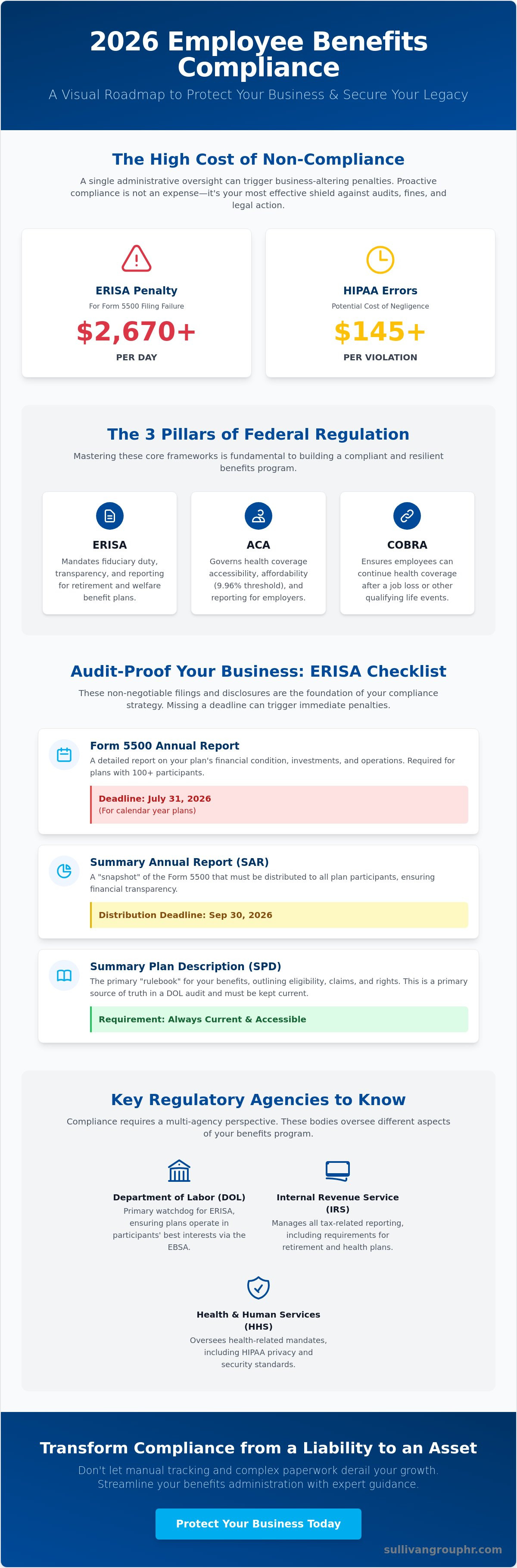
The financial stakes are too high to ignore. For example, ERISA penalties for failing to file a Form 5500 can exceed $2,500 per day. These aren't just minor slaps on the wrist; they're business-altering expenses. Beyond the numbers, there's a psychological weight to consider. Transparency in your benefits administration builds deep-seated trust. When employees know their health data is safe and their retirement funds are handled with fiduciary care, they feel more connected to your mission. Effective employee benefits compliance transforms a potential administrative nightmare into a strategic advantage that attracts and retains top talent.
The Cost of Compliance vs. The Price of Ignorance
Failing to meet reporting standards creates a domino effect of financial and operational stress. Form 5500 errors and ACA reporting mistakes often trigger immediate flags for federal auditors. You might also face hidden costs that don't appear on a fine schedule: lost productivity, mounting legal fees, and the emotional drain of a prolonged investigation. In a DOL audit, "I didn't know" is never a valid defense. Ignorance doesn't stop the clock on daily penalties or shield you from the scrutiny of federal agents. It's always more cost-effective to invest in proper systems today than to pay for remediation tomorrow.
Regulatory Bodies You Need to Know
Staying protected requires understanding who is watching. The Department of Labor’s Employee Benefits Security Administration (EBSA) is the primary watchdog for ERISA plans, ensuring they're operated in the best interest of participants. However, they aren't the only ones at the table. You must also coordinate with the IRS for tax-related reporting and the Department of Health and Human Services (HHS) for privacy standards. Total HR risk management requires a multi-agency perspective. We help you align these moving parts into a single, cohesive strategy that keeps your business safe, stable, and secure.
The Core Compliance Framework: ERISA, ACA, and COBRA Requirements
How do you ensure your benefits strategy is built on a rock-solid foundation? It starts with understanding the three pillars of federal regulation: ERISA, the ACA, and COBRA. These aren't just acronyms to fill space in an employee handbook. They represent the core of employee benefits compliance. ERISA mandates transparency. The ACA ensures accessibility. COBRA provides continuity. Together, they form a framework that protects your business from risk while supporting your team’s well-being.
Your Summary Plan Description (SPD) is your most vital disclosure tool. Think of it as the rulebook for your benefits. If it's outdated or missing, you're essentially flying blind. The U.S. Department of Labor treats the SPD as the primary source of truth during an audit. It must clearly outline eligibility, benefits, and the claims process. Keeping these documents current is a fundamental fiduciary duty that ensures you're operating solely in the interest of your participants. Utilizing professional employee benefits management can help you keep these critical documents updated as regulations shift.
ERISA Reporting and Disclosure Checklist
Maintaining ERISA standards requires a steady rhythm of reporting and communication. Missing a single deadline can trigger the daily penalties we discussed earlier. Focus on these three critical areas to stay secure:
- Form 5500: For calendar year plans, this is due by July 31, 2026. This filing is a non-negotiable requirement for plans with 100 or more participants.
- Summary Annual Reports (SAR): These financial snapshots must reach participants by September 30, 2026. They provide the transparency your employees expect.
- Fiduciary Responsibilities: You must act with care, skill, and diligence. This includes monitoring service providers and ensuring all plan fees remain reasonable.
ACA and COBRA: Staying Ahead of the Deadlines
Determining your status as an Applicable Large Employer (ALE) is the first step in ACA mastery. This is calculated based on your count of full-time equivalents (FTEs) from the previous year. If you hit the 50-employee threshold, the "Employer Mandate" applies to your organization. For plan years beginning in 2026, the ACA affordability percentage is 9.96% of household income. This is a critical figure for calculating employee contributions and avoiding "pay or play" penalties.
COBRA compliance is equally sensitive. Missing an election notice deadline is a fast track to litigation. With individual COBRA costs estimated at $750 to $850 per month in 2026, the financial stakes for former employees are high. They're more likely to notice errors when their coverage is at risk. Clear communication and automated tracking are your best defenses against these administrative pitfalls.
Navigating Privacy and Leave: HIPAA, FMLA, and Medicare Part D Obligations
Are you protecting your team's most sensitive information as carefully as your own? Beyond the financial filings of ERISA, employee benefits compliance extends into the deeply personal realm of health privacy and family leave. Privacy, protection, and parity are the three pillars that define a modern, compliant workplace. When you master these obligations, you do more than avoid fines. You create a culture of safety where employees feel respected and secure during their most vulnerable moments.
The regulatory landscape is shifting quickly. As of February 16, 2026, HIPAA protections have expanded to include specific safeguards for substance use disorder records in legal proceedings. This update reflects a broader federal push toward total participant security. For a complete look at these evolving requirements, the U.S. Department of Labor Compliance Guide serves as an essential resource for staying ahead of enforcement trends. We help you translate these complex rules into simple, repeatable workflows that safeguard your business and your people.
HIPAA Compliance in a Digital Workspace
In our era of digital records, protecting Protected Health Information (PHI) requires more than just a locked filing cabinet. You must implement physical, technical, and administrative safeguards to prevent data breaches. This includes maintaining up-to-date Business Associate Agreements (BAAs) with every vendor that touches your plan data. Training your team is equally vital. Even a simple Tier 1 "no knowledge" violation can cost $145 per instance. However, uncorrected willful neglect is far more damaging. As of January 28, 2026, Tier 4 violations now start at $73,011 per violation, with an annual cap exceeding $2.1 million. Consistent training ensures your staff handles sensitive benefits information with the rigor the law demands.
Coordinating FMLA and Medicare Notices
Managing leave and retirement notices requires precision timing. Under the Family and Medical Leave Act (FMLA), you must maintain an employee's health benefits during their unpaid leave as if they were still working. Failing to do so can lead to "interruption of coverage" claims that are both costly and damaging to morale. Simultaneously, you must keep an eye on the calendar for Medicare Part D. October 15th is the annual cutoff for notifying all Medicare-eligible participants of their creditable coverage status. Most employers remember the employee notice but forget the secondary disclosure to CMS. Linking these deadlines to your benefits management solutions ensures no filing falls through the cracks. Finally, remember that mental health parity is a top DOL priority for 2026. Your plan must offer mental health and substance use disorder benefits that are no more restrictive than your medical and surgical coverage. This focus on parity ensures every member of your team has equal access to the care they need.
Audit-Proofing Your Benefits: Documentation and Reporting Best Practices
If a Department of Labor auditor arrived at your office tomorrow morning, would you feel confident or cornered? Audit-proofing isn't about scrambling when a letter arrives. It's about building a defense-first strategy that makes employee benefits compliance a permanent, manageable part of your operations. By centralizing your data and automating your alerts, you transform a chaotic paper trail into a strategic shield. This proactive approach ensures that when regulators come calling, you have the answers ready, organized, and verified.
To achieve total organizational security, follow this four-step documentation framework:
- Step 1: Centralize all plan documents. Gather your wrap documents, insurance contracts, and trust agreements. Wrap documents are essential because they bridge the legal gap between your various insurance policies and specific ERISA requirements.
- Step 2: Establish a Compliance Calendar. Set automated alerts for every federal filing date. This simple step prevents the "I forgot" errors that lead to the daily fines we discussed in previous sections.
- Step 3: Conduct annual self-audits. Act like your own auditor. Look for missing notices, late enrollments, or inconsistencies before the government does.
- Step 4: Maintain a 7-year record retention policy. While ERISA generally requires six years, a seven-year buffer provides an extra layer of safety for all benefits-related data and participant communications.
Common Compliance Red Flags to Avoid
Auditors look for easy wins. One of the most common red flags is an inconsistent plan definition between your Summary Plan Description (SPD) and the actual insurance contract. If these documents don't match, you're vulnerable. You must also update plan documents within 60 days after any material reduction in benefits. Finally, never miss the 90-day window for providing SPDs to new participants. These small timing errors are often the first things a DOL investigator will check.
The Power of Digital Record Keeping
In a modern workspace, paper files are a liability. They're difficult to search, easy to lose, and a nightmare to organize during a site visit. Utilizing secure cloud storage for your applicant tracking and onboarding data ensures a clean digital thread from the day an employee is hired to their final benefit election. This digital approach allows for strict version control of your employee handbooks and ensures that every distributed notice is timestamped and archived. Ready to move from administrative burnout to organizational security? Our experts at Sullivan Group HR can help you automate these complex documentation functions today.
Strategic Benefits Management: Moving from Risk to Resilience
How do you turn a complex regulatory burden into a source of strength? Many owners see employee benefits compliance as a series of obstacles to overcome. At Sullivan Group HR, we see it differently. We transform compliance into a strategic shield that protects your assets and validates your commitment to your team. We don't just provide software; we provide the expert advocacy your business deserves to navigate the 2026 landscape with confidence. This partnership allows you to stop worrying about the "what ifs" and start focusing on your company's actual potential.
Our use of the isolved People Cloud allows for the automation of complex benefits calculations that often lead to administrative burnout. By moving away from manual tracking and into a unified human capital management system, you ensure that no regulation falls through the cracks. It's a human-first approach to HR technology. We believe that while systems provide the data, people provide the wisdom. Our team works alongside you to interpret that data, ensuring your benefits strategy is as robust as your business plan.
Integrated Success: Compliance Meets Technology
Success in 2026 requires unified data. When your payroll and benefits systems speak the same language, automating ACA reporting and COBRA notifications becomes a reality rather than a goal. You gain real-time visibility into enrollment status and eligibility tracking. This visibility is vital for managing the 9.96% ACA affordability threshold or the new mandatory Roth catch-up rules for high earners that we discussed previously. By eliminating fragmented systems, you drastically reduce the manual entry errors that serve as audit triggers for federal agencies. You move from a reactive state of "fixing" to a proactive state of "managing."
Your Partner in Long-Term Security
Choosing the right employee benefits packages for small business is about more than just coverage. It's about building a foundation for long-term organizational security. Our no-nonsense expertise acts as a direct extension of your leadership team. We provide the regional wisdom that large, national firms simply cannot replicate. We understand the specific nuances of your territory and the unique pressures your local business faces. Our legacy is built on your success. Focus on your professional potential; we'll focus on the protection. Together, we'll ensure your organization remains resilient, compliant, and ready for whatever the future holds.
Secure Your Legacy and Scale with Confidence
Is your organization ready to move beyond the fear of federal audits? We've explored how a proactive approach to ERISA, ACA, and HIPAA standards acts as a silent shield for your growth. By centralizing your documentation and adopting a digital-first strategy, you eliminate the administrative burnout that often leads to costly oversight. Total organizational security isn't just about following rules. It's about creating a culture of stability where your team feels protected and your leadership feels empowered.
Maintaining employee benefits compliance requires a partner who understands the local landscape and the technical rigor of modern HR. Since 1998, we've provided the expert HR consulting and no-nonsense advocacy needed to protect regional businesses. With access to the industry-leading isolved HCM platform and our integrated payroll systems, you gain total visibility into every filing and enrollment. This visibility ensures no regulation falls through the cracks while you focus on your company's future.
Secure your business with Sullivan Group HR’s comprehensive benefits management today. You've worked hard to build your legacy. We're here to help you protect it and reach your full professional potential.
Frequently Asked Questions
What are the most common mistakes an employee benefits compliance checklist helps prevent?
A comprehensive checklist prevents missed filing deadlines, outdated plan documents, and the failure to distribute required participant notices. It specifically targets high-risk areas like the October 15th Medicare Part D notification and the July 31st Form 5500 deadline. By following a structured process, you avoid the inconsistent plan definitions that often trigger federal audits and lead to costly penalties.
If I use a broker or a payroll vendor, am I still legally responsible for compliance?
Yes, the employer remains the legal plan administrator and carries the ultimate fiduciary responsibility for the plan. While partners provide the tools and expertise to manage daily tasks, you're the one held accountable in a DOL investigation. This is why choosing an expert partner for employee benefits compliance is vital for your organization's long-term security and peace of mind.
What is the penalty for failing to file Form 5500 on time in 2026?
The ERISA penalty for failing to file a Form 5500 can exceed $2,500 per day for certain failures. These daily fines accumulate rapidly and can significantly impact your company's bottom line. Maintaining a strict compliance calendar is the most effective way to ensure you meet the July 31st deadline and protect your business from these avoidable financial hits.
How often should I update my Summary Plan Description (SPD)?
You must provide an updated Summary Plan Description to participants every five years if you've made any changes to the plan. If no changes have occurred, you still need to distribute a new SPD every ten years. However, you're required to notify employees of any "material reduction" in covered services or benefits within 60 days of the change taking effect.
Does benefits compliance change based on the number of employees I have?
Compliance requirements scale as your workforce grows. For instance, the ACA "Employer Mandate" applies once you reach 50 full-time equivalents, while Form 5500 filings are generally required for plans with 100 or more participants. We help you monitor these specific thresholds so you can focus on your professional potential without worrying about missing a new regulatory tier.
What is a Wrap Document, and do I really need one for my benefits plan?
A Wrap Document is a legal instrument that "wraps" around your existing insurance policies to ensure they meet ERISA's strict disclosure requirements. Most carrier-provided booklets don't contain all the legally mandated language. You need this document to bridge that gap and provide the total transparency that federal regulators expect during a routine plan review.
Can an automated HCM platform like isolved handle all my ACA reporting?
An automated HCM platform like isolved is designed to streamline complex employee benefits compliance tasks, including ACA data tracking and 1095-C generation. It monitors your ALE status in real-time and reduces the manual entry errors that often lead to audit flags. This technology ensures your reporting is accurate, timely, and fully integrated with your payroll and time-tracking data.
What should I do first if I receive a notice of a DOL audit?
Contact your HR consultant immediately to begin an internal review of your plan records. Your first step is to gather the specific documents requested, such as your SPD, Form 5500s, and any Business Associate Agreements. Don't volunteer extra information; focus on providing the requested data in an organized, professional manner that demonstrates your commitment to administrative rigor.


