
What if your most powerful growth tool wasn't a new marketing campaign, but your payroll? For many local owners, the struggle is real. You're fighting rising healthcare costs and the constant risk of losing your best people to corporations with deeper pockets. It's a heavy weight to carry. Finding the right employee benefits packages for small business shouldn't feel like a second full-time job. You deserve a solution that protects your culture, your compliance, and your time.
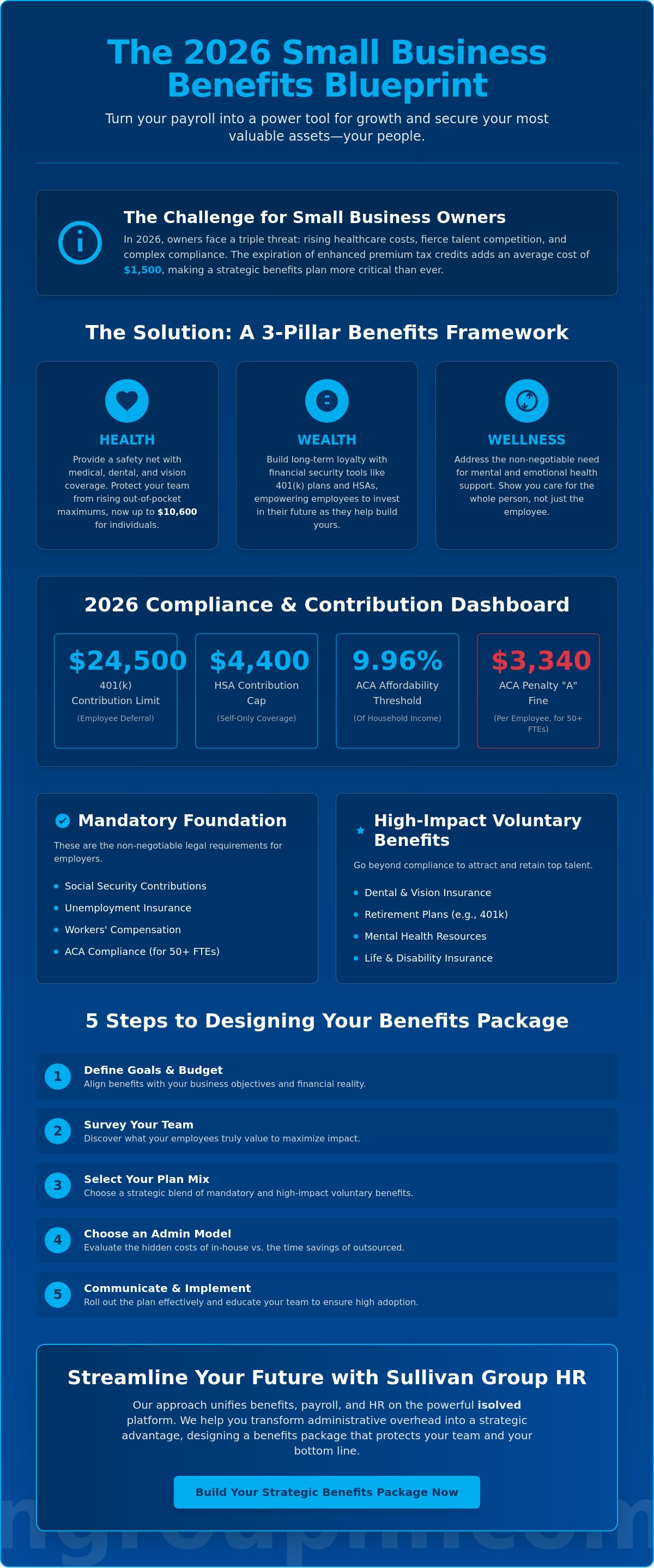
We understand the unique hurdles you face in 2026. With the expiration of enhanced premium tax credits potentially costing small business owners an average of $1,500, the stakes have never been higher. This guide shows you how to design, implement, and manage a benefits strategy that actually works for your budget. We'll break down the latest IRS updates, including the $24,500 401(k) contribution limit and the new $4,400 HSA cap for self-only coverage. You'll discover how to automate your administration, satisfy the 9.96% ACA affordability threshold, and turn your benefits into a strategic shield that secures your team and your future.
Key Takeaways
- Master the three-part framework of Health, Wealth, and Wellness to transform your benefits from a simple expense into a powerful retention tool.
- Identify the "Big Three" mandatory benefits you must provide to remain compliant while navigating complex ACA and FMLA thresholds.
- Learn a five-step process for designing employee benefits packages for small business that reflect your unique culture and respect your bottom line.
- Evaluate the hidden costs of in-house administration versus outsourced models to reclaim your time for high-level strategy.
- Discover how a unified technology approach using the isolved platform removes administrative silos and simplifies the entire employee lifecycle.
What Defines Competitive Employee Benefits Packages for Small Business in 2026?
Are you viewing your benefits as a bill or a bridge? In 2026, the most successful owners have stopped looking at employee benefits as a transactional cost of doing business. Instead, they see them as a holistic investment in the entire employee lifecycle. A competitive package is no longer just about offering a standard medical plan and hoping for the best. It's about creating a foundation of security that allows your team to focus on growth rather than survival.
To stay ahead, we recommend a three-part framework for your strategy: Health, Wealth, and Wellness. Health covers the essential medical, dental, and vision needs that keep your team physically capable. Wealth focuses on long-term security, utilizing tools like 401(k) plans with the 2026 contribution limit of $24,500 and Health Savings Accounts. Wellness addresses the mental and emotional health of your staff, which has become a non-negotiable requirement for the modern workforce. When you align these three pillars, you move from being a mere employer to becoming a protective ally.
The Shift from Perks to Protection
In 2026, employees aren't looking for flashy office perks; they're looking for a buffer against market volatility. With rising out-of-pocket maximums reaching $10,600 for individuals, your team needs to know they won't be bankrupted by a single health crisis. Security is the primary emotional driver for talent today. By offering high-value employee benefits packages for small business, you provide a sense of stability that national corporations often fail to deliver with their sterile, one-size-fits-all approaches. In 2026, a robust benefits strategy serves as your primary strategic growth lever, turning administrative overhead into a shield for your most valuable assets.
Recruitment and Retention in the Small Business Sector
The cost of turnover is a silent killer for small companies. Replacing a key team member often costs significantly more than the annual premiums for a robust benefits plan. You can level the playing field with Fortune 500 competitors by focusing on personalization. While big firms offer rigid systems, you can offer a culture where benefits feel like a supportive handshake. This psychological impact is profound. When an employee feels their family's health and future are protected by their workplace, their loyalty shifts from a paycheck to a partnership. This human-centric approach to Employee Benefits Management is exactly what keeps top talent from jumping ship when a larger firm comes calling.
The Buying Guide: Mandatory vs. Voluntary Benefit Components
How do you build a safety net that satisfies federal requirements while still delighting your team? Constructing competitive employee benefits packages for small business requires a clear eye for both legal obligations and cultural differentiators. You must first secure the foundation. Every employer must contribute to Social Security, provide unemployment insurance, and maintain workers' compensation insurance. These are non-negotiable. To ensure you're covering every base, consult the SBA Guide to Employee Benefits for a full checklist of federal hiring responsibilities.
Once the foundation is set, you move into the voluntary space. This is where you transform a job into a career. Voluntary benefits like dental, vision, and retirement plans aren't just "extra" anymore. They are the tools you use to protect your staff from life's unexpected turns. A 401(k) plan, for instance, is a powerful retention anchor. With the 2026 employee contribution limit rising to $24,500, you provide a clear path for your team to build long-term wealth while they help you build your business.
Legal Requirements and Compliance Thresholds
Size matters when it comes to compliance. If you reach the 50 full-time equivalent (FTE) employee mark, the Affordable Care Act (ACA) mandate kicks in. Failing to offer minimum essential coverage can result in a Penalty A fine of $3,340 per employee. Beyond federal rules, state-specific mandates for disability or paid family leave can catch local owners off guard. Ignoring these thresholds leads to more than just fines; it damages your reputation as a reliable employer. Staying compliant ensures your business remains a safe harbor for your workers.
High-Impact Voluntary Benefits for 2026
Modern employees seek holistic support. Mental health resources and Employee Assistance Programs (EAPs) have moved from "nice-to-have" to essential. You might also consider financial wellness tools or student loan repayment assistance to alleviate the stress that often follows your team into the office. Don't overlook flexible work arrangements. It's a zero-cost benefit that offers massive returns in morale and work-life balance.
Integrated Health Solutions: HSA, FSA, and HRA
Tax-advantaged accounts are a win-win for your budget and your people. For 2026, the HSA contribution limit for self-only coverage is $4,400, while the Health FSA limit is $3,400. These accounts empower employees to manage their own care with pre-tax dollars. Implementing these through benefits management solutions simplifies the administrative burden. It keeps your data organized and your employees informed. If you feel overwhelmed by these acronyms, our team at Sullivan Group HR can help you choose the strategy that fits your unique tax profile.
Evaluating Administrative Models: In-House vs. Outsourced Management
Who really manages your benefits? Is it you, or is the paperwork managing you? Many small business owners believe that keeping administration in-house is the most cost-effective path. In reality, the hidden costs of manual management often outweigh the perceived savings. When you manage employee benefits packages for small business yourself, you're not just handling health insurance. You're juggling compliance, data entry, and employee questions that never seem to end. This creates the "HR Team of One" dilemma. You spend your day fighting fires instead of building your business.
A professional partnership provides the protective rigor you need to grow safely. By utilizing Human Resources Consulting and Payroll Outsourcing, you shift the burden to experts who live and breathe these regulations. This transition ensures your business remains a secure harbor for your team while you focus on high-level strategy. It's about moving from a transactional vendor relationship to a long-term partnership that values people over systems. We focus on three core areas to help you succeed: compliance, cost, and culture.
The Burden of Manual Benefits Administration
Manual administration is a trap that steals your most valuable resource: time. Consider the hours spent on open enrollment, tracking COBRA notices, and reconciling monthly carrier bills. In 2026, paper-based systems or disconnected spreadsheets are more than just slow. They're a liability. One manual data entry error in a payroll file or a tax document can trigger a chain reaction of audits and fines. These "hidden" costs accumulate quickly, draining your bottom line and increasing your administrative burden. You can't afford to let manual processes put your legacy at risk.
- Enrollment Friction: Manual forms lead to lost data and frustrated employees.
- Compliance Risk: Missing a single regulatory update can result in thousands of dollars in penalties.
- Data Silos: When payroll and benefits don't talk to each other, errors are inevitable.
The Strategic Advantage of HR Outsourcing
Outsourcing your benefits management isn't just about offloading tasks. It's about gaining a competitive edge. When you partner with an expert, you gain access to group purchasing power that typically remains out of reach for smaller firms. This levels the playing field with larger corporations. More importantly, you receive proactive guidance on HR risk management to protect your company from future litigation. This shift allows you to stop being an administrator and start being the strategic leader your company needs to thrive. You gain peace of mind, improved efficiency, and a more resilient organization.
5 Steps to Designing Your Small Business Benefits Package
How do you build a strategy that balances employee needs with your financial reality? Designing employee benefits packages for small business doesn't have to be a guessing game. It requires a disciplined approach that moves from assessment to execution. You need a plan that is sustainable, scalable, and supportive. By following a structured five-step process, you can transform your benefits from a source of stress into a competitive advantage. It's about building a foundation that grows with your company while keeping your team secure.
- Audit, Budget, and Build: Start with the data before you pick the plans.
- Prioritize and Layer: Secure the essentials before adding the perks.
- Sync and Streamline: Connect your benefits to your technology for a friction-free experience.
Step 1 & 2: Assessment and Budgeting
Do you know what your team actually values? Step one is auditing your current culture through direct surveys. You might find that your staff prioritizes mental health support over a slightly lower deductible. Once you understand their needs, you must set a sustainable budget. We recommend building a multi-year benefits roadmap to avoid the "sticker shock" of annual premium hikes. Understanding what is human capital management informs your budget decisions by helping you view these costs as an investment in your workforce's long-term productivity rather than a simple expense.
Step 3, 4 & 5: Selection and Implementation
Once the budget is locked, you must prioritize your coverage. Start with the "Must-Haves" like medical plans and compliance requirements. Then, layer in the "Differentiators"—those voluntary benefits that make your offer stand out in a crowded market. Finally, the execution relies on your technology platform. Your benefits must sync perfectly with your payroll system to eliminate manual data entry. A smooth open enrollment experience is vital. It's the moment your employees realize they are protected. If the process is clunky, the value of the benefit is lost in the frustration of the paperwork.
Ready to build a strategy that protects your people? Our team can help you design a custom benefits roadmap that fits your specific business goals.
Streamlining the Future: The Sullivan Group HR Approach
Are you ready to stop chasing paperwork and start leading your people? Designing employee benefits packages for small business is only the first step. The real challenge lies in the day-to-day execution that keeps your company compliant and your employees happy. At Sullivan Group HR, we believe you shouldn't have to choose between elite technology and a personal touch. Our partnership with the isolved platform provides a unified solution that bridges the gap between administrative duty and organizational security.
We've seen too many local owners struggle with "data silos." This happens when your payroll, time tracking, and benefits systems don't talk to each other. It leads to duplicate entries, missed updates, and unnecessary stress. Our approach eliminates these silos by creating a single source of truth for your entire workforce. This isn't just about software. It's about creating a steady, reliable beat for your business operations. We focus on three core strengths: unified technology, expert advocacy, and regional insight.
The Power of the isolved HCM Platform
The isolved platform transforms how your team interacts with their benefits. Through intuitive self-service portals, your employees gain the power to manage their own life events and coverage selections. This reduces the constant stream of questions hitting your desk. For you, the owner, it offers real-time reporting that drives better financial decision-making. By automating the transition from applicant tracking and onboarding to the benefits pipeline, we ensure no new hire falls through the cracks. It's a seamless journey from candidate to valued team member.
Your Protective HR Partner
Why settle for an automated chatbot when you can have a "no-nonsense" authority in your corner? We provide the expert Human Resources Consulting you need to navigate the nuances of your specific territory. Technology is the engine, but our human capital management expertise is the navigator. We understand that selecting employee benefits packages for small business is a high-stakes decision that impacts your culture for years to come. We offer the peace of mind that comes from knowing your professional benefits management is handled with rigor and care.
Your legacy deserves more than administrative overwhelm. It's time to move toward a future where your benefits protect your bottom line as much as they protect your people. Are you ready to see the difference a localized handshake makes? Contact Sullivan Group HR today to schedule your strategic benefits audit and secure your organization's future.
Secure Your Legacy with a Strategic Benefits Shield
Is your business ready to move from administrative survival to strategic growth? We've explored how the right employee benefits packages for small business act as a shield for your culture and your compliance. You've seen the importance of balancing mandatory requirements with high-impact voluntary perks. You also know that manual administration is a liability you can no longer afford in 2026. Your team deserves a foundation of security that only a professional partnership can provide.
The path forward is clear. By integrating the industry-leading isolved HCM platform with established expertise since 1998, you gain a partner that values your people over simple processes. We provide the comprehensive payroll and benefits integration you need to reclaim your time and protect your bottom line. This isn't just about software; it's about a localized handshake and a long-term relationship built on reliability and results.
Your success is our primary metric. Let's build a future where your business is a safe harbor for top talent and a source of pride for you. We're here to help you lead with confidence.
Frequently Asked Questions
Do small businesses have to provide health insurance by law?
Under federal law, you only must provide health insurance if you have 50 or more full-time equivalent employees. Businesses under this threshold are not legally required to offer coverage, but many choose to do so to stay competitive in a tight labor market. Keep in mind that state-specific mandates can vary. We help you navigate these local regulations to ensure you remain compliant while protecting your bottom line.
What is the average cost of employee benefits for a small business?
The total cost depends on the depth of your coverage and your specific industry. Generally, benefits account for roughly 30% of total employee compensation. This includes mandatory contributions like Social Security and Workers' Compensation Insurance, as well as voluntary perks. Investing in employee benefits packages for small business is best viewed as a strategic tool for reducing turnover rather than just a line-item expense.
Can a small business offer a 401(k) without high administrative fees?
Yes, modern retirement solutions allow small firms to offer 401(k) plans without the overwhelming fees of the past. By utilizing group purchasing power or integrated Payroll Administration, you can provide top-tier retirement options. With the 2026 employee contribution limit set at $24,500, your team can build significant wealth. This turns a complex financial tool into a straightforward retention anchor for your staff.
How do voluntary benefits help with employee retention?
Voluntary benefits provide the personalized security that modern employees crave. By offering options like dental, vision, or life insurance, you show your team that you value their life outside the office. This builds a culture of partnership rather than a transactional relationship. When employees feel their specific needs are met, they are far less likely to leave for a larger corporation.
What is the difference between an HRO and a PEO for benefits?
A PEO operates under a co-employment model, while an HRO acts as an extension of your own internal department. In a PEO arrangement, you share certain risks and responsibilities with your partner. An HRO model allows you to maintain full control while outsourcing the heavy lifting of Payroll Outsourcing and Employee Benefits Management. Both models aim to reduce your administrative burden and protect your organizational security.
How does an integrated HCM platform like isolved simplify benefits?
An integrated HCM platform like isolved eliminates the need for manual data entry across multiple disconnected systems. It creates a single source of truth where payroll, time tracking, and benefits data flow together seamlessly. This reduces the risk of costly errors and simplifies the open enrollment process for your staff. You get real-time reporting and a streamlined workflow that saves you hours of administrative work every week.
What are the most requested 'wellness' benefits in 2026?
In 2026, employees are prioritizing holistic wellness that covers mental, physical, and financial health. Highly requested benefits include mental health support, financial coaching, and flexible caregiving assistance for families. These aren't just perks; they are essential tools for a healthy, focused workforce. By addressing these needs, you create a supportive environment that fosters long-term loyalty and productivity.
How often should a small business review its benefits package?
You should conduct a comprehensive review of your benefits package at least once a year. This ensures your offerings remain aligned with current market trends and regulatory changes, such as the 2026 ACA affordability threshold of 9.96%. Regular audits allow you to adjust your budget and strategy before sticker shock sets in. We recommend a proactive approach to keep your package competitive and your business secure.


