

A final paycheck may be due immediately, within a few days, or on the next regular payday, depending on the state and whether the employee was fired or resigned. That’s why final paycheck laws by state matter: deadlines vary. The Fair Labor Standards Act requires payment for all time worked but does not set a deadline for issuing a final paycheck.
Some state rules are especially time-sensitive. The California Department of Industrial Relations says employees who are fired must receive their final paycheck immediately. Employees who quit generally must be paid within 72 hours, or immediately if they gave at least 72 hours’ notice.
Need to know what belongs in final pay, whether unused vacation must be paid out, or what may happen if wages arrive late? This guide explains how state deadlines differ, identifies states without a specific final-paycheck deadline, and covers PTO payout rules and potential penalties. Use it to understand the requirements and the details that can affect a final payment’s amount or timing.
Key Takeaways
- Arizona’s deadline for a discharged employee is whichever comes first: within 7 working days or the next payday, according to the Industrial Commission of Arizona.
- Unused vacation payout depends on state rules and employer policy. California requires unused vacation to be paid at termination; in Illinois, payout is required when the employment contract or policy provides for it.
- Late-pay consequences can be costly: according to the California Department of Industrial Relations, employers that deliberately delay final wages may owe the employee’s daily wage for each late day, up to 30 days.
- Alabama, Florida, Georgia, and Mississippi have no specific state final-paycheck deadline, so the federal next-regular-payday rule applies.
What are Final Paycheck Laws?
Final paycheck laws set when employees must receive earned wages after resigning or being terminated. The rules vary by state, and the deadline may depend on how employment ends.
Final Pay Deadlines After Resignation
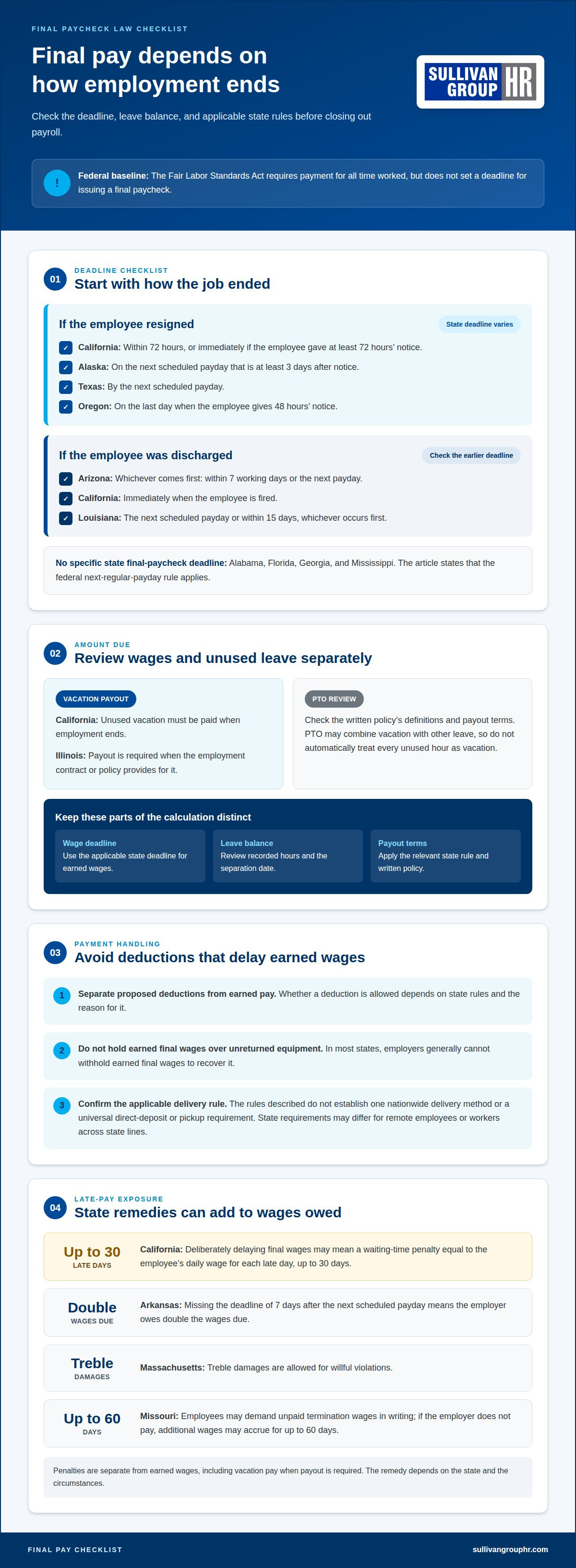
Final pay deadlines after resignation are state rules setting when employees who quit must receive earned wages. In California, employees who quit must receive final wages within 72 hours, or immediately if they gave at least 72 hours’ notice, according to the California Department of Industrial Relations. In Alaska, payment is due on the next scheduled payday at least three days after notice. In Texas, it is due by the next scheduled payday. Oregon requires payment on the last day when an employee gives 48 hours’ notice. These examples show how notice and separation timing can affect payroll.
Final Pay Deadlines After Termination
Final pay deadlines after termination set when an employer must pay an employee who was discharged. In Arizona, a discharged employee must receive a final paycheck by whichever comes first: within 7 working days or the next payday, according to the Industrial Commission of Arizona. California requires payment immediately when an employee is fired, according to the California Department of Industrial Relations. Louisiana sets a deadline of the next scheduled payday or within 15 days, whichever occurs first. The final paycheck laws by state therefore require payroll to account for both location and separation type.
Final Paycheck Deductions
A final-paycheck deduction is an amount subtracted from wages owed when employment ends. Whether a deduction is allowed depends on the state’s rules and the reason for it; these examples do not establish a nationwide rule. In most states, employers generally cannot withhold earned final wages to recover unreturned equipment. Payroll should distinguish proposed deductions from wages already earned and avoid delaying payment over company property.
Final Paycheck Delivery Methods
Final paycheck delivery is how owed wages reach an employee by the applicable deadline. The federal Fair Labor Standards Act requires payment for all time worked but does not set a final-paycheck deadline. The rules covered here establish neither a nationwide delivery method nor a universal requirement for direct deposit or pickup. State requirements may differ for remote employees or workers across state lines, so use the applicable state rule when setting the payment process.
PTO and vacation payout at termination
Unused vacation and paid time off can affect the amount due when employment ends, but state rules differ. Treat the wage deadline and leave balance as separate parts of the final-pay calculation.
Unused Vacation Payout
Unused vacation payout is payment for vacation time an employee earned but did not use before employment ended. California requires unused vacation to be paid out when employment terminates. In Illinois, unused vacation must be paid if the employment contract or policy provides for payout. These examples show why both the state and written policy matter.
Unused PTO in Final Pay
Unused PTO is paid time off remaining in an employee’s balance when employment ends. PTO may combine vacation with other leave, so the written policy’s definitions and payout terms are key. Review the balance, accrual method, and separation date together. A scheduled payroll period or final-wage deadline does not by itself determine whether unused PTO is payable.
Start with the leave policy in effect during the employee’s final work period. Identify which hours are recorded as vacation, general PTO, or another leave category, then compare the balance with the policy’s payout terms. If the terms differ by category, do not automatically treat every unused hour as vacation. California’s vacation payout requirement and Illinois’s contract-or-policy condition illustrate how payout rules vary by state.
Keep the final-wage calculation separate from the PTO decision. A wage deadline in a particular state does not establish a universal PTO rule. Document the balance, applicable policy, and separation date to give the calculation a clear basis. If an employee requests an explanation, a category-by-category breakdown can show how the amount was determined.
For broader benefits questions that arise during separation, explore employee benefits management.
Penalties for late final pay
Late final-pay penalties are consequences an employer may face when earned wages miss the applicable deadline. The amount and remedy depend on the state, the length of the delay, and whether wages remain unpaid.
Late or Unpaid Wage Penalties
A late-wage penalty is an added amount that may be owed after an employer misses a final-pay deadline. California employers that deliberately delay final wages may owe a waiting-time penalty equal to the employee’s daily wage for each late day, up to 30 days, according to the California Department of Industrial Relations. Arkansas employers that miss the deadline of 7 days after the next scheduled payday owe double the wages due. Massachusetts allows treble damages for willful violations under Mass. Gen. Laws ch. 149, § 148.
The penalty is separate from earned wages, including vacation pay when payout is required. Missouri employees may demand unpaid termination wages in writing; if the employer doesn’t pay, additional wages may accrue for up to 60 days. These examples show why the missed deadline and the state’s remedy both matter.
Claims for Unpaid Final Wages
A claim for unpaid final wages is a request to recover wages an employer failed to pay. Workers can submit a wage complaint to their state labor agency or pursue available back-wage recovery mechanisms through the U.S. Department of Labor. Keep pay statements, time records, the separation date, and written messages together to document what remains unpaid.
Start by identifying the state deadline and unpaid amount, then organize records showing hours worked, the regular payday, and any payment received. The Fair Labor Standards Act provides protections when employers fail to follow state and federal minimum-wage and final-pay laws, but it does not set a final-paycheck deadline. Clear records help explain the issue when making a complaint or seeking recovery.
States without final paycheck laws
A state without a specific final-paycheck deadline has no separate state deadline for issuing final wages. That does not remove the obligation to pay earned wages. Instead, federal timing guidance provides the fallback, making these states an important exception when reviewing final paycheck laws by state.
Alabama, Florida, Georgia, and Mississippi have no specific state final-paycheck deadline. In these states, former employees must be paid by the next regular pay period after leaving, whether employment ends through resignation or termination. Use the next regular pay period as the timing reference rather than assuming final wages are due immediately or on an unrelated date.
The Fair Labor Standards Act requires employers to pay for all time worked, but it does not set a deadline for issuing final paychecks. Federal Wage and Hour Division guidance says employers in states without a final-paycheck law must pay former employees by the next regular pay period. Payroll can apply this rule by recording the separation date, identifying the established pay cycle, and including all earned wages in the relevant payment.
Do not confuse these four states with states that set their own deadlines. A state-specific rule may require payment by the next business day, within a stated number of working days, or by a scheduled payday. Final paycheck laws by state therefore require a location-based review before payroll sets a former employee’s payment date.
For a resignation or termination in Alabama, Florida, Georgia, or Mississippi, use the next regular pay period as the federal timing guide and base the calculation on recorded work. Treat unused vacation as a separate question, since payout requirements can depend on state rules or employer policy. A consistent payroll workflow helps teams apply the right timing without treating every state alike.
Strengthen your process with payroll administration support so state deadlines are easier to manage.
Sullivan Group HR
Sullivan Group HR helps employers manage payroll processes and account for state-specific final-pay deadlines. Its Payroll Administration and Payroll Outsourcing services support employee pay processing, including coordination when someone leaves the organization. HCM brings related workforce processes together, while an Applicant Tracking System supports hiring workflows.
Consider this support when payroll spans multiple states, pay schedules, or separation scenarios and your internal processes need greater consistency. A clear approach to final pay helps teams account for separation details and earned wages without treating every state deadline as the same.
For support with your payroll needs, contact Sullivan Group HR.
Build a more consistent offboarding process
Make final-pay decisions part of a clear employee offboarding process. Assign responsibility for recording the separation date, confirming hours and leave balances, and routing the information to payroll. A consistent handoff helps your team apply the right state rule rather than relying on memory or a one-size-fits-all checklist.
Make the process easy to maintain. Keep state-specific steps with your payroll procedures, update them when requirements change, and document how each separation was handled. This gives your team a practical reference for future resignations or terminations, including cases involving employees in different states. A dependable process supports accurate payroll and a clearer experience for departing employees.
For employers who want help strengthening their payroll approach, Sullivan Group HR can be a resource. Contact Sullivan Group HR to discuss the support that fits your team. With a thoughtful process in place, you can handle final-pay responsibilities with greater clarity and keep your people operations moving forward.
Frequently Asked Questions
How Long Does an Employer Have to Send a Final Check?
The deadline depends on the state and whether the employee resigned or was terminated. For example, Nevada requires payment within three days after discharge, while New Mexico sets five days for fixed amounts and 10 days for variable amounts. Where a state has no specific deadline, federal guidance points to the next regular pay period. Identify the applicable state rule and separation type to determine the deadline.
Does final pay have to include unused vacation?
Unused vacation is included in final pay when state rules or the employer’s policy require payout. Distinguish vacation hours from other leave balances before calculating final pay, because a combined PTO bank may be treated differently from a separately tracked vacation balance. The policy’s definitions, accrual records, and separation date help establish which unused hours are covered. A balance alone does not show whether payout is due.
How long can a company hold your last paycheck?
A company can’t use earned wages as leverage for unreturned equipment in most states. South Dakota permits withholding a final paycheck until company property is returned under S.D. Codified Laws § 60-11-14. Otherwise, the applicable final-pay deadline controls; in states without a specific deadline, federal guidance uses the next regular pay period. An equipment dispute doesn’t generally justify holding earned wages.
Is termination pay different from final pay?
Final pay means wages still owed when employment ends, such as compensation for work already performed. “Termination pay” can describe money connected with ending a job more broadly, so the phrase alone does not establish what an employee is owed. Separate earned wages from any other payment described in an employment agreement or workplace policy, then identify the rules that apply to each amount.
Is the deadline different when an employee quits?
It can be. Nevada requires payment after resignation by the next regularly scheduled payday or within seven days, whichever comes first. In Hawaii, an employee who gives at least one pay period’s notice must be paid immediately when employment ends. These examples show why payroll needs the resignation date and notice details, not just the next scheduled payday, to determine when final wages are due.
What is the difference between last pay and final pay?
“Last pay” often means the most recent paycheck an employee received, while “final pay” means the wages owed when employment ends. For example, an employee may receive a regular paycheck before leaving and still be owed wages for later workdays. To determine what remains due, compare the pay period covered by the last check with the employee’s final work period and recorded pay.


