
A team can’t address a capability gap it hasn’t identified. Building a skills matrix for your team means mapping the skills each role needs against the proficiency people demonstrate. This helps you spot missing capabilities, expertise concentrated in too few hands, and skills the team could use more effectively.
It’s tempting to list every skill people might need, but a matrix is most useful when it reflects the outcomes your team is responsible for. The challenge is agreeing on which skills matter, then assessing them using more than self-reported confidence.
This guide explains why organizations use skills matrices, how to agree on core team skills, and how to combine self-assessments with manager feedback and practical evidence. It also shows how to turn the findings into next steps for training, hiring, and development.
Key Takeaways
- Use a skills matrix to make team capabilities visible and connect them to the work your organization needs to deliver.
- Agree on a focused set of skills tied to team outcomes instead of trying to track every possible capability.
- Combine employee self-assessments with manager input and practical evidence for a more balanced view of proficiency.
- Look for both missing skills and expertise concentrated in too few people, then use those findings to guide development and hiring.
Combining self-assessments with manager assessments
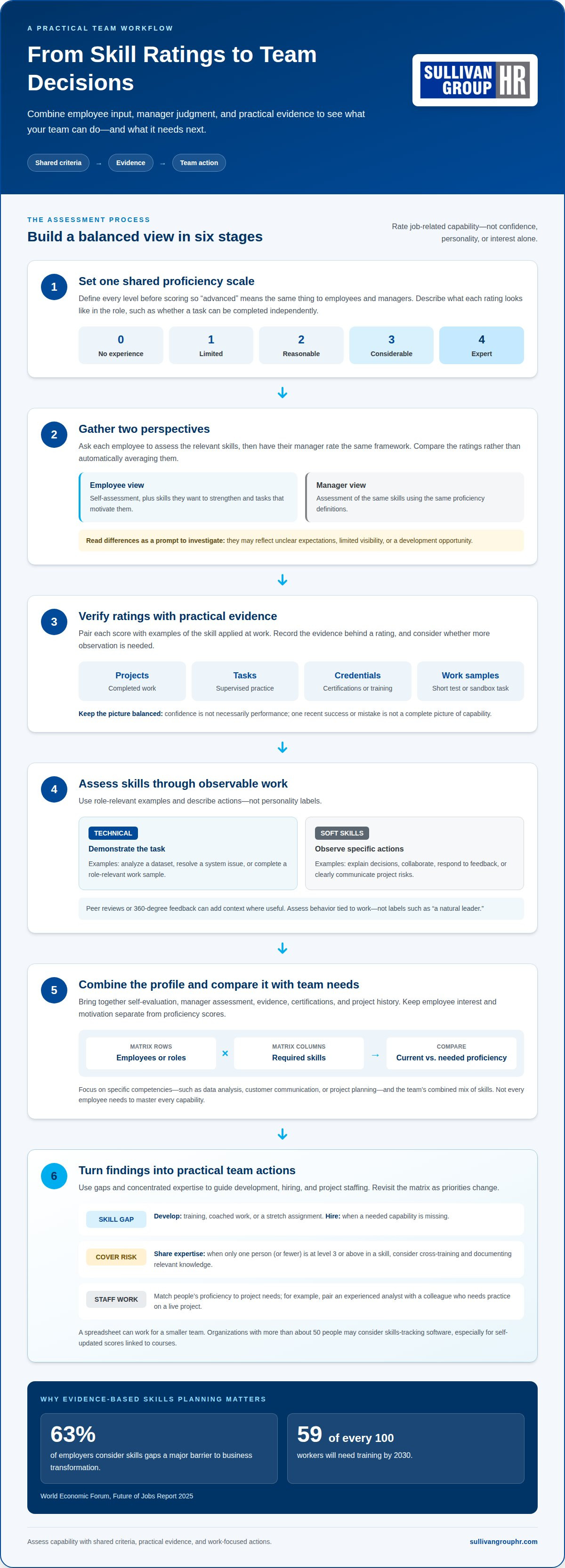
Use more than one perspective to make skill ratings meaningful. The steps below bring together employee input, manager judgment, and evidence of skills applied at work.
-
Gather Self and Manager Assessments
Ask each employee to rate relevant skills, then have their manager assess the same framework. Describe each proficiency level so “advanced” means the same thing to both. Compare ratings rather than automatically averaging them. Differences may point to unclear expectations, limited visibility, or a development opportunity. Ask employees which skills they want to strengthen and which tasks motivate them, but distinguish interest from demonstrated ability.
-
Assess Skills with Evidence
Pair each rating with evidence, such as completed projects, supervised tasks, certifications, or training applied in practice. For a technical skill, a short test or sandbox task can show how someone tackles a realistic problem. A self-rating reflects perceived confidence, not necessarily performance. Managers should record the example behind a score and avoid treating one recent success or mistake as a complete picture of someone’s capability.
-
Evaluate Technical and Soft Skills
Assess technical skills through role-relevant work samples, such as analyzing a dataset or resolving a system issue. Evaluate soft skills through observable actions, including how someone explains decisions, collaborates, or responds to feedback. Use peer reviews or 360-degree feedback where those perspectives add useful context. Keep criteria tied to work, not personality labels. For example, rate whether a colleague communicates project risks clearly, rather than calling them “a natural leader.”
-
Assess Employee Capabilities
Bring together each employee’s self-evaluation, manager assessment, certifications, and project history. Note where evidence supports a rating and where further observation would help. Record employee interest and motivation separately, not as proficiency scores. Then use the matrix to compare individual strengths with team needs. This can highlight development opportunities, identify who can share expertise, and reveal where a skill depends heavily on one person.
Why do organizations use skills matrices?
A skills matrix gives leaders a structured view of capabilities against role requirements. Build one by defining skills, setting proficiency levels, assessing employees, comparing results with team needs, and updating actions. A spreadsheet can work for a smaller team; organizations with more than about 50 people may consider skills-tracking software, especially for self-updated scores linked to courses. The results can guide training, hiring, and project staffing.
-
Set Consistent Proficiency Levels
Choose one rating framework and define each level before scoring employees. A practical example uses levels from 0 to 4: 0 means no experience, 1 limited, 2 reasonable, 3 considerable, and 4 expert experience or knowledge. Explain what each rating looks like in the role, such as whether someone can complete a task independently. Don’t mix scales or rely on labels like “good” without shared definitions.
-
Use the Matrix for Gap Analysis
List employees or roles in rows, required skills in columns, and proficiency ratings in the cells. Define specific competencies, such as data analysis, customer communication, or project planning, rather than broad labels like “technical ability.” Compare current ratings with the levels needed for team outcomes. The World Economic Forum’s Future of Jobs Report 2025 reports that 63% of employers consider skills gaps a major barrier to business transformation. Record the difference as a gap to address, not as a judgment of an employee.
-
Apply the Matrix to Team Planning
Turn each gap into a practical decision: provide training to develop a skill, hire when a capability is missing, or assign project work to people with the right proficiency. For example, an experienced analyst could pair with a colleague who needs practice on a live project. Start with a spreadsheet; consider software if maintaining ratings or connecting them to courses becomes difficult. Review the matrix as priorities change, and update staffing and development plans accordingly.
Identifying capability gaps and concentrated expertise
Limit access to people who use the matrix for staffing or development, and explain its purpose before collecting ratings. Keep entries focused on job skills, discuss the context with employees, and leave out personal details that don’t help assess capability.
-
Identify Required Roles and Skills
Map each role to the capabilities needed for team goals, then compare those requirements with current ratings. Focus on the team’s combined mix of skills rather than expecting every employee to master every capability. For example, a project may need data analysis and client communication, with different people contributing each strength. Don’t add skills without a clear work context or business need.
-
Identify Training and Coaching Needs
Turn each gap into a specific development action. If an employee has basic knowledge but needs support applying it, pair training with coached work or a stretch assignment. Compare the evidence behind ratings before choosing a course; a low score may reflect limited opportunities to demonstrate a skill, not a lack of ability. The World Economic Forum’s Future of Jobs Report 2025 estimates that 59 out of every 100 workers will need training by 2030. When internal resources are limited, engaging specialized providers like ISCT - Integrated Solutions for Consultation & Training can help organizations deliver structured learning programs aligned with identified needs.
- Review the matrix for skills held by only one person. A cover risk exists when only one person or fewer has reached level 3 or above in a skill. For example, if one employee handles a critical process, cross-train a colleague and document the relevant knowledge. This reduces reliance on individual expertise and helps managers plan forward for absences, transitions, or new projects.
- Use skill gaps to guide hiring and onboarding. If a capability is missing, decide whether the team can develop it internally or needs a new role with that skill. Translate the gap into job requirements, then shape onboarding around the work the new hire needs to learn. Revisit the matrix when project needs change so hiring plans reflect current priorities, not outdated assumptions.
Agreeing on core team skills
A focused matrix starts with skills that support the team’s goals. Building a skills matrix for your team works best when people agree on priorities before rating anyone.
- Start with the work the team must deliver over the next 12 months. Identify five to ten important tasks or outcomes for each role, then ask which capabilities make that work possible. For a customer support role, examples might include resolving complex cases and explaining product changes clearly. This keeps the skill list connected to actual responsibilities, not abstract ideals.
- Invite people who understand different parts of the work, including someone doing the role, their manager, and colleagues who depend on its results. Ask each person to suggest skills tied to specific tasks, then group overlapping terms. For example, “clear updates” and “stakeholder communication” may describe related behaviors, but the group should agree on one useful label.
- Rank candidate skills by their effect on team outcomes. Keep capabilities that directly support quality, delivery, customer experience, or upcoming priorities. Remove skills that sound valuable but have no clear connection to the team’s work. A design group, for instance, might prioritize user research and prototyping over a broad category such as “creativity.”
- Use a workshop to test the list from different perspectives. One design-team framework grouped skills into craft, driving for outcome, leadership, and traits. These categories can prompt discussion, but adapt them to your team rather than adopting labels automatically. Ask members to identify missing capabilities and explain their choices with examples from work.
- Agree on a manageable final set and record why each skill matters. If the team chooses ten core skills, define each in plain language and link it to an outcome. As you build the matrix, make sure it reflects the team’s collective capability, not a requirement for everyone to excel at everything. Revisit the choices when responsibilities or business priorities shift.
Sullivan Group HR
Sullivan Group HR can support organizations whose skills matrix points to hiring needs or broader workforce planning questions. If the findings reveal a missing capability, its Applicant Tracking System supports the hiring process as you seek candidates for roles the team needs. HCM can also support organizations managing employee information and workforce processes alongside skills planning.
A matrix helps identify priorities, but it doesn’t replace decisions about role requirements, employee development, or staffing. Use its findings to clarify what the team needs next, then consider whether support with hiring or HCM fits that need. Contact Sullivan Group HR to discuss your organization’s workforce needs.
Put your workforce priorities into motion
A skills matrix becomes more useful when its findings inform decisions beyond the spreadsheet. As you continue building a skills matrix for your team, connect capability priorities with the workforce processes that support hiring and employee administration. This gives leaders a clearer path from identifying a need to planning what happens next.
Sullivan Group HR offers HCM, Payroll Outsourcing, and Payroll Administration. These services can be relevant when workforce planning raises questions about how your organization manages its people and payroll processes. Choose a next step that fits your priorities, whether that means refining capability plans or reviewing the systems that support them.
Contact Sullivan Group HR to discuss your workforce needs and move forward with a practical plan.
Frequently Asked Questions
How often should the matrix be updated?
Set a recurring review date and revisit the matrix at least every three months, or sooner when a vacancy arises or a significant project change occurs. Skills and business priorities shift, so outdated ratings can mislead staffing decisions. For most technical teams, an annual skills-matrix review is a suitable rhythm, with additional updates when changes arise. Assign someone to record new evidence and completed training.
What is a team skills matrix and what is it used for?
A team skills matrix is a working view of the capabilities available across a group. It can help a project lead decide who should partner on an unfamiliar assignment or help a manager identify backup coverage before a key employee changes roles. Treat it as a planning aid, not an employee ranking. Its value comes from using the information to make clear workforce decisions.
What skills should you include in a team skills matrix?
Include capabilities directly connected to the team’s work and goals. A customer service group might track product troubleshooting, written communication, and de-escalation; a finance group might track forecasting, reporting, and data tools. Include transferable skills only when they support actual responsibilities. Make each entry specific enough that different managers can recognize the same behavior in real work.
How should you define and score skill proficiency levels?
Describe each proficiency level through observable work, not adjectives alone. For data analysis, one level might involve preparing a clean report independently; another might involve explaining complex findings and advising colleagues. Apply the same descriptions to everyone assessed on that skill. Before scoring the full team, test the scale on a sample role and clarify any unclear wording so ratings remain comparable.
How do you assess employee skills accurately and fairly?
Use consistent criteria and more than one relevant source of evidence. For example, assess presentation skills using a work sample, manager observations, and the employee’s reflection on the task. Give employees a chance to explain relevant context, such as limited access to a particular project. Record evidence alongside each rating, and avoid comparing people whose roles or opportunities differ substantially.
How do you identify team skill gaps from a skills matrix?
Compare the capabilities the team needs with demonstrated capability in relevant roles. A gap exists when a required skill is missing or current proficiency falls short of the work expected. Also look for skills held by only one person, as this can create a coverage concern. Turn each finding into a decision, such as arranging a handover, developing another employee, or planning a hire.


