

A handbook can fall out of step with your workplace even when the document itself hasn’t changed. Review it at least annually, and sooner if you add a state, restructure, complete an acquisition, or notice that policies are being applied differently from how they’re written. Employee handbook review and update services can help identify gaps before they become harder to manage.
Keeping a handbook current takes more than checking for new laws. Written policies also need to reflect day-to-day practices and account for federal, state, and local requirements where employees work. That can be difficult to coordinate as your team and workplace arrangements change.
This article explains how to assess an existing handbook, which policies need attention, and how to put updates into practice. You’ll also learn when to review sooner than planned and what to consider when seeking HR support, so you can move forward with clearer policies and a more consistent process.
Key Takeaways
- Compare written policies with everyday workplace practices to spot gaps and decide whether the policy or the practice needs to change.
- Account for federal, state, and local rules that apply where employees work, including location-specific requirements.
- Use a structured annual review to revisit policies as laws, workplace needs, and employee arrangements change.
- When policies are updated, communicate significant changes, collect employee acknowledgments, and keep prior versions on file.
How do I know if my employee handbook is still compliant, and how often should I update it?
Review the handbook at least annually, and sooner when your workforce, work locations, or practices change. Compare written policies with what managers actually do, then address gaps that could cause confusion or compliance concerns.
Policy and Practice Alignment
Compare each written policy with real workplace procedures, including how managers handle leave requests, attendance, complaints, and discipline. For example, if the handbook tells employees to report absences to one manager but supervisors direct them elsewhere, the policy and practice don’t align. Decide whether the written rule or the actual procedure should change, then communicate that decision consistently.
Unclear or inconsistently applied policies can leave employees with different expectations and make disputes harder to resolve. Give the reviewer your current handbook, related procedures, employee work locations, and examples of how managers apply key rules.
Harassment, Discrimination, and Accommodation Policies
Review equal employment opportunity, anti-harassment, complaint reporting, and reasonable accommodation procedures together. Check that employees can tell how to report a concern, who receives it, and what happens next. A reporting route that doesn’t match the workplace process needs attention.
Look for clear language that sets out responsibilities and supports consistent decisions. Compare these policies with current legal requirements and the procedures managers actually follow.
Current-Issue Policy Review
Check whether technology policies explain acceptable use, confidentiality, data security, and responsible use of AI. If employees use AI tools for work but the handbook says nothing about protecting confidential information, the policy may need an update. Keep the guidance practical and consistent with workplace procedures.
For remote work, review scheduling, attendance, equipment, data security, and performance standards. Compare written expectations with how remote and hybrid employees are managed. Annual reviews help keep these policies aligned as work arrangements and organizational needs change.
Choosing a Qualified Review Service
Choose a reviewer who considers applicable federal, state, and local requirements alongside your actual workplace practices. Ask how the review identifies gaps, explains recommended changes, and distinguishes handbook edits from operational changes. This keeps the review focused on your workplace, not just the document.
Provide the current handbook, related policies and procedures, employee work locations and arrangements, and examples of how rules are applied. An HR professional can assess whether revisions are needed; legal questions may require legal counsel. A review can help reduce outdated or conflicting guidance, but a handbook alone can’t prevent every dispute or compliance issue.
Federal, state, and local employment-law compliance
A handbook must reflect the rules that apply where each employee works. Federal requirements may set a baseline, while state and local jurisdictions can add different standards. If your organization has employees in several states, map each work location to relevant policies and identify where a national rule needs a location-specific addition. Assess coverage by employee location, not just company headquarters.
Thresholds can also affect which federal requirements apply. In the United States, businesses exceeding 20 full-time or full-time-equivalent employees come under the purview of the Age Discrimination in Employment Act (ADEA), according to the U.S. Equal Employment Opportunity Commission. California employees must receive a 30-minute meal break after working 5 hours, according to California Department of Industrial Relations, Division of Labor Standards Enfor. These examples show why a single handbook may need state or local addenda.
Growth can change the scope of a review. When an organization opens an office or hires employees in a new location, it may need a handbook addendum for that location. Changes in employee headcount can also affect which policies apply. Review work locations and headcount alongside the handbook, then identify policies that need revision or an addition. Track legislation in states where employees work, and involve HR and legal counsel in the review.
A federal, state, and local compliance review should connect each applicable rule to clear handbook language and workable procedures. Check leave, pay, workplace conduct, and reporting policies against the jurisdictions where staff work. An annual review helps keep policies current, but a new location or organizational change calls for an earlier review. For benefits-related policies, employee benefits management can help support consistent administration alongside handbook updates.
Annual handbook reviews
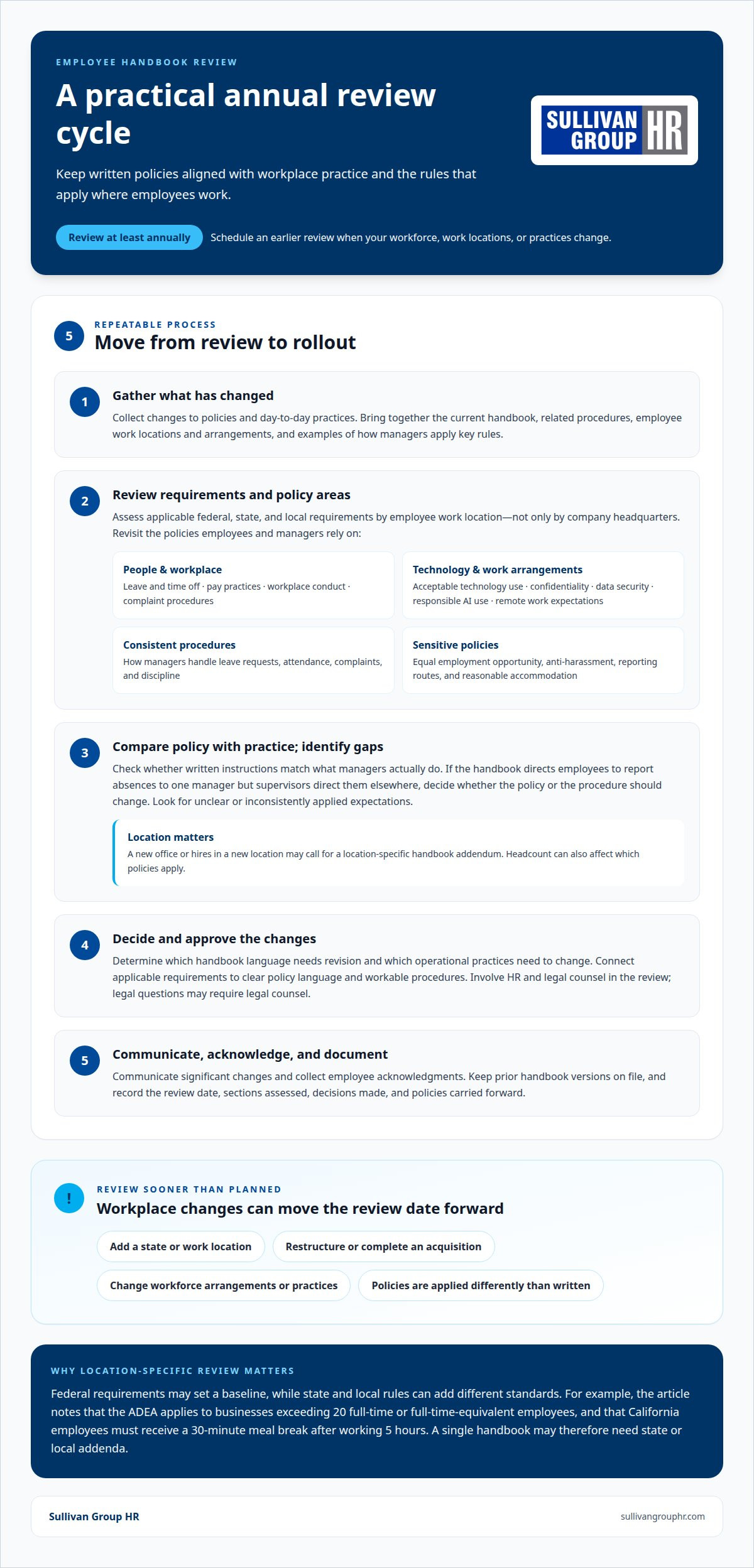
Schedule a handbook review at least annually, even after a steady year. Employment laws, workplace practices, and employee expectations can change between review cycles. A set annual date gives managers a reliable opportunity to assess whether policies still match the way work gets done. It also makes updates easier to plan, communicate, and document.
Use the annual review to work through the handbook by topic. Revisit leave and time-off policies, pay practices, complaint procedures, technology guidance, and remote work expectations. Compare each policy with current procedures and ask managers where employees encounter unclear instructions. For example, if remote employees’ attendance expectations differ by team, decide whether the policy or management practice needs to change.
Build a repeatable process: gather policy and practice changes, review relevant requirements, identify gaps, approve revisions, and prepare employee communications. Record the review date, sections assessed, decisions made, and policies carried forward. This gives the next review a clear starting point and helps managers explain current expectations consistently.
Don’t wait for the annual review after a major change. Review sooner if the organization adds a state, completes an acquisition, restructures, or finds that written policies are being applied differently in practice. These events can change which rules or procedures apply. Use the annual schedule as a baseline, with significant changes prompting an earlier review.
Include current issues on the review agenda. Dozens of new employment laws have taken effect across the country in the last three years, including laws involving pay transparency, leave, harassment training, and AI in hiring. Consider whether policies reflect these developments and the organization’s actual culture. A customized review connects relevant changes to clear guidance, rather than adding broad language managers can’t apply.
Reviewing and updating an existing handbook
Start with the current document, then review it section by section against applicable employment laws and workplace procedures. Flag outdated references, unclear instructions, and policies managers apply inconsistently. Pay particular attention to leave, pay, harassment reporting, accommodations, technology, and remote work. If employees work in multiple states, identify where policies need location-specific guidance instead of assuming one rule fits every workplace.
Separate proposed changes into two groups: handbook edits and workplace procedure changes. For example, a revised harassment policy may need clearer reporting steps, while a manager’s practice may need to change before the written policy can accurately describe it. Record the reason for each revision, who approved it, and which handbook version it replaces. This creates a useful record for future reviews.
- Prepare a clean, dated version that clearly identifies revised policies.
- Communicate changes to employees, especially when significant policies or procedures change.
- Collect updated acknowledgments and retain electronic copies of prior versions.
After distributing updates, brief managers on changes that affect their decisions. If attendance guidance changes, for example, managers need consistent instructions before applying the new procedure. Keep a record of the announcement, training, and acknowledgments with the current document. This helps employees find the right guidance and gives the next review a reliable starting point.
Benefits policies deserve careful coordination: handbook wording should reflect the organization’s actual benefits practices. For help managing those benefits, explore employee benefits management. Keep the handbook review focused on accurate, understandable policies, and involve legal counsel when a proposed revision raises a legal question.
Sullivan Group HR: Employee Benefits Management
Sullivan Group HR supports HR and administrative processes connected to employee policies. If a handbook update affects benefits information, Employee Benefits can support related benefits administration. The isolved HCM platform supports broader human capital management, while Payroll Administration and Payroll Outsourcing address payroll operations connected to workplace processes.
These services can help when your organization needs support carrying related HR or benefits processes forward after a handbook review. They complement policy work; they don’t replace legal guidance about which requirements apply or how policies should be written.
Contact Sullivan Group HR to discuss support for employee benefits management and related HR operations.
Make handbook updates part of everyday practice
A revised handbook is most useful when its guidance carries into daily decisions. Give managers a clear process for sharing policy changes, answering employee questions, and directing concerns to the right internal contact. This follow-through helps keep the document connected to how the organization operates.
Set a practical next step: assign responsibility for maintaining the current version, recording future changes, and coordinating policy updates with related HR processes. Employee handbook review and update services can help structure that work, while legal questions about specific requirements belong with legal counsel.
Sullivan Group HR can support related HR operations through HCM, Payroll Outsourcing, and Payroll Administration. If you’re ready to discuss support that fits your organization’s needs, contact Sullivan Group HR. A steady review process can help your team move ahead with clearer guidance and greater confidence.
Frequently Asked Questions
What is a professional employee handbook review?
A professional review assesses whether handbook policies are clear, current, and workable for the organization. An HR professional examines how written guidance connects with workplace procedures, including how managers handle employee questions and concerns. The review can identify sections that need revision and issues requiring legal input. For example, unclear instructions about who receives a complaint may call for clearer reporting steps.
Do you provide multi-state or remote workforce updates?
Sullivan Group HR provides compliance support covering federal, state, and local employment regulations. For employees in multiple states or remote roles, handbook updates should account for where employees work and how procedures apply to them. A consistent core policy can be paired with location-specific guidance where requirements differ. Remote work policies should also reflect actual expectations for communication, equipment, and performance.
How do I keep my handbook up to date after it’s created?
Assign an internal owner to maintain the current handbook and record policy questions that arise in day-to-day work. Ask managers to flag recurring exceptions, unclear instructions, or procedures that no longer match written guidance. For example, repeated confusion about who approves a request may mean responsibilities need clarification. Use these observations to set review priorities and coordinate changes.
How long does it take?
The timeline depends on the handbook’s length, the number of work locations, and how many policies need revision. Reviewing one policy differs from assessing several locations and workplace procedures. Preparing the current handbook and related policy documents helps clarify the scope. Revisions may also take longer if internal approvals or legal input are needed.
What do employee handbook review and update services include?
Employee handbook review and update services generally assess policy language, identify sections needing attention, and outline practical revisions. A review may consider how managers apply procedures, whether location-specific guidance is needed, and how employees will receive significant changes. The final work should identify which sections need updating and what communication or acknowledgment steps follow. Direct legal questions to legal counsel.
How often should employers review and update an employee handbook?
Review the handbook at least annually, then revisit it sooner after a major organizational or workplace change. A new work location, restructuring, or recurring differences between written policies and actual practices can prompt an earlier review. Keep a simple record of the review date, sections assessed, and decisions made. That record helps the next review focus on what has changed since the previous assessment.


