

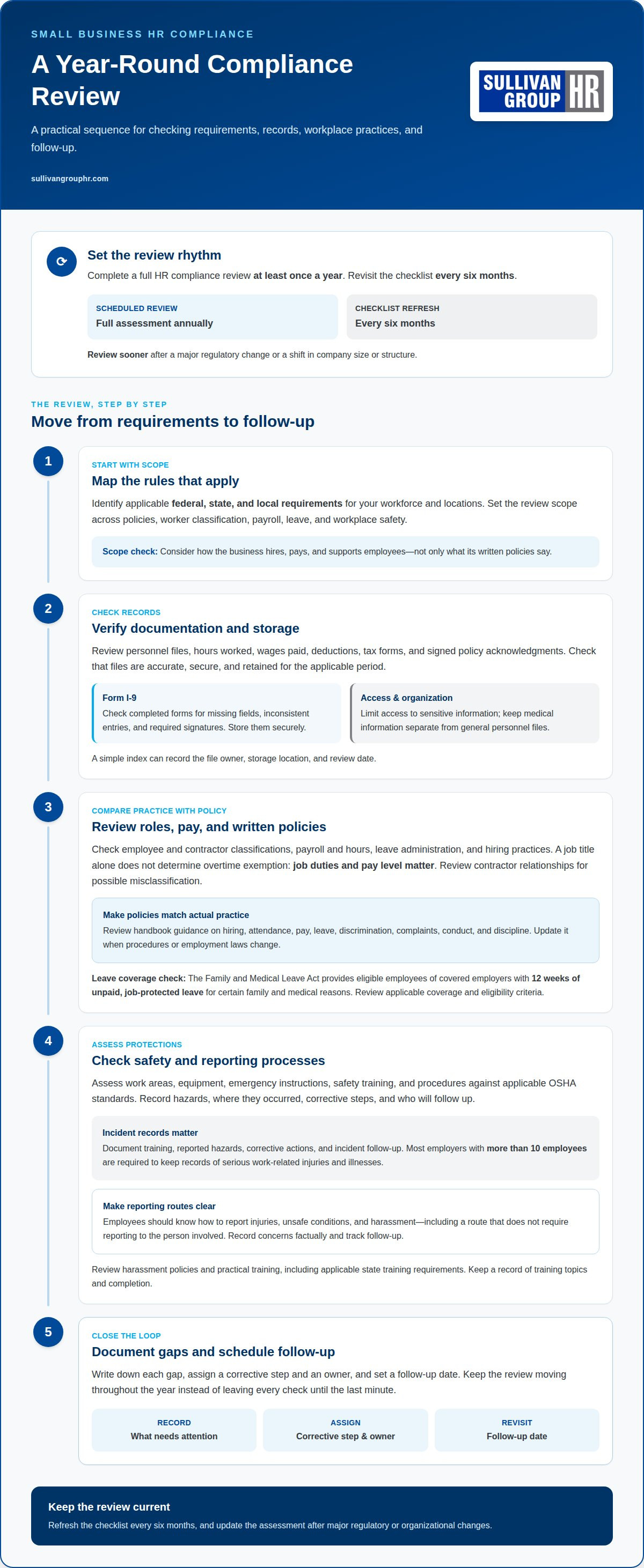
A small business should complete a full HR compliance review at least once a year and revisit its checklist every six months. An HR compliance assessment for a small business should also be updated after a major regulatory change or a shift in company size or structure. Regular reviews help uncover gaps in payroll, records, and employee protections.
Compliance can feel like one more responsibility competing for your time. A steady review schedule makes it more manageable: address key requirements throughout the year instead of leaving every check until the last minute.
This article explains how often to review HR compliance and what to examine in employee records, workplace safety, harassment prevention, minimum wage, and overtime. Use the practical framework to keep reviews focused and timely.
Key Takeaways
- Schedule a full HR compliance review at least once a year, and revisit your checklist every six months.
- Keep employee records organized, accurate, securely stored, and reviewed against applicable retention requirements.
- Assess workplace safety procedures and harassment-reporting channels, and keep relevant training and policies current.
- Review worker classifications, hours, overtime, and wage rates against the requirements that apply to your business.
1. What Is an HR Risk Assessment for Small Businesses?
An HR risk assessment reviews how your business hires, pays, and supports employees. It compares workplace practices with applicable federal, state, and local requirements, then identifies gaps to address. For a small business, the review should cover policies, employee and contractor classification, payroll, leave, and workplace safety.
Start with worker classification. A job title alone doesn’t determine whether an employee is exempt from overtime; job duties and pay level matter. Review contractor relationships, too, because misclassifying an employee as an independent contractor can create tax, penalty, and legal risks. Under the Fair Labor Standards Act (FLSA), pay, overtime, recordkeeping, and youth employment requirements deserve attention. Keep job descriptions aligned with actual work, and make handbook policies clear about roles, conduct, discrimination, and reporting concerns.
For hiring records, U.S. employers must verify each new employee’s identity and employment authorization using Form I-9, as required by U.S. Citizenship and Immigration Services. Review completed forms for accuracy and store them securely. Check that handbook policies reflect how hiring, pay, leave, and workplace complaints are handled in practice, not just on paper.
To conduct an assessment, first map the rules that apply to your workforce and locations. Then review policies, personnel and payroll records, worker classifications, and safety procedures. Document gaps, assign corrective steps, and set dates for follow-up reviews.
How much does an audit or consultant cost? The price depends on the case and is given after a quote request; cost factors include workforce size, locations, records, and review scope.
Consequences depend on the requirement and circumstances. Misclassification can expose a business to tax penalties, fines, and legal risks. Wage errors may also need correction and can lead to penalties.
Assess hiring documentation, wage and hour practices, leave administration, and workplace safety together. For example, the Family and Medical Leave Act provides eligible employees of covered employers with 12 weeks of unpaid, job-protected leave for certain family and medical reasons, according to the U.S. Department of Labor. Review whether your workforce and policies meet applicable coverage and eligibility criteria.
2. HR documentation and recordkeeping
Organized records help show how workplace procedures operate and support consistent decisions. Include personnel files, hours worked, wages paid, deductions, tax forms, and signed policy acknowledgments. Keep records secure, limit access to sensitive information, and follow the retention period for each record type. A simple index can identify the file owner, storage location, and review date.
Form I-9 files need their own accuracy review. Audit completed forms for missing fields, inconsistent entries, and required signatures, then document any corrections properly. Store employment eligibility records so authorized staff can retrieve them without exposing unrelated personnel information. Keep W-4 forms, payroll tax filings, and other tax-related documents organized alongside the records that support payroll operations.
Handbooks and written policies should match current practices. Review sections on attendance, pay procedures, leave, discrimination, complaints, and discipline whenever procedures or employment laws change. For disciplinary actions, record the date, policy involved, employee response, and follow-up. Consistent documentation helps explain why similar situations received similar treatment.
Safety records connect incident reporting to prevention. Assess workplace safety procedures against OSHA standards, and document training, reported hazards, corrective actions, and incident follow-up. Most employers with more than 10 employees are required to keep records of serious work-related injuries and illnesses. A clear reporting process helps supervisors capture what happened, when it happened, and what response followed.
Review records on a set schedule, and assign responsibility for updates after hiring, policy changes, or workplace incidents. Keep medical information separate from general personnel files and restrict access. For benefit-related documentation, employee benefits management can help connect plan administration with organized employee records.
3. Workplace safety and anti-harassment measures
A workplace safety review should examine hazards, reporting procedures, and how managers respond. Assess work areas, equipment, emergency instructions, and safety training against applicable OSHA standards. Use a checklist to record each hazard, its location, the corrective step, and who will follow up. For example, a blocked exit requires a documented response, not just a verbal reminder.
Make reporting straightforward. Employees should know how to report injuries, unsafe conditions, and harassment, including a route that doesn’t require reporting to the person involved. The internal process should identify who receives reports, how concerns are recorded, and how follow-up is tracked. Keep incident details factual, protect sensitive information, and document actions taken to address each concern.
Harassment prevention depends on clear policies and practical training. Explain prohibited conduct, reporting options, and the steps managers take after a complaint. Harassment prevention training is mandatory in many U.S. states, so include applicable state requirements in the review. Record training topics and completion, then update materials when workplace policies or procedures change.
Connect injury prevention with workers’ compensation planning. Review how the business reports workplace injuries, preserves relevant records, and routes claims information to the appropriate people. Workers’ compensation insurance can be part of that planning, but it doesn’t replace hazard controls or prompt incident reporting. Safety responsibilities apply across roles; exempt classification doesn’t remove the need to address workplace hazards.
Close the review by assigning owners and follow-up dates to each open item. Track recurring hazards, delayed repairs, training gaps, and unresolved complaints. Consider whether staffing changes, new equipment, or altered work processes call for a fresh risk assessment. Keep safety documentation with related policies, while limiting access to private complaint and injury details. This links workplace protection with wage and hour reviews without treating either as a substitute for the other.
4. Minimum wage and overtime under the FLSA
Review wage rates against the highest applicable federal, state, and local minimum wage. According to the U.S. Department of Labor, the federal minimum wage under the FLSA is $7.25 per hour for covered, non-exempt workers. State or local requirements may set a higher rate, so identify the rules that apply to each work location and update payroll when rates change.
Tipped employees require a separate review. According to the U.S. Department of Labor, the federal minimum direct wage for tipped employees is $2.13 per hour. Check that payroll records correctly reflect the wage paid and the employee’s tipped status. Include the applicable state and local rules in the same review, since the federal rate alone may not determine the required pay.
For overtime, compare recorded hours with the applicable threshold and confirm that non-exempt employees receive the correct pay for qualifying hours. Review classification based on job duties and pay level, not job title alone. Compare time records, schedules, and payroll entries. A missed shift or inaccurate time entry can affect a paycheck, so investigate discrepancies and document corrections.
Use a consistent wage-and-hour process for every pay cycle. Review employee rates, recorded hours, overtime calculations, deductions, and payroll changes. Check that written pay practices match actual operations, and train the people who approve time or submit payroll data. Clear responsibility helps catch errors before they recur and become costly. Payroll noncompliance can lead to penalties, so routine review is a practical control.
Keep a record of each review, the issue found, and the corrective action taken. If payroll processing needs additional support, get help with payroll administration to keep wage and hour practices organized and consistent.
Sullivan Group HR
Sullivan Group HR helps small businesses organize people operations through HCM, payroll services, and hiring tools. When review findings point to inconsistent payroll processes or scattered hiring records, Payroll Administration or Payroll Outsourcing can help organize those workflows. Applicant tracking, screening, and onboarding tools support a more structured hiring process, while isolved HCM technology brings key workforce processes together.
These services support day-to-day administration, but they don’t replace legal advice or determine which employment laws apply. Consider reaching out when payroll tasks are taking time away from operations or hiring records are difficult to manage. Share the process you want to improve, and Sullivan Group HR can discuss how its services fit your needs.
Build a steadier HR rhythm
Make compliance reviews a regular part of managing your business, not a task that returns only when a concern arises. An HR compliance assessment for a small business can connect people processes with daily operations and make follow-up easier to plan.
When you’re ready to strengthen the systems behind that work, Sullivan Group HR offers HCM, Payroll Outsourcing, and Payroll Administration. These services support workforce and payroll processes that need consistent attention as your business changes. Start with a conversation about where your current processes create the most friction and what support would help.
Contact Sullivan Group HR to discuss HR support. A clear plan can help you move forward with greater confidence and keep your attention on building a healthy workplace.
Frequently Asked Questions
How often should a small business review HR compliance?
Schedule a full review at least once a year, and revisit the checklist every six months. Also review relevant policies and processes after a major regulatory change, a change in company structure, or hiring employees in another state. For example, adding a remote employee can affect which state’s employment and payroll requirements need attention.
What Is an HR Risk Assessment for Small Businesses?
It’s a structured review of workplace practices, records, and processes to identify compliance gaps and decide what needs attention. An HR compliance assessment for a small business might trace a recent hire from application through onboarding, then compare the records and steps with the business’s written procedures. The findings help prioritize corrections and assign responsibility for follow-up.
Are the rules the same in every state?
No. Federal employment rules provide a baseline, while state and local requirements may add obligations. A business with employees in more than one state should account for each employee’s work location, including applicable employment rules, registration, and tax withholding. For example, a policy written for one state may need adjustments before use with a workforce in another.
Do EEOC laws apply to small businesses?
Some federal laws enforced by the Equal Employment Opportunity Commission apply based on employer size, and their coverage thresholds differ. Most federal employment laws enforced by the EEOC apply to companies with 15 or more employees; the Age Discrimination in Employment Act applies to companies with more than 20 employees. The Equal Pay Act applies to employers with even one employee, so size alone doesn’t settle every compliance question.
Do small businesses with only a few employees really need an employee handbook?
A handbook can help even a small team understand workplace expectations and where to raise concerns. It gives employees and managers a shared reference for topics such as attendance, communication, and workplace conduct. For example, a written process for reporting a concern can help prevent employees from relying on inconsistent verbal instructions as the team grows or responsibilities shift.
Is this checklist legal advice?
No. A checklist is a practical aid for organizing an HR review, not legal advice or an individualized interpretation of employment law. It can surface questions about policies, records, and workplace practices, but applying a rule to a specific situation may require legal analysis. Use the checklist to identify issues that need closer review, rather than treating it as a legal determination.


