

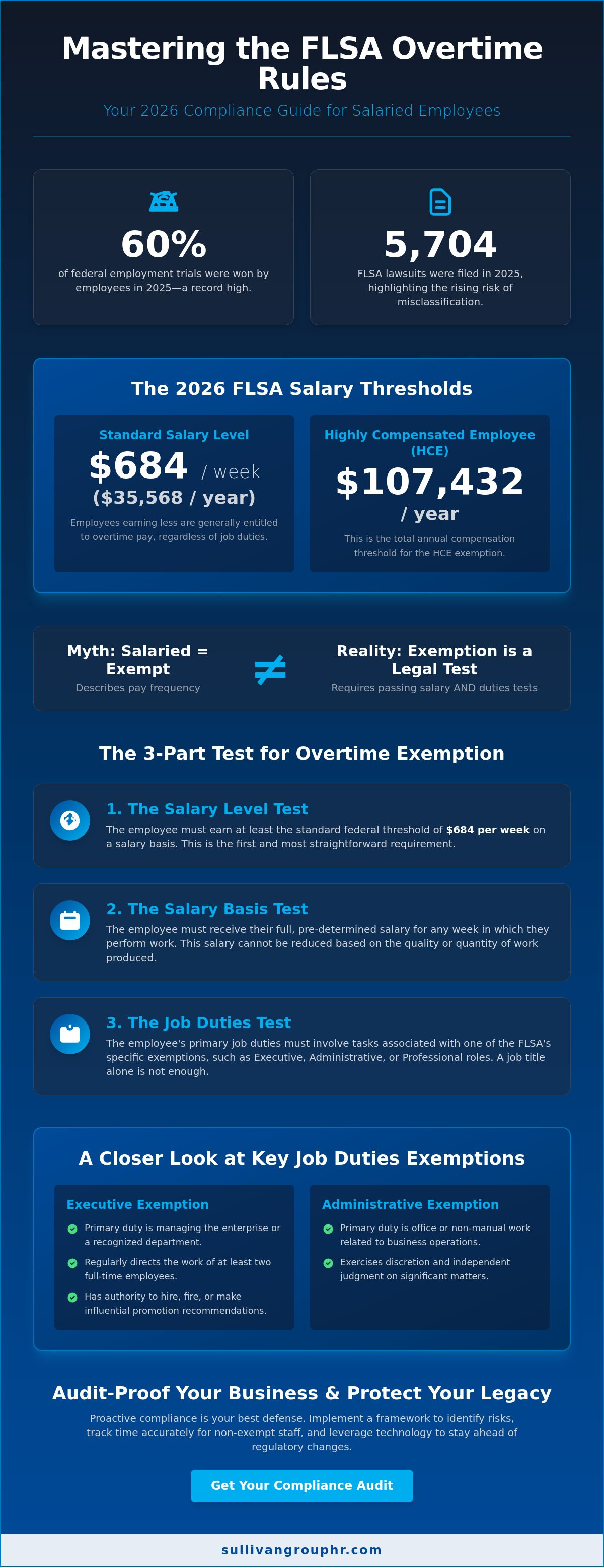
Did you know that employees won 60% of federal employment trials in 2025? That's a record high that should make every business owner pause. We know you've likely spent months bracing for massive salary hikes, only to see the Department of Labor restore the 2019 levels in May 2026. It's confusing, it's time-consuming, and it's frankly overwhelming to manage alone when you're trying to build a legacy. You want to reward your talent fairly, but the fear of a DOL audit or a misclassification error can keep you up at night.
We're here to act as your partner and guide through these shifting sands. This guide will help you master the FLSA overtime rules for salaried employees so you can focus on your professional potential instead of red tape. We've built a clear path to help you understand the restored $684 weekly threshold, simplify the complex "duties tests," and implement a reliable framework for auditing your staff. By the end of this article, you'll have the tools to protect your business, support your people, and ensure your payroll remains fully compliant in 2026.
Key Takeaways
- Understand why the restored $684 weekly salary threshold defines the federal standard for overtime exemption in 2026.
- Master the FLSA overtime rules for salaried employees by applying the essential three-part test to every role in your organization.
- Identify your "salaried non-exempt" workforce and implement mandatory time-tracking to prevent expensive payroll oversights.
- Create a proactive internal audit framework that shields your business from the increasing risk of misclassification lawsuits.
- Leverage modern HCM technology and isolved to automate threshold alerts, making complex regulatory compliance feel manageable and organized.
Understanding the FLSA Overtime Rules in 2026
The Fair Labor Standards Act of 1938 remains the bedrock of American wage protection. It's the law that ensures your team is paid fairly for every hour they contribute to your legacy. At its core, the FLSA requires that most employees receive 1.5 times their regular rate of pay for any work exceeding 40 hours in a workweek. But for many business owners, the real challenge lies in the "exempt" classification. How do you know if your team members are actually ineligible for that extra pay? It comes down to a three-part framework: how much they earn, how they are paid, and what they actually do. Mastering the FLSA overtime rules for salaried employees starts with understanding these pillars: Salary Level, Salary Basis, and Job Duties.
The 2026 Salary Threshold Update
Are you still tracking the 2024 rule changes? If so, it's time to reset your strategy. In May 2026, the Department of Labor officially rescinded the 2024 rule following significant court challenges. This means the federal standard salary threshold has been restored to $684 per week, or $35,568 annually. While this provides a lower financial barrier than previously expected, the legal landscape remains brisk and purposeful. For your highly compensated employees (HCE), the threshold is now $107,432 per year. These figures act as a primary gatekeeper. If an employee earns less than the $684 weekly minimum, they are generally entitled to overtime pay, regardless of their title or responsibilities. Staying current with FLSA overtime rules for salaried employees offers a moment of stability for your budget, but it requires a fresh audit of your current payroll data to ensure every classification is accurate and defensible.
Why "Salaried" Does Not Always Mean "Exempt"
One of the most dangerous myths in business is the idea that a flat salary automatically waives overtime requirements. It doesn't. Paying someone a fixed monthly amount describes their pay frequency, not their legal status. You might have a dedicated manager on a salary who still qualifies for overtime because they don't meet the specific duties test or the 2026 salary threshold. Misunderstanding this distinction is a leading cause of the 5,704 FLSA lawsuits filed in 2025. This is where professional payroll administration becomes a critical safety net. Outsourcing these complex functions allows you to move away from guesswork and toward guaranteed compliance. It transforms a daunting administrative burden into a streamlined process, ensuring your people are protected, secure, and valued. Are your records ready for a DOL audit today? If you're relying on old assumptions, the answer might be no.
The Three-Part Test for Overtime Exemption
How do you distinguish between a salaried employee who deserves overtime and one who is truly exempt? It's not just about the paycheck. To master the FLSA overtime rules for salaried employees, you must apply a rigorous three-part test to every role. Meeting the 2026 salary threshold of $684 per week is only the first gate. You must also satisfy the salary basis and job duties requirements to remain compliant. The "salary basis" test ensures your team receives a guaranteed minimum amount each pay period that isn't subject to reduction based on the quality or quantity of their work. If you dock pay because of a slow afternoon or a minor error, you risk losing that exemption entirely for the whole department. Does your current payroll structure provide that level of security?
The final and most complex hurdle is the duties test. This is where "Title Inflation" becomes a significant legal liability. Giving someone the title of "Manager" or "Director" doesn't automatically make them exempt under FLSA overtime pay requirements. The Department of Labor looks past the business card to see what the employee actually does all day. If a supervisor spends the majority of their shift performing the same manual tasks as the staff they lead, they likely won't pass an audit. If you're struggling to classify a borderline role, our human resources consulting experts can provide a definitive classification audit to protect your business legacy.
The Executive and Administrative Exemptions
To qualify for the executive exemption, an employee's primary duty must be managing the enterprise or a recognized department. They must regularly direct the work of at least two full-time employees and have genuine authority in hiring, firing, or promotion decisions. The administrative exemption is often more nuanced. It requires the employee to perform office or non-manual work directly related to management or general business operations. Crucially, they must exercise "discretion and independent judgment" on significant matters. It's about making choices that affect the business trajectory, not just following a set of pre-written instructions.
Professional and Computer Employee Exemptions
The professional exemption covers two distinct groups: learned and creative professionals. Learned professionals perform work requiring advanced knowledge in a field of science or learning, typically acquired through prolonged intellectual instruction. Creative professionals must perform work requiring invention, imagination, originality, or talent in a recognized artistic field. For your tech talent, the computer employee exemption applies to high-level systems analysts, programmers, or software engineers. This does not include employees who primarily engage in hardware repair or basic help-desk support. Identifying these distinctions correctly is the difference between a stable organization and a costly legal dispute.
Salaried Non-Exempt: The Growing Middle Ground
What happens when a valued team member earns a steady salary but doesn't meet the federal pay minimum? They fall into the salaried non-exempt category. This is a growing middle ground that many employers overlook. Since the 2026 salary threshold remains at $684 per week, any salaried employee earning less than this amount is legally entitled to overtime pay. You cannot simply point to their "salary" as a reason to skip the time clock. For these workers, tracking every minute is a mandatory requirement, not a suggestion. Transparency in timekeeping builds a foundation of trust. It prevents the kind of confusion that leads to costly litigation and ensures your people feel respected for every hour they give to your mission.
Managing this group requires a shift in mindset. You must move away from the "set it and forget it" approach of traditional salaried roles. Some businesses utilize the "Fluctuating Workweek" method to calculate pay, which is a valid but complex tool. It allows for a fixed salary to cover a varying number of hours, provided certain strict criteria are met. However, the margin for error is slim. Referencing the U.S. Department of Labor Overtime Pay guidelines is a great starting point for understanding these nuances. When you prioritize accuracy, you protect your business and your team simultaneously.
Calculating the "Regular Rate" for Salaried Staff
Converting an annual salary into a weekly regular rate is the first step in mastering the FLSA overtime rules for salaried employees. You don't just divide by 40 and call it a day. You must take the total weekly compensation and divide it by the total hours actually worked. Does that employee receive non-discretionary bonuses or commissions? Those must be included in the "regular rate" calculation. Failing to include these extra payments is a common pitfall that creates significant back-pay liabilities. Accuracy here isn't just about math; it's about organizational security.
Managing Time and Attendance for Salaried Teams
How do you track hours for a salaried professional without making them feel micromanaged? The answer lies in an integrated workforce management solution. Modern tools offer mobile time-tracking that empowers remote employees to log their contributions easily. It's about safety and results, not surveillance. You must also set clear policies regarding "off-the-clock" work. If a salaried non-exempt employee checks emails or takes a call after hours, that time counts. Establishing these boundaries early creates a culture of reliable advocacy and long-term organizational security.
Audit-Proofing Your Business Against Misclassification
What would a surprise Department of Labor audit cost your business today? The financial impact of "getting it wrong" is staggering. Beyond simple back pay, you could face liquidated damages that double the amount owed, plus hefty legal fees. In 2025, federal employment lawsuits reached a peak of 26,635 cases. This isn't just a bureaucratic hurdle; it's a direct threat to your organizational security. To protect your legacy, you must conduct a proactive internal classification audit. This means moving beyond what's written on paper and looking at the daily reality of your team's workflow. Are your job descriptions accurate, current, and descriptive? If a manager's role has shifted toward manual tasks over time, your classification must shift with it to remain compliant with FLSA overtime rules for salaried employees.
Training your leadership team is the next critical step. Managers are often the ones who inadvertently create liability by allowing "off-the-clock" work or failing to report extra hours. They need to understand that "unauthorized" overtime is still compensable time. If the work is performed, it must be paid. Clear communication prevents these hidden costs from spiraling. If you're feeling overwhelmed by these administrative burdens, our human resources consulting experts can help you build a bulletproof compliance strategy.
Common FLSA Red Flags to Watch For
- Title Inflation: Be wary of "Assistant Manager" roles where the employee spends more than 50% of their time on manual labor or customer service rather than directing staff.
- Improper Deductions: Never deduct pay from an exempt employee for partial-day absences. This action can immediately void their exempt status for the entire pay period.
- Missing Records: If you aren't recording hours for your salaried non-exempt staff, you have no defense against a claim for unpaid overtime.
The Role of HR Risk Management
Protecting your business requires more than just a passing glance at your payroll. Effective HR risk management identifies these hidden liabilities before they become legal nightmares. A third-party compliance review offers a fresh, unbiased perspective on your operations. It helps you create a reliable "audit trail" through consistent recordkeeping and documented classification decisions. This level of professional rigor fosters a sense of security for you and your people. When you prioritize accuracy, you build a company that can withstand any regulatory shift. Understanding the FLSA overtime rules for salaried employees is the first step toward a secure, compliant workplace.
Leveraging HCM Technology for FLSA Compliance
Are you still managing your workforce using fragile spreadsheets and manual calculations? In 2026, that's a risk you don't need to take. Transitioning to a unified HCM platform transforms compliance from a reactive scramble into a proactive strategy. By automating the complexities of FLSA overtime rules for salaried employees, you free yourself to focus on building your team's future. Technology provides the safety, movement, and results required to stay ahead of shifting federal standards. It's about moving away from transactional paperwork and toward a long-term relationship with your data. In addition to robust technology, seeking strategic support and practical advice from experts like Pioneer HR ensures your talent is managed with total confidence and professional rigor.
Real-Time Compliance with isolved
We utilize isolved to provide a level of professional rigor that manual systems simply can't match. This platform automates threshold alerts. It flags any employee who approaches the 40-hour mark before they cross it. It also simplifies digital recordkeeping. This ensures you meet the strict DOL three-year retention requirements without physical clutter. Employee self-service portals offer transparency into pay and status. This fosters an atmosphere of reliable advocacy and trust within your organization. It's a localized "handshake" that combines our regional wisdom with world-class tech. You get the benefit of a system that learns your specific territory's nuances while keeping your payroll bulletproof and organized.
Partnering for Peace of Mind
The best technology still requires a human touch. That's why we combine high-tech tools with high-touch payroll administration outsourcing. This "Fractional HR" advantage gives you expert guidance without the overhead of a full-time department. We act as your coach and ally. We help you navigate the nuances of the $684 weekly threshold and the duties tests discussed earlier. Our approach is logical and deeply supportive of your success. We believe in putting the "human" back into human capital management by valuing people over automated processes. Our team understands that every business owner in our region has a unique legacy to protect. We treat your compliance as our own primary metric of success.
Managing salaried staff in 2026 requires a steady, reliable beat. With court decisions vacating previous rules and the DOL restoring 2019 levels, the landscape is brisk and purposeful. You need a partner who understands the entire lifecycle of a professional relationship. From talent acquisition to long-term organizational security, we provide the stability you need to thrive. Ready to secure your payroll? Schedule a compliance consultation with Sullivan Group HR today to ensure your business remains a leader in local expertise and regulatory safety.
Securing Your Legacy Through Compliant Payroll
Are you ready to turn administrative confusion into organizational strength? Navigating the FLSA overtime rules for salaried employees doesn't have to be a solo journey. We've explored the restored $684 weekly threshold, the nuances of the duties test, and the power of unified HCM technology. These aren't just rules to follow; they are the building blocks of a fair, secure, and thriving workplace. By auditing your classifications and leveraging smart automation, you protect your most valuable asset: your people. You move away from guesswork and toward guaranteed compliance.
As an isolved Certified Provider with 25+ years of HR consulting expertise, we offer the national compliance coverage you need with the local touch you deserve. We act as your advocate and coach, ensuring your payroll is bulletproof and your business is secure. Don't let the fear of a DOL audit or a misclassification error slow your professional momentum. Protect your business with a Sullivan Group HR compliance audit. You've built something remarkable. Let's work together to ensure it stays protected for years to come.
Frequently Asked Questions
Can an employee waive their right to overtime if they prefer a flat salary?
No, an employee cannot legally waive their right to overtime pay. The Fair Labor Standards Act is a federal mandate designed to protect workers; private agreements to bypass these rules are unenforceable. Even if an employee requests a flat salary to avoid tracking hours, you remain liable for any unpaid overtime if they don't meet the specific exemption criteria. Protecting your business means following the law regardless of individual preferences.
Does the 2026 FLSA threshold apply to highly compensated employees (HCE)?
Highly compensated employees follow a separate, higher threshold of $107,432 per year as of May 2026. To qualify for this streamlined exemption, the employee must receive at least $684 per week on a salary basis and regularly perform at least one of the duties of an exempt executive, administrative, or professional employee. This higher bar reflects their greater responsibility and impact within your organization's legacy.
What happens if a salaried exempt employee works only 30 hours in a week?
You must pay the employee their full guaranteed salary for any week in which they perform work. The "salary basis" test requires that pay isn't reduced because of the quantity of work performed. If you dock pay for a short workweek, you risk destroying their exempt status. This mistake can trigger back-pay liabilities for the entire department and invite unwanted regulatory scrutiny.
How should I handle "travel time" for salaried non-exempt employees?
You must pay for travel that occurs as part of the employee's principal activity, such as moving between job sites during the day. While ordinary commuting from home to work isn't compensable, travel that keeps them away from home overnight or involves work during transit must be recorded. Tracking these hours accurately is vital for maintaining compliance with FLSA overtime rules for salaried employees who fall below the pay threshold.
Are there different overtime rules for non-profit organizations?
Non-profits generally follow the same FLSA overtime rules for salaried employees as for-profit businesses. Coverage applies if the organization has an annual business volume of at least $500,000. Even if the enterprise isn't covered, individual employees may still be protected if they engage in interstate commerce. This includes activities like processing out-of-state donations or managing mailings across state lines. It's a nuanced area where professional guidance provides essential safety.
Can I pay an exempt employee a bonus without losing their exempt status?
Yes, you can pay bonuses or commissions without jeopardizing an employee's exempt status. You can even use non-discretionary bonuses to satisfy up to 10% of the standard salary level requirement. These payments must be made at least annually to count toward the 2026 threshold. This provides a flexible way to reward your talent while keeping your payroll administration secure and organized.
What records must I keep for salaried employees who are exempt from overtime?
You must maintain basic records including the employee's full name, social security number, and occupation. While you aren't federally required to track daily hours for truly exempt staff, you must keep records of the total wages paid each period. We recommend keeping detailed job descriptions and performance reviews as well. This documentation creates a reliable audit trail that proves their duties align with their exempt status.


