

If the Department of Labor knocked on your door tomorrow morning, would your leave records stand up to the scrutiny? It's a question that keeps many entrepreneurs awake at night, and for good reason. You've worked hard to build your team, but now the complexities of FMLA administration for small business feel like a weight dragging down your momentum. We understand that you'd rather focus on your people and your products than get buried in a mountain of regulatory paperwork.
Managing leave isn't just about checking boxes; it's about protecting the business you've sacrificed so much to create. With the fine for willful notice violations now sitting at $204 per occurrence, the cost of a simple manual error is higher than ever. We're here to help you move from a place of uncertainty to a position of total control. You'll learn how to master federal requirements with a clear roadmap for compliance, tracking, and risk mitigation.
This guide provides a deep dive into the 50-employee threshold rules for 2026 and offers a streamlined process for handling complex leave requests. We'll explore how to manage intermittent leave without the paperwork errors that lead to legal exposure. Let's transform your administrative burden into a strategic shield for your company's future.
Key Takeaways
- Determine if your company meets the 50-employee threshold and understand how the "50/20 rule" dictates your legal obligations in 2026.
- Master the three pillars of FMLA administration for small business to eliminate the manual errors that lead to costly Department of Labor audits.
- Identify the hidden financial and operational costs of in-house leave management versus a streamlined, integrated HCM approach.
- Follow a bulletproof checklist to recognize FMLA triggers and issue mandatory eligibility notices like Form WH-381 with complete confidence.
- Discover how the isolved platform provides real-time tracking to turn your administrative burden into a source of organizational security.
Does FMLA Apply to Your Small Business? Navigating the 50-Employee Threshold
Does your business feel the growing pains of success? Crossing the 50-employee mark is a major milestone, but it also triggers the Family and Medical Leave Act of 1993. This federal mandate requires you to provide job-protected, unpaid leave for specific family and medical reasons. It's a vital safety net for your team, but it's a complex compliance hurdle for you. Understanding where you stand is the first step toward security.
You aren't subject to FMLA the moment you hire your 50th person. The law uses what's known as the "50/20" rule. This means you must have 50 or more employees for at least 20 workweeks in either the current or the preceding calendar year. These weeks don't have to be consecutive. This specific nuance is why FMLA administration for small business requires constant, vigilant monitoring. If you're hovering near that threshold, you're already in the "danger zone" for compliance risks.
Even if you are a "covered employer," an individual employee isn't automatically eligible for leave. They must work at a site where the company employs at least 50 people within a 75-mile radius. This provision often exempts remote-heavy small businesses or those with small, scattered satellite offices. It's designed to protect employers from the operational strain of managing leave in locations where they lack a deep bench of staff to cover shifts.
The 50-Employee Count: Who Actually Qualifies?
Who exactly counts toward your total? The answer is almost everyone. You must include part-time staff, temporary workers, and even employees who are currently on leave or suspended. Under 2026 standards, a "covered employer" is any private-sector business that meets the 50-employee criteria within the 50/20 rule timeframe. Tracking this manually is a recipe for disaster. Integrated payroll administration makes this headcount automatic. It gives you a real-time view of your status, so you're never surprised by a sudden change in your legal obligations.
The Risk of the "Mini-FMLA": State-Level Mandates
Federal rules are only half the battle. Many states have enacted "mini-FMLA" laws with much lower thresholds, sometimes applying to businesses with as few as one or 15 employees. For instance, Delaware and Minnesota both implemented new paid family and medical leave programs on January 1, 2026. You must monitor federal and state compliance simultaneously to avoid "stacking" leave, where an employee takes federal and state leave back-to-back. Comprehensive HR risk management protects you from these overlapping regulations. It ensures you aren't just following the law, but actively shielding your business from litigation.
The Administrative Burden: Why FMLA is More Than Just Paperwork
Is your HR department a strategic asset or a filing cabinet? For many, FMLA administration for small business feels like a full-time job hidden inside another one. It isn't just about handing over a form; it's a multi-layered legal responsibility. Success rests on three core pillars: Eligibility, Notification, and Documentation. If any pillar crumbles, your business is left exposed to costly litigation. Following the U.S. Department of Labor FMLA guidance is the only way to ensure these pillars remain standing under pressure.
The burden doesn't stop at the paperwork. You must maintain an employee's group health benefits during their 12-week leave period as if they never left. When they return, the "Equivalent Position" rule applies. This means you must restore them to their original job or one that is nearly identical in pay, benefits, and working conditions. These requirements are where many small businesses stumble, especially when trying to balance a lean budget with federal mandates. If these requirements feel like a liability waiting to happen, partnering with a team for human capital management can turn that risk into a predictable process.
Intermittent Leave: The Small Business Productivity Killer
Can your workflow handle an employee missing two hours every Tuesday? Intermittent leave allows staff to take time off in small increments, sometimes as short as one hour. This creates administrative chaos for managers trying to track total usage against the 12-week entitlement. You have the right to request medical certifications for chronic conditions to verify the need for this flexibility. To prevent abuse and ensure accuracy, the isolved HCM platform automates this hour-by-hour tracking. It replaces error-prone spreadsheets with real-time data, providing a clear defense against retaliation claims.
The 5-Day Rule: Timely Notifications are Non-Negotiable
Time is your greatest enemy in a DOL audit. Once you become aware that an employee's leave might qualify for FMLA, you have exactly five business days to provide an eligibility notice. Delaying this step can lead to "interference" claims, where an employee argues you prevented them from using their legal rights. In the eyes of the law, "I didn't know the rule" is never a valid defense. You need a system that triggers these notifications automatically. Consistent, timely communication is the difference between a smooth transition and a devastating legal battle. Don't let a calendar error define your company's reputation.
In-House vs. Outsourced FMLA: Evaluating the Risk to Your Growth
Are you scaling your vision or just scaling your stress? As your headcount grows, the choice between managing leave internally or seeking expert help becomes a defining moment for your company. In-house management often looks cheaper on a balance sheet, but it carries heavy, invisible costs. You're paying for specialized software, constant manager training, and hundreds of hours of executive time that should be spent on growth. FMLA administration for small business is too complex to be a side project for your office manager.
Many owners rely on manual spreadsheets to track leave. This is a gamble you don't need to take. A unified human capital management approach replaces guesswork with precision. Beyond the technology, there's the "Objectivity Factor." Using a third-party administrator removes internal bias and friction. It ensures that every decision is based on data and official FMLA forms, not personal relationships. This shift moves the burden of compliance accuracy away from your desk and onto a dedicated partner.
The Hidden Cost of FMLA Non-Compliance
The price of a mistake is staggering. When leave management goes wrong, the Department of Labor doesn't just ask for a correction. You could face a mountain of liabilities including back pay, front pay, liquidated damages, and attorney fees. Defending a single FMLA lawsuit often exceeds $100,000 in legal costs alone. Small businesses are particularly vulnerable to "Retaliation" claims during layoffs or performance reviews. If your documentation isn't perfect, a standard business decision can look like a legal violation in court.
Why a PEO or HR Outsourcing Firm is the Safer Bet
Choosing an outsourcing partner gives you more than just software. You gain access to expert HR consultants who handle the tough conversations so you don't have to. This partnership provides a seamless link to payroll administration outsourcing. It ensures benefit deductions and tax filings remain accurate while an employee is away. You get peace of mind knowing every request follows a documented, legal workflow. We protect your culture while you protect your bottom line. It's about moving from administrative anxiety to organizational security.
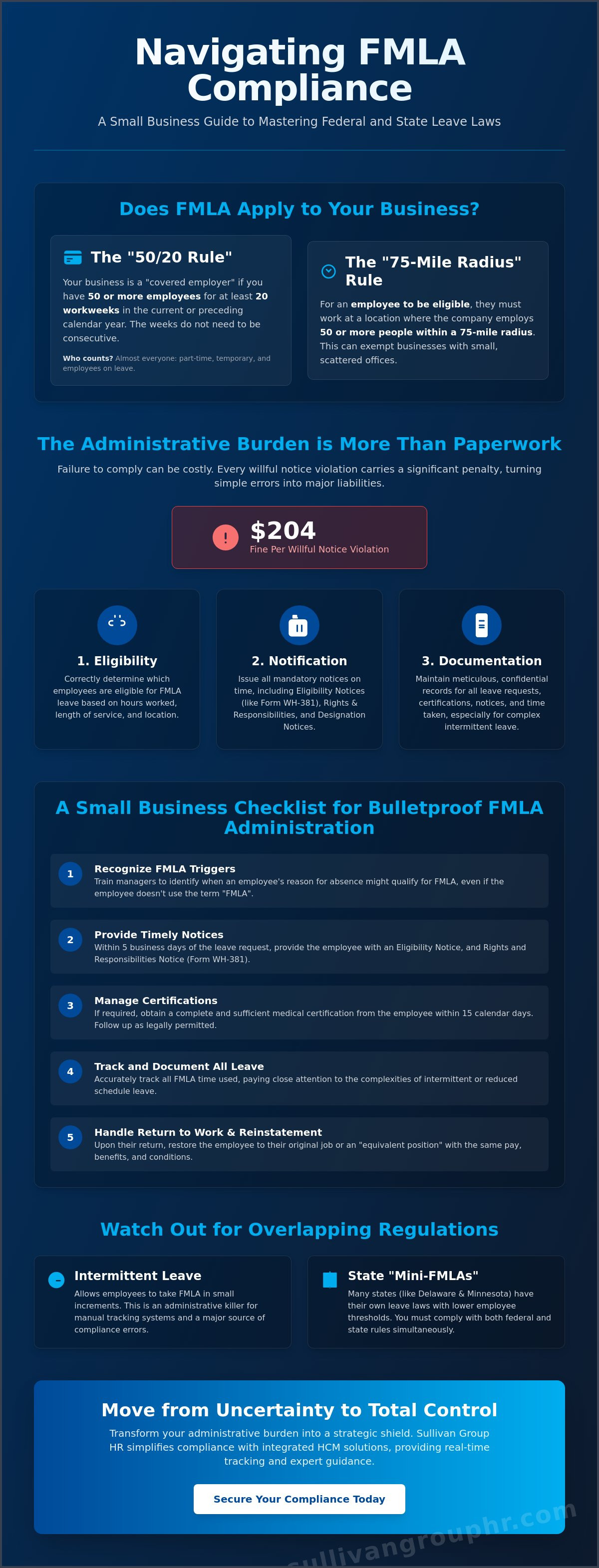
A Small Business Checklist for Bulletproof FMLA Administration
Are you ready for the next time an employee mentions a surgery or a sick family member? Effective FMLA administration for small business isn't about intuition; it's about a repeatable, documented process. You need a system that starts the moment a "trigger" event occurs and doesn't end until the employee is safely back at their desk. This checklist ensures you don't miss a single legal requirement while maintaining your company's operational flow.
- Step 1: Identify the "Trigger." You must recognize when a request qualifies as FMLA. Employees don't have to use the specific phrase "FMLA." If they mention a "serious health condition," the compliance clock starts immediately.
- Step 2: Issue the Notice of Eligibility. Use Form WH-381. You have five business days to provide this notice once the need is known. It outlines their rights and your specific expectations.
- Step 3: Authenticate Medical Certification. Ask for verification of the health condition. You have the right to ensure the leave is legitimate before officially approving the request.
- Step 4: Designation Notice. This is your final written word. Officially approve or deny the leave and specify exactly how many hours or weeks are being used.
- Step 5: Return-to-Work Certification. Before they resume their duties, ensure they are fit for duty. This protects both the employee and your company from potential safety risks.
Documenting the "Interactive Process"
Confidentiality is your best shield. You must keep all FMLA medical records in a separate, secure file. Never mix these with standard personnel records. If a certification comes back incomplete, don't ignore it. Reach out and explain what's missing without overstepping privacy boundaries. We recommend maintaining a detailed communication log. These records serve as vital evidence to disprove retaliation claims if a dispute ever arises. Consistency in your documentation proves that you value people over just checking boxes.
Coordinating FMLA with Short-Term Disability (STD) and Workers’ Comp
Managing leave is rarely a standalone task. FMLA provides job protection, while Short-Term Disability (STD) provides income protection. In most cases, these should run concurrently. Things get even more complex when a Workers' Comp injury triggers FMLA rights. You must manage these overlapping timelines with extreme care to avoid "stacking" leave. This coordination is a key part of effective FMLA administration for small business. Utilizing strategic benefits management simplifies this coordination. It ensures your policies work together rather than against each other.
Ready to secure your business against administrative errors? Let our experts guide you through the process with our human resources consulting services.
Sullivan Group HR: Simplifying Compliance Through Integrated HCM
How much faster could your business grow if you weren't looking over your shoulder at regulatory traps? FMLA administration for small business doesn't have to be a source of constant anxiety. We believe that administrative rigor and empathetic partnership should go hand in hand. By choosing Sullivan Group HR, you're not just buying software; you're gaining an ally that turns your administrative burden into organizational security. We help you acquire talent, compensate fairly, and secure your company's future through bulletproof compliance.
Our approach removes the guesswork from leave management. While earlier sections of this guide highlighted the dangers of manual tracking and missed deadlines, we provide a concrete solution that eliminates those risks. We provide a dedicated HR consultant who understands the specific nuances of your local territory. You get a no-nonsense expert who knows your business by name, not just by a client number. This personal touch ensures that your FMLA decisions are both legally sound and culturally aligned.
The isolved Advantage: Data-Driven Leave Management
The isolved platform is the engine that drives your compliance strategy. It replaces fragmented spreadsheets with a single, reliable source of truth. Data-driven management allows you to stop reacting to crises and start predicting needs. The platform provides:
- Automated Alerts: Never miss a milestone. The system triggers notifications for eligibility windows, certification deadlines, and the critical 5-day notice requirement.
- Employee Self-Service: Empower your team. Employees can request leave and upload medical documents through a secure, confidential portal, reducing the burden on your managers.
- Unified Reporting: See the big picture. Leadership gains instant access to workforce availability reports, making it easier to plan for coverage during intermittent or long-term absences.
Our Human-Centric Approach to HR Outsourcing
Technology is a powerful tool, but it can't replace human wisdom. A faceless, tech-only solution often fails when a situation becomes complex or sensitive. We integrate your leave management with your existing applicant tracking and onboarding systems. This creates a seamless lifecycle for every employee, from their first day to their eventual return from a protected leave.
When you partner with us, you're choosing a legacy of stability and regional expertise. We handle the difficult conversations and the dense paperwork so you can focus on the professional potential of your team. You deserve the peace of mind that comes from knowing your documentation is audit-ready at all times. Sullivan Group HR protects both the person and the process.
Securing Your Business Future Through Strategic Compliance
Are you ready to trade administrative anxiety for organizational security? You've seen how the 50-employee threshold and overlapping state mandates can create a legal minefield. Mastering FMLA administration for small business isn't just about following rules; it's about protecting the people who make your success possible. By moving away from manual spreadsheets and embracing a unified approach, you're building a foundation built on clarity, safety, and results.
We're here to be your coach and ally in this journey. Our team provides access to the industry-leading isolved HCM platform for real-time tracking, backed by expert human resources consulting that understands your local territory. We offer a comprehensive integration of payroll, benefits, and risk management into one seamless workflow that keeps you audit-ready. Protect your business and your people with Sullivan Group HR’s FMLA solutions.
You've built something remarkable. Don't let administrative burdens hold you back. With the right partner by your side, you can focus on your professional potential while we safeguard your legacy. Let's move forward with confidence.
Frequently Asked Questions
Is FMLA leave paid or unpaid for small business employees?
Federal FMLA leave is strictly unpaid. It provides job protection and benefit maintenance; it does not provide income replacement. However, you can require employees to use their accrued vacation or sick time during this period to keep their paychecks flowing. It's vital to check state mandates, as programs in Delaware and Minnesota began providing paid benefits on January 1, 2026. This coordination ensures your team stays supported while you maintain clear financial boundaries.
Does FMLA apply to businesses with fewer than 50 employees in 2026?
Federal FMLA does not apply unless you've reached 50 employees for at least 20 workweeks. But don't stop there. Many states have lower thresholds, sometimes as low as one employee, for their own family leave programs. Effective FMLA administration for small business requires looking at both federal and local laws simultaneously. This dual-track awareness prevents you from falling into a compliance gap that could lead to costly litigation or Department of Labor fines.
Can I fire an employee who is on FMLA leave?
Yes, you can fire an employee on leave, but only for reasons completely unrelated to their absence. If a layoff or performance-based termination would have occurred regardless of the leave, you're within your rights. However, the burden of proof is on you. You must have ironclad documentation to prove the decision wasn't retaliatory. Without perfect records, these terminations often trigger devastating audits that could have been avoided with better documentation.
What is the difference between FMLA and the Americans with Disabilities Act (ADA)?
FMLA provides a specific entitlement to 12 weeks of leave, while the ADA focuses on reasonable accommodations for disabilities. FMLA is a rigid set of rules; the ADA is an interactive process. Sometimes, an employee who exhausts their 12 weeks of FMLA may still be entitled to additional leave as a "reasonable accommodation" under the ADA. Managing these two laws requires a strategic, unified approach to human capital management to protect your company's interests.
How do I calculate the 12-month period for FMLA eligibility?
You have four choices for calculating the 12-month period: the calendar year, a fixed "service year," a year starting from the first day of leave, or a rolling 12-month period measured backward. Most employers prefer the rolling backward method because it prevents employees from "stacking" leave at the end of one year and the start of the next. Once you choose a method, you must apply it consistently to everyone in your organization to remain compliant.
What happens if an employee fails to provide medical certification?
You can legally deny FMLA protection if an employee fails to provide medical certification after 15 calendar days. You must first give them a written notice of the deficiency and a clear chance to fix it. If they still don't comply, the absence is no longer protected leave. This clear boundary protects your operations from unverified absences while ensuring your FMLA administration for small business remains fair, consistent, and legally defensible at all times.
Are small businesses required to provide paid parental leave?
There is no federal requirement for paid parental leave, but state laws are changing the landscape rapidly. As of January 1, 2026, states like Delaware and Minnesota require employers to participate in paid family leave programs funded through payroll contributions. Even if you aren't subject to federal FMLA, you might still be responsible for these state-level paid benefits. We help you navigate these shifting tides with a focus on your company's long-term organizational security.
How does FMLA work for remote employees living in different states?
For remote workers, FMLA eligibility depends on the office they report to or where their work is assigned. If that "home base" has 50 employees within a 75-mile radius, the remote employee is covered, regardless of where their home office is located. This nuance is vital for modern, distributed teams. You must track the reporting structure carefully to ensure you aren't missing a hidden compliance obligation. We help you map these relationships to ensure total workforce compliance.


