
With global employee engagement hitting a record low of 20% in 2025, is your business currently paying the price for a disconnected workforce? Disengaged employees cost the global economy $10 trillion annually. For many business owners, the real cost is the exhaustion of high turnover and the quiet weight of low morale in hybrid teams. You want to know how to build a positive company culture that creates a loyal, productive environment without it feeling like a forced exercise.
We agree that culture isn't just words in a handbook; it's the daily, friction-less experience of being employed by you. Discover a structural, human-centric approach to building a culture that drives retention, boosts performance, and reduces recruitment costs. We'll walk through the 2026 strategic framework for establishing trust, providing systematic recognition, and aligning your team with a shared sense of purpose.
Key Takeaways
- Move beyond superficial perks like office games and treat your culture as the core operating system that drives every business decision.
- Establish psychological safety as your foundation to ensure employees feel secure sharing ideas, taking risks, and providing honest feedback.
- Learn how to build a positive company culture by aligning your structural HR systems, from payroll to benefits, with your organization's mission.
- Implement a tactical five-step plan that starts with anonymous cultural audits and ends with actionable, lived-out core values.
- Leverage fractional human resources consulting to offload administrative burdens, giving you the space to focus on genuine leadership and team growth.
What is Positive Company Culture? Defining the 2026 Standard
Think of your company culture as the invisible operating system running in the background of every meeting, email, and project. It's the silent force that determines whether your team thrives or simply survives. While many leaders focus on the surface, Organizational culture is actually the collection of shared values, beliefs, and behaviors that dictate how work gets done when you aren't in the room. It anchors your team, protects your brand, and drives your bottom line.
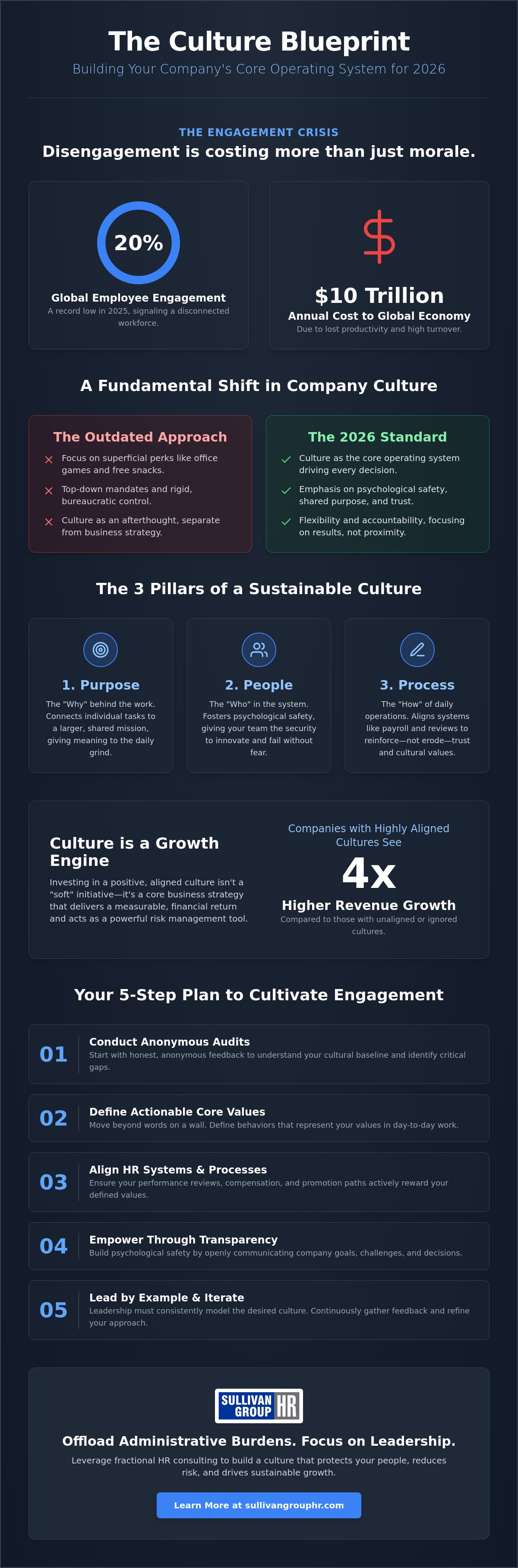
In 2026, the era of perk-based culture is over. Ping pong tables and catered lunches are no longer enough to mask a toxic environment. Today's workforce demands a purpose-based culture where shared goals take precedence over superficial office amenities. If you're wondering how to build a positive company culture, start by shifting your focus from what you provide to who you are as an organization. A strong culture acts as your most effective risk management tool, protecting you from the legal and financial fallout of high turnover and workplace conflict. The data supports this shift; companies with highly aligned cultures see 4x higher revenue growth compared to those that ignore these human elements.
The Three Pillars: Purpose, People, and Process
A sustainable culture rests on a three-part foundation. First is Purpose. This provides the "why" behind the daily grind, connecting individual tasks to a larger mission. Second is People. This pillar focuses on psychological safety, giving your team the security to innovate and the support to fail without fear. Finally, there is Process. This is where your daily operations, from payroll to performance reviews, either reinforce or erode trust. When these three pillars align, you move away from a transactional workplace and toward a long-term professional partnership.
Why Traditional Culture Models Fail in a Modern Market
Top-down mandates and office-centric requirements no longer resonate with today's elite workforce. The market has shifted toward an experience-centric model where the quality of the workday matters more than the physical location of the desk. Leaders who rely on rigid, bureaucratic control often find themselves facing administrative burnout and low morale. They struggle to attract talent because they're using a 20th-century playbook for a 21st-century team. In the modern market, 2026 culture is a blend of flexibility and accountability.
Does your current framework empower your people or restrain them? By focusing on results rather than proximity, you build a culture of mutual respect. This approach reduces the friction of daily management and allows you to lead with confidence. When you prioritize the human experience, you don't just fill seats; you build a legacy of success that survives any market shift.
The Foundation: Trust, Transparency, and Psychological Safety
Some leaders dismiss culture as "fluff," but that's a dangerous misconception. A toxic environment isn't just unpleasant; it's expensive. When you understand how to build a positive company culture, you're actually investing in your bottom line. High-trust teams outperform low-trust competitors in every metric, from operational efficiency to creative innovation. This isn't about being "nice." It's about creating a protective environment where people can perform at their peak without the weight of administrative friction.
Central to this foundation is psychological safety. It's the freedom for an employee to voice a concern, admit a mistake, or share a bold idea without fear of retribution. Without it, your best talent stays silent, and your business risks go unmanaged. Leaders who practice radical transparency regarding financial and strategic goals invite their team into the mission. When you're vulnerable about challenges, you signal that it's safe for others to do the same. If you want to improve company culture, you must first secure the foundation of trust through consistent, honest leadership.
Building Trust Through Consistent Communication
Trust isn't built in a single annual meeting. It's forged through regular, honest "State of the Company" updates that keep everyone aligned. Move away from outdated annual reviews and toward continuous feedback loops. This keeps communication brisk and purposeful. Many successful firms use workforce management solutions to maintain consistent touchpoints across hybrid teams. If you're feeling overwhelmed by the administrative side of these processes, partnering with an HR expert can help you stay focused on your people while we handle the systems.
Empowering Autonomy: Moving from Micromanagement to Mastery
In a high-trust culture, the "how" matters less than the "what." Micromanagement is a symptom of fear; mastery is a result of empowerment. By setting clear KPIs, you allow employees to own their results. This autonomy is directly linked to long-term employee retention. When people feel trusted to manage their own workflows, they're more engaged and less likely to burn out. This shift from control to coaching is a vital step in how to build a positive company culture that lasts. It minimizes cognitive load for leadership and maximizes output for the team.
The Structural "How": Aligning HR Systems with Cultural Values
Culture isn't just a feeling; it's a function of your infrastructure. You can hold all the team-building retreats you want, but if your payroll is consistently late or your benefits are impossible to access, trust will evaporate. A broken administrative system sends a clear, if unintentional, message: our people aren't our priority. When business owners ask how to build a positive company culture, they often overlook the "hard" side of HR. Your systems must mirror your values. If you value transparency and respect, your payroll and benefits systems must be reliable, clear, and easy to navigate.
This alignment starts long before a new hire's first day. By utilizing a modern applicant tracking and onboarding system, you signal a high standard of professionalism from the very first click. It tells the candidate that your organization is organized, tech-forward, and protective of their time. This is a critical step to improve company culture by setting the tone for a professional partnership rather than a transactional job.
Onboarding: The Cultural Handshake
Why do the first 90 days matter so much? This period dictates whether a new hire becomes a long-term asset or a turnover statistic. The first day shouldn't be a mountain of paperwork; it should be a cultural immersion. We use the isolved platform to move the administrative burden into the background. This allows your new team members to focus on building relationships and understanding your mission. Does your current "welcome" experience mirror your brand values, or does it feel like a bureaucratic hurdle? A smooth, digital-first onboarding process proves you value efficiency and human connection over red tape.
Your physical office environment is often the backdrop for your culture, and showcasing it effectively is vital for employer branding. For businesses looking to capture their space with professional precision, Houzpics | Real Estate Photographers in Hilton Head, SC provides the high-end photography and videography needed to make a lasting impression on future hires.
Benefits as a Cultural Statement
A generic benefits package suggests a generic culture. To truly stand out, you must tailor benefits management solutions to the actual needs of your workforce. In 2026, employees look for more than just health insurance. They want to know you value their life outside of work. This means offering support for financial wellness, mental health, and work-life balance. When your benefits reflect the specific demographics and desires of your team, you're not just providing a service; you're making a cultural statement. It shows you're listening, you care, and you're invested in their long-term security.
Tactical Execution: 5 Steps to Cultivating Engagement in 2026
Moving from a theoretical framework to a thriving workplace requires a deliberate, step-by-step approach. You've already addressed the structural foundations of trust and technology; now it's time to activate those systems. If you're committed to how to build a positive company culture, you must treat engagement as a continuous project rather than a one-time initiative. This involves listening to your team, defining your path, and providing the tools they need to succeed.
- Step 1: Audit your current culture. Use anonymous, honest surveys to find out where you actually stand. You might discover that your perception of the office vibe differs significantly from the daily reality of your staff.
- Step 2: Define actionable core values. Move away from aspirational posters and select 3-5 core values that dictate behavior. If "accountability" is a value, define exactly what that looks like in a hybrid meeting.
- Step 4: Implement formal recognition. Celebrate wins that align with your core values. This reinforces the behaviors you want to see and makes your culture visible and tangible.
- Step 5: Review your tech stack. Ensure your human capital management system actually supports these goals. If your software is clunky, it will erode the very engagement you're trying to build.
Execution is where many businesses falter because they lack the time to manage the details. If you're ready to offload the administrative weight and focus on your people, contact our HR consulting team to start building your custom strategic framework.
Measuring What Matters: Culture Analytics
Data provides the clarity you need to make informed leadership decisions. By using eNPS (Employee Net Promoter Score), you can track the overall health of your organization in real time. Don't stop at the company-wide level; monitor turnover rates by department to identify "toxic pockets" that might need extra support or intervention. You cannot manage what you do not measure. These metrics act as an early warning system, allowing you to protect your workforce before a small issue becomes a full-blown retention crisis.
The Power of Peer-to-Peer Recognition
While praise from a supervisor is valuable, recognition from a colleague often carries more weight because it comes from someone in the trenches. When you understand how to build a positive company culture, you realize that a "shout-out" culture is self-sustaining. Use integrated HCM tools to make this process easy and immediate. By linking every piece of recognition back to your core values, you create a steady rhythm of positive reinforcement that keeps your team connected, even in a remote or hybrid environment.
Scaling Culture: How Sullivan Group HR Protects Your People
How much of your day is spent actually leading your team versus managing their paperwork? For many business owners, the dream of strategic mentorship is often sidelined by the daily reality of payroll processing, tax compliance, and benefits enrollment. These administrative burdens are silent culture-killers. They steal the time and mental energy required for how to build a positive company culture that actually scales as you grow. When you're overwhelmed by the "how" of employment, you lose sight of the "who" in your organization. This is where a professional partnership changes the trajectory of your business.
Sullivan Group HR acts as your protective partner, stepping in to handle the complex professional functions that keep you from your people. Through our "Fractional HR" model, you gain access to regional expertise and hard-earned wisdom without the prohibitive cost of a full-time executive. We provide the structural rigor you need, utilizing the isolved platform to deliver the data-driven insights necessary for informed cultural decisions. This approach creates an atmosphere of reliable advocacy where your workforce feels secure and your leadership feels empowered. We manage the systems so you can value the people.
Removing the Administrative Friction
A seamless payroll experience is the ultimate "trust-builder" in any organization. When checks are accurate and on time, you reinforce the bedrock of respect that we discussed in the foundations of this framework. By reducing HR risk and ensuring regulatory compliance, we create a stable, secure environment where employees can focus on their work rather than their worries. This shift frees up your leadership team to engage in high-value mentorship and strategic planning. It moves your brand away from a transactional identity and toward a long-term professional relationship. We handle the talent acquisition, compensation, and security so you can focus on building a legacy.
Your Partner in Growth and Culture
Our approach combines authoritative support with modern HCM technology. We don't believe in sterile, one-size-fits-all solutions. Instead, we customize HR strategies to fit your unique cultural vision and the specific nuances of your local territory. We help you navigate the entire lifecycle of a professional relationship, ensuring that your mission remains the priority. By emphasizing interpersonal value over automated, tech-only processes, we ensure your culture remains human-centric even as you scale. We are approachable, community-oriented, and focused on your success as the primary metric of our own. Ready to transform your workplace and discover how to build a positive company culture that lasts? Contact Sullivan Group HR today.
Building Your Legacy Through People
Are you ready to move beyond superficial perks and create a workplace that truly thrives? We've explored how a purpose-based operating system, anchored in trust and psychological safety, defines the modern standard. You now understand that how to build a positive company culture requires aligning your structural HR systems with your core values. From the first handshake during onboarding to the reliability of every paycheck, your infrastructure must prove that you value your people.
The transition from administrative burnout to high-impact leadership begins with the right partnership. Sullivan Group HR provides decades of expertise in human-centric consulting, combined with the power of the industry-leading isolved HCM platform. We handle the complexities of payroll outsourcing, risk management, and compliance so you can reclaim your time for mentorship and growth. Let Sullivan Group HR handle your administrative burdens so you can focus on your people.
Your team is your greatest asset and your strongest competitive advantage. By protecting their experience today, you're securing the long-term stability of your business. Let's start building a culture your people actually enjoy.
Frequently Asked Questions
Can you build a positive company culture with a remote or hybrid team?
Building a successful culture in a remote or hybrid setting is entirely possible when you prioritize intentional communication. Since you don't have a physical office to anchor the team, your digital interactions must serve as the cultural environment. If you want to learn how to build a positive company culture from a distance, shift from proximity-based management to results-oriented trust. Use regular video touchpoints to ensure every team member feels like a valued partner.
How long does it take to see the results of a culture change initiative?
Expect to see initial shifts in team morale within 90 days, but a complete cultural transformation typically takes 6 to 18 months. Culture is an operating system that requires consistent updates and maintenance to function correctly. Early wins often come from fixing administrative friction, like payroll errors or unclear benefits. However, deep-seated behavioral changes require ongoing leadership coaching and repeated reinforcement of your core values to truly stick and drive performance.
Who is ultimately responsible for company culture—HR or the CEO?
The CEO is the primary architect of the vision, while HR serves as the structural engineer who builds the framework. Leadership must model the behaviors they want to see, as culture always flows from the top down. HR's role is to provide the systems, such as performance management and recruitment tools, that reinforce that vision. When these two forces align, they create a protective environment where the workforce can thrive and perform at its peak.
What are the most common "culture killers" in small businesses?
The most common culture killers include micromanagement, inconsistent communication, and broken administrative processes. When a business owner tries to control every detail, it erodes the autonomy and trust necessary for a healthy workplace. Additionally, if payroll is late or benefits are confusing, it sends a message that the team's security isn't a priority. These small points of friction eventually lead to high turnover and a general sense of burnout across the organization.
How do we maintain culture during periods of rapid growth or scaling?
Protect your culture during rapid growth by documenting your core values and integrating them into your hiring process. As you scale, you can't rely on simple osmosis to spread your mission to new hires. Every new team member must be a cultural match, not just a skill match. Utilizing a modern applicant tracking system helps you screen for these traits early. This ensures your foundational values remain strong even as your headcount doubles or triples.
Is it possible to "fix" a toxic company culture, or is it better to start over?
You can fix a toxic culture, but it requires a radical commitment to transparency and leadership change. It starts with an honest audit to identify the specific behaviors that allowed toxicity to grow in the first place. When considering how to build a positive company culture after a difficult period, start by removing the administrative friction points that cause the most stress. Rebuilding trust takes time, but a human-centric approach can save a struggling team.
How does HR outsourcing affect our existing company culture?
HR outsourcing actually strengthens your culture by removing the administrative burdens that distract you from your people. When you offload payroll, compliance, and risk management, you gain the mental space to focus on mentorship and strategic leadership. It ensures your employees have a professional, reliable experience with their benefits and compensation. This professional touch reinforces trust and stability, making your organization feel more secure and organized for every member of the team.
What role does technology play in maintaining a positive workplace?
Technology should act as a bridge that simplifies daily tasks and connects your team across different locations. In 2026, tools like the isolved platform provide the data needed to track engagement and the ease of use that prevents employee frustration. When your tech stack is intuitive, it reduces the cognitive load for your employees. This allows them to focus on high-value work and meaningful collaboration rather than fighting with clunky, outdated software systems.


