

What if the most expensive part of your HR department isn't the software you buy, but the manual processes you keep? For many leaders, the "invisible drain" of payroll errors, disconnected systems, and compliance gaps is a silent profit killer. Learning how to justify the cost of an HCM platform isn't just about finding room in the budget. It's about protecting your people, your time, and your professional peace of mind.
You probably feel the weight of fragmented systems that won't talk to each other, creating unnecessary friction every pay cycle. It's a heavy burden to carry alone. We're here to help you move from being a reactive administrator to a proactive strategist. This guide will teach you how to quantify efficiency, compliance, and retention to turn HR into a growth engine. We'll explore a clear framework for calculating ROI, the benefits of consolidating your tech stack, and how to navigate the 2026 regulatory landscape with confidence. From new state-mandated paid leave programs in Maine and Minnesota to shifting tax incentives for child care, you'll learn to build a business case that leadership can't ignore.
Key Takeaways
- Identify the "administrative tax" hidden in manual workflows and learn how a small payroll error margin can cost your business thousands every year.
- Master how to justify the cost of an HCM platform by calculating your total cost of ownership and the immediate savings found in tool consolidation.
- Quantify the strategic impact of an integrated Applicant Tracking System to lower your cost-per-hire and strengthen long-term employee retention.
- Build a robust "compliance shield" that automates record-keeping to protect your assets from the rising risks of DOL audits and regulatory penalties.
- Discover how pairing the isolved platform with a dedicated HR partner transforms a simple software purchase into a long-term engine for unified success.
The Invisible Drain: Calculating the Real Cost of Manual HR Processes
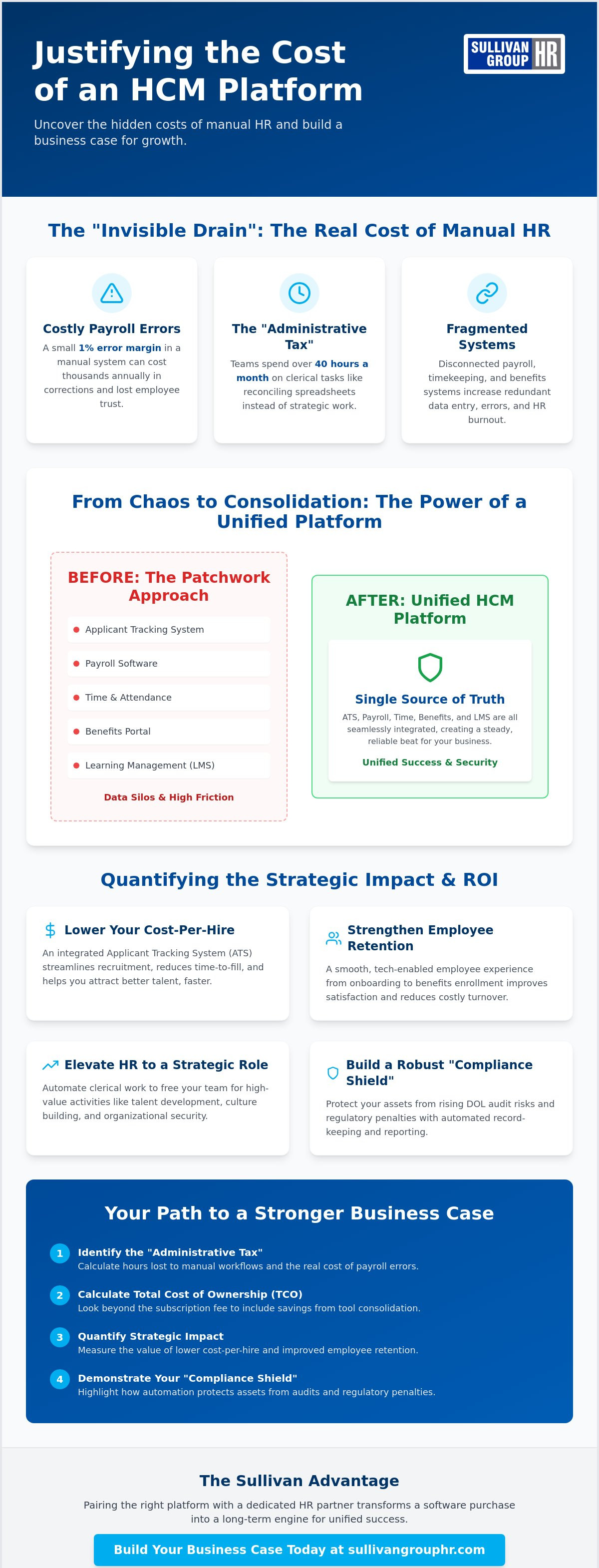
Is your HR team actually moving your business forward, or are they just keeping their heads above water? When business owners ask how to justify the cost of an HCM platform, they usually start with the price tag. However, the real expense isn't the software; it's the "Administrative Tax" you're already paying. This tax is the cumulative cost of every manual data entry point, every paper form, and every fragmented system that doesn't talk to the others. It's a silent profit killer that drains your resources before you even cut a single paycheck.
Consider the 1% payroll error margin. In a manual environment, even a small mistake can cost thousands annually in corrections, back-pay, and lost employee trust. When your team spends forty hours a month reconciling spreadsheets instead of developing your next generation of leaders, your business pays a price that never appears on a software invoice. These friction points, like manual benefits enrollment and paper-based onboarding, don't just slow you down. They lead to HR burnout and high turnover. A robust Human Resource Management System (HRMS) acts as the foundation for modern operations, replacing chaos with a steady, reliable beat.
The True Cost of the Status Quo
Analyze the labor hours your staff spends on manual reporting and data reconciliation. Are they performing strategic work or clerical tasks? Many entrepreneurs believe manual processes are "free" because they don't have a monthly subscription fee. In reality, these are your most expensive HR functions. The opportunity cost is staggering. Every hour spent on a filing cabinet is an hour lost to talent development, culture building, and organizational security. Understanding this hidden drain is the first step in learning how to justify the cost of an HCM platform to stakeholders who only see surface-level expenses.
Identifying Fragmented System Friction
Data silos between payroll, timekeeping, and benefits are more than just an inconvenience; they're a liability. Redundant data entry increases the risk of compliance failures and creates a disjointed experience for your employees. When systems don't talk, errors multiply. This lack of integration forces your team to act as human bridges between software, which is a waste of their professional potential. Administrative friction is the primary barrier to mid-market scaling. By consolidating these functions, you move away from a transactional vendor identity and toward a long-term relationship built on safety and results.
Building the Business Case: Beyond the Per-Employee Price Tag
When leadership asks for the numbers, don't just hand them a quote. Start with a comprehensive cost-benefit analysis that accounts for the Total Cost of Ownership (TCO). This includes implementation, training, and ongoing maintenance fees that often hide beneath the surface. Realizing how to justify the cost of an HCM platform requires looking at the bigger picture of organizational health. It's about moving away from a patchwork of disconnected apps and toward a single, secure source of truth. This shift reduces the cognitive load on your team and makes daunting administrative tasks feel manageable and organized.
Unified success isn't just a buzzword. It's a result. Integrated systems provide a steady, reliable beat for your business lifecycle. From the moment of talent acquisition to the final compensation cycle, data remains consistent. This reliability is exactly how to justify the cost of an HCM platform to a board focused on long-term security. By positioning yourself as a strategist rather than a clerk, you demonstrate that HCM is a catalyst for organizational security, not just a line-item expense.
Consolidating the HR Tech Stack
Fragmented systems are expensive. When you calculate "Tool Consolidation Savings," you aren't just cutting subscription fees. You're eliminating the IT overhead required to keep five different systems synced and secure. A single platform replaces your Applicant Tracking System (ATS), Learning Management System (LMS), Time and Attendance, and Benefits Administration portal. This reduction in complexity is one of the primary integrated HR and payroll software benefits that mid-market companies often overlook. It simplifies your professional functions into a streamlined workflow that protects your data and your time.
The Value of Employee Self-Service
How many hours does your HR team lose to simple questions? "How much PTO do I have?" or "Where is my W-2?" are inquiries that drain productivity and create administrative friction. Employee self-service portals empower your workforce to manage their own data. This improves accuracy and provides 24/7 mobile access, which is essential for workforce engagement in 2026. It's a shift that boosts morale while freeing your HR staff for high-impact consulting. If you're ready to see how these efficiencies look in your specific territory, partnering with a regional expert can help you map out these savings with precision.
Quantifying Strategic Impact: Retention, Talent, and Productivity
Are your employees merely names on a spreadsheet or the engine of your growth? Shifting your focus from administrative costs to human potential is the ultimate way to achieve Maximizing Your Return on People. When you understand how to justify the cost of an HCM platform, you stop seeing software as a line-item expense. Instead, you see it as a strategic investment in the safety and stability of your workforce. It creates an atmosphere of reliable advocacy where every team member can thrive.
An integrated Applicant Tracking System (ATS) is your first line of defense in a competitive market. It isn't just about posting jobs; it's about speed, precision, and quality. By centralizing the hiring process, you reduce your cost-per-hire and secure top talent before your competitors even finish their first interview. This efficiency delivers immediate results to your bottom line while building a stronger organizational foundation.
Reducing Turnover Through Onboarding
A professional onboarding experience sets the tone for the entire professional relationship. First impressions matter. Replacing a frontline employee can cost 40% of their annual salary, while replacing a leader can cost up to 200%, according to Gallup data from 2026. These are not small numbers. Our applicant tracking and onboarding guide shows how a seamless transition from candidate to employee creates a sense of security. This structured approach is a primary factor in reducing early-stage turnover, making the ROI of an HCM platform clear and immediate.
Modern talent expects modern tools. For Gen Z and Millennial workers, a paper-based system is a red flag that suggests a lack of investment in their future. These generations value transparency, feedback, and growth. Research shows that 94% of employees would stay at a company longer if it invested in their career development. An HCM platform provides the framework for this evolution, signaling that you are a forward-thinking, people-first employer.
Data-Driven Decision Making
How do you spot "Quiet Quitting" before it's too late? Labor analytics provide real-time visibility into engagement and productivity. Instead of guessing, you can use data to identify attrition risks and career path needs. This clarity allows for better budget forecasting and resource allocation across your entire territory. HCM data transforms HR from a cost center to a profit-protector by safeguarding your human capital investment. It provides the hard evidence you need when explaining how to justify the cost of an HCM platform to your executive team.
The Compliance Shield: Protecting Your Assets from Regulatory Risk
How much would a Department of Labor audit cost your business today? For many owners, the answer is enough to shutter their doors. When you evaluate how to justify the cost of an HCM platform, you have to look at it as a high-grade insurance policy against regulatory friction. Manual payroll is a magnet for "Regulatory Red Flags" that invite unwanted scrutiny. Automated record-keeping creates a "Compliance Shield" that protects your assets from the rising tide of labor law changes in 2026. It moves your business away from a transactional vendor identity and toward a state of long-term organizational security.
As of January 2026, 19 states have increased their minimum wages, including Arizona, Colorado, and Washington. If you operate across state lines, keeping up with these shifts manually is a recipe for FLSA violations. Delaware, Maryland, Maine, and Minnesota are also rolling out new state-mandated Paid Family and Medical Leave (PFML) programs this year. An HCM platform automates these updates, ensuring you never miss a deduction or a filing deadline. This level of organization doesn't just save time; it projects a professional image to regulators. It shows that you value people over systems while using those systems to protect your people.
Mitigating Payroll and Tax Risk
Multi-state tax filing is a complex puzzle. Errors in this area lead to compounding penalties and interest that can dwarf the cost of any software subscription. By using integrated HR risk management guide strategies, you can transition from reactive panic to audit readiness. The ROI here is found in the legal fees you never have to pay and the settlements you never have to sign. An HCM platform handles evolving labor laws without requiring your team to perform manual research every week. This structure minimizes cognitive load, making daunting regulatory tasks feel manageable and organized.
Standardizing HR Consulting and Policy
Consistency is your best defense against discrimination claims. An HCM platform ensures your employee handbook isn't just a dusty PDF on a drive; it's a living framework that governs every interaction. Integrated timekeeping prevents "Wage and Hour" lawsuits by providing a transparent, verifiable record of every minute worked. This is especially critical with new requirements like the Colorado Artificial Intelligence Act, effective June 30, 2026, which demands "reasonable care" in employment decisions. If you feel overwhelmed by these shifting sands, consulting with a regional expert can help you secure your organizational future with confidence.
The Sullivan Advantage: Maximizing isolved for Long-Term Value
Are you looking for a software vendor or a long-term ally? In the complex professional landscape of 2026, technology alone cannot solve every administrative burden. Realizing how to justify the cost of an HCM platform requires more than just a feature list. It requires a partner who understands your specific territory and your unique workforce. Sullivan Group HR leverages the isolved platform to deliver 'Unified Success,' moving you away from transactional relationships toward a state of organizational security. We bridge the gap between automated systems and interpersonal value.
The "Scalability Factor" is where your investment truly pays off. Our model allows you to grow your business without growing your administrative headcount. By utilizing the latest isolved People Cloud™ updates, including autonomous AI agents and integrations with partners like Remote for global hiring, we help you scale with precision. This approach minimizes cognitive load and ensures your internal team stays focused on high-impact strategy. We customize the HCM experience to your specific industry, ensuring the software mirrors your actual workflows rather than forcing you into a generic box.
The Synergy of Tech and Talent
Software is a tool. People are the power. Our "Fractional HR" model provides the professional expertise that automated, tech-only competitors lack. We provide the "human touch" that keeps your organization grounded while your technology reaches for the clouds. This synergy creates a sense of security for business owners who feel overwhelmed by regulatory shifts. It's a long-term partnership that evolves with your business, providing hard-earned wisdom that a chatbot simply cannot replicate. Sullivan Group HR protects your professional potential by acting as your coach, advocate, and regional expert.
Getting Started with isolved People Cloud
The road to a frictionless HCM implementation doesn't have to be daunting. We provide a clear, chronological roadmap that handles the heavy lifting of data migration and setup. Our team ensures your transition is steady and reliable, mirroring the actual lifecycle of your professional relationships. We move you from talent acquisition to long-term security with a purposeful rhythm. If you're ready to transform your HR department from a line-item expense into a strategic growth engine, the first step is clarity. Request a personalized ROI analysis for your business to see exactly how we can secure your future.
Ready to Secure Your Organizational Future?
Your business deserves more than a patchwork of spreadsheets and silent profit drains. By quantifying the administrative tax and building a case around retention and risk mitigation, you now have a roadmap for how to justify the cost of an HCM platform to your leadership team. You've seen how integrated systems don't just save time; they create a secure foundation for every employee in your organization. From automated tax filings to seamless onboarding, the results are measurable, steady, and reliable.
Success in 2026 requires a balance of innovative technology and hard-earned wisdom. Sullivan Group HR brings over 25 years of HR outsourcing expertise to your territory, combining the industry-leading isolved platform with comprehensive risk management and compliance protection. We don't just provide software; we provide a protective shield and a strategic partnership that grows with you. It's time to move away from transactional vendors and embrace a relationship that values your people over simple automation.
Secure your business growth with a unified HCM solution from Sullivan Group HR. We're ready to help you thrive.
Frequently Asked Questions
What is the average ROI of an HCM platform implementation?
The return on investment stems from eliminating the "administrative tax" of manual labor and preventing costly payroll errors. Organizations with high employee engagement experience 21-51% less turnover than those with low engagement. By reducing the cost of replacing employees, which ranges from 40% to 200% of their annual salary, the platform pays for itself through improved retention and productivity.
How long does it typically take for an HCM platform to pay for itself?
Most businesses reach a break-even point within the first 18 to 24 months of operation. This timeline depends on how quickly you consolidate fragmented tools and eliminate redundant data entry. By automating complex requirements like the new state-mandated PFML programs rolling out in 2026, you'll see immediate gains in efficiency that accelerate your payback period.
Can an HCM platform really reduce my insurance premiums?
Yes, especially regarding Workers' Compensation Insurance and general liability coverage. A unified system provides accurate safety records and ensures consistent application of your employee handbook policies. Many carriers view organizations with standardized HR consulting and risk management practices as lower-risk, which can lead to more favorable rates and fewer claims over time.
What are the hidden costs of HCM software I should watch out for?
Implementation fees, data migration, and ongoing staff training are the most common expenses that don't appear in the base price. When you're learning how to justify the cost of an HCM platform, it's vital to calculate the Total Cost of Ownership (TCO) over a three-year period. A regional expert can help you identify these "invisible" costs upfront so your budget stays on track.
How do I compare the cost of HR outsourcing vs. buying a software subscription?
A software subscription provides the tool, but HR outsourcing provides the professional expertise to manage it. Outsourcing often eliminates the need to hire additional full-time HR staff as your business scales. You should compare the salary and benefits of an internal HR manager against the flat fee of a professional partner who handles both the technology and the strategy.
Is an HCM platform worth it for a business with fewer than 50 employees?
It's often more critical for smaller teams because a single compliance error or payroll mistake has a larger relative impact on your bottom line. Small businesses must navigate the same complex laws, like the Colorado Artificial Intelligence Act, without the benefit of a massive legal department. A platform provides the "compliance shield" you need to grow safely without adding administrative headcount.
What is the difference between an HRIS and an HCM platform in terms of cost?
An HRIS generally handles core data and payroll, while an HCM platform is a comprehensive suite that includes talent acquisition and performance management. While an HCM platform may require a higher initial investment, it replaces multiple disparate software subscriptions. This consolidation is a primary way how to justify the cost of an HCM platform by reducing your overall IT overhead.
How does a unified HCM platform improve payroll tax compliance?
It automates calculations and filings based on the latest local and state regulations in real-time. With 19 states increasing minimum wages in 2026, manual tracking creates a high risk for FLSA violations and tax penalties. A unified system ensures that every deduction and filing is accurate and on time, protecting your business from the compounding interest of compliance failures.


