

What if outsourcing payroll gave you back time without taking away oversight? That is the key to how to outsource payroll well: make it a controlled handoff, not a blind transfer. Payroll administration can pull attention from running your business, while questions about provider responsibilities, employee data, and accountability can make a change feel risky.
Those concerns are reasonable. A provider can handle agreed payroll tasks, but your business still needs accurate information, clear decision-makers, and a way to review each pay run. The right arrangement matches the service scope and technology to your needs, with support for the work you want to hand off.
This guide covers how to assess your current process, compare providers, prepare payroll records, and plan a transition around your pay schedule. It also explains what to confirm about data security, tax responsibilities, and ongoing support. With clear responsibilities and practical review steps, you can reduce administrative work while keeping visibility and control.
Key Takeaways
- Before outsourcing payroll, map the tasks, employee types, pay schedules, work locations, and systems a provider needs to understand.
- Compare providers on service scope, transition support, reporting, communication, and data safeguards. Confirm who owns each task.
- Agree on payroll dates, information cutoffs, approval roles, and escalation contacts before transferring records.
- Validate employee and payroll information before launch, then review early payroll runs for discrepancies and unresolved questions.
- Keep the arrangement dependable with recurring checks of exceptions, reconciliations, system access, employee questions, and changing business needs.
How to Outsource Payroll Without Losing Control of the Process
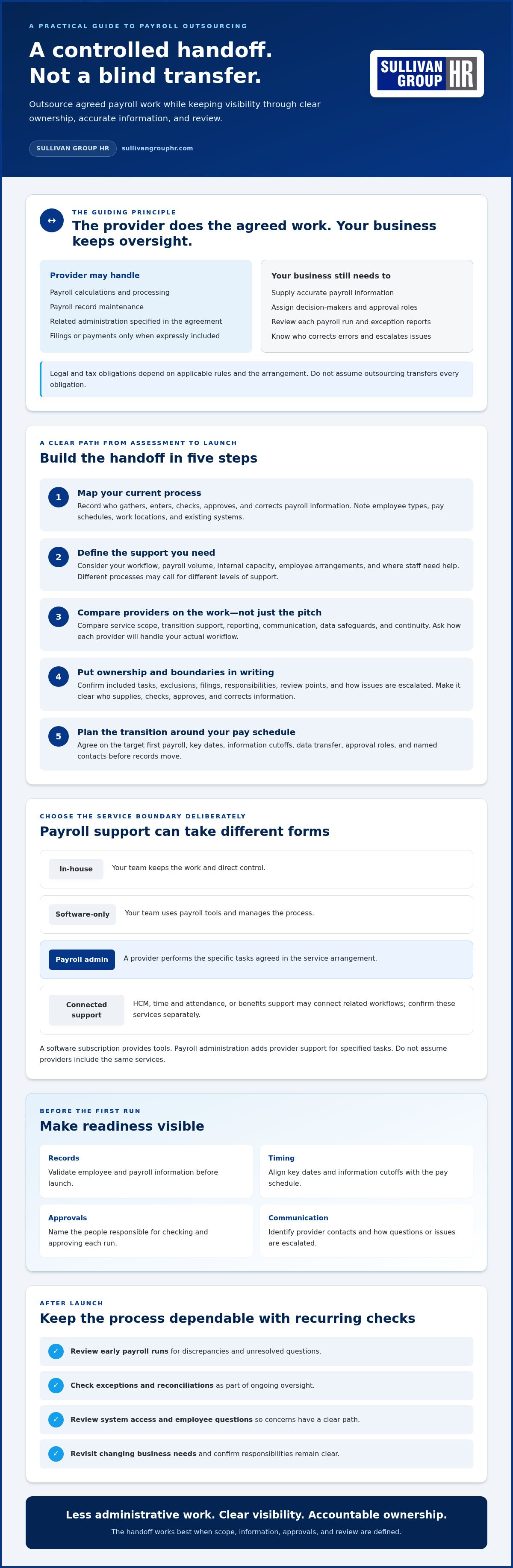
Outsourcing changes who performs payroll tasks, not the need for your business to oversee the process. Your team still needs to provide accurate inputs, review results, and approve each run. The difference is that a provider can take on specific work, leaving your staff more time for other priorities.
Businesses may consider outsourcing when payroll takes too much staff time, pay rules or employee arrangements make processing harder to manage, or a key person’s absence could interrupt the routine. Payroll is one example of business process outsourcing: an organization brings in an external provider to perform defined work. The value of that arrangement depends on setting clear boundaries for the work.
Payroll outsourcing is an arrangement in which an outside provider performs agreed payroll work, such as calculating pay, processing payroll, maintaining payroll records, and handling related administration. The exact tasks depend on the service agreement. A payroll software subscription gives your team tools to do the work; payroll administration adds provider support for specified tasks. Broader HR outsourcing may connect payroll with areas such as benefits management, time and attendance, or HR consulting, but confirm those services separately.
What payroll tasks can an outside provider handle?
Depending on the agreement, a provider may support payroll calculations and processing, maintain records, and assist with related administration. Do not assume every provider includes the same tasks. Confirm who collects and enters changes, what reviews take place, and whether any filings or payments are included. Payroll administration is distinct from benefits management, timekeeping, and broader HR consulting, even when a business chooses to coordinate these functions.
What remains the employer’s responsibility?
Keep a review step in your process. Before treating a payroll run as complete, check submitted pay information, approvals, and exception reports. For example, confirm that hours, pay changes, and employee updates have been reviewed by the appropriate person. Document who supplies information, who checks it, who approves it, and who corrects errors. This ownership map helps prevent gaps when responsibilities are shared between your team and the provider.
Legal and tax obligations depend on applicable rules and the details of the arrangement. Do not assume outsourcing transfers every obligation or resolves every compliance question. Ask the provider to describe its responsibilities in writing, identify what remains with your business, and explain how issues are escalated. For a payroll outsourcing arrangement such as Sullivan Group HR’s, confirm the specific tasks and filings included before work begins. Clear scope, careful review, and documented ownership keep the handoff accountable.
How to Outsource Payroll: Assess Needs and Select the Right Service
The right service starts with the work your business actually needs done. Before comparing providers, document how payroll runs today and where your team needs support. That makes it easier to compare equivalent services instead of choosing based on a software demonstration or a general promise of convenience.
- Map current tasks: Note who gathers, enters, checks, approves, and corrects payroll information.
- Define requirements: Record employee types, pay schedules, work locations, approval roles, and existing systems.
- Compare providers: Ask how each provider handles your workflow, security, support, reporting, and continuity needs.
- Confirm scope: Get included tasks, exclusions, filings, and responsibilities in writing.
- Plan the transition: Agree on the target first payroll, key dates, data transfer, and named contacts.
Use these details to assess the complexity of your process and the capacity of your internal team. A small team with consistent pay may need a different level of support than a business managing multiple employee types, work locations, or pay schedules. Consider payroll volume, but also how much time your staff can reliably spend collecting information, reviewing results, and resolving exceptions.
Which payroll outsourcing model fits your business?
Keeping payroll in-house preserves direct control but leaves the work with your team. Software-only support provides tools while your staff manages the process. Outsourced payroll administration assigns agreed tasks to a provider. Connected HCM, time and attendance, or benefits support may be relevant if you want related workflows considered together. No model suits every business. Match the scope to your workload and your team’s ability to provide oversight.
A payroll processor handles agreed pay-related tasks; a broader HR support provider may also help coordinate payroll with other HR administration.
Questions to ask a potential payroll provider
Ask for clear, written answers. Which tasks and filings are included? Who approves payroll, handles employee inquiries, and corrects submitted information? How are user access and employee data protected, and how are urgent issues escalated? Also ask what reports, implementation support, continuity arrangements, and ongoing points of contact are available. Record the answers in a comparison sheet, and treat any external resource or documentation as a prompt to verify details directly with providers.
These steps make how to outsource payroll a practical scope-setting exercise, not a guess. If you are weighing payroll administration alongside broader HR support, discussing payroll scope and transition needs with Sullivan Group HR can help clarify which arrangement fits your operations.
How to Compare Payroll Providers on Security, Support, and Clear Ownership
A provider’s pitch matters less than the working arrangement behind it. Compare each provider against the requirements you documented. Look for clear answers about who does what, when information is due, and how problems are handled. A platform alone cannot replace a clear agreement.
Use the same comparison framework with each provider:
Scope: Which payroll tasks, filings, corrections, off-cycle requests, and employee inquiries are included? What remains with your team?
Implementation help: Who guides data transfer and setup? What information must your business provide, and how will readiness be reviewed?
Support access: What channels and hours are available? Who is your point of contact, and how are issues escalated?
Reporting: Which reports are provided, how often, and what approvals or reviews are expected from your business?
Data safeguards: How are records transferred, stored, and accessed? Ask how access is assigned, reviewed, and removed when an employee’s role changes.
How to evaluate service scope and accountability
Match the proposed services line by line against your needs. If your team expects the provider to address an incorrect time entry, clarify who can submit the correction, the cutoff for changes, and who confirms the updated result. Ask how employee questions are routed and how unresolved issues move up the support chain.
Before signing, make sure the service agreement spells out responsibilities, submission deadlines, approval steps, reporting, and issue-resolution paths. The IRS says employers can remain ultimately responsible for the deposit and payment of federal tax obligations when payroll duties are outsourced. Confirm how that applies to your arrangement. Do not treat a provider’s involvement as a substitute for understanding your own obligations.
How to assess payroll data protection and support
Ask specific questions rather than relying on a general claim that data is “secure.” Who can access sensitive employee records? How is access reviewed when responsibilities change? What methods are used to transfer records, and how can your business raise a concern about access or handling? Request documentation for security claims and verify the details directly rather than assuming a particular certification or safeguard applies.
Also confirm support hours, response channels, continuity plans, and whom to contact if a payroll issue arises near a cutoff. Compare those answers alongside scope and reporting. This makes how to outsource payroll a decision based on visible responsibilities and communication, not promises of error-free processing or guaranteed compliance.
How to Transition Payroll to a Provider Step by Step
Plan the handoff around a real payday, not just a system setup date. Agree with the provider on the target first payroll, information cutoffs, task owners, and whom to contact if a problem threatens the schedule. Leave time to compare records and resolve gaps before relying on a live payroll cycle.
Use this sequence to keep the transition organized:
- Prepare: Gather current payroll records and document how information is collected, checked, and approved.
- Transfer securely: Agree with the provider on a secure method for sending sensitive records. Avoid casual email or other unapproved channels.
- Configure: Review how employee details, pay schedules, deductions, and timekeeping inputs will be set up.
- Validate: Reconcile source records and review sample payroll outputs. Where practical, run a parallel cycle to compare results before going live.
- Launch and review: Confirm readiness, run the first payroll, and schedule a follow-up to capture questions and process gaps.
What information should you prepare?
Ask the provider for its specific intake list, then assemble the records needed for the agreed service scope. Depending on your setup, that may include:
- Employee records and compensation details.
- Pay schedules, deductions, and relevant historical payroll data.
- Current processes, approval contacts, and timekeeping inputs.
- Reporting preferences and the existing systems involved in payroll.
Check records for missing or inconsistent details before transfer. Agree on the approved transfer method and confirm who can access the files. A clear handoff protects sensitive information and gives the provider a sound foundation for setup.
How to validate the first payroll cycles
Before approving a live run, assign reviewers and compare key totals and employee-level details with approved source records. Check that pay, deductions, and time inputs match what your business submitted. If something differs, document the discrepancy, identify who will investigate it, and record how it was corrected. Do not rely on a sample output until the appropriate people have reviewed it.
After launch, hold a review to capture employee questions, recurring exceptions, missed inputs, and workflow adjustments. This turns early experience into practical improvements while responsibilities are still fresh. If you are preparing a provider handoff, discuss payroll transition needs with Sullivan Group HR.
How to Keep Outsourced Payroll Reliable After Launch
Going live is the start of the working relationship, not the finish line. Reliable outsourced payroll depends on timely inputs, clear approvals, and regular communication between your team and the provider. Keep responsibilities documented and use recurring reviews to catch process gaps before they become repeat issues.
What should an ongoing payroll review include?
Choose a review schedule that fits your payroll cycle and the responsibilities in your agreement. At each review, check payroll reports, employee or compensation changes, exceptions, reconciliations, unresolved questions, and follow-up items from the previous cycle. Give each item an owner and a due date.
Include access and workflow changes, too. A new approver, a departing employee, or a shift in responsibilities may mean permissions need to be updated. As the workforce changes, confirm that the people supplying, checking, and approving information still have the right roles. Record decisions and corrections so your team and provider share the same understanding.
When is it time to revisit your provider or service scope?
Reassess the arrangement when payroll becomes more complex, workforce needs change, or your internal team has less capacity to manage its part of the process. Compare actual support with the written agreement. Are tasks being completed as expected? Are reporting, cutoffs, and escalation paths clear? Do communication methods still work for everyone involved?
Connected support may be worth discussing if time and attendance or benefits administration affects the payroll workflow. Keep the decision tied to your needs, and confirm exactly what is included rather than assuming related services are bundled together. Sullivan Group HR provides payroll administration through an integrated HR outsourcing offering, with access to the isolved HCM platform and related options such as time and attendance, employee benefits management, and HR consulting. Confirm the service scope and relevant platform details for your situation.
Regular reviews help you adjust before gaps become habits. If your needs have shifted, discuss payroll and HR support with Sullivan Group HR after outlining the tasks, controls, and support your business needs.
Move Forward With a Clear Payroll Plan
Outsourcing payroll works best when you choose a service that matches your needs and keep responsibilities visible. A planned transition, clear approvals, and regular reviews help your team stay informed while a provider handles the agreed work. Those are the essentials of how to outsource payroll without treating the handoff as a loss of control.
Start by writing down what you need handled, what your team will continue to own, and what you will review after launch. Compare providers on scope, support, and data safeguards, then confirm the details in writing before moving employee information.
Sullivan Group HR includes payroll administration in its integrated HR outsourcing services. Clients can access the isolved HCM platform alongside related HR services, with the specific scope confirmed for each arrangement. Ready to discuss what fits your business? Talk with Sullivan Group HR about your payroll needs.
With a thoughtful plan and a suitable partnership, you can make payroll easier to manage while keeping your business engaged at every step.
Frequently Asked Questions
Can a small business outsource payroll?
Yes, a small business can outsource some or all agreed payroll administration. The right scope depends on how much work your team can manage, the complexity of your pay process, and the support you want. Start by listing recurring tasks and who handles them now. Then compare providers on responsibilities, support, and data safeguards. A clear handoff can reduce administrative demands while keeping your business involved in reviews and approvals.
How much does it cost to outsource payroll?
There is no standard price for payroll outsourcing. Costs depend on factors such as the provider, service scope, workforce needs, and payroll complexity. Request a written quote that separates included services from additional charges, and compare proposals against the same requirements. Ask whether tasks such as payroll administration, filings, corrections, or employee inquiries are included. Confirm Sullivan Group HR’s pricing directly for the specific arrangement you are considering.
What information do I need to provide when outsourcing payroll?
Prepare the information your provider needs to understand your workforce and payroll process. This may include employee records, compensation details, pay schedules, deductions, and relevant historical payroll data. Document approval contacts, current processes, timekeeping inputs, reporting preferences, and the systems involved. Ask the provider for its exact intake list, since requirements vary by service scope. Agree on a secure transfer method before sharing sensitive employee information.
What payroll tasks can an outsourced provider handle?
An outsourced provider may handle agreed tasks such as payroll calculations, processing, record maintenance, and related administration. The exact scope varies, so confirm each responsibility in writing, including who handles corrections, employee questions, and any filings. Software access alone may leave your team responsible for running payroll, while payroll administration can include provider support for specified tasks. Benefits management, time and attendance, and broader HR consulting are separate services to confirm as needed.
What remains my responsibility when I outsource payroll?
Your business should continue to oversee payroll inputs, reviews, and approvals, even when a provider performs agreed tasks. Assign people to supply information, check reports, approve payroll, and follow up on exceptions. The IRS explains that employers may remain responsible for federal tax obligations after outsourcing payroll duties. Confirm how tax deposits, payments, and other duties apply to your arrangement. Do not assume the provider’s role removes your need for oversight.
How long does it take to switch payroll providers?
There is no universal transition timeline. The time required depends on record readiness, the provider’s setup process, your payroll schedule, and the complexity of your needs. Ask the provider to map the steps and agree on a target first payroll, data cutoffs, task owners, and contingency contacts. Allow time to reconcile records and review sample outputs before relying on a live cycle. Do not set a launch date without confirming readiness with everyone involved.
Is outsourcing payroll secure?
Security practices vary by provider, so ask how employee records are transferred, stored, and accessed; how user permissions are reviewed and removed when roles change; and how security concerns are reported. Request explanations and supporting documentation for any security claims, then verify the details directly. Your business also has a role: limit access to authorized users and use only transfer methods agreed upon with the provider.


