

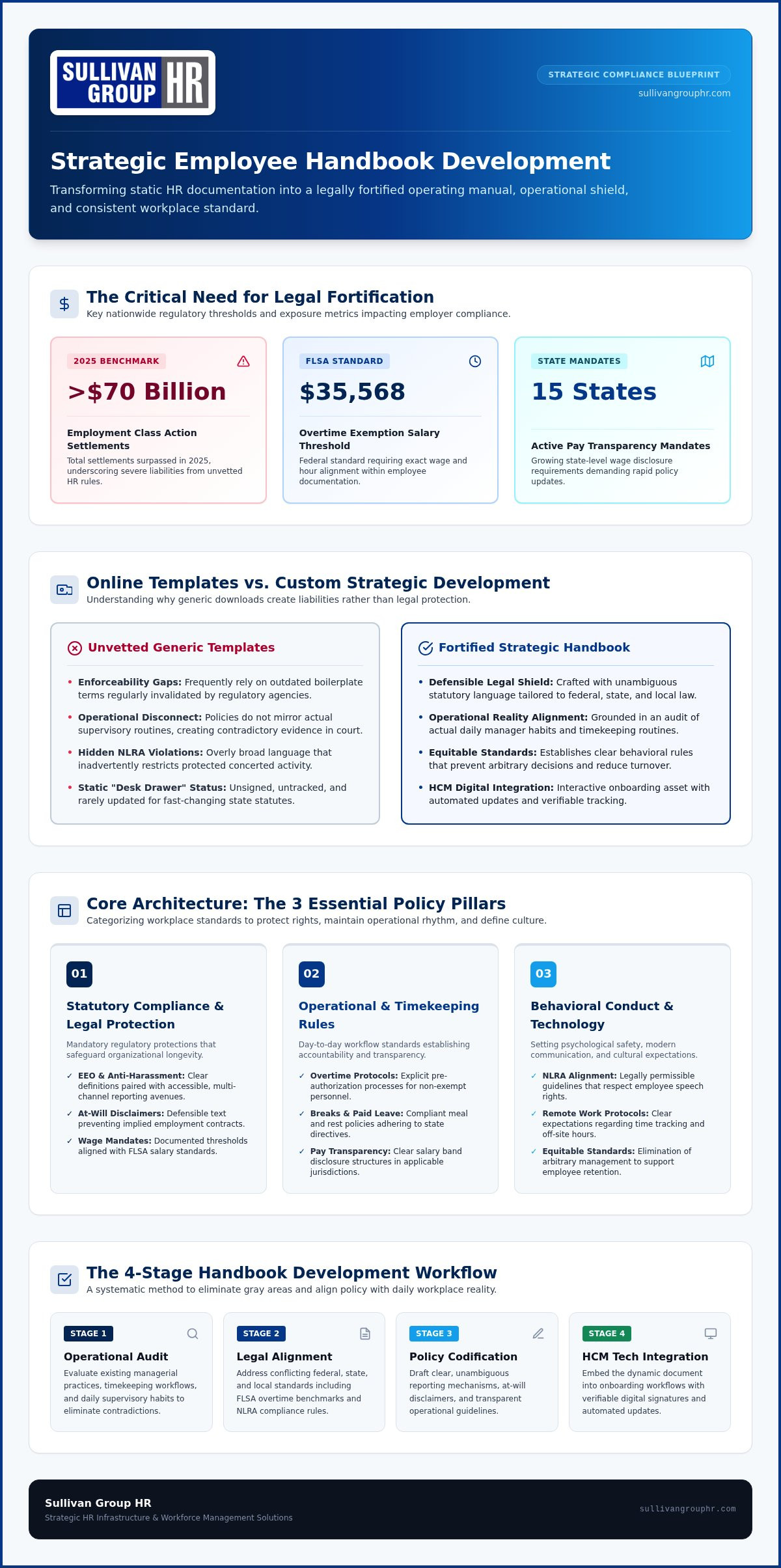
Did you know that total class action settlements for employment cases surpassed $70 billion in 2025? It's a staggering figure that highlights a growing reality for business owners across the country. You likely feel the pressure of hidden regulatory liabilities and the confusion of shifting wage and hour laws. The process of employee handbook development often feels like a defensive chore rather than a strategic advantage. You deserve a partner who understands that a generic online template won't protect your hard earned legacy or your team.
We agree that managing conflicting federal, state, and local standards is exhausting. Whether it's the $35,568 FLSA overtime threshold or new pay transparency mandates in 15 states, the rules change quickly. This guide promises to help you master the complete process of employee handbook development to protect your company, clarify workplace standards, and drive operational consistency. We will explore how to build a legally fortified document, align your culture with daily expectations, and use modern HCM technology to automate annual updates. It's time to transform your handbook into a reliable advocate for your success and put the human back into your resources.
Key Takeaways
- Learn how strategic employee handbook development moves beyond generic templates to create a legally fortified shield for your unique business.
- Categorize essential policies into statutory compliance, operational rules, and behavioral conduct to ensure every department stays aligned.
- Master a step-by-step audit process to ensure your written policies actually match your daily operational reality and managerial habits.
- Identify hidden compliance blind spots, such as outdated NLRA language, that could create severe regulatory liabilities if left unaddressed.
- Explore how to transform static documents into interactive onboarding assets using modern HCM technology for verifiable compliance tracking.
What Is Employee Handbook Development and Why Does Your Business Need It?
Are your workplace rules clearly defined, or are they living in a "gray area" of verbal agreements and assumptions? True employee handbook development is the strategic process of codifying your company's core DNA into a functional operating manual. An employee handbook serves as the cornerstone of your HR infrastructure, setting unambiguous behavioral standards across every department. It isn't just a stack of papers to be signed and forgotten; it's a living document that ensures your team knows exactly what is expected from day one. This clarity allows your leadership to focus on growth rather than constant conflict resolution.
Think of your handbook as your primary legal shield. When regulatory disputes arise, this document is often the first piece of evidence requested by agencies or courts. However, a great handbook does more than mitigate risk. It balances necessary legal protections with a vibrant, supportive culture. It tells your employees that you value their safety, their rights, and their professional growth. By documenting these policies, you provide a roadmap for success that protects both the business and the people who power it.
The Hidden Vulnerabilities of Generic Online Templates
It's tempting to download a free template and call it a day. But unvetted internet forms often contain fatal gaps in compliance. These generic documents frequently use unenforceable boilerplate language that courts and agencies regularly strike down. More importantly, a one-size-fits-all approach fails to reflect your actual operational workflows. If your handbook says one thing but your supervisors do another, you've created a liability rather than a defense. Effective employee handbook development requires a deep audit of your specific daily habits to ensure the rules on the page match the reality on the ground.
Establishing Consistent Workplace Expectations Across Your Team
Confusion is the enemy of productivity. Clear guidelines prevent arbitrary management decisions that lead to employee frustration and legal disputes. When everyone follows the same playbook, it fosters a sense of fairness and psychological safety. This transparency isn't just good for morale; it's good for your bottom line. Standardized protocols help reduce the friction that leads to burnout. Organizations with transparent workplace guidelines often see lower annual turnover rates because employees feel secure in their roles. You aren't just writing rules; you're building a foundation for long-term retention, trust, and operational excellence.
Core Policies Every Modern Employee Handbook Must Include
Are you confident that your current policy set covers every modern risk? Effective employee handbook development requires a three-pronged approach. You must categorize your rules into statutory compliance, operational rules, and behavioral conduct. This structure ensures you meet legal mandates while maintaining the daily rhythm of your business. By following employee handbook best practices, you move beyond generic lists to create a protective framework that reflects your specific culture. Clarity drives results. Confusion kills productivity.
Mandatory Statutory and Protective Employment Policies
Your handbook must lead with robust equal employment opportunity (EEO) and anti-harassment provisions. It's not enough to simply forbid discrimination; you must provide clear, accessible reporting procedures for your team. You also need to define at-will employment disclaimers clearly to avoid creating implied employment contracts. Don't forget wage and hour standards. With the FLSA overtime threshold at $35,568 as of May 2026, your pay policies must be precise. Strategic employee handbook development ensures these protections are woven into your daily workflow rather than hidden in a drawer.
Operational, Timekeeping, and Compensation Guidelines
Consistency starts with transparent rules for time and pay. You should outline clear overtime authorization rules, meal breaks, and paid leave practices that reflect current state laws, such as pay transparency requirements now active in 15 states. Connecting these policies directly to structured workforce management solutions ensures compliance is automated, not manual. Specify your protocols for remote work hours and time tracking to prevent "off-the-clock" work disputes. Reliable advocacy for your business begins with these concrete operational standards.
Digital Conduct, Cybersecurity, and Asset Protection
In a digital first world, your assets need more than just a physical lock. Define your expectations for company hardware, email systems, and proprietary file security. You must also outline appropriate workplace communication standards across all digital channels and social networks. Protecting confidential company data and intellectual assets is a non-negotiable priority. These guidelines safeguard your hard earned legacy while giving employees a clear boundary for professional digital behavior. If you feel overwhelmed by these administrative burdens, our human resources consulting team acts as a supportive ally to help you build a compliant foundation.
The Step-by-Step Employee Handbook Development Process
How do you move from a collection of ideas to a legally sound operating manual? Successful employee handbook development is a journey of discovery, drafting, and deployment. It isn't a one and done writing exercise. It's a strategic alignment of your company's values with the legal realities of the modern workplace. You need a structured path to ensure your final product is both protective and practical. By following a clear sequence, you minimize cognitive load and make daunting administrative tasks feel manageable.
Step 1: Conduct a Comprehensive Operational and Policy Audit
Managers often develop informal habits that contradict your official expectations. You must identify these gaps before they become liabilities. Start by reviewing daily supervisor routines against your stated procedures. Are they following the rules, or have they created their own? Identify critical coverage gaps across departments through targeted leadership discovery questions. Incorporating proactive insights from robust HR risk management frameworks ensures your audit is thorough. This stage is about honesty, safety, and results.
Step 2: Draft Compliant, Plain-Language Company Standards
Dense legalese alienates your staff. It creates an unnecessary barrier between management and the team. Instead, replace confusing jargon with accessible, human-centric guidelines. Your tone should reflect your company values while preserving the necessary regulatory precision. If the language is too complex, employees won't read it, and managers won't enforce it. Craft clear reporting structures so every team member knows exactly where to bring their concerns. This clarity builds trust, improves morale, and reduces daily administrative friction.
Step 3: Executive Sign-Off and Annual Maintenance Cycles
Your handbook needs buy-in from the top to be effective. Coordinate cross-departmental reviews among leadership, operations, and human resources personnel. This collaborative approach ensures the rules work for everyone, not just the front office. Many successful organizations secure experienced human resources consulting support to validate their final drafts. Finally, establish a mandatory annual review schedule. Laws shift constantly. A static document is a risky document. Regular updates keep your business secure, organized, and ahead of the curve. Employee handbook development is a continuous cycle of protection and improvement.
Common Legal Pitfalls and Compliance Blind Spots in 2026
Are you unintentionally creating legal traps for your own business? Even the most well intentioned employee handbook development can fail if it ignores the shifting landscape of regulatory scrutiny. The National Labor Relations Board (NLRB) remains focused on the Stericycle standard. In February 2026, Memorandum 26-03 further clarified that overbroad handbook rules can chill protected activity, even if they aren't actively enforced. You must ensure your policies on workplace conduct, social media, and confidentiality don't interfere with your team's rights to discuss wages or working conditions. This requires a delicate balance between professional rigor and empathetic partnership.
Overly Restrictive Discipline Systems and At-Will Erosion
Rigid, mandatory progressive discipline structures are a common blind spot. While consistency is key, these systems can inadvertently create implied employment contracts. If your handbook promises a specific five step warning process before termination, you may lose the right to act quickly during severe misconduct. When navigating complex workplace investigations or formal litigation arising from misconduct allegations, legal teams and employers often explore Criminal & Civil Case Polygraphs to establish credibility and verify disputed facts. You need to preserve executive discretion. Every discipline policy should reinforce at-will status with clear, unambiguous language. This protects your ability to make necessary personnel changes without the fear of a breach of contract claim. It's about movement, safety, and results for your organization.
Managing a distributed team introduces a web of conflicting standards. A blanket national policy is no longer enough. You must account for state variations regarding final paycheck timing, sick leave, and non-competes. For example, as of September 9, 2026, New York law gives employees the right to access and dispute their personnel records. Meanwhile, California's minimum wage rose to $16.90 in January 2026, and non-compete agreements are generally void under state law. You should implement state-specific addenda alongside a centralized national core handbook structure to avoid violating stricter local labor regulations.
Inconsistent policy enforcement is another high risk area. If one supervisor allows remote work flexibility while another forbids it for the same role, you invite discrimination claims. Total class action settlements reached $70 billion in 2025, proving that these administrative gaps have massive financial consequences. Don't let your handbook become a liability. If you need a protective ally to audit your current standards, you can partner with our human resources consulting team to secure your future.
Integrating Your Handbook into Modern HCM and Onboarding Workflows
Why leave your critical compliance documents buried in a static PDF? True employee handbook development doesn't end when the drafting stops. It thrives when you transform those static pages into interactive onboarding assets using modern technology systems. Storing a document in an isolated desktop folder leaves your business exposed. Instead, you need a dynamic process that links policy updates directly to your daily operations. This integration protects your company, clarifies workplace standards, and drives operational consistency across your entire organization. It converts a passive legal disclaimer into an active tool for team alignment.
Seamless Digital Acknowledgment and Compliance Tracking
Are you still relying on fragile paper sign-off sheets or unverified email replies? Loose paperwork easily disappears, leaving dangerous gaps in your legal defense. You can replace those manual risks with secure, time-stamped digital acknowledgments. Efficiency meets safety. Streamline your verification process by using integrated applicant tracking and onboarding systems. When a new hire joins your team, the handbook is delivered, reviewed, and signed within a single digital ecosystem. This process captures a verifiable digital signature to maintain an indisputable compliance audit trail. If a regulatory agency requests proof during a dispute, you can generate instant audit reports showing exactly which employees have reviewed the latest updates. This eliminates the guesswork and keeps your business audit-ready at all times.
The Power of Unified Human Resources Consulting and Technology
How do you maintain this high level of security as your business grows? The answer lies in combining expert human advice with scalable software capabilities. By linking policy acknowledgments directly to automated employee profiles within the isolved platform, you eliminate manual tracking errors entirely. This unified human capital management approach ensures your rules stay active across payroll, attendance, and onboarding systems. Your handbook must evolve seamlessly as your business expands nationally, adapting to changing multi-state laws without disrupting your daily operations. You don't have to carry this administrative burden alone. Partnering with professional HR consultants keeps your policies active, legally defensible, and perfectly aligned with your company culture. Take the first step toward total workplace protection, operational clarity, and reliable advocacy with Sullivan Group HR.
Securing Your Workplace Future
Your business is a legacy in motion. It deserves a foundation that reflects your hard earned success. We've explored how strategic employee handbook development transforms a static document into a protective shield and an operational roadmap. You now understand that modern compliance requires more than just words on a page. It demands the seamless integration of digital audit trails and the hard earned wisdom of local expertise to navigate shifting national regulations.
Don't let administrative burdens or hidden liabilities slow your growth. Sullivan Group HR brings decades of professional human resources consulting and compliance expertise to your side. We provide comprehensive national support through payroll administration, benefits management, and risk mitigation. By leveraging the industry leading isolved HCM platform, we ensure your policies are active, verifiable, and always up to date. You can finally move from managing paperwork to leading your team with confidence.
Build a legally fortified, customized handbook with Sullivan Group HR and protect the future of your organization today.
Common Questions About Employee Handbook Development
How often should a company update its employee handbook?
You should review and update your handbook at least once per year or whenever significant regulatory changes occur. In 2026, shifting overtime thresholds and new state leave laws make annual maintenance vital for your protection. A static document creates unnecessary risk. Regular updates ensure your policies reflect actual operational reality and current federal mandates. This proactive approach fosters security for your business while keeping your team informed, aligned, and safe.
Can a poorly written employee handbook create an accidental employment contract?
Yes, a poorly drafted document can inadvertently erode at-will employment status. If your language is too rigid or promises specific disciplinary steps, a court might interpret it as an implied contract. You must include clear, conspicuous disclaimers stating the handbook is not a contract. Strategic employee handbook development preserves your executive discretion. This protects your right to terminate employment for severe misconduct without being forced to follow a mandatory warning sequence.
Is an employee handbook legally required for small businesses in the United States?
While federal law doesn't strictly mandate a written handbook, having one is essential for proving compliance with various labor regulations. You need documented proof that you've communicated anti-discrimination policies and wage standards to your team. Without these written rules, defending against a regulatory audit or lawsuit becomes incredibly difficult. A well crafted handbook serves as your primary legal shield. It provides reliable advocacy for your business regardless of your company size or industry.
What happens if an employee refuses to sign the handbook acknowledgment form?
If an employee refuses to sign, you should document the refusal immediately with a witness present. Note that the employee received the document and had the opportunity to ask questions. A refusal to sign does not exempt the worker from following your established workplace standards. Using modern HCM technology like isolved simplifies this process by capturing digital timestamps. This provides a clear, indisputable audit trail for every policy distribution even when physical signatures are missing.
How should businesses manage employee handbooks for remote workers across multiple states?
You should utilize a centralized national core handbook supplemented by state specific addenda. This approach addresses conflicting standards like California's $16.90 minimum wage or New York's personnel record access laws. Blanket national policies often violate stricter local regulations, creating unnecessary liability. Managing these nuances through professional human resources consulting ensures your distributed team remains compliant. It provides a localized handshake for workers across the country while maintaining total organizational consistency.
What is the difference between an employee handbook and a standard operating procedure?
An employee handbook focuses on the behavioral, legal, and cultural expectations of your organization. It covers broad topics like anti-harassment, benefits, and overall conduct. In contrast, a standard operating procedure (SOP) provides technical, step by step instructions for specific job tasks. While the handbook defines who you are and how you treat people, the SOP defines how the work is executed. Both are necessary for movement, safety, and results in your daily operations.
Why shouldn't employers use generic, downloadable employee handbook templates?
Generic templates often contain outdated legalese that fails to meet current NLRB standards or specific state requirements. These "one size fits all" documents don't reflect your actual managerial habits or operational workflows. If your written policy contradicts your daily supervisor actions, you've created a significant legal vulnerability. Custom employee handbook development ensures your rules are enforceable, relevant, and supportive of your unique company culture. It moves you away from sterile, bureaucratic forms toward a protective partnership.


