
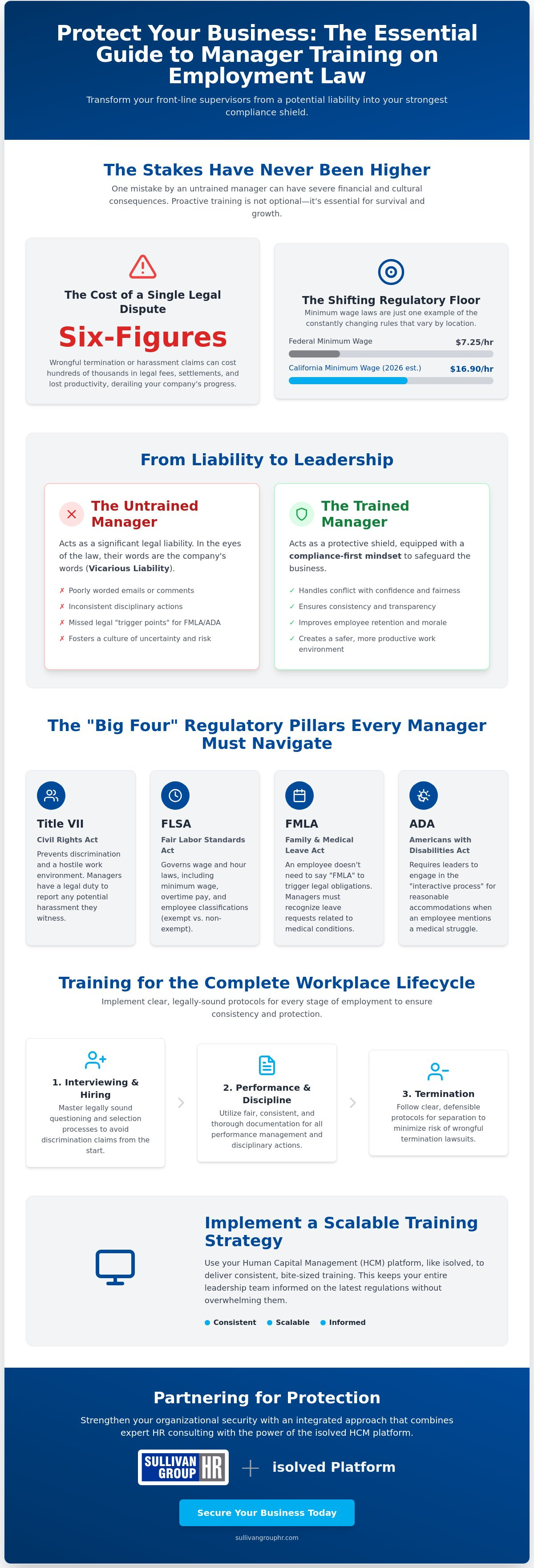
If your front-line supervisor makes one wrong comment during a termination, is your business prepared for the six-figure price tag of a legal dispute? It's a heavy burden to carry. You've built your company with pride, and the thought of it being derailed by an avoidable mistake is exhausting. Between the federal minimum wage staying at $7.25 and California's rate climbing to $16.90 in 2026, the regulatory floor is constantly shifting. Implementing comprehensive manager training on employment law is no longer optional if you want to protect your growth. It’s overwhelming to keep every department consistent when rules change by the zip code.
We believe you deserve a management team that acts as a protective shield rather than a liability risk. You'll learn exactly how to equip your leadership with the legal knowledge necessary to mitigate risk, ensure compliance, and foster a productive culture. This guide provides a strategic preview of the "Big Four" regulatory pillars. We'll walk through clear protocols for hiring, discipline, and termination to ensure your business remains secure, organized, and ready for the future.
Key Takeaways
- Identify why front-line supervisors represent your greatest legal risk and how to transform them into a reliable compliance shield.
- Navigate the "Big Four" regulatory pillars—including Title VII and FLSA—by implementing structured manager training on employment law.
- Master the workplace lifecycle with clear protocols for legally sound interviewing, hiring, and performance documentation.
- Scale your protection using your HCM platform to deliver bite-sized training that keeps your leadership team consistent and informed.
- Strengthen your organizational security through an integrated partnership that combines expert HR consulting with the power of the isolved platform.
Why Manager Training on Employment Law is a 2026 Business Necessity
What does it truly mean to protect your business in 2026? It starts with the people you've trusted to lead your teams. Manager training on employment law is the essential education of your leaders on the complex web of federal and state regulations. While you focus on high-level strategy, your managers are in the trenches. They're the ones making the daily decisions that either strengthen your company or expose it to significant risk. In our experience, managers are the primary source of legal liability for most companies. One poorly worded email or a casual, inappropriate comment during a performance review can trigger a chain reaction of HR nightmares.
Investing in your leadership team provides a three-part value: safety, compliance, and culture. When your managers understand the rules, they create a safer environment for everyone. The cost of ignorance is simply too high to ignore. While every case is different, even a single wrongful termination or harassment claim can cost a small business hundreds of thousands of dollars in legal fees and lost productivity. Beyond the financial impact, these mistakes damage your reputation and demoralize your best talent. You've worked too hard to let an avoidable management error derail your progress.
The Manager as a Legal Representative
Do you realize that in the eyes of the law, your manager’s words are actually the company’s words? This is the core of vicarious liability. If a supervisor makes a mistake, the business holds the bag. It doesn't matter if you didn't know about the conversation; the legal responsibility remains with you. To stay secure in 2026, your leadership team needs a compliance-first mindset that prioritizes legal awareness in every interaction. Understanding the fundamentals of labour law ensures that your team operates within the boundaries of both federal mandates and local ordinances. This foundational knowledge prevents small misunderstandings from turning into expensive court dates.
Moving from Liability to Leadership
Legal knowledge does more than just stop lawsuits. It actually empowers your managers to handle conflict with confidence. When a leader knows the rules, they don't hesitate or second-guess themselves. They act with fairness, transparency, and consistency. There's a direct link between fair treatment and employee retention that every business owner should recognize. We often find that when managers receive high-quality manager training on employment law, they feel more professional and better supported. Positioning this training as a professional development perk transforms a regulatory burden into a powerful tool for leadership growth and organizational stability.
The "Big Four" Regulatory Pillars Every Manager Must Navigate
Compliance isn't a static checklist. It's a dynamic skill that requires constant refinement. For your leadership team, four specific federal pillars form the foundation of a legally secure workplace. When you invest in manager training on employment law, you aren't just teaching rules; you're providing a compass for daily decision-making. Are your supervisors prepared to identify a legal "trigger point" before it explodes? Most legal issues stem from a lack of awareness regarding Title VII, the FLSA, the FMLA, and the ADA. Ensuring your operations remain secure, compliant, and productive starts with these fundamentals.
Title VII of the Civil Rights Act prohibits discrimination, but its modern application focuses heavily on preventing a hostile work environment. Managers must understand that their role is proactive. Similarly, the Americans with Disabilities Act (ADA) requires leaders to engage in the "interactive process" the moment an employee mentions a struggle related to a medical condition. Even the Family and Medical Leave Act (FMLA) has hidden traps. An employee doesn't have to say the letters "F-M-L-A" to trigger the company's legal obligations. A manager who misses these cues puts the entire organization at risk. If you feel your team needs a refresher, our HR consulting services can help bridge those knowledge gaps.
Title VII and the Modern Definition of Harassment
In 2026, a respectful business environment is defined by more than just the absence of overt misconduct. It's defined by civility and active intervention. Managers have a strict legal duty to report any potential harassment they witness or hear about. "Looking the other way" is no longer just a management failure; it's a legal liability. Training should focus on bystander intervention, ensuring leaders know how to stop unprofessional behavior in its tracks. You can find a detailed breakdown of manager responsibilities under EEOC guidelines to help your team stay compliant. Promoting a culture of civility protects your people and your bottom line.
Wage and Hour Compliance in a Hybrid World
The Fair Labor Standards Act (FLSA) presents new challenges in our hybrid world. Managing remote employees requires strict adherence to time-tracking protocols. With minimum wages varying from the federal $7.25 per hour to California's $16.90 in 2026, managers must be vigilant about local standards. One of the most common risks involves "off-the-clock" work. Do your managers send "quick" after-hours texts to non-exempt staff? Those small interactions are legally compensable time. If they aren't tracked and paid, you're vulnerable to a Department of Labor audit. Effective manager training on employment law emphasizes the necessity of accurate time and attendance tracking. It ensures every hour worked is accounted for, regardless of where the work happens. Precision is the only way to prevent expensive wage and hour disputes.
Beyond the Basics: Training for the Workplace Lifecycle
How often do your managers interact with employees without considering the legal implications? Employment law isn't a separate department; it's the invisible framework for every conversation, from the first interview to the final exit interview. Effective manager training on employment law must move beyond abstract theories and into the daily lifecycle of your workforce. When your leaders understand how to apply these principles in real time, they protect the company's future while building a culture of trust and transparency. It's about moving from reactive damage control to proactive organizational security.
Compliant Recruiting and Onboarding
The legal risks for your business begin long before a new hire signs their offer letter. During the interview process, casual conversation is often where managers fall into the "protected class" trap. Asking about a candidate’s weekend plans or family life might seem friendly, but it can inadvertently reveal protected information that leads to claims of bias. We recommend using a structured applicant tracking and onboarding system to keep the process objective. Remember, the job description is a foundational legal document. It defines essential functions and sets the standard for every hiring decision you make. If the description is vague, your legal defense will be too.
Performance management is the next critical phase where legal awareness is non-negotiable. Many leaders rely on "gut feelings" or personality assessments, but these are indefensible in a legal dispute. Your managers must learn the necessity of objective, contemporaneous documentation. This means recording facts, dates, and specific behaviors as they happen, rather than trying to reconstruct events months later. Consistency across departments is the only way to prove that every employee is held to the same professional standard. It reduces friction, improves morale, and creates a clear path for growth.
The Art of Legal Documentation
Why is "poor fit" one of the most dangerous phrases in a manager's vocabulary? In a courtroom, "poor fit" is often interpreted as a placeholder for discrimination. To protect your business, teach your managers to focus exclusively on behaviors and measurable results. If an employee is failing, the documentation should reflect missed deadlines or specific conduct violations rather than personality clashes. We also caution against the "Friday Afternoon" rule. Rushed, emotional terminations at the end of the week often lead to procedural errors and immediate lawsuits. A well-documented "paper trail" ensures that if you must part ways with an employee, the decision is supported by a mountain of evidence.
We often hear the objection that leadership teams simply don't have time for this level of detail. The reality is that you don't have time for a lawsuit. By integrating manager training on employment law into the natural rhythm of your business, you save hours of future administrative burden. Training shouldn't be an extra task on a crowded to-do list. It is the essential tool that makes every other management task safer, faster, and more effective.
Implementing a Scalable Training Strategy with HCM Technology
How do you ensure every leader in your organization stays on the same page as rules shift? Consistency is the greatest challenge for growing companies. Manual spreadsheets and scattered emails simply won't cut it in 2026. To protect your business, you need a system that delivers manager training on employment law automatically, reliably, and measurably. By leveraging technology, you transform compliance from a stressful annual event into a continuous, manageable process. This approach ensures your leadership team is always prepared, whether they are handling a remote team or a local storefront.
Building a scalable strategy requires a structured, five-step approach:
- Step 1: Audit knowledge gaps. Start by identifying which managers lack experience with specific regulations like the FMLA or ADA.
- Step 2: Deploy micro-learning. Use your HCM platform to send bite-sized modules that managers can complete in five to ten minutes.
- Step 3: Track completion. Maintain a digital record of who has finished their training and signed off on updated policies.
- Step 4: Schedule refreshers. Laws evolve quickly; quarterly updates on emerging 2026 regulations keep your team sharp.
- Step 5: Reward compliance. Integrate legal awareness and documentation accuracy into your manager performance KPIs.
Using isolved to Automate Compliance
The isolved People Cloud simplifies training delivery by keeping everything in one central hub. It’s more than just a place to store files; it’s an integrated workforce management solution that connects training to real-world data. For example, you can use time and attendance data to flag potential FLSA risks before they become claims. If a non-exempt employee is consistently responding to messages after hours, the system alerts you. This allow you to intervene early, providing targeted manager training on employment law where it's needed most. It’s about using data to move faster and stay safer.
Building a Digital Audit Trail
Why are paper handbooks a significant liability in 2026? Paper is hard to track, easy to lose, and nearly impossible to update across multiple locations. Digital signature tracking for policy updates ensures that every manager has acknowledged the latest standards, from California’s $16.90 minimum wage to new state-specific paid leave programs. Your HCM data serves as a vital first line of defense during a Department of Labor audit. It provides the concrete proof that you have acted with due diligence. If you're ready to modernize your approach and secure your growth, explore our HCM solutions to see how we can help.
Partnering for Protection: Sullivan Group HR’s Integrated Approach
Why face the complexity of 2026 regulations alone? You've built your business through grit, local expertise, and a commitment to your people. Protecting that legacy requires more than just a software subscription or a generic handbook. Sullivan Group HR acts as your fractional HR partner and compliance coach, providing the high-level guidance you need without the overhead of a full-time executive department. We believe that professional rigor and empathetic partnership go hand in hand. By combining our hard-earned wisdom with the technical power of the isolved platform, we move your business beyond transactional HR into a state of long-term organizational security.
Our approach is built on three essential pillars: expert advocacy, scalable technology, and localized knowledge. We don't just tell you what the law says; we show you how to apply it in your specific territory. This integrated model ensures that your manager training on employment law is consistent, documented, and effective. When your leadership team feels supported by an established regional expert, they lead with greater confidence and less fear. It’s about creating an environment where safety and results are the standard, not the exception.
Professional Human Resources Consulting
Generic training often fails because it doesn't account for the unique nuances of your industry. We tailor our manager training on employment law to your specific risk profile, whether you are managing a local medical facility or a multi-state distribution center. This customization ensures that your supervisors aren't just memorizing rules—they are learning how to protect your specific culture. Our human resources management services offer the peace of mind that comes from having an expert on call. When a difficult employee situation arises on a Tuesday afternoon, you aren't searching for answers in a manual. You're calling a partner who knows your business by name.
Your Next Steps to a Compliant Culture
Are you ready to transform your management team from a source of risk into a shield for your business? A proactive HR risk management strategy is the most effective way to secure your growth in 2026. The process is simple: we audit your current gaps, implement a custom training plan, and provide the digital tools to track your success. Don't wait for a Department of Labor notice to arrive in the mail. Request a consultation for your management team today to build a foundation that lasts. We handle the administrative complexity and the regulatory burdens so you can focus on what you do best: growing your company and serving your community.
Build a Future-Proof Leadership Team
Are you ready to turn your leadership team into your company's strongest asset? Protecting your growth in 2026 requires a proactive stance on compliance. We've explored how identifying the "Big Four" pillars and mastering the workplace lifecycle can prevent costly disputes. By implementing structured manager training on employment law, you ensure that every decision is backed by legal rigor and professional consistency. This isn't just about avoiding lawsuits; it's about building a culture where safety, results, and people thrive together. You deserve the security that comes from a well-prepared team.
Sullivan Group HR has served as an established expert in human capital management since 1998. We provide the hard-earned wisdom and technical tools necessary to navigate this complex landscape. Our all-in-one approach combines payroll, benefits, and HR risk management with access to the industry-leading isolved HCM platform. You don't have to carry the burden of administrative complexity alone. We are here to act as your coach, ally, and advocate through every organizational challenge.
Secure your business and empower your leaders with Sullivan Group HR consulting. You have the vision for your company's success, and we have the tools to help you reach it with complete confidence.
Frequently Asked Questions
Is manager training on employment law legally required?
Specific mandates depend on your state and the regulatory topic. While federal law doesn't always require a specific training session, states like California and New York mandate regular sexual harassment training for all supervisors. Even without a direct mandate, providing this education is a practical necessity. It establishes a "due diligence" defense that can significantly reduce your liability during a legal dispute or a Department of Labor audit.
What are the most common employment law mistakes managers make?
The most frequent errors involve "off-the-clock" work and failing to recognize leave requests. Supervisors often send after-hours texts to non-exempt staff or ignore the "trigger points" of the FMLA when an employee mentions a medical struggle. Casual interview questions about a candidate's family life are also common traps. These small, unintentional actions often lead to expensive discrimination or wage and hour claims that could have been avoided.
How often should managers receive updated legal training?
You should provide comprehensive updates at least once a year, supplemented by quarterly "micro-learning" refreshers. Employment regulations evolve rapidly, especially at the state and local levels. Regular intervals ensure your leadership team stays sharp and keeps compliance as a core priority. Frequent, bite-sized updates are often more effective than a single, overwhelming annual session for maintaining a legally secure and consistent workplace culture.
Can managers be held personally liable for employment law violations?
Yes, managers can be held personally liable under certain federal laws like the FLSA and the FMLA. This means their individual assets could potentially be at risk in a lawsuit, not just the company's bank account. Implementing rigorous manager training on employment law is a critical step in protecting both your individual leaders and your organization. It ensures everyone understands the high stakes of every professional interaction.
How does an HCM platform help with employment law compliance?
An HCM platform like isolved automates the delivery and tracking of essential training modules. It creates a permanent digital audit trail of policy acknowledgments and completion certificates, which serves as a vital defense during investigations. The system also flags real-time risks, such as unauthorized overtime or inconsistent leave patterns. By connecting data to documentation, you move from reactive damage control to proactive organizational security.
What should be included in a basic employment law training module?
A foundational module must cover anti-harassment, wage and hour basics, leave management, and disability accommodations. It should focus on the specific behaviors and "trigger points" that supervisors encounter daily. Effective manager training on employment law includes practical scenarios and exercises on objective documentation. Teaching leaders how to record facts rather than feelings is the best way to ensure your "paper trail" stands up in court.
How do I handle a manager who refuses to follow compliant procedures?
You must treat a refusal to follow compliance protocols as a serious disciplinary issue. Start by documenting the specific instances of non-compliance and providing corrective coaching to address the behavior. If the manager continues to ignore established procedures, you may need to consider termination to protect the company from future liability. Consistency is essential; you cannot afford to have a "rogue" leader who puts your entire business at risk.
What is the "interactive process" under the ADA that managers must know?
The interactive process is a collaborative, good-faith dialogue between an employer and an employee to identify a reasonable accommodation for a disability. Managers must recognize when an employee mentions a medical struggle and initiate this conversation immediately. It is not the employee's job to suggest the perfect solution. The law requires the manager to engage actively and document every step of the search for a workable accommodation.


