

Intermittent FMLA leave is allowed when a qualifying reason makes separate periods of medically necessary leave or a reduced work schedule appropriate. Managing intermittent FMLA leave means distinguishing qualifying absences from ordinary attendance issues and tracking each leave increment consistently. Bonding leave after a birth or placement is different: intermittent or reduced-schedule bonding leave requires the employer’s agreement.
Clear rules make recurring absences easier to handle for employees and employers alike. This guide explains how intermittent leave relates to attendance policies, how to track time in the smallest applicable increments, and how to coordinate planned medical treatment. It also covers notice: according to the U.S. Department of Labor, employees should request foreseeable FMLA leave at least 30 days in advance when possible. With the right process, employers can apply leave procedures consistently while giving employees a clear path to report and schedule qualifying absences.
Key Takeaways
- Separate qualifying leave from ordinary attendance concerns by applying reporting rules consistently.
- Coordinate FMLA time with available paid leave under your organization’s policies.
- Track each absence using the smallest increment your payroll system applies to other leave.
- Plan ahead for scheduled treatment and coordinate timing to limit unnecessary disruption.
1. When is Intermittent Leave Permitted?
Intermittent FMLA leave divides time off into separate blocks for one qualifying reason. Medically necessary leave may also reduce an employee’s usual daily or weekly schedule. For example, an ongoing condition requiring treatment at least twice a year may support intermittent medical leave. Bonding leave after a birth or placement is different: employees may take it intermittently only by employer agreement, and bonding time must conclude within 12 months.
Eligibility depends on both the employee and the workplace. According to the U.S. Department of Labor, eligible U.S. employees may take up to 12 weeks of unpaid FMLA leave during a 12-month period, based on their standard workweek. The U.S. Department of Labor states that an employee generally must have worked for the employer for at least 12 months and logged 1,250 work hours during the 12 months immediately before leave begins. The workplace coverage test requires at least 50 employees within 75 miles of the employee’s work location, according to the U.S. Department of Labor.
Certification should explain why the qualifying reason requires intermittent leave. Employers may require medical certification that describes the treatment regimen and establishes why leave is medically necessary. Review each response for completeness, clarity, and legibility. The certification should answer every question clearly and without ambiguity. For example, it may estimate how often absences or appointments are expected and how long they will last, helping the employer assess the requested schedule.
When an initial certification is incomplete or insufficient, employers may request additional information or clarification. The employee generally has 15 days to provide a complete and sufficient certification after the employer requests it, according to the U.S. Department of Labor. If the employer identifies a deficiency and requests correction, the employee must provide the additional information within seven days. Employers may authenticate or clarify certifications when needed. For ongoing absences, the U.S. Department of Labor allows recertification every six months, no more often than every 30 days, and only in connection with an absence.
2. Can intermittent FMLA absences be counted against an employee under an attendance policy?
Approved FMLA absences generally shouldn’t be treated as attendance violations or counted more harshly than comparable absences. Employees generally follow usual, customary notice and call-in procedures under 29 C.F.R. § 825.302(d), absent unusual circumstances. Apply the same communicated policy to qualifying and non-FMLA absences. Managing intermittent FMLA leave means documenting reports consistently, without adding penalties because leave is intermittent or reduced.
FMLA leave is unpaid, but employers may require employees to use accrued, available paid leave during FMLA leave. Coordinate payroll coding with paid-leave policies, and administer benefits under the applicable plan and workplace procedures. Keep the FMLA designation clear even when paid time covers some or all of an absence. Employees should be able to understand how their leave and pay records relate.
Employers may temporarily transfer employees taking foreseeable intermittent leave to an available alternative position if the employees are qualified and the transfer better accommodates recurring absences. The position must provide equivalent pay and benefits, though duties may differ, and the transfer must not adversely affect the employee. When the need for intermittent leave ends, the employee must return to the same or an equivalent job held when leave began.
FMLA protections don’t remove every attendance responsibility. An employer may discipline an employee who fails to follow communicated, consistently enforced call-in procedures, unless extenuating circumstances prevent compliance. A clear policy should explain how employees report each absence, identify its qualifying reason, and record its duration. If leave is approved for multiple qualifying conditions, employers may require employees to identify which condition applies to each absence.
Coordinate family and medical leave procedures with applicable state leave policies, paid-time rules, and benefits administration. A consistent process for managing intermittent FMLA leave should clarify how overlapping requests are recorded, which notice procedures apply, and how updates reach employees. Accurate time and attendance administration helps connect absence reports with payroll records without turning protected leave into an attendance penalty.
3. Minimum increments for tracking leave
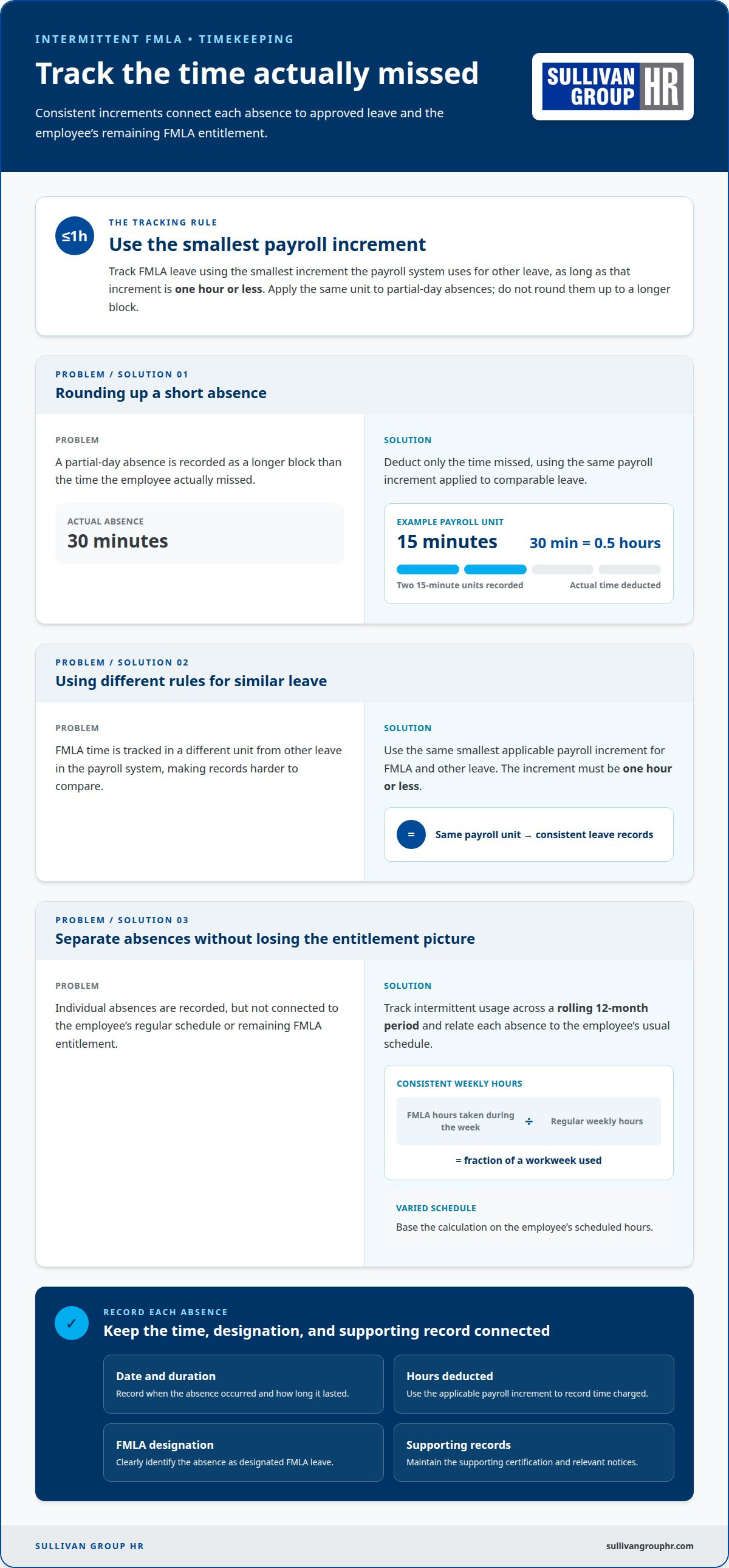
Consistent records link each absence to the employee’s approved medical leave and remaining FMLA entitlement. According to the U.S. Department of Labor, employers must track FMLA leave using the smallest increment their payroll system uses for other leave, provided that increment is one hour or less. Employers may require employees to report partial-day absences using that same increment rather than rounding them up.
For example, if payroll records other leave in 15-minute increments, a 30-minute absence uses 30 minutes, or 0.5 hours, of FMLA leave. The system should deduct the time actually missed, not a longer block. If an employee leaves early for a health condition, record the missed work time using the same payroll unit applied to comparable leave.
Intermittent usage is tracked across a rolling 12-month period. For an employee with consistent weekly hours, calculate the fraction of a workweek used by dividing FMLA hours taken during that week by regular weekly hours. That method lets HR connect separate absences to the employee’s usual schedule and available entitlement. A varied schedule requires a calculation based on the employee’s scheduled hours.
What are an employer’s recordkeeping and designation requirements? Maintain an accurate record of each absence’s date, duration, hours deducted, and FMLA designation, along with the supporting certification and relevant notices. Employers generally must send a designation within five business days after receiving all supporting documentation needed to decide whether leave qualifies. Clear records help distinguish approved medical leave from other time away.
Reconcile absence reports with payroll entries before each pay period closes. If an employee’s report and recorded hours differ, document the discrepancy and correct the entry using established procedures. A reliable tracking process keeps Family and Medical Leave Act records aligned with payroll, certification, and each approved reason for leave.
4. Scheduling planned medical treatment
Planned treatment calls for coordination, not employer control over qualifying leave. According to the U.S. Department of Labor, foreseeable FMLA leave should be requested at least 30 days in advance when possible. Employees should share the expected appointment schedule and update it when circumstances change. That gives managers time to plan coverage while preserving the leave process.
For medically necessary treatment, employees and employers should make reasonable efforts to schedule appointments in a way that doesn’t unduly disrupt business operations. An employee who regularly attends treatment might request a consistent appointment time, such as 1:00 p.m., if the provider’s schedule allows. Employers generally can’t dictate when qualifying intermittent leave is used, but can discuss workable timing for planned care.
Keep the reason for leave clear. A medical certification may describe the treatment regimen and explain why intermittent absences are medically necessary. Qualifying reasons can include an employee’s serious health condition or caring for a family member with a serious health condition. Expected treatment frequency and duration help everyone plan, though actual appointments may vary with the employee’s medical circumstances.
Medical opinions follow a defined sequence when certification is disputed. If the employer’s first and second medical opinions differ, the employer may require a third opinion, which is binding. This process addresses disagreement about the medical assessment; it doesn’t allow an employer to replace a qualifying reason with a scheduling preference. Record the agreed appointment pattern and any changes so absence reports match the approved leave.
To make planned absences easier to coordinate, connect appointment notices with staffing and time records. A supervisor can arrange coverage for the known treatment window, while HR records the leave separately from other absences. For help aligning workforce systems with scheduling needs, explore HCM support.
Sullivan Group HR
Sullivan Group HR helps employers connect workforce administration with the systems and processes behind payroll and employee records. When intermittent absences require extra coordination between leave tracking and pay, HCM and Payroll Administration can support more organized HR operations. Payroll Outsourcing can also help employers manage payroll processes.
Turn to Sullivan Group HR when your team needs a clearer administrative framework for recurring leave, payroll records, and workforce information. The right setup can help HR staff keep routine processes aligned while applying the organization’s leave policies.
Contact Sullivan Group HR to discuss support for your HR and payroll administration needs.
Build a Leave Process That Works Day to Day
Use this guidance as a starting point for a leave process that stays clear as staffing needs change. Review how your HR, payroll, and workforce records work together. Identify where managers report absences, how HR records approved leave, and how payroll receives the information it needs. Clear handoffs can make recurring leave easier to administer and help employees understand what to expect.
Managing intermittent FMLA leave also means maintaining a process people can follow consistently, rather than relying on informal reminders or disconnected records. Sullivan Group HR offers HCM, Payroll Outsourcing, and Payroll Administration to support organizations’ broader workforce and payroll operations. These services can support a plan to strengthen the administrative systems around employee leave.
Take the next step toward a more organized approach. Contact Sullivan Group HR to discuss your HR and payroll administration needs. With a clear process and the right operational support, your team can move forward with greater confidence.
Frequently Asked Questions
When is Intermittent Leave Permitted?
Intermittent FMLA leave is permitted when medically necessary for a qualifying reason, such as recurring treatment for an ongoing health condition or care for a family member. It can be taken in separate blocks or through a reduced schedule. Bonding leave after a birth or placement may be intermittent only if the employer agrees, and the bonding time must conclude within 12 months.
Can intermittent FMLA absences be counted against an employee under an attendance policy?
Employers generally can’t count approved FMLA absences as attendance violations or apply stricter rules to them than to other absences. Employees still follow the usual call-in and notice procedures, except when unusual circumstances prevent compliance. For example, an employer can require the standard absence report but shouldn’t penalize an employee simply because a qualifying absence occurs intermittently.
How do you track intermittent FMLA hours accurately?
Record the actual time missed using the smallest increment the payroll system uses for other leave, as long as that increment is one hour or less. For instance, with payroll entries in 15-minute increments, a 30-minute absence counts as 30 minutes, or 0.5 hours. Keep the date, duration, and leave designation together so each entry can be reconciled with payroll.
Who is eligible for intermittent FMLA leave?
Employees must meet the FMLA’s service and hours requirements, and their workplace must satisfy the coverage test. According to the U.S. Department of Labor, eligibility generally requires at least 12 months of employment and 1,250 work hours during the 12 months before leave. The employee’s work location must also be within 75 miles of a site where the employer has at least 50 employees.
What medical conditions qualify for intermittent FMLA leave?
A condition may qualify for intermittent leave when it meets the definition of a serious health condition and makes separate absences or a reduced schedule medically necessary. Recurring treatment for an ongoing condition is one example; an employee may also need time to care for a family member with a qualifying condition. The certification should explain the expected frequency and duration of the absences or treatment.
How is the 12-week FMLA entitlement calculated for intermittent leave?
The entitlement is measured against the employee’s standard workweek and applicable 12-month FMLA period. Each qualifying absence reduces the available leave in proportion to the work time missed. For a consistent schedule, divide FMLA hours used during a workweek by the employee’s regular weekly hours to calculate the fraction of a workweek taken. Varied schedules use scheduled hours averaged over the prior 12 months.


