

A single missed shift doesn’t necessarily mean an employee has abandoned the job. Knowing how to handle an employee no-call no-show starts with a clear policy, a prompt attempt to reach the employee, and a pause before taking disciplinary action. In most U.S. states with at-will employment, an employer may terminate an employee after one incident, but a protected absence or circumstances beyond the employee’s control can change the response.
It’s understandable to want a firm rule when an unreported absence disrupts the workday. The challenge is defining what counts as a no-call/no-show and applying the policy fairly, while allowing for emergencies and legal protections.
This article explains how to define the absence, respond when an employee may be dealing with an emergency, and review applicable federal and state laws before taking action. It also covers how a written attendance policy can set expectations and guide decisions about when repeated no-call/no-shows may lead to termination.
Key Takeaways
- Define a no-call/no-show in writing, including which contact methods count and what notice is expected.
- Assess whether an emergency or protected leave may explain the absence before moving toward discipline.
- Review applicable federal and state requirements, then apply the policy consistently to comparable cases.
- Set clear attendance expectations and use them to guide decisions about repeated missed shifts and possible termination.
HR Handling of No-Call/No-Shows in Emergencies
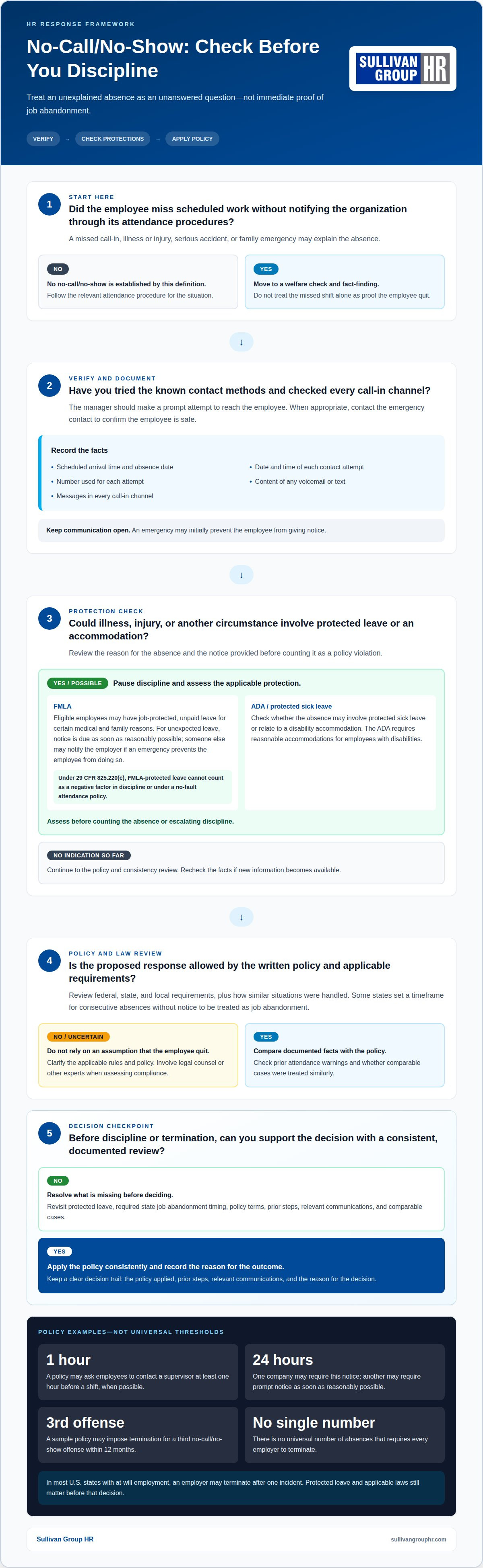
A no-call/no-show occurs when an employee misses scheduled work without notifying the organization through its attendance procedures. A missed call-in, unexpected illness or injury, serious accident, or family emergency may explain the absence. HR should treat the situation as an unanswered question, not immediate proof of job abandonment.
Start with a welfare check. The manager should try the employee’s known contact methods and, when appropriate, contact the emergency contact to confirm the employee is safe. HR should record the scheduled arrival time, absence date, each contact attempt’s date and time, the number used, and the content of any voicemail or text. Before classifying the absence, check every call-in channel for a message. Keep communication open, since an emergency may initially prevent the employee from giving notice.
Next, assess whether illness or injury could involve protected sick leave, the Family and Medical Leave Act (FMLA), or the Americans with Disabilities Act (ADA). The FMLA provides eligible employees job-protected, unpaid leave for certain medical and family reasons. For unexpected FMLA leave, employees must notify employers as soon as reasonably possible; someone else may notify the employer if an emergency prevents the employee from doing so. Under 29 CFR 825.220(c), FMLA-protected leave cannot count as a negative factor in discipline or under a no-fault attendance policy. The ADA requires reasonable accommodations for employees with disabilities, so consider whether an absence may relate to an accommodation before deciding discipline.
Should employers pay for a missed shift or accrued PTO? Pay for missed hours depends on applicable wage rules and the employee’s pay status, ensuring any final calculations or pay adjustments do not breach statutory floors like the national minimum wage. Under federal law, final pay is generally due by the next regular payday; accrued unused vacation or PTO must be handled according to applicable requirements.
Prevention starts before an absence. Clear call-in instructions, consistent manager responses, and a workplace culture where employees can raise urgent needs make it easier to give notice. A time-and-attendance process can also help managers identify missed clock-ins and start a timely welfare check.
How HR professionals check applicable federal and state laws before disciplining or terminating an employee
Before taking disciplinary action, HR reviews the reason for the absence, the employee’s notice, and the laws that apply where they work. An absence may involve protected leave, and penalizing an employee for a protected absence or failing to give advance notice may violate applicable law. Attendance procedures should accommodate notice requirements under relevant leave laws.
Federal rules are only part of the review. HR also checks applicable state and local requirements, since some states set a timeframe for treating consecutive absences without notice as job abandonment. A policy defining abandonment must comply with those rules. HR should also review the written policy and how similar situations were handled, rather than relying on a manager’s assumption that an employee quit.
Progressive discipline gives managers a consistent path from a warning to more serious action. A sample policy may impose termination for a third no-call/no-show offense within 12 months, but that is a policy example, not a universal legal threshold. In most U.S. states with at-will employment, an employer may terminate after one incident. Protected leave and applicable laws still matter before that decision.
For each case, HR can compare documented facts with the policy, confirm whether the employee had prior attendance warnings, and review whether comparable cases were treated similarly. If the absence may qualify for protected leave, HR should assess that before counting it toward discipline or escalating to termination. The review should also account for any state-required job-abandonment timeframe.
Keep the decision trail clear: record the policy applied, prior steps, relevant communications, and the reason for the outcome. HR should involve its legal team or other experts when assessing policy compliance. If the absence affects benefit administration, employee benefits management is a related area to address alongside workforce decisions.
3. No-Call/No-Show Policy: How Many Before Termination?
There’s no single number of no-call/no-show absences that requires every employer to terminate. The threshold should be clear in the written policy and consistent with applicable laws, protected leave, and the handling of similar situations. A policy can set progressive steps, but HR should exclude protected absences before counting violations.
A useful policy spells out the reporting process. It identifies whom employees must notify, when they should give notice, and which channels they can use, such as a phone call or designated messaging system. For example, a policy may ask employees to contact a supervisor at least one hour before a shift when possible. It should also explain what to do if the employee cannot reach that person.
Set expectations for unexpected absences without making them impossible to meet during an emergency. A company may require 24 hours’ notice, while another policy may focus on prompt notice as soon as reasonably possible. The chosen rule should fit the work setting and applicable leave requirements. Before revised policies take effect, existing employees should receive advance notice and clear instructions about the change.
Job abandonment needs its own definition. A policy may treat a specified number of consecutive missed shifts without notice as abandonment, but some states set rules for the timeframe employers may use. HR should align the definition with those requirements and distinguish abandonment from a documented, protected absence.
A professionally prepared template should turn these decisions into practical steps: reporting channels, manager follow-up, documentation, escalation, and when HR reviews possible termination. It should also explain how managers apply the same standard across teams. A sample policy might define a specific number of consecutive missed days as abandonment, but that example must be adapted to applicable law and workplace needs. Clear procedures help managers arrange coverage while treating employees consistently, and organizations looking to build operational resilience can also turn to staffing partners like Amplify Yourself, LLC for dedicated virtual administrative support.
4. Defining a No-Call/No-Show
A no-call/no-show combines two events: an employee misses scheduled work and fails to notify the organization about the absence. A practical answer to how to handle an employee no-call no-show starts with defining both parts in the attendance policy. For example, the policy can explain whether missing a shift without contacting a supervisor differs from arriving late or missing work after giving notice.
Notice timing matters, too. A company may classify notice received less than an hour before a shift as a no-call/no-show, but the policy should state that threshold plainly. It should also identify who receives notice, when employees should send it, and which methods count, such as a phone call or designated message channel. If employees can report absences through several channels, managers should check each one before recording a violation.
That distinction helps HR assess the facts before deciding what to do. An employee who called the wrong manager, left a message through an approved channel, or reported an absence late may present a different situation from someone who gave no notice. How to handle an employee no-call no-show also depends on the reason for the absence. A serious accident or illness, for example, may prevent timely contact, so one missed shift alone doesn’t establish job abandonment.
Clear definitions make expectations easier to communicate. HR can use the written policy to explain what employees should do if their usual contact is unavailable and what managers should do after receiving a report. A practical definition separates the absence, the attempted notice, and when it arrived. This gives supervisors a consistent record to review before discipline, rather than relying on assumptions about intent.
For help aligning attendance procedures with HR practices, get HR support.
Sullivan Group HR: Employee Benefits Management
Sullivan Group HR supports employers with Employee Benefits Management and broader human capital management. When an employee’s absence leads to a leave or separation decision, coordinated benefits administration can help organize related processes alongside payroll responsibilities.
Employers looking to streamline these connected tasks can also explore Payroll Administration or Payroll Outsourcing. The right support depends on which responsibilities the organization wants help managing and how they fit its existing HR processes.
For help with employee benefits and related HR administration, contact Sullivan Group HR.
Build a More Consistent HR Process
Use the next policy review to clarify who owns attendance decisions and how managers communicate expectations. A consistent approach helps employees understand the process and gives supervisors a clear path when an unusual situation arises. It also creates room to improve the employee experience without treating every absence the same way.
A practical approach to how to handle an employee no-call no-show depends on HR processes that carry decisions into day-to-day administration. Sullivan Group HR offers HCM, Payroll Outsourcing, and Payroll Administration to support connected workforce and pay processes. These offerings may suit organizations looking to coordinate HR responsibilities as they refine their internal practices.
Consider where administrative support could help your team focus on clear, consistent processes. Contact Sullivan Group HR for support. With a thoughtful plan and the right support, your organization can move forward with confidence.
Frequently Asked Questions
No-Call/No-Show Policy: How Many Before Termination?
No single absence count applies to every employer. In most U.S. states with at-will employment, termination may follow one incident, while a sample progressive policy may set termination at a third offense within 12 months. Those are different approaches, not a universal rule. HR should apply the written threshold only after accounting for protected leave and comparing the situation with similar attendance decisions.
What if an employee had an emergency and could not call?
If an emergency prevented notice, treat the missed shift as unresolved until HR learns more. A serious accident, injury, illness, or family crisis may keep an employee from calling. For unexpected FMLA leave, someone else, such as a family member, may notify the employer on the employee’s behalf if the employee cannot. Keep communication open and assess applicable protections before taking disciplinary action.
What is job abandonment?
Job abandonment is an employer’s policy-based treatment of consecutive missed shifts without notice as an indication that an employee has left the job. It isn’t automatically established by one missed shift. Some states address what timeframe is reasonable, so HR must apply the relevant rule and distinguish unexplained silence from protected leave or an emergency that prevented contact.
What counts as an employee no-call no-show?
An employee no-call/no-show generally means the employee misses a scheduled shift without notice through the employer’s required process. Policy details determine edge cases. For example, a company may classify notice given less than an hour before a shift as a violation. Before recording the absence under that definition, HR should check every approved call-in channel for a message.
What steps should an HR professional take immediately after an employee fails to report to work?
Confirm the scheduled shift and start time, check approved call-in channels, and arrange coverage. Have the manager contact the employee to check on their safety, using an emergency contact when appropriate. Record the absence and outreach attempts before deciding whether the policy applies. An attendance system can alert a manager when no clock-in appears within 15 minutes of the scheduled start.
How should an HR professional contact and document an employee after a no-call no-show?
Use a dated, factual record rather than conclusions such as “abandoned the job.” Note the scheduled shift, each contact attempt’s time, the number or channel used, whether anyone answered, and the content of any voicemail or text. If another manager tries later, record that attempt separately. A clear timeline helps HR compare events with the policy and review any subsequent discipline.


