

Could a simple administrative oversight really put your personal savings at risk? For many local business owners, the complexity of semi-weekly versus monthly schedules feels like a trap waiting to spring. You work hard to build your legacy, and the last thing you want is the IRS knocking on your door because of a clerical delay. It's exhausting to manage growth while worrying about the heavy penalties for late payroll tax deposits that can quickly spiral out of control.
We’re here to help you secure your business and your peace of mind through people, payroll, and protection. This guide explains the exact costs of delays and provides a clear path to protect your assets from escalating IRS actions. You'll learn the details of the 2% to 15% penalty ladder, the 2026 rules for the Trust Fund Recovery Penalty, and how to request a penalty abatement if you've already missed a deadline. We'll also explore how professional payroll administration puts the human back in human capital management, turning regulatory hurdles into a streamlined, worry-free process.
Key Takeaways
- Master the tiered IRS penalty system to see how minor delays lead to major liabilities.
- Shield your personal assets by understanding how the Trust Fund Recovery Penalty impacts business owners and officers.
- Calculate the exact penalties for late payroll tax deposits and identify the critical windows where rates jump to 15%.
- Unlock potential relief options including First-Time Abate policies and "Reasonable Cause" exceptions for qualified businesses.
- Secure your people, payroll, and protection by transitioning to integrated payroll administration that monitors 2026 regulations.
Understanding the IRS Failure to Deposit (FTD) Penalty
The IRS views payroll taxes differently than your annual corporate income tax. When you withhold money from an employee's paycheck, you act as a temporary steward for the federal government. These are known as "Trust Fund Taxes." They aren't part of your operating capital. They're funds held in escrow for the benefit of your team and the country. If these funds are used to float business expenses or cover cash flow gaps, the IRS responds with swift, tiered fines. We understand the weight of this responsibility. You're balancing the books while trying to keep your team's trust intact, and a single mistake can feel like a personal failure.
Compliance depends on three specific factors: the right time, the right amount, and the right way. Missing any one of these triggers IRS penalties for late payment. The system is designed to penalize delays immediately, with costs that escalate the longer the money stays in your account instead of theirs. Understanding the penalties for late payroll tax deposits starts with knowing that the IRS isn't just looking for the money. They're looking for precision. Finally, the "right way" means using the Electronic Federal Tax Payment System (EFTPS). Mailing a check when you're required to pay electronically can trigger a penalty even if the funds arrive on time.
Which Taxes are Subject to FTD Penalties?
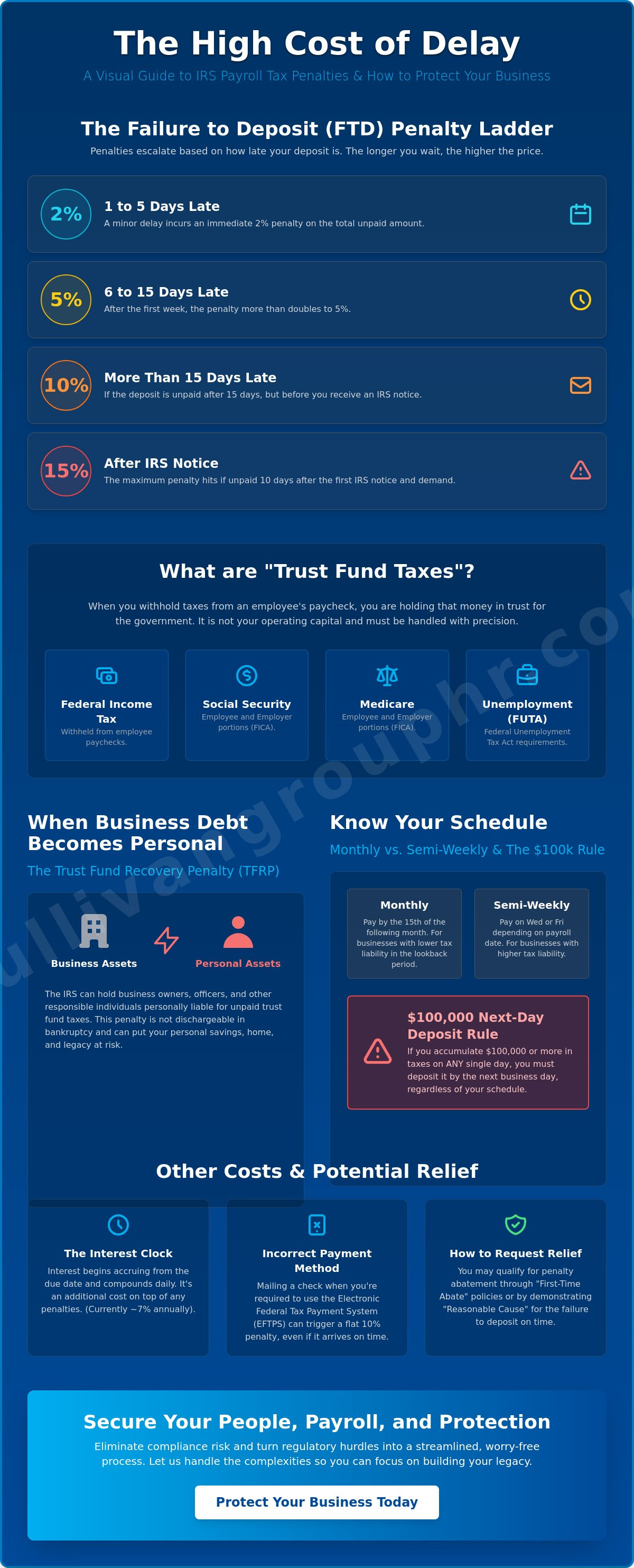
Not all taxes follow the same rules. FTD penalties specifically target the funds you hold in trust. These include federal income tax withholdings taken from employee pay and both the employer and employee portions of Social Security and Medicare (FICA). It also covers Federal Unemployment Tax Act (FUTA) requirements. Because these amounts represent the literal "trust" between an employer and the workforce, the government prioritizes their collection above almost all other business debts. Protecting these funds is the first step in protecting your legacy.
The Two Deposit Schedules: Monthly vs. Semi-Weekly
How often must you pay? The IRS assigns your schedule based on a lookback period. This is the total tax liability you reported during a specific 12-month window. Monthly depositors generally pay by the 15th of the following month. Semi-weekly depositors follow a faster rhythm, with deadlines falling on Wednesdays or Fridays based on pay dates. The most dangerous trap is the $100,000 Next-Day Deposit Rule. If you accumulate $100,000 or more in taxes on any day, you must deposit it by the next business day. Mistaking your schedule or missing this threshold is one of the most common reasons businesses face penalties for late payroll tax deposits.
The Cost of Delay: A Day-by-Day Penalty Breakdown
How quickly can a small administrative oversight turn into a significant financial burden? The IRS doesn't wait long to act. They use a structured, time-sensitive ladder to determine the cost of your delay. Understanding these penalties for late payroll tax deposits is essential for protecting your bottom line. The clock starts the very minute the deadline passes, and the percentages climb rapidly as the days tick by. We see business owners work too hard to let their profits be consumed by avoidable fines.
The IRS Failure to Deposit Penalty follows a strict timeline. If you're one to five days late, the penalty is 2% of the unpaid deposit. By day six, that figure jumps to 5%. If you exceed 15 days, you're looking at a 10% penalty. The highest tier hits 15% if the debt remains unpaid ten days after you receive your first IRS notice. These costs are designed to be painful enough to ensure compliance, and they can easily wipe out a month's worth of growth. If you feel overwhelmed by these timelines, professional payroll administration can act as your first line of defense.
How the IRS Calculates Your Total Debt
It's a common misconception that these penalties stack on top of each other. They aren't additive. You pay the highest tier that applies to your situation, not the sum of all tiers. However, the penalty is only one part of the equation. An "Interest Clock" also starts ticking from the very first day the payment was due. For 2026, the interest rate logic is based on the federal short-term rate plus 3%, which currently sits at approximately 7% annually. This interest compounds daily, meaning your debt grows even while you're preparing your response to the IRS.
The Hidden Cost of "Incorrect Way" Deposits
Did you know you can be penalized even if you pay the full amount on time? If you're required to use the Electronic Federal Tax Payment System (EFTPS) and you choose to mail a paper check instead, the IRS can hit you with a 10% penalty. This is known as an "incorrect way" deposit. Precision matters in every step of the process. Manual errors in the deposit amount or filing incorrect information on Form 941 or Form 944 are often treated with the same severity as a late payment. A reliable partner ensures your filings are accurate, your methods are compliant, and your business remains secure.
Trust Fund Recovery: When Business Debt Becomes Personal
Do you believe your corporate structure provides a total shield against tax debt? While a corporation or LLC usually protects your personal assets, the IRS has a specific tool that bypasses these protections. It's called the Trust Fund Recovery Penalty (TFRP). This isn't just another addition to the penalties for late payroll tax deposits. It's a shift in liability from the business entity directly to you. We see many business owners surprised to learn that the IRS can look past the company name to collect what is owed. This is the ultimate enforcement tool because it targets the individuals behind the desk.
The IRS identifies "Responsible Persons" during an investigation. This definition is broader than you might think. It includes anyone with the duty and authority to ensure taxes are paid. This could be the business owner, a CFO, or even a bookkeeper with check-signing authority. If you have the power to decide which creditors get paid, the IRS may consider you responsible. They aren't just looking for the person who made the mistake. They're looking for the person who had the power to prevent it. Protecting your legacy means ensuring everyone in your financial chain understands this weight.
A critical factor in these cases is "willfulness." This is where many owners feel the most stress. In the eyes of the IRS, willfulness doesn't require a bad motive or an intent to defraud. It simply means you knew the taxes were due and you chose to pay other expenses instead. If you paid your landlord, a key supplier, or even your own salary while your payroll taxes remained unpaid, the IRS views that as a willful act. This distinction is vital. It's the difference between a business hurdle and a personal financial crisis.
The 100% Penalty Rule
The TFRP is often called the 100% penalty because it equals the full amount of the unpaid trust fund taxes. This includes the income tax you withheld from employees and their portion of Social Security and Medicare. When the IRS "pierces the corporate veil," they can seize personal bank accounts, place liens on your home, and garnish other income. This debt follows you personally even if the business closes. It can devastate your personal credit and long-term security for years to come. It's a price no business leader should have to pay for a filing error.
Proactive Risk Management to Avoid TFRP
The most dangerous habit a business can develop is using payroll tax money as "working capital" during a lean month. It's tempting to think you'll catch up next week, but the interest and penalties for late payroll tax deposits move faster than most cash flows. Documentation is your best defense. If you can show that you took every possible step to comply, you're in a much stronger position. We recommend reviewing our HR Risk Management guide to build a more resilient compliance framework. Clear processes don't just save money. They protect the people who built the company.
Penalty Abatements: How to Correct a Payroll Tax Error
Did you realize too late that a deadline passed? That sinking feeling in your stomach is something every business owner understands. While the penalties for late payroll tax deposits are strict, the IRS does provide a path for correction. You aren't just a number to them; you're a taxpayer with a history. If you've been compliant for the past three years, you might qualify for the First-Time Abate (FTA) policy. This is a administrative grace period for your first slip-up. It's a way for the government to acknowledge your legacy of reliability while keeping your business moving forward. We believe one mistake shouldn't define your professional future.
Beyond the FTA, the IRS considers "Reasonable Cause." This isn't a loophole for poor planning. It's a provision for genuine life events that make compliance impossible. Valid reasons include natural disasters, fires, or the death or serious illness of a key person. Even an unavoidable absence can count. If you recently transitioned from a monthly to a semi-weekly schedule and made a mistake, you might also qualify for an Administrative Waiver. The key is to act the moment you realize the error. Silence only makes the interest grow louder. Do you have the documentation ready to prove your case?
Steps to Request a Penalty Removal
Speed is your best ally when fighting penalties for late payroll tax deposits. First, pay the underlying tax immediately. You can't ask for a penalty removal until the original debt is settled. Paying now stops the daily interest clock from compounding further. Second, gather your evidence. Collect hospital records, fire reports, or proof of a natural disaster. Documentation turns an explanation into a verified case. Finally, submit your request. You can call the IRS practitioner line for smaller amounts or draft a formal abatement letter for larger liabilities. Clarity and honesty are your strongest tools here.
When Abatement is Denied: Payment Plans and OICs
What happens if your request is rejected? You still have options to manage the debt without crashing your cash flow. An Installment Agreement allows you to pay over time, often reducing the failure-to-pay rate to 0.25% per month. While an "Offer in Compromise" (OIC) sounds attractive, it's a rigorous process that the IRS rarely grants to active businesses. Navigating these negotiations requires a steady hand and expert insight. If you're facing an IRS notice, our team provides the payroll administration support you need to resolve past errors and prevent future ones. Professional representation ensures you don't face the bureaucracy alone.
Eliminating Compliance Risk with Integrated Payroll Administration
Are you tired of checking the calendar with a sense of dread? The 2026 regulatory environment is complex, but it doesn't have to be a source of constant anxiety. By moving from a manual, fragmented approach to an integrated system, you eliminate the gaps where errors thrive. Our use of the isolved platform automates tax calculations and deposit triggers. This ensures that the penalties for late payroll tax deposits never become a reality for your firm. We believe in providing a sense of security that allows you to lead with confidence rather than fear.
This transition is about more than just software. It's about moving from "Reactive Panic" to "Proactive Growth." When your payroll, time and attendance, and tax filings are in sync, you gain the clarity needed to make bold business decisions. We invite you to explore our strategic guide on What is Human Capital Management? to see how this holistic approach protects your organizational security while fostering a culture of success. You built your business to create a legacy; we provide the administrative rigor to keep that legacy safe.
Real-Time Filing vs. Manual Entry
Manual entry is the playground of human error. Even a small typo in a deposit amount can trigger a mismatch that leads to penalties for late payroll tax deposits. Our integrated system utilizes automated EFTPS integration to ensure every dollar is accounted for and sent on time. By connecting time and attendance data directly to your tax triggers, we eliminate the "amount" errors that often plague growing businesses. Sullivan Group HR assumes the administrative burden, allowing you to focus on the human side of your business while we handle the technical precision.
The Sullivan Group HR Advantage
Choosing a partner is about finding an ally who understands your local territory and the nuances of national compliance. We offer more than just a platform. We offer legacy expertise, hard earned wisdom, and a "no-nonsense" authority that national, tech-only competitors simply cannot match. Our approach is built on three pillars: People, Payroll, and Protection. This framework ensures your business remains stable, your employees remain paid, and your personal assets remain secure. Don't let administrative complexity slow your momentum. Let Sullivan Group HR handle your payroll administration so you can get back to what you do best.
Securing Your Business Legacy and Peace of Mind
Are you ready to trade administrative dread for professional peace of mind? You now understand the high stakes involved in the IRS tiered penalty system. From the rapid jump to 15% fines to the personal liability of the Trust Fund Recovery Penalty, the risks to your personal and professional assets are real. Protecting your hard earned wisdom means moving beyond manual systems that leave room for error. Avoiding penalties for late payroll tax deposits is a matter of implementing the right triggers and having a partner who monitors changing 2026 regulations for you.
We believe your focus belongs on your people, not on tax paperwork. Our team provides access to the industry leading isolved HCM platform combined with expert payroll tax compliance monitoring. Since 1998, we’ve built a legacy of professional human resources consulting rooted in stable, no-nonsense advocacy for local employers. You don't have to face the complexity of federal compliance alone. Let’s work together to ensure your business remains secure and your future remains bright.
Secure your business with professional payroll administration from Sullivan Group HR
Common Questions About Payroll Tax Compliance
What is the penalty for being one day late on a payroll tax deposit?
Being even one day late on your deposit triggers an immediate 2% penalty on the unpaid amount. This rate applies for the first five days of delinquency before jumping to 5% on the sixth day. Are you prepared for the cost of a simple 24-hour delay? Even a minor administrative oversight can move your business into the first tier of IRS fines.
Can I get my payroll tax penalty waived if it is my first time?
Yes, you may qualify for the First-Time Abate (FTA) policy if you have a clean compliance record for the previous three years. This administrative waiver is designed to protect reliable business owners from the financial impact of a single, isolated error. Have you checked your filing history recently? If you’ve been consistently on time, the IRS may remove the penalty to support your continued growth.
Does the IRS charge interest on payroll tax penalties?
The IRS charges interest on the underpayment from the original due date, and this interest compounds daily. For 2026, the rate is based on the federal short-term rate plus 3%, which currently sits at approximately 7% annually. This interest applies to both the tax debt itself and the penalties. This means your total liability grows every single day the payment remains outstanding.
Who is personally liable for unpaid payroll taxes in a corporation?
Any "Responsible Person" who has the authority to direct the payment of corporate funds can be held personally liable. This often includes business owners, CFOs, and even bookkeepers with check-signing authority. The IRS isn't just looking for the person who made the error. They're looking for anyone who had the power and duty to ensure the taxes were paid to the government.
What happens if I pay my payroll taxes but forget to file Form 941?
Forgetting to file Form 941 triggers a "Failure to File" penalty, which is separate from the penalties for late payroll tax deposits. This fine is 5% of the unpaid tax for each month the return is late, capped at 25%. Even if you paid the tax on time, the IRS requires the formal return to reconcile your account and confirm your total liability.
How do I know if I am a monthly or semi-weekly depositor?
Your deposit schedule is determined by the total tax liability you reported during a specific 12-month lookback period. If you reported $50,000 or less in taxes during that window, you are generally a monthly depositor. If your liability exceeded that amount, you must follow the faster semi-weekly schedule. Mistaking your schedule is a common trap that leads to unexpected fines and interest.
What is the 100% penalty for payroll taxes?
The 100% penalty refers to the Trust Fund Recovery Penalty (TFRP), which equals the full amount of unpaid income and FICA taxes withheld from employees. This penalty is unique because it doesn't just fine the business. It allows the IRS to collect these specific "trust" funds directly from the personal assets of the individuals responsible for the non-payment. It's the government's most aggressive collection tool.
Can the IRS take my personal assets for business payroll tax debt?
Yes, the IRS can seize personal bank accounts, place liens on your home, or garnish other income to satisfy these debts. Because the penalties for late payroll tax deposits can escalate so quickly, the IRS uses personal asset seizure as a final enforcement tool for "trust fund" taxes. Corporate structures do not provide a shield in these cases because you are holding employee money in trust.


