
Are you spending more time managing spreadsheets than growing your team? It's a common trap for successful entrepreneurs. With 68% of companies now outsourcing at least one HR function, the real challenge is deciding which partnership actually fits your vision. Choosing between PEO vs HRO vs ASO is the difference between shared liability, administrative relief, or customized consulting.
We understand the specific nuances of managing a team in this landscape. Between the 2026 Social Security wage base limit of $184,500 and the constant fear of a Department of Labor audit, the administrative burden feels overwhelming. You want to protect your business, empower your people, and finally stop worrying about compliance legalities. You deserve an HR strategy that acts as a coach and an ally, not just another vendor invoice.
This guide will show you how to select the right model to reduce liability and access Fortune 500-level benefits. We'll provide a clear decision-making framework to help you find a single source of truth for your HR data. You'll learn how to move from talent acquisition to compensation and long-term organizational security with total peace of mind.
Key Takeaways
- Identify the right fit for your business by comparing PEO vs HRO vs ASO models based on your specific needs for liability protection and administrative relief.
- Learn how the co-employment model acts as a protective shield, allowing you to offer Fortune 500-level benefits to attract and keep top-tier talent.
- Discover how to maintain your company's unique identity and EIN while offloading selective, high-burnout tasks like payroll administration and recruiting.
- Apply our 2026 selection framework to audit your internal HR capacity and evaluate your tolerance for regulatory risk and Department of Labor audits.
- Understand why a unified HCM platform like isolved serves as the critical backbone for managing your entire employee lifecycle through a single source of truth.
Decoding the Acronyms: What is PEO, HRO, and ASO?
Does the current alphabet soup of HR services leave you feeling more confused than empowered? It's easy to get lost in the jargon. However, understanding the fundamental differences between a Professional Employer Organization (PEO), an HRO, and an ASO is vital for your long-term security. In 2026, choosing a model isn't just about how many employees you have. It's about how much risk you want to carry and how much control you want to keep.
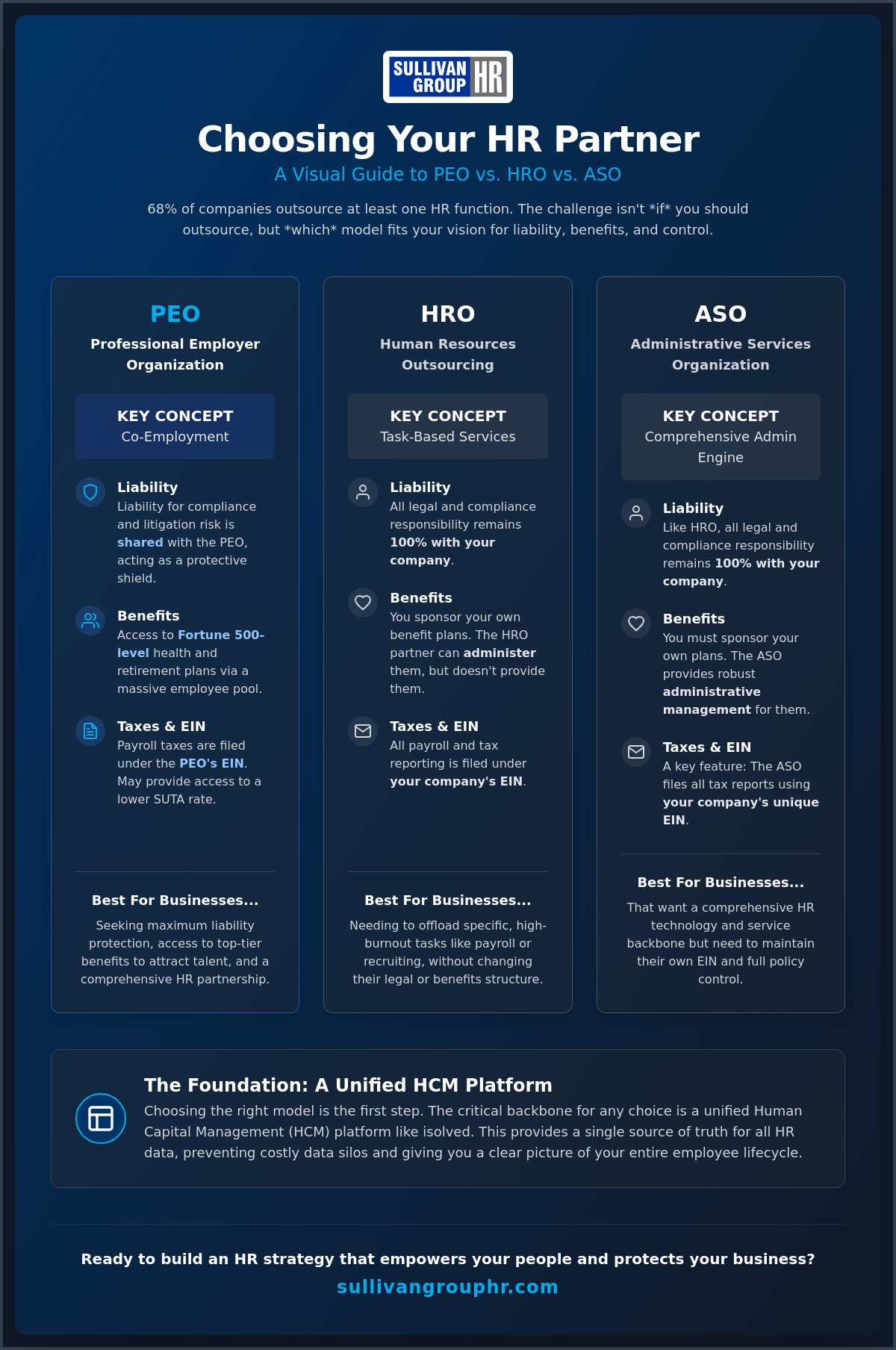
A PEO operates on the principle of co-employment. This means the provider becomes the employer of record for tax and insurance purposes, while you remain the onsite employer managing daily work. In contrast, Human Resources Outsourcing (HRO) is a discrete, task-based service. You hire a partner to handle specific headaches like payroll or recruiting without changing your legal employer status. Finally, an Administrative Services Organization (ASO) provides a robust administrative engine while keeping everything under your own Federal Employer Identification Number (EIN). When comparing PEO vs HRO vs ASO, the choice dictates your company's legal structure and financial liability.
The Core Distinctions at a Glance
- Liability: In a PEO, you share the burden of compliance and litigation risk. With HRO and ASO models, the legal responsibility stays entirely on your shoulders.
- Benefits: PEOs allow you to join a massive buying pool for enterprise-grade health and retirement plans. ASO and HRO models typically require you to sponsor your own plans, though the provider manages the paperwork.
- Control: While all models leave you in charge of your culture, ASO and HRO models offer the highest level of autonomy over policy and provider selection.
Why the Acronym Soup Matters to Your Bottom Line
Choosing the wrong path often leads to technical debt or redundant software costs that eat into your margins. If you pick an HRO for payroll but a separate ASO for benefits, you might end up paying for two different platforms that don't talk to each other. This creates data silos that make it impossible to get a clear picture of your labor costs. Your choice also impacts your State Unemployment Tax Act (SUTA) rates. A PEO might allow you to use their established, often lower rate, while an ASO requires you to maintain your own based on your company's specific history.
The technical handling of your taxes is perhaps the most significant operational shift. Under a PEO model, the provider files payroll taxes under their own EIN, whereas an ASO files all tax reports using your company's unique EIN. This distinction determines who the IRS looks to first if a filing error occurs.
In 2026, the rise of complex local regulations, such as Colorado's Artificial Intelligence Act or new PFML requirements in states like Maine and Delaware, makes these definitions even more critical. You need a partner who understands your local territory and provides a protective shield against shifting legislation. Whether you seek the "Power of the Pool" or the autonomy of your own EIN, the model you choose should simplify your professional life, not complicate it.
The PEO Model: Shared Liability and Fortune 500 Benefits
What if you could offer your team the same benefits package as a global tech giant without the enterprise price tag? For many small business owners, the PEO model makes this possible. When evaluating PEO vs HRO vs ASO, the Professional Employer Organization (PEO) stands out for its unique ability to level the playing field. This structure creates a protective shield around your company. It allows you to focus on your mission while experts manage the administrative heavy lifting.
The "Power of the Pool" is a game-changer. By grouping thousands of employees together from different companies, a PEO gains massive negotiating power. You get access to enterprise-grade health insurance and retirement plans that are usually reserved for Fortune 500 firms. Verified data shows that 61% of SMBs choose to outsource health insurance to stay competitive. It's a strategic move to attract top talent who expect high-quality coverage.
One major worry we hear is the fear of losing control. Let's be clear: you don't lose your team. You still hire, fire, and lead your people every day. You maintain your culture. The PEO simply handles the compliance, payroll taxes, and workers' compensation behind the scenes.
Co-Employment Explained: A Partnership of Protection
Think of co-employment as a smart division of labor. You are the onsite supervisor. You manage performance and daily goals. The PEO acts as the administrative employer. They take on the responsibility for payroll tax filing, reporting, and unemployment insurance. This shared liability is a core part of any PEO vs. ASO comparison.
Risk management is another vital layer. If a workers' compensation claim arises, the PEO's dedicated team manages the process from start to finish. This reduces your administrative burnout and ensures you stay compliant with shifting state laws. It's about movement and safety for your workforce.
When the PEO Model is the Right Strategic Move
This model is perfect for rapid-growth startups. If you're expanding into multiple states in 2026, the compliance burden is heavy. A PEO simplifies this by managing different state tax IDs and local labor laws for you. It keeps you organized as you scale.
You also gain access to proactive Human Resources Consulting. Instead of reacting to problems, you have an ally helping you build a better workplace. This partnership provides a reported average annual cost savings ROI of 27.2% for businesses that make the switch. It's a legacy of stability for your company's future.
ASO and HRO: Maintaining Control with Professional Support
Do you want the administrative power of a large-scale HR department while keeping your company's legal autonomy? For many established firms, the co-employment model of a PEO isn't the right fit. You might have spent years building a favorable workers' compensation experience rating or negotiating specific health plans. In these cases, understanding the nuances of PEO vs HRO vs ASO allows you to offload the grunt work without surrendering your Federal Employer Identification Number (EIN).
The ASO and HRO models offer a "pick and choose" approach to HR. They provide a high-tech administrative engine that runs in the background. This allows your leadership team to focus on culture and growth while experts handle the regulatory minefield of 2026. Whether it's managing the new Social Security wage base limits or filing complex payroll taxes, these models keep you in the driver's seat.
The ASO Advantage: Administrative Relief Without Co-Employment
An Administrative Services Organization (ASO) acts as your back-office powerhouse. The most significant benefit is that you retain full ownership of your tax ID and insurance experience ratings. If your business has a history of low workplace safety incidents, you keep those lower premiums for yourself. You get the benefit of a modern Human Capital Management (HCM) platform without the shared liability of co-employment.
The cost structure is also distinct. While PEOs often charge a percentage of total gross payroll, ASOs typically utilize a per-employee-per-month (PEPM) fee. This makes your HR costs more predictable as your salaries grow. It's a clean, transparent way to access professional-grade payroll administration and benefits management while maintaining total control over your vendor relationships.
HRO: Strategic Consulting and Tactical Execution
Human Resources Outsourcing (HRO) is the most flexible tool in your professional arsenal. Think of it as a fractional HR director for your leadership team. You can engage an HRO partner for specialized, high-impact projects like creating a new employee handbook or conducting a detailed compensation study. This ensures your pay scales remain competitive in a tight 2026 labor market.
Using human resources management services through an HRO model allows you to scale specific departments as needed. If your recruiting team is overwhelmed by a sudden hiring surge, an HRO partner can step in to manage the applicant tracking system and onboarding. It's about movement, results, and targeted support. You get expert guidance on workforce management and organizational design exactly when you need it, ensuring your people stay empowered and your business remains secure.
The 2026 Selection Framework: How to Choose Your Model
How do you move from administrative burnout to professional freedom? It's time to build a concrete framework for your decision. Selecting the right path among PEO vs HRO vs ASO requires a clear-eyed look at your current operations and your 2026 goals. This isn't just a transactional vendor choice. It's a strategic partnership designed to protect your legacy and empower your people.
Start with a five-step audit to find your perfect fit. First, assess your internal HR capacity and technical debt. Are your managers wasting hours on manual payroll entries? Second, evaluate your risk tolerance. If a Department of Labor audit happened tomorrow, would you feel secure or terrified? Third, analyze your benefits competitiveness. In a tight labor market, subpar health plans are a silent killer of growth. Fourth, determine your expansion plans. If you're moving into new states, you need a partner who understands local nuances. Finally, review the technology stack to ensure it can scale with your ambitions.
Regulatory Compliance in 2026
The complexity of state-specific labor laws has reached a fever pitch. With new PFML requirements taking effect in states like Maryland and Minnesota, manual tracking is no longer a viable option. Your outsourcing model must handle HR risk management proactively to avoid costly penalties. Automated I-9 verification and strict termination compliance are now baseline requirements for any business owner who values security and movement. You need an ally who anticipates these shifts before they impact your bottom line.
Technology as the Great Equalizer
Technology should simplify your life, not complicate it. A unified HCM platform is non-negotiable regardless of the model you choose. Modern self-service portals reduce administrative friction by letting employees manage their own benefits, tax forms, and time tracking. Fragmented data silos are the single biggest threat to HR efficiency in 2026 because they prevent you from seeing the real-time financial health of your organization. When your data is unified, your decision-making becomes faster and more accurate.
Ready to stop the administrative burnout? Connect with our local experts to find the outsourcing model that protects your business and empowers your people.
Sullivan Group HR: Unified HCM and Personalized Partnership
Are you tired of being treated like a support ticket by a faceless national vendor? While the technical choice between PEO vs HRO vs ASO is a critical business decision, the human partner behind the model is what actually drives your success. In 2026, technology alone isn't enough. You need an HR ally who understands your local territory and shares your commitment to excellence. We bridge the gap between automated, tech-only platforms and traditional, slow-moving firms.
At Sullivan Group HR, we operate through a simple but powerful three-part framework: Protect, Support, and Grow. We protect your legacy by managing complex compliance. We support your daily operations with professional rigor. We help you grow by providing the strategic tools needed to attract and keep top-tier talent. This relationship-first approach ensures that your HR strategy is a motor for growth, not a source of administrative burnout.
The isolved Advantage: Human Capital Management Redefined
Success in the modern workforce requires a single source of truth for your data. We utilize isolved, a premier Human Capital Management (HCM) platform that eliminates the chaos of fragmented systems. This unified technology allows you to integrate applicant tracking and onboarding directly with your payroll and benefits. When your systems talk to each other, you eliminate manual errors and reduce technical debt.
Executive decision-making becomes faster with real-time reporting and analytics at your fingertips. You can see exactly where your labor costs are going and how your benefits utilization looks across the board. Because our platform is flexible, you enjoy a seamless transition between different service levels as your business scales. Whether you start with a targeted HRO project or move into a full PEO partnership, your data stays in one secure, organized place.
A Relationship-First Approach to Outsourcing
Why settle for a transactional vendor when you can have an extension of your own team? Our experts provide the "no-nonsense" authority you need to navigate the 2026 regulatory landscape with confidence. We combine the efficiency of payroll administration outsourcing with high-level strategic consulting. This ensures that every administrative task we handle is aligned with your long-term organizational security.
We value people over automated processes. Our team acts as your coach and advocate, providing a localized "handshake" that national firms simply cannot replicate. We are here to help you master the nuances of your specific industry while protecting your bottom line. Are you ready to reclaim your time and empower your workforce? Schedule your HR strategy audit with Sullivan Group HR today and discover the power of a true partnership.
Secure Your Future with the Right HR Partnership
Are you ready to reclaim your focus and lead your team with total confidence? The decision between PEO vs HRO vs ASO represents a pivotal moment for your business's operational health. Whether you choose the shared protection of a PEO or the tactical flexibility of an HRO, the goal remains the same: a secure environment where your people can thrive. By auditing your current capacity and aligning with a partner who understands the 2026 regulatory landscape, you move from reactive survival to proactive growth.
You deserve a single source of truth for your data and an ally who acts as an extension of your own leadership team. We provide access to the industry-leading isolved HCM platform, proactive HR risk management, and customized solutions that range from simple payroll to full HR consulting. Stop letting administrative burnout dictate your professional potential. You've worked hard to build your legacy; now let us help you protect it with professional rigor and empathetic support. Your journey toward a more organized and resilient workplace starts today.
Ready to simplify your HR? Schedule a consultation with our experts today.
Frequently Asked Questions
Is a PEO the same as an ASO?
No, a PEO and an ASO are legally distinct models. The primary difference lies in the employer relationship. A PEO uses a co-employment agreement to share liability and file taxes under their EIN. An ASO provides administrative relief while you maintain total ownership of your tax ID and insurance ratings. It's a choice between shared protection or independent control.
Will I lose control of my employees if I use a PEO?
You do not lose control of your team. You still manage daily performance, hiring decisions, and your company culture. The PEO acts as your administrative coach and ally, handling the backend compliance and payroll reporting. This partnership allows you to focus on leading your people while experts manage the regulatory heavy lifting.
Can an ASO provide the same health insurance rates as a PEO?
Generally, an ASO cannot match the scaled health insurance rates of a PEO. PEOs utilize the "Power of the Pool" to negotiate enterprise-grade rates for thousands of employees at once. In an ASO model, your benefits are typically based on your own company's specific risk profile. This is a vital distinction when comparing PEO vs HRO vs ASO for your 2026 talent strategy.
How does an HRO model help with compliance audits?
An HRO model provides tactical execution and strategic consulting to shield your business. Our experts can conduct mock audits, update handbooks for 2026 state-specific laws, and organize your HR data. This turns a daunting Department of Labor audit into a manageable, organized process. It ensures your records are a single source of truth for all regulatory requirements.
Which model is best for a multi-state business in 2026?
A PEO is often the most efficient choice for rapid multi-state expansion. It simplifies movement into new territories by managing diverse state tax IDs and local labor laws for you. However, an ASO utilizing a unified HCM platform also provides the necessary visibility for compliance. The right choice depends on whether you want to manage those state registrations yourself.
What is the cost difference between PEO, ASO, and HRO models?
The cost structure varies based on the level of liability and service you require. PEOs often charge a percentage of gross payroll, while ASO and HRO models typically use a per-employee-per-month fee or project-based rates. You should evaluate the total value of reduced administrative burnout and access to better benefits when making your decision. We help you find the most cost-effective path for your growth.
Can I switch from a PEO to an ASO as my company grows?
You can certainly switch models as your business evolves. Many companies start with a PEO to access Fortune 500-level benefits and attract top talent. Once they reach a certain size, they may transition to an ASO to manage their own insurance experience ratings. We ensure a seamless transition between these service levels so your data stays secure and your people stay supported.
Does Sullivan Group HR offer all three models?
Yes, we do. Sullivan Group HR provides customized solutions ranging from payroll outsourcing to full human resources consulting. Our "Protect, Support, Grow" framework allows us to tailor a partnership that fits your specific risk tolerance and goals. Whether you need a full PEO relationship or selective HRO support, we provide the unified isolved platform to empower your workforce.


