
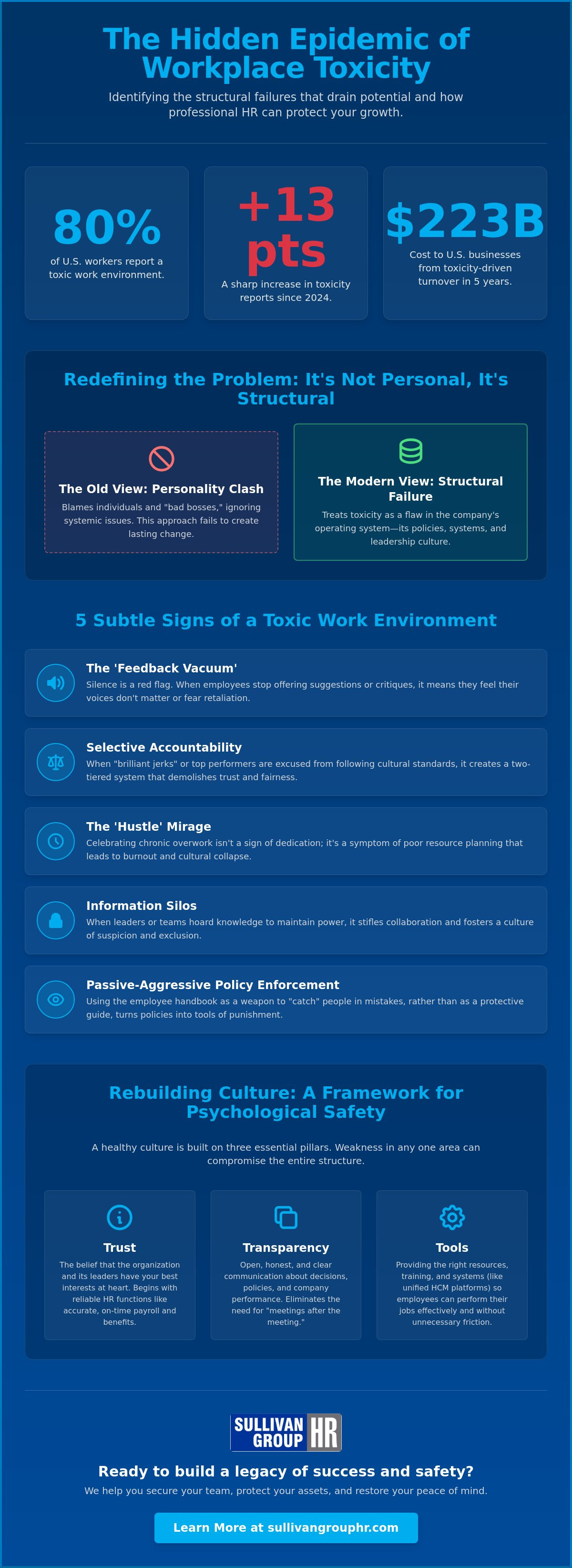
Did you know that 80% of U.S. workers now report working in a toxic environment? That is a sharp 13-point increase since 2024. As a leader, you've likely felt the sting of high turnover or the quiet drain of disengaged teams. It's difficult to scale when you're constantly replacing talent; in fact, turnover driven by toxic culture has cost U.S. businesses $223 billion over the past five years. Often, the root cause isn't pay; it's the subtle signs of a toxic work environment that damage your culture from the inside out.
We understand that you want to build a legacy of success and safety for your employees. It's frustrating to watch turnover climb while worrying about potential litigation or DOL audits. We are here to help you secure your team, protect your assets, and restore your peace of mind. This guide will show you how to identify structural rot and implement professional HR strategies to protect your growth. We'll provide a clear toxicity checklist, a framework to rebuild psychological safety, and a look at the massive ROI that comes from a healthy workplace.
Key Takeaways
- Redefine toxicity as a structural failure rather than a personality clash to better protect your professional potential.
- Identify the subtle signs of a toxic work environment, including the "feedback vacuum" and the dangers of selective accountability.
- Recognize how fundamental HR functions like payroll and benefits management serve as the primary building blocks of organizational trust.
- Quantify the hidden "Turnover Tax" to understand how cultural rot directly impacts your bottom line and recruiting efforts.
- Implement a proactive framework for cultural audits and unified HCM systems to secure your team’s long-term success.
What Defines a Toxic Work Environment in 2026?
What exactly is a toxic workplace? In 2026, we define toxicity as a pervasive pattern of negative behavior that systematically outweighs an employee's professional potential. It isn't just a bad boss or a stressful deadline. It's a structural failure. To understand the foundational elements, we can look at what is a toxic workplace and how its characteristics seep into every corner of an organization. When the environment becomes a barrier to growth, you're no longer managing a team; you're managing a crisis.
The workforce has shifted. Today's top talent prioritizes psychological safety over high salaries. Why? Because workers have realized that a paycheck can't compensate for a compromised mental state. If your team feels they must hide their mistakes to survive, you've already lost the battle for innovation. Identifying the signs of a toxic work environment starts with recognizing when fear has replaced focus. Are your people thriving, or are they simply surviving the workday?
Is your office high-pressure or just plain toxic? There's a vital difference. High-pressure environments are about the work. The goals are steep, but the support is steady. Toxic environments are about the people and the systems. In a toxic space, the goals are moving targets and the support is nonexistent. We rely on a three-part framework for cultural health: Trust, Transparency, and Tools. Without these three pillars, even the most talented team will eventually crumble under the weight of cultural rot.
The ROI of a Healthy Culture
Healthy cultures aren't just "nice to have." They're the engine of your business. Positive environments drive innovation and encourage discretionary effort. This is the extra mile employees go because they believe in the mission. There's also a direct link between employee well-being and customer satisfaction. If your team feels protected, they'll protect your clients. In a tight 2026 labor market, your culture is your most significant competitive advantage.
Culture vs. Climate: Understanding the Difference
Think of climate as the mood of the day. Think of culture as the operating system of the company. A few bad days don't equal toxicity. Everyone has a rough Monday or a stressful quarter. However, a bad system always leads to toxicity. Leadership sets the cultural baseline. You decide if the operating system is built on collaboration or fear. Recognizing the signs of a toxic work environment is the first step toward reclaiming your team's potential and securing your company's future.
5 Subtle Signs of a Toxic Work Environment Leaders Often Miss
Identifying the signs of a toxic work environment is rarely as simple as spotting a screaming manager or overt harassment. Often, the rot is quiet. It lives in the spaces between your official policies and the daily reality of your team. If you aren't looking for the subtle indicators, you might miss the moment your culture begins to shift from productive to predatory.
- The 'Feedback Vacuum': Silence isn't always agreement. When employees stop offering suggestions or critiques, it's often because they've concluded their voices don't matter. A lack of dissent is a major red flag for psychological safety.
- Selective Accountability: This happens when "brilliant jerks" or top performers are allowed to bypass cultural standards because of their output. This creates a two-tier system that destroys trust.
- The 'Hustle' Mirage: Are you celebrating the person working until midnight as a hero? You're actually celebrating a failure of resource planning. Research on toxic workplace effects shows that chronic overwork isn't a sustainable strategy; it's a precursor to total cultural collapse.
- Information Silos: Knowledge should be a shared resource. When managers hoard information to maintain power or control, they create a culture of exclusion and suspicion.
- Passive-Aggressive Policy Enforcement: If you only pull out the employee handbook to "catch" someone in a mistake, you've turned a guide into a weapon. Policies should protect and clarify, not punish.
Communication Breakdowns and Gossip
Watch for the "meeting after the meeting." If the real decisions or critiques happen in private Slack channels or whispers, your formal communication has failed. This shift from professional collaboration to "watercooler" complaining is a primary indicator of cultural decay. Transitioning to transparent systems like employee self-service portals can help bridge this gap. If you're unsure where to start, engaging with human resources consulting can provide an objective view of these hidden friction points.
The Rise of 'Quiet Quitting' as a Toxicity Metric
Disengagement is the final stage before turnover. In hybrid or remote teams, this looks like cameras staying off, slow response times, or a sudden drop in discretionary effort. Using time and attendance data isn't about micromanaging; it's about identifying patterns of withdrawal before they become resignations. Spotting these signs of a toxic work environment early allows you to intervene before the cost of replacement hits your bottom line.
Structural Toxicity: How Poor HR Systems Fuel Cultural Rot
Many leaders look for personality clashes when investigating cultural issues. They often overlook the invisible machinery of the business. Are your systems working for you or against you? Trust isn't built during a team-building retreat; it's built on payday. When the administrative foundations of your company are cracked, cultural rot is inevitable. Structural failure is one of the most overlooked signs of a toxic work environment because it feels like a "back-office" problem rather than a human one.
Inconsistent benefits management is a primary driver of resentment. When one employee receives a perk that another is denied without a clear policy, you create a "haves vs. have-nots" dynamic. This lack of transparency leads to perceived favoritism. These "grey areas" in your operations force employees to guess the rules. Guesswork breeds anxiety, and anxiety eventually turns into toxicity. A unified HCM platform like isolved provides a single source of truth, ensuring every team member sees the same rules, the same benefits, and the same path forward.
Payroll Errors and the Erosion of Trust
Why is payroll so critical to culture? A single missed or incorrect paycheck can permanently damage the employer-employee bond. It sends a message that the company doesn't value the basic survival of its staff. For many, this is the ultimate sign of a failing organization. Stability is the bedrock of psychological safety. Implementing payroll administration outsourcing ensures that your team is paid correctly and on time, every time. Automated payroll through isolved eliminates the friction of human error, protecting your reputation as a reliable employer.
The Compliance-Toxicity Connection
Fear at the top trickles down. If leadership is constantly stressed about a potential DOL audit, that tension permeates the entire office. Outdated employee handbooks are another hidden danger. When discipline is inconsistent because the rules are unclear, employees feel targeted rather than coached. This is where the protective value of professional human resources consulting becomes clear. By hardening your compliance and clarifying your policies, you remove the "fear of the unknown" that often characterizes the signs of a toxic work environment. You move from a reactive state of crisis management to a proactive state of leadership.
The True Price of Toxicity: Calculating the Risk to Your Growth
What is the true cost of silence? Many leaders hesitate to address the signs of a toxic work environment because cultural change feels daunting. However, the "Turnover Tax" is far more expensive than any HR intervention. Replacing a manager or specialist can cost your business between $50,000 and $200,000 per person. When you calculate the $223 billion that toxic culture has cost U.S. businesses over the past five years, the financial risk becomes impossible to ignore. Beyond the ledger, your employer brand is at stake. In our digital world, one negative Glassdoor review can deter the very talent you need to scale.
How does toxicity impact your long-term scaling? It creates a friction that slows down every Human Capital Management (HCM) process. Recruiting takes longer because candidates sense the tension. Training becomes a revolving door. Even your most efficient systems can't fix a team that doesn't want to be there. You end up spending your time managing personalities instead of pursuing your professional potential. You aren't just losing money; you're losing the ability to compete in your local market.
Hidden Costs of Disengagement
Productivity vanishes when employees "work to rule." They meet the letter of their job description but offer no innovation or heart. This disengagement can cost your company the equivalent of 34% of an employee's salary in lost productivity. Presenteeism is even more insidious. This occurs when employees are physically present but mentally checked out due to environmental stress. Toxic turnover is the loss of your most valuable cultural ambassadors.
Risk Management and Legal Exposure
A hostile culture is a magnet for litigation. Toxic environments lead to a spike in workers' compensation insurance claims as stress manifests in physical and mental health issues. You also face the threat of "Constructive Discharge" lawsuits. This legal claim arises when an employee proves that the workplace was so intolerable they were forced to resign. To protect your assets and your future, it's time to partner with an HR expert who can help you identify these risks before they become liabilities.
Rebuilding Culture: Professional HR Strategies for a Healthy Workplace
How do you move from a state of survival to one of professional potential? Identifying the signs of a toxic work environment is only half the battle. The real work begins when you decide to fix it. Rebuilding a culture requires a shift from reactive damage control to proactive system building. It is about creating a workspace where your team feels protected, valued, and heard. We follow a proven five-step process to help you reclaim your organizational health and secure your legacy.
- Step 1: Conduct a cultural audit. You can't fix what you haven't measured. Use anonymous surveys and exit interviews to identify the root causes of friction.
- Step 2: Implement a unified HCM platform. We recommend isolved to centralize your communication and data. This eliminates the "grey areas" that lead to perceived favoritism.
- Step 3: Revitalize your benefits management solutions. Showing your team they are valued through tangible support is the fastest way to earn back their trust.
- Step 4: Empower managers. Most toxicity stems from poor leadership. Give your managers the professional HR consulting and training they need to lead with empathy and rigor.
- Step 5: Prioritize transparency in talent acquisition. If you aren't honest about the role and the culture from day one, you're just inviting future turnover.
Leveraging the isolved People Cloud
Morale is hard to quantify without the right tools. Our workforce management solutions provide the data-driven insights you need to monitor team health in real time. The power of the employee self-service portal cannot be overstated. It fosters autonomy and trust by giving your staff control over their own professional lives. By using integrated applicant tracking systems, you can ensure every new hire aligns with your revitalized cultural standards.
The Sullivan Group HR Advantage
We understand that business owners often feel overwhelmed by administrative burdens. That is why we offer more than just a service; we provide a protective partnership. A fractional HR partner brings the "no-nonsense" wisdom and regional expertise needed to reset your culture. We move you away from transactional vendor relationships toward an empathetic partnership focused on your long-term growth. We are here to act as your coach and ally. Protect your team and your business with Sullivan Group HR today.
Secure Your Legacy and Reclaim Your Culture
Are you ready to move from a state of constant firefighting to a period of sustainable growth? We've explored how signs of a toxic work environment often stem from broken systems rather than just difficult personalities. From the hidden "Turnover Tax" to the erosion of trust caused by payroll errors, cultural rot is a measurable risk to your business. However, identifying the rot is only the first step toward building a resilient organization.
You don't have to navigate these administrative and cultural hurdles alone. We provide the tools and expertise needed to harden your defenses and support your team. By combining our "no-nonsense" HR consulting with the industry-leading isolved HCM platform, we help you eliminate structural friction. We take over the heavy lifting of payroll and benefits administration so you can focus on your professional potential. It's time to build a workplace where people don't just work, but thrive.
Scale your business with confidence—Partner with Sullivan Group HR
Your team is your most valuable asset. Protecting them is the smartest investment you'll ever make. We are here to help you lead with confidence and secure your company's future.
Frequently Asked Questions
What is the #1 sign of a toxic work environment?
High employee turnover without a clear cause is the most visible indicator of a failing culture. When people leave at a rate higher than the 1.9% national average seen in early 2026, it often points to deep structural issues. Other signs of a toxic work environment include a "feedback vacuum" where employees stop sharing ideas. If your best talent is exiting despite competitive pay, the problem is almost certainly the environment itself.
Can a toxic work environment be fixed without firing everyone?
Yes, you can restore culture by addressing the structural failures and leadership behaviors that caused the rot. It starts with a cultural audit to identify specific friction points. You must implement clear policies and consistent accountability for everyone, including top performers. By hardening your HR systems and providing leadership training, you create a new baseline of trust. This allows your existing team to feel safe and productive once again.
How do I tell my boss the culture is toxic without getting fired?
Focus on business outcomes and data rather than personal feelings. Frame the conversation around productivity loss, turnover costs, or the risk of disengagement. Use specific examples of how current "grey areas" in policy create confusion for the team. By positioning yourself as an ally who wants to protect the company's growth and professional potential, you make the feedback a professional contribution rather than a personal attack.
What are the legal consequences of a toxic workplace for an employer?
Employers face significant risks including harassment lawsuits, "Constructive Discharge" claims, and increased workers' compensation premiums. While federal law doesn't explicitly prohibit bullying, state laws in places like California have much stricter harassment protections. If toxicity overlaps with protected characteristics, you could face EEOC charges. Professional human resources consulting is essential to mitigate these risks and ensure you remain compliant with evolving 2026 regulations and enforcement priorities.
How does poor payroll administration contribute to workplace toxicity?
Poor payroll administration erodes the fundamental trust between an employer and their team. When paychecks are late or incorrect, it sends a message that the company doesn't value the employee's basic livelihood. This administrative friction creates a "haves vs. have-nots" dynamic and fuels deep resentment. Reliable systems are the bedrock of a healthy culture. Without them, no amount of team-building can restore the psychological safety needed for a team to thrive.
Is micromanagement always a sign of a toxic environment?
Not always, but chronic micromanagement is a primary driver of disengagement and withdrawal. In a healthy setting, close supervision might be necessary for training or high-stakes projects. However, when it becomes the standard operating procedure, it signals a lack of trust. This behavior often leads to "quiet quitting." Employees stop offering discretionary effort because they feel their professional potential is being stifled by a lack of autonomy and respect.
How can an HCM platform like isolved help improve company culture?
An HCM platform like isolved improves culture by providing transparency and a single source of truth for the entire team. It streamlines communication through employee self-service portals, giving staff autonomy over their benefits and schedules. By automating payroll and time tracking, you eliminate the human errors that cause friction. Data-driven insights from the platform also help leaders spot patterns of disengagement and signs of a toxic work environment before they lead to turnover.
What is the difference between a high-stress job and a toxic one?
High-stress jobs focus on the work, while toxic jobs focus on the people and the politics. In a high-pressure environment, the goals are difficult but the support from leadership is steady and predictable. In a toxic environment, the stress is caused by unpredictable behavior, lack of accountability, or structural failures. If the pressure comes from a lack of tools, poor communication, or unfair treatment, you're dealing with toxicity, not just a busy season.


