

Is your in-house HR department quietly draining your growth capital while you struggle to keep up with shifting regulations? You aren't alone if you feel that rising salaries and the constant fear of a compliance audit are keeping you up at night. Managing manual payroll and complex benefits management shouldn't be your full-time job. As your local partner, we believe you deserve an ally who helps you recruit, pay, and protect your team with confidence.
In this guide, we break down the true cost of HR outsourcing in 2026 so you can stop guessing and start growing. You'll discover a clear framework for comparing vendors, a deep dive into common pricing models, and the steps to calculate a real return on your investment. We'll explore how modern HCM technology and expert HR consulting can turn administrative burdens into predictable, manageable results. We're here to put the human back in your human resources. Let's look at how you can protect your bottom line while finally reclaiming your time to focus on your mission.
Key Takeaways
- Learn to distinguish between PEO, ASO, and HRO models. This clarity helps you select a pricing structure that matches your specific business goals.
- Identify the specific variables that drive the cost of HR outsourcing. Knowing these factors allows you to negotiate with confidence and eliminate hidden fees.
- See how the expense of a dedicated HR hire compares to a flexible service fee. This comparison reveals the true overhead of in-house administration.
- Quantify the value of organizational security. Discover how expert HR consulting and benefits management reduce the financial impact of turnover and compliance risks.
- Explore how a unified technology platform simplifies your daily operations. A single system for payroll and time tracking creates a more efficient, predictable workflow.
Understanding HR Outsourcing Pricing Models in 2026
How do you choose the right path for your organization's future? The landscape of Business Process Outsourcing (BPO) has evolved to offer more transparency and flexibility than ever before. To find the right fit, you must first understand the three primary structures that define the industry. Each model offers a different level of partnership, risk sharing, and administrative relief.
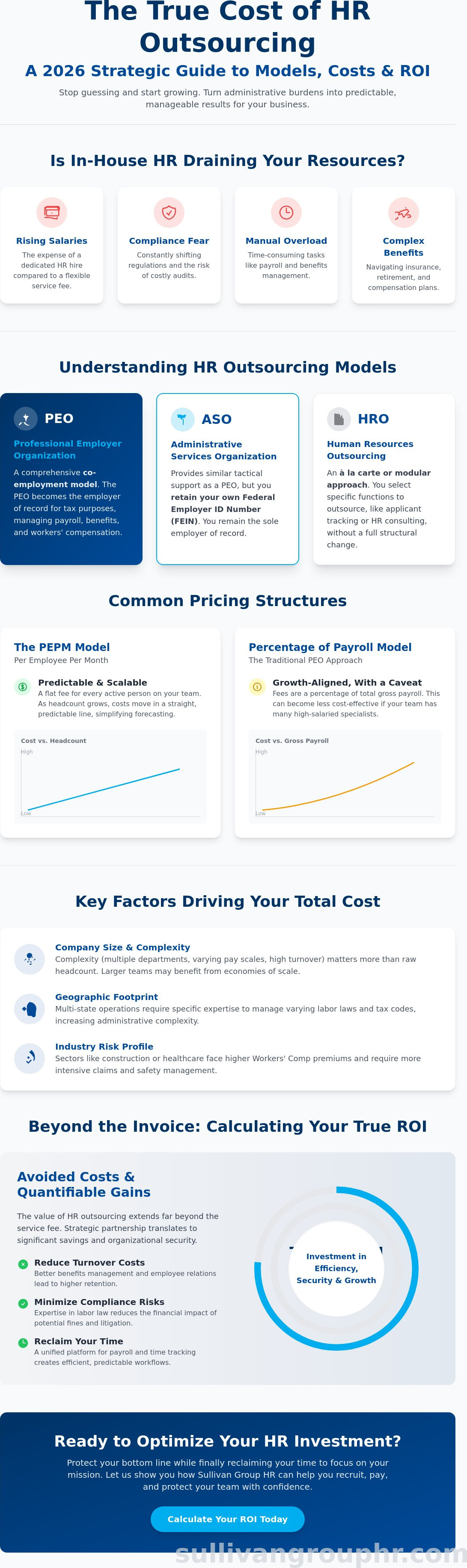
Professional Employer Organizations (PEOs) use a co-employment model to manage your payroll administration and workers' compensation insurance. Administrative Services Organizations (ASOs) provide similar tactical support but keep the employment tax filings under your own Federal Employer Identification Number. Finally, Human Resources Outsourcing (HRO) allows you to pick specific functions, such as human resources consulting or applicant tracking, without a full-scale structural change. Choosing between these isn't just about administrative ease. It's about how you want to recruit, pay, and protect your team.
Modern businesses are moving away from rigid, one-size-fits-all contracts. They now prefer "modular" pricing. This approach allows you to pay only for the tools you actually use, such as time and attendance or a specific applicant tracking system. This flexibility ensures your cost of HR outsourcing aligns perfectly with your current operational needs rather than a hypothetical future state.
The PEPM Model: Predictable and Scalable
Are you tired of fluctuating monthly bills? The Per Employee Per Month (PEPM) model offers the stability your leadership team craves. You pay a flat fee for every active person on your team. It's simple. It's scalable. It's transparent. This model typically covers essential functions like payroll outsourcing and employee benefits management. As your headcount grows, your expenses move in a straight, predictable line. Mid-market CFOs often prefer this model because it removes the complexity of variable service fees. It allows you to forecast your administrative spend with total confidence.
Percentage of Payroll: The Traditional PEO Approach
Some providers calculate fees based on a percentage of your total gross payroll. This traditional approach is common in full-service PEO arrangements where the provider takes on more significant compliance responsibilities. While it aligns the provider's incentives with your company's growth, you must watch the impact of high-earner salaries. As your total labor spend increases, so does your service fee. This model can become less cost-effective than flat fees if your team consists of high-salaried specialists. You should evaluate this model carefully to ensure your cost of HR outsourcing doesn't outpace the value of the services provided. Understanding these nuances is the first step toward achieving a predictable monthly HR spend.
Factors That Drive the Total Cost of HR Outsourcing
What determines your final invoice? The cost of HR outsourcing isn't a static number. It's a dynamic calculation based on your unique operational fingerprint. While basic payroll administration might seem straightforward, several variables can shift your total investment. You aren't just buying a service. You're investing in a structure that scales with your ambition. Understanding these drivers helps you move from reactive spending to strategic planning.
- Company Size and Complexity: Larger teams often benefit from economies of scale. However, complexity matters more than raw headcount. Do you have multiple departments, varying pay scales, or high turnover? These factors require more intensive human capital management.
- Geographic Footprint: Operating in a single state is simpler than managing a remote team across five. Multi-state compliance requires specific expertise to manage varying labor laws and tax codes.
- Industry Risk Profile: High-risk sectors like construction or healthcare often face higher Workers' Compensation Insurance premiums. Your provider must account for the additional administrative time required to manage these claims and safety audits.
The Technology Factor: HCM Platform Implementation
Your choice of technology is a major driver of long-term value. Implementing a platform like isolved involves a one-time setup fee. This initial cost covers the heavy lifting of data migration and system configuration. Recurring maintenance fees follow, but they're often offset by the efficiency of a unified system. HCM implementation costs are an investment in data integrity. By centralizing time and attendance with payroll, you eliminate the manual errors that lead to costly corrections. If you're ready to streamline these systems, Sullivan Group HR can help you integrate these tools seamlessly.
Compliance and Risk Management Add-ons
Do you need more than just a paycheck processor? Deep-level Human Resources Consulting adds value but also impacts the total cost of HR outsourcing. Specialized reporting for the EEOC or ACA requires meticulous tracking. While these services add to your monthly invoice, they serve as a protective shield. They prevent the "compliance tax" that arrives in the form of government fines or litigation. While industry benchmarks provide a baseline for what employers can expect to pay, your specific risk profile dictates the final investment. You're paying for a partner who keeps you safe and compliant.
The True Cost Comparison: In-House vs. Outsourced HR
Is an internal hire truly the most efficient path for your business? Many leaders assume an in-house manager is the most cost-effective choice. However, they often overlook the "Total Cost of Ownership" that comes with a dedicated department. The cost of HR outsourcing represents a strategic shift from heavy, fixed overhead to a flexible, performance-driven model. It's about moving from a system that drains your resources to one that protects your growth. When you compare these two paths, the numbers tell a compelling story of safety and scalability.
The Fully Loaded Cost of an In-House HR Department
An internal HR department costs much more than just a monthly salary. You must account for payroll taxes, health insurance, and retirement contributions for every staffer. According to 2026 data, a full-time HR manager's salary alone typically ranges between $55,000 and $75,000 per year. When you add recruitment fees and the time spent on onboarding, that single hire becomes a significant financial commitment. There are also hidden costs. You're paying for office space, specialized furniture, and the hardware required for a modern office. Staying current on 2026 labor laws also requires a constant budget for training and development. If your internal expert misses a single regulatory update, your business faces the risk of audits and litigation.
The Outsourcing Advantage: Efficiency at Scale
Why pay for a single person's expertise when you can access an entire team of specialists? Outsourcing creates a shared-service model that effectively lowers the cost per employee. You gain access to enterprise-level technology like isolved without the staggering licensing fees of disparate software tools. This unified approach eliminates the need for multiple subscriptions for time tracking, payroll administration, and an applicant tracking system. Perhaps most importantly, you eliminate the "single point of failure" risk. If a one-person HR shop leaves your company, your payroll and compliance stop. With an outsourced partner, your organizational security remains constant and reliable.
What could your leadership team achieve with 20 extra hours every week? For many growing companies with 100 employees, the annual cost of in-house HR staff exceeds $180,000. In contrast, comprehensive outsourced support for that same group can range from $60,000 to $120,000. That's a potential saving of 33% to 66%. While you evaluate the best HR outsourcing services of 2026, remember that the goal isn't just to save money. It's to buy back your focus. Reinvesting those saved hours into innovation, sales, and strategy is how you truly scale. The cost of HR outsourcing is an investment in your company's professional potential.
Beyond the Invoice: Calculating ROI and Avoided Costs
What is the price of a mistake? When evaluating the cost of HR outsourcing, many business owners only look at the monthly service fee. They forget to calculate the "cost of doing nothing." In 2026, the regulatory environment is more aggressive than ever. A single reporting error or a mishandled termination can lead to financial devastation. True ROI isn't just about what you spend. It's about what you successfully avoid. You need a strategy that allows you to comply, retain, and grow with total peace of mind.
Avoided Costs: The Insurance of Professional HR
Think about the last time you reviewed your labor law compliance. The average penalty for a Department of Labor (DOL) audit can reach thousands of dollars per employee for simple wage and hour violations. Professional HR risk management prevents these five-figure legal settlements before they ever start. By outsourcing, you move from a reactive "hope for the best" strategy to a proactive "shield and protect" framework. We define compliance ROI as the delta between your service fees and the potential fines you would face alone. It's the most effective insurance policy your business will ever buy.
Soft ROI: Employee Experience and Retention
How much does it cost to replace your best manager? Industry data suggests that losing a key employee can cost up to 33% of their annual salary in lost productivity and recruitment fees. A 10% reduction in annual turnover can save a growing company tens of thousands of dollars. Through expert employee benefits management and human resources consulting, you provide a culture that people don't want to leave. You gain access to high-tier benefits at lower rates, making your talent acquisition efforts more competitive. This professional growth, powered by HCM consulting, ensures your team feels valued, secure, and motivated.
The savings continue with your Workers' Compensation Insurance. Proactive claims management and safety training lower your Experience Modification (E-Mod) rating over time. This directly reduces your premiums. When you combine this with integrated time and attendance tracking, you stop overpaying for labor. You eliminate "buddy punching" and manual entry errors that inflate your payroll. These tools ensure your cost of HR outsourcing pays for itself through increased operational efficiency. Are you ready to see how these savings apply to your specific situation? Consult with our local experts today to calculate your potential ROI and reclaim your focus.
Choosing a Partner: How Sullivan Group HR Optimizes Your Investment
How do you move from understanding the market to making a definitive choice for your company's future? Your choice of partner determines whether the cost of HR outsourcing becomes a lingering burden or a powerful catalyst for growth. At Sullivan Group HR, we don't believe in transactional relationships or sterile, bureaucratic service. We believe in advocacy. Our philosophy is built on an authoritative, no-nonsense approach that values your people over automated tickets. We combine deep regional expertise with a high-tech infrastructure designed for mid-market growth. This balance allows you to follow our core functional framework: Protect, Support, and Grow.
Administrative friction is a silent profit killer that many business owners ignore until it's too late. When your employee data lives in separate spreadsheets and disconnected apps, you pay for it in manual hours and entry errors. We leverage isolved, a unified platform that brings your entire employee lifecycle into one secure place. This isn't just about modern software. It's about reducing the friction that inflates your cost of HR outsourcing. By centralizing your applicant tracking system and time and attendance, we turn chaotic administrative tasks into a steady, reliable beat. You get the power of enterprise technology with the warmth of a local partner who understands your territory.
A Unified Approach to Human Capital Management
Understanding what is human capital management is the first step toward achieving predictable overhead. When you treat HR as a strategic function rather than a back-office chore, you unlock long-term organizational security. Our integrated payroll administration and employee benefits management eliminate data silos. This means your benefits data flows directly into payroll without manual intervention. It's safe. It's efficient. It's professional. Our human resources consulting team acts as your coach and ally, ensuring your compensation and compliance structures are built for the specific nuances of 2026 and beyond.
Next Steps: Evaluating Your HR Spend
Are you ready to stop overpaying for inefficient processes and manual work? The path to a predictable monthly HR spend starts with a comprehensive cost audit of your current operations. We help you look at your total labor spend, disparate software licensing fees, and the hidden cost of administrative time. To prepare for a transparent quote, gather your current payroll reports, workers' compensation history, and benefits invoices. This data allows us to build a framework that fits your specific industry needs and geographic footprint. Don't let administrative burdens hold your business back from its professional potential. If you're ready to stabilize your overhead and reclaim your focus, Contact Sullivan Group HR for a custom quote today. Let's protect your bottom line together.
Take the Next Step Toward Organizational Security
Are you ready to transform your administrative burden into a strategic advantage? We've explored how shifting from heavy in-house overhead to a flexible model protects your bottom line and your people. By now, it's clear that the true cost of HR outsourcing is an investment in your company's professional potential. You deserve a partner who brings decades of legacy and hard-earned wisdom to your human resources consulting. Our team is here to ensure you stay compliant, efficient, and focused on your core mission.
You don't have to manage these complexities alone. With access to the industry-leading isolved HCM platform and our expert risk management, you can eliminate manual errors and data silos for good. It's time to move toward a more predictable monthly spend and a more secure future. We're ready to act as your coach and ally in this journey. Request a Transparent HR Cost Analysis today to see exactly how we can help you protect, support, and grow your organization. Your growth is our primary metric of success.
Frequently Asked Questions
What is the average monthly cost per employee for HR outsourcing?
Industry standards for the cost of HR outsourcing typically range from $50 to $200 per employee per month depending on the scale of your organization. Smaller teams often see higher per-head rates due to minimum service requirements. Medium-sized businesses usually find more leverage in the $100 to $150 range. Your final rate depends on whether you choose a basic payroll plan or a comprehensive human capital management strategy that includes consulting and insurance.
Are there hidden fees like implementation or software maintenance?
Most providers charge a one-time implementation fee to cover data migration and system configuration. This ensures your transition to a platform like isolved is seamless and accurate from day one. You might also encounter recurring software maintenance or platform fees that cover continuous updates and security patches. We believe in total transparency, so we recommend reviewing your service agreement for any per-check fees or year-end reporting charges that could impact your budget.
How does HR outsourcing affect my Workers' Compensation premiums?
Outsourcing can lead to significant savings on your Workers' Compensation Insurance through proactive claims management and safety training. By reducing your Experience Modification (E-Mod) rating, you lower the multiplier used to calculate your premiums. Your partner acts as a protective shield, managing audits and ensuring your team members are classified correctly. This specialized oversight turns a mandatory expense into a managed cost that rewards your commitment to workplace safety and risk mitigation.
Can I outsource only specific functions like payroll to save money?
Yes, you can choose a modular approach to outsource only specific functions like payroll administration or an applicant tracking system. This à la carte model allows you to address your most immediate administrative burdens without committing to a full-service PEO structure. It's a practical way to scale your HR support as your business grows. You pay for the expertise you need today while maintaining the flexibility to add human resources consulting or benefits management later.
Is it cheaper to hire an HR freelancer or an outsourcing firm?
A freelancer may offer a lower hourly rate, but they often lack the enterprise-level technology and multi-person backup of a dedicated firm. When you hire a firm, you aren't just getting a person; you're getting a unified HCM platform and a team of specialists. This reduces the single point of failure risk. A firm provides a higher level of organizational security and long-term stability that a solo contractor simply cannot match.
What is the typical ROI timeframe for switching to an HCM platform?
Many businesses experience immediate relief from administrative friction within the first 90 days. The full financial ROI typically materializes within six to twelve months as you eliminate disparate software fees and reduce manual data entry errors. Long-term value comes from avoided costs like compliance penalties and improved employee retention. By centralizing time and attendance with payroll, you start capturing labor cost savings from the very first pay cycle.
How do multi-state operations impact the cost of HR services?
Managing a remote team across state lines increases the complexity of your payroll administration and tax filings. Each state has unique labor laws, leave requirements, and unemployment tax rates that must be monitored. Most providers adjust the cost of HR outsourcing to account for this additional compliance workload. It's a necessary investment to protect your business from the compliance tax that comes with multi-jurisdictional reporting errors and missed local filings.
Does the size of my company significantly change the pricing model?
Yes, company size dictates whether you'll benefit more from a flat Per Employee Per Month (PEPM) fee or a percentage of gross payroll. Smaller teams often prefer the predictability of flat fees to keep their monthly spend stable. As you grow beyond 50 employees, you gain more leverage to negotiate tiered pricing or comprehensive HCM bundles. Your provider should help you transition between these models as your headcount and complexity evolve to ensure your investment remains optimized.


