

What if workers’ comp is easier to manage when it’s connected to the way you already handle payroll and HR? For small business owners, workers comp insurance for small business raises practical questions: Is coverage required for your workforce, what might it cover, and how can you prepare for a claim without disrupting daily operations?
Those concerns are understandable. State rules differ, and factors such as where employees work, their roles, and payroll records can affect coverage and administration. Workers’ comp commonly helps cover medical care and wage replacement for eligible work-related injuries, but benefits and requirements vary by state and policy.
This 2026 guide explains common coverage and its limits, the state requirements and workforce details to review, and the payroll information that supports ongoing administration. You’ll also see how connecting workers’ compensation with HR and payroll processes can make responsibilities easier to track. Clear records and coordinated support help you prepare to support employees, manage claims, and keep your business moving.
Key Takeaways
- Understand which work-related injuries or illnesses workers’ compensation may address, and why coverage depends on policy terms and state rules.
- See how injury reporting, documentation, claim review, and return-to-work coordination fit together, while recognizing who makes each decision.
- Assess workers comp insurance for small business by considering your state, workforce classifications, business structure, and other relevant circumstances.
- Organize payroll and employee records to support routine administration and keep business information accurate.
- Learn how Sullivan Group HR connects workers’ compensation insurance with payroll administration and HR outsourcing.
Workers’ comp insurance for small business: what it protects
Workers’ compensation insurance covers qualifying injuries or illnesses connected to an employee’s work, with benefits and exclusions shaped by the policy and applicable state rules. It addresses work-related claims, not every injury or every business risk.
Workers’ comp serves a different purpose from general liability and health insurance. General liability typically addresses certain claims involving third parties, such as bodily injury or property damage. Health insurance generally covers eligible medical care under its plan terms rather than serving specifically as coverage for workplace injuries. These types of protection aren’t interchangeable.
A workplace injury can affect more than the person who gets hurt. If an employee strains their back while lifting at work, for example, they may need medical attention and time away from regular duties. The business may need to report the incident, gather records, respond to claim-related requests, and adjust staffing or work assignments. A clear process helps owners support the employee while keeping essential operations moving.
What can a workers’ comp policy cover?
Common coverage categories include medical care for a qualifying work-related injury or illness and partial wage replacement when an employee can’t work as usual. Rehabilitation or disability-related benefits may apply to a particular claim, depending on the policy and jurisdiction. Coverage isn’t automatic for every incident. Eligibility, limits, and exclusions can differ, so review the applicable policy terms and state rules to understand what may apply.
Who is workers’ comp designed to protect?
Workers’ comp is intended to support employees who experience qualifying work-related injuries or illnesses. Employers help by maintaining appropriate coverage and following relevant workplace processes. How a business’s people are treated can vary: employees, owners, corporate officers, and independent contractors may be handled differently under state rules. Don’t assume one classification or exemption applies everywhere. Verify requirements for each state where your workforce performs work.
For small businesses, the practical value of workers comp insurance for small business goes beyond having a policy in place. It connects employee support with the steps a business must manage after an incident. Record what happened, when it happened, the employee’s role, and the work location. These details help organize follow-up, but don’t determine coverage or claim outcomes, which depend on the policy and the relevant insurer or authority.
Think of workers’ comp as one part of a broader protection and response plan. It doesn’t replace safe work practices, accurate employee records, or thoughtful coordination when someone needs time to recover. Understanding what the coverage is meant to address gives you a stronger starting point for supporting your team and managing your responsibilities.
How workers’ comp insurance works after a workplace injury
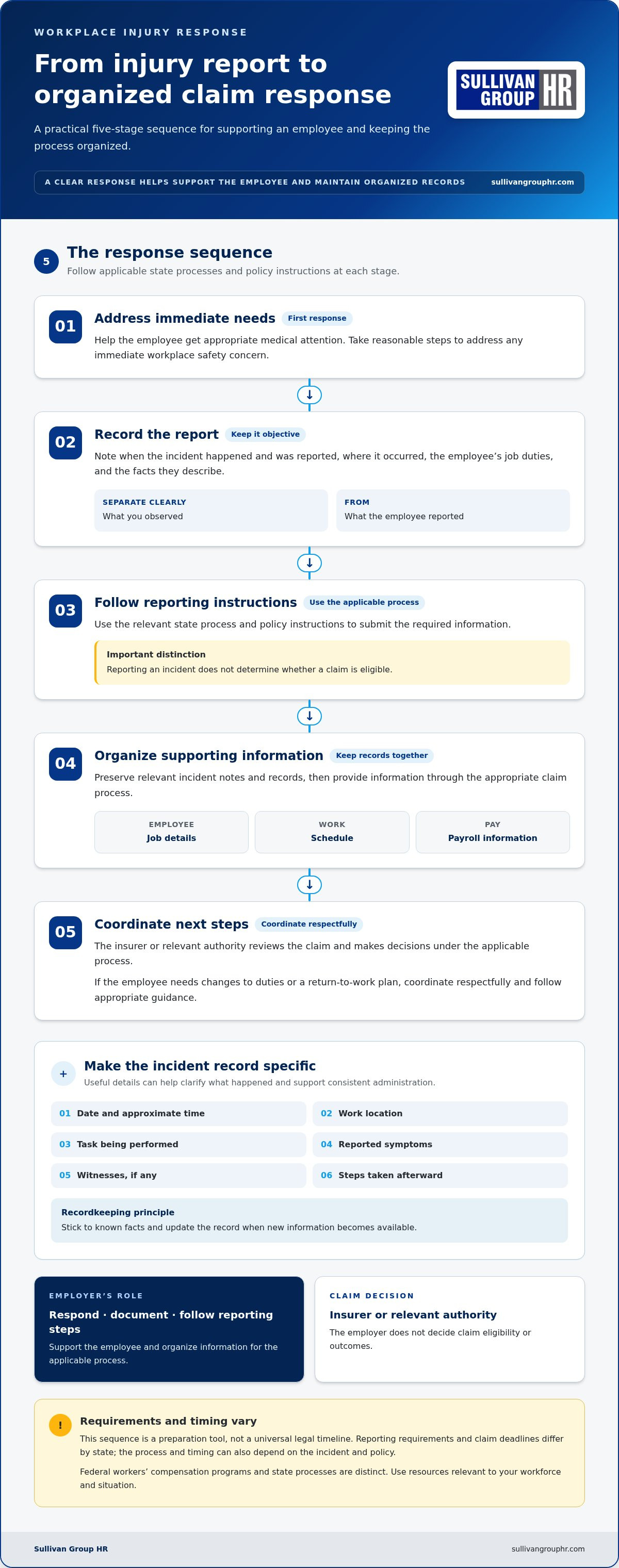
A clear response helps you support an employee and keep the claim process organized. The employer’s role is to respond, document, and follow applicable reporting steps. Claim decisions belong to the insurer or relevant authority, not the employer. The process and timing can depend on the incident, policy, and state rules.
A practical sequence after an injury
- Address immediate needs. Help the employee get appropriate medical attention and take reasonable steps to address any immediate workplace safety concern.
- Record the report. Note when the incident happened and was reported, where it occurred, the employee’s job duties, and the facts they describe. Keep the language objective, separating what you observed from what the employee reported.
- Follow reporting instructions. Use the applicable state process and policy instructions to submit the required information. Reporting an incident doesn’t determine whether a claim is eligible.
- Organize supporting information. Preserve relevant incident notes and records, such as the employee’s job details, schedule, and payroll information. Provide information through the appropriate claim process.
- Coordinate next steps. The insurer or relevant authority reviews the claim and makes decisions under the applicable process. If the employee needs changes to duties or a return-to-work plan, coordinate respectfully and follow appropriate guidance.
This sequence is a preparation tool, not a universal legal timeline. Reporting requirements and claim deadlines aren’t the same in every state. The U.S. Department of Labor’s Office of Workers’ Compensation Programs (OWCP) provides information about federal workers’ compensation programs and links to state resources. Federal programs and state processes are distinct, so use the resources relevant to your workforce and situation.
Why accurate records matter
Specific details help clarify what happened and support consistent administration. A report that says “injured during shift” may leave important questions unanswered. A more useful record can include the date and approximate time, work location, task being performed, reported symptoms, witnesses if any, and steps taken afterward. Stick to known facts and update the record when new information becomes available.
Keep job descriptions, work schedules, payroll details, and incident documentation organized in a secure process. Accurate payroll and job information can help explain the employee’s role and work circumstances during review. Limit access to sensitive employee information to people who need it for their responsibilities, and follow your organization’s record-handling practices.
Good records support administration, but they don’t guarantee approval, benefits, or a particular decision. Claim facts, policy terms, and the applicable state process guide those outcomes. For a small business, connecting workers comp insurance for small business with consistent HR and payroll practices can make it easier to assemble relevant information after an incident. Sullivan Group HR provides workers’ compensation insurance, payroll administration, and HR outsourcing. Learn about integrated HR and payroll support as part of your approach.
How small businesses should assess workers’ comp needs and state rules
There isn’t one nationwide checklist that settles every business’s workers’ compensation obligations. Requirements can depend on where work is performed, how the workforce is classified, the business structure, and the type of work. A business with employees in several states may need to review each jurisdiction separately, even if its main office is in one location.
Use the factors below to organize your review. They identify details to verify, not universal rules or answers.
| Factor | What to verify |
|---|---|
| Work location | Which state’s requirements may apply where each person performs work, including remote work locations. |
| Workforce classification | How the state treats employees, independent contractors, and other worker arrangements. |
| Ownership and business structure | Whether owners, officers, or members are treated differently under the relevant state’s rules. |
| Business activity | Whether the type of work or industry affects the requirements that apply. |
| State-specific details | Any thresholds, exceptions, or other conditions that may apply to this workforce and business. |
Which business details can affect coverage obligations?
Start with a current picture of who works for the business, what they do, and where they work. A worker’s title or contract label alone may not settle their legal classification; the applicable state rules and working arrangement matter. An owner’s role or the company’s structure may also affect how coverage is treated. Avoid relying on a rule that applies to a different state, industry, or workforce setup.
How can a business verify its state requirements?
Check current guidance from the workers’ compensation agency in every state connected to your operations. Look for information about covered worker categories, business activities, ownership, thresholds, exceptions, and any required process for obtaining coverage. Compare that guidance with your actual workforce and work locations. If a detail is unclear, use the agency’s official resources to identify the appropriate next step rather than assuming a rule applies.
Keep a state-by-state record of what you reviewed, the date, the agency source, and any follow-up needed. Revisit it when your workforce changes, you begin operating in another state, or job duties shift. This record helps your team distinguish verified requirements from assumptions and supports consistent administration.
Assessing workers comp insurance for small business is part of broader workforce risk planning. A wider HR risk management guide can put coverage questions in context alongside other people-related responsibilities. Focus on your specific operations, review each jurisdiction’s current guidance, and update your review as the business evolves.
How to prepare payroll and HR records for workers’ comp administration
Consistent records make workers’ compensation administration easier as your business changes. A new hire, a shift in job duties, or an employee working in a different location can affect the information your business needs to keep current. Instead of assembling details only when a request arrives, build small updates into regular HR and payroll routines.
Keep a practical record set that reflects how your business operates:
- Payroll information: Maintain accurate payroll records for the relevant periods, along with clear documentation of corrections.
- Employee details: Keep hiring dates, current roles, work locations, and job descriptions up to date.
- Workforce changes: Record role changes, departures, and shifts in work arrangements so employee information doesn’t become outdated.
- Incident documentation: Preserve relevant reports and supporting records when a workplace injury or illness is reported.
- Access practices: Store records securely and limit access to confidential employee information according to your organization’s practices.
Keep records current, not just complete
A file can contain plenty of information and still be difficult to use if it’s outdated or inconsistent. Set a regular review point to compare payroll details with employee roles and current work arrangements. Update records when a change occurs rather than waiting for an annual review. This gives your team a clearer, more consistent account of the workforce.
These practices support accurate business information and routine administration. They don’t determine policy terms, set premium calculations, or guarantee an insurer’s decision. Those matters depend on the applicable policy and the relevant insurer or authority. Treat recordkeeping as the foundation for providing clear information, not as a way to predict coverage or claim outcomes.
Coordinate HR and payroll workflows
HR and payroll often hold related details about hiring, job changes, work locations, and compensation records. Consistent processes for updating that information can reduce duplicate entry and make it easier to resolve mismatched details. If your payroll processes need broader support, the payroll administration outsourcing guide explores how businesses can approach that decision.
Sullivan Group HR provides payroll administration and workers’ compensation insurance, alongside HR outsourcing. Clients also access the isolved HCM platform for human capital management. The platform and human support can complement coordinated workflows, without changing policy terms or determining an insurer’s decisions.
For workers comp insurance for small business, make the review routine: update workforce details, reconcile payroll records, document relevant changes, and protect sensitive information. Sullivan Group HR connects payroll administration, HR outsourcing, and workers’ compensation insurance. Explore integrated HR and payroll support for your business.
How Sullivan Group HR supports small-business workers’ comp administration
Understanding coverage and state requirements is one part of the work. The day-to-day challenge is keeping workers’ compensation connected to HR and payroll activities that provide current information about your workforce. Sullivan Group HR brings workers’ compensation insurance, payroll administration, and HR outsourcing together, helping small businesses coordinate these responsibilities rather than manage them as separate concerns.
What does an integrated HR relationship bring together?
Workers’ compensation, payroll, and HR all relate to people and their work. Hiring, job changes, payroll updates, and workplace incidents can each prompt information updates or administrative tasks. Coordinated processes can help a business keep responsibilities visible and information consistent, while coverage terms and claim decisions remain with the applicable policy and decision-makers.
Sullivan Group HR has operated since 1998 and provides access to the isolved HCM platform for human capital management. Technology can support business processes, while human support helps keep the relationship grounded in your organization’s needs. The platform is part of the broader HCM relationship; this does not imply a specific workers’ compensation feature or claim outcome.
To prepare for a conversation about connected support, gather a current overview of:
- Your workforce, including roles, work locations, and recent changes.
- The payroll and HR processes your team currently manages.
- The states where employees perform work and the requirements you’ve reviewed.
- Areas where responsibilities or records are difficult to coordinate.
This overview can help clarify where your existing process works well and where better coordination may be useful. It doesn’t replace a review of applicable state requirements or policy terms. It gives you a grounded starting point for discussing how workers’ compensation insurance, payroll administration, and HR support fit your operations.
What is a practical next step for a small business?
Start with what you know: review your workforce, bring relevant records together, and note which state requirements apply to your operations. Then consider whether you have a manageable process for keeping HR and payroll information current. If those responsibilities are spread across separate workflows, an integrated relationship can connect related tasks and support.
For workers comp insurance for small business, coordination matters because coverage is only one part of the ongoing work. Sullivan Group HR combines workers’ compensation insurance with payroll administration and HR outsourcing, supported by access to isolved HCM. This connects people-focused responsibilities with everyday processes, without making assumptions about policy details or claim results.
If you’re looking for connected support, explore Sullivan Group HR’s services. Reviewing your workforce, records, and state obligations is a practical first step toward more manageable administration.
Make your next step a manageable one
Use your workers’ comp review to build a process that can keep pace with your business. As your team and operations change, decide who will update workforce records, revisit state requirements, and coordinate HR and payroll information. Clear ownership turns a complex responsibility into work your team can approach one step at a time.
Workers comp insurance for small business is easier to manage when it fits into the routines you already use to support employees and run payroll. Sullivan Group HR brings workers’ compensation insurance together with broader HR and payroll support, with clients accessing the isolved HCM platform as part of their human capital management relationship.
Ready to make those responsibilities more connected? Explore HR and workers’ compensation support for your business and take a practical step toward a coordinated approach. Clear processes and connected support can help you focus on your people and keep your business moving.
Frequently Asked Questions
Is workers’ comp insurance required for every small business?
Not necessarily. Workers’ compensation requirements are set through state-specific rules, and the answer can depend on where people work, how they’re classified, the business activity, and ownership structure. If your company has workers in more than one state, review each relevant state workers’ compensation agency’s guidance rather than relying on the rules for your main office. Revisit official guidance when operations or workforce arrangements change.
Can a small business operate without workers’ comp if it has only one employee?
Possibly, but one employee doesn’t produce the same answer everywhere. State rules may consider the worker’s classification, the kind of work, the employer’s structure, and other circumstances; exceptions also differ. Before deciding to go without coverage, identify the state or states where the employee works and review those agencies’ current workers’ compensation guidance. Headcount alone isn’t a reliable substitute for a jurisdiction-specific review.
How much does workers’ comp insurance cost for a small business?
There’s no single price that applies to every small business. The amount can depend on factors such as the work performed, payroll information, how roles are classified, policy terms, and the insurer’s rating approach. Treat estimates as business-specific, and keep employee duties and payroll details accurate when information is requested. State requirements and policy conditions also affect available coverage, so a general estimate may not reflect your situation.
What happens if an employee gets injured before a claim is filed?
If an employee is hurt before a claim is filed, respond to the injury first and report it promptly through the applicable process. Record when and where it happened, the employee’s account, and relevant work details, then preserve related records. Follow policy instructions and state reporting procedures, even if you’re unsure whether the event will qualify. The insurer or relevant authority reviews the claim, and timing depends on the applicable process.
Does workers’ comp cover an employee who gets sick because of work?
A work-related illness may qualify for workers’ compensation, but not every condition connected in time to a job is automatically covered. A claim must meet applicable requirements, and review may consider the connection to work, supporting information, policy terms, and state rules. Report the concern through the appropriate process and document relevant work details. The insurer or responsible authority determines how the specific claim is handled.
Are business owners and independent contractors covered by workers’ comp?
Owners and independent contractors aren’t treated identically in every jurisdiction. A state may consider business structure, the person’s actual working arrangement, and how that person is classified; a contract label alone may not settle the question. Review the rules where the work is performed, including provisions relevant to owners or officers. Don’t assume that a title, ownership stake, or contractor agreement automatically includes or excludes someone.
Can payroll records affect workers’ comp administration?
Yes. Payroll records help keep workforce and compensation information accurate for routine administration, information requests, and reviews. Missing payroll periods or inconsistent dates, for example, can make it harder to explain information associated with a policy period. Keep records current and organized, but remember they don’t set coverage terms or decide a claim. For workers comp insurance for small business, payroll data is an input, not the final coverage decision.


