
What if the next Department of Labor audit wasn't a source of panic, but a chance to prove your company's operational excellence? It's a bold question, especially when you're already juggling the overlapping demands of ERISA, COBRA, and the ACA. We understand the pressure. The fear of massive fines and the administrative burnout from manual tracking can make employee benefits compliance feel like an impossible hurdle. You deserve to protect your business, support your people, and secure your legacy without the constant weight of regulatory stress.
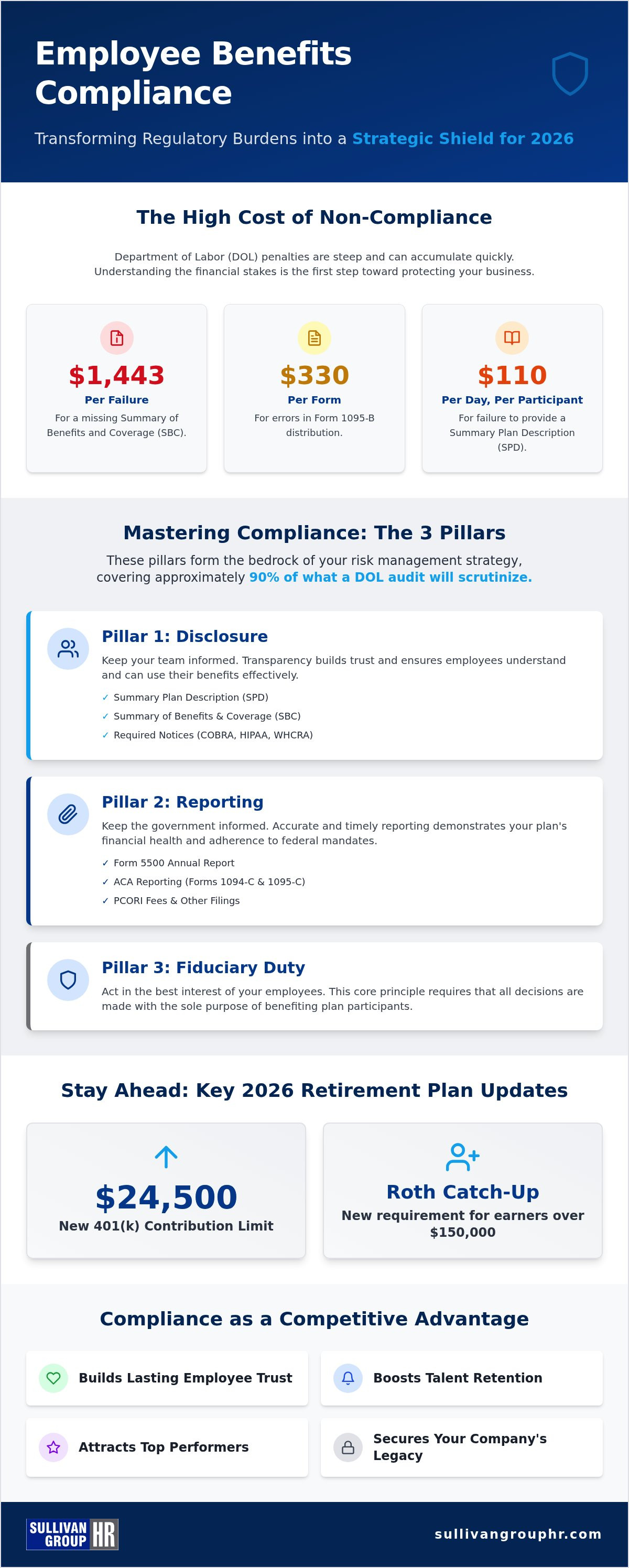
You don't have to manage these complexities in a vacuum. As your partner in professional growth, we're here to transform legal burdens into a strategic business shield. This guide breaks down essential 2026 updates, from the $24,500 401(k) contribution limit to the new Roth catch-up requirements for earners over $150,000. You'll discover how to streamline your internal processes, gain total peace of mind during an audit, and build the high level of employee trust that keeps your best talent exactly where they belong.
Key Takeaways
- Simplify the complex regulatory landscape by focusing on the three essential pillars: disclosure, reporting, and fiduciary duty.
- Learn how to conduct an internal compliance checkup to identify and fix common red flags before they trigger a costly DOL investigation.
- Transform employee benefits compliance from a stressful legal requirement into a strategic business shield that builds employee trust and long-term retention.
- Discover how the isolved HCM platform acts as a digital safety net, automating manual tracking to eliminate administrative burnout.
- Bridge the compliance gap as your business grows by partnering with established experts who handle the heavy lifting of federal and state regulations.
What is Employee Benefits Compliance and Why Does It Matter?
What exactly is employee benefits compliance? At its core, it's the disciplined adherence to federal and state laws that govern your employer-sponsored plans. This isn't just about following rules; it's about meeting the rigorous standards set by the Employee Benefits Security Administration (EBSA). These regulations, primarily rooted in the Employee Retirement Income Security Act of 1974 (ERISA), ensure that the promises you make to your team are kept. Compliance requires a commitment to accuracy, transparency, and consistency.
We believe compliance should be more than a defensive posture. Think of it as your "Compliance Shield." As a regional expert with a long history of local advocacy, we know that administrative burdens can feel overwhelming. This shield doesn't just block legal arrows; it protects your company's equity and the people who build it every day. When you shift your focus from merely avoiding fines to actively safeguarding your professional community, compliance becomes a cornerstone of modern business growth. It's about movement, safety, and results.
The True Cost of Non-Compliance in 2026
Ignoring the details can be expensive. In 2026, the financial stakes are higher than ever. Consider these specific Department of Labor (DOL) penalties. Failure to provide a Summary Plan Description (SPD) can cost up to $110 per day, per participant. Errors in Form 1095-B distribution can trigger fines of up to $330 per form. Missing a Summary of Benefits and Coverage (SBC) can result in penalties of $1,443 per failure. These numbers add up quickly.
Beyond these checks, you face the "hidden" costs of reputational damage. Trust evaporates. When employees feel their financial security is at risk, retention suffers. Utilizing comprehensive benefits management solutions helps you close these gaps before they become liabilities. It's about protecting your business, supporting your people, and securing your legacy.
Compliance as a Competitive Advantage
Why do some firms attract top talent effortlessly? They offer transparency and security. A compliant benefits plan tells your team that you value their future as much as their daily output. It creates a stable environment where long-term organizational security isn't just a goal, but a reality. By prioritizing regulatory rigor, you aren't just checking boxes; you're building a culture of advocacy and reliability. Employee benefits compliance is a strategic business asset that fuels growth, not a tax that hinders it.
The Three Pillars of Benefits Regulatory Rigor
You don't need to be a lawyer to master employee benefits compliance. You just need a reliable system. By organizing the regulatory chaos into three manageable categories, you can transform a daunting task into a streamlined process. These three pillars; Disclosure, Reporting, and Fiduciary Duty; form the bedrock of your HR risk management strategy. When you master these areas, you've already covered roughly 90% of what any Department of Labor audit will scrutinize. It's about creating a culture of safety and results rather than just reacting to deadlines.
Disclosure: Keeping Your Team Informed
Transparency builds trust. Disclosure ensures your employees understand exactly what they're getting and how to use their benefits. It starts with the Summary Plan Description (SPD). This is the definitive rulebook for your benefits, and it's not optional. You must also provide the Summary of Benefits and Coverage (SBC) to help employees compare plans easily. Finally, don't overlook specific required notices like those for COBRA, HIPAA, and the Women’s Health and Cancer Rights Act (WHCRA). Keeping your team informed isn't just a rule. It's a way to build a long-term relationship with your workforce.
Reporting: Keeping the Government Informed
Reporting keeps the government in the loop regarding your plan's health. The most critical piece is Form 5500. This annual report details your plan’s financial status and participation levels. Alongside this, ACA Reporting remains a top priority for 2026. You must accurately file 1094-C and 1095-C forms to prove you're meeting the employer mandate. Stay diligent about PCORI fees and other filing requirements to avoid the penalties mentioned in the previous section. If the paperwork feels like it's piling up, our Human Resources Consulting experts can help you audit your current files for accuracy.
Fiduciary Duty: Acting in the Best Interest
Fiduciary duty is your highest legal obligation. It requires you to act solely in the interest of your plan participants. This means making prudent decisions, managing plan expenses reasonably, and avoiding any conflicts of interest that could harm the plan. If you or your staff handle plan assets, you must maintain a fiduciary bond. This protects the plan from losses due to fraud or dishonesty. It's a protective measure that secures your company’s legacy. When you treat fiduciary duty as a commitment to your people, employee benefits compliance becomes a natural outcome of your leadership.
Audit Readiness: A Checklist for Peace of Mind
Audit letters arrive without warning. They don't care if you're busy. They only care if you're ready. Think of this section as a private coaching session for your business. We want to move you from a reactive scramble to a proactive state of total confidence. Achieving true employee benefits compliance requires more than just good intentions; it requires a documented trail of precision. By identifying red flags now, you secure your company's legacy and protect your people from unnecessary disruption.
Internal Document Review
Your paperwork is the first thing an investigator will scrutinize. It needs to be current, consistent, and complete. Start with these three focus areas: Documents, Delivery, and Data. This isn't about bureaucracy; it's about building a reliable advocacy for your team.
- Update your SPDs: Ensure your Summary Plan Descriptions reflect 2026 legislative changes. This includes the new $24,500 contribution limit for 401(k) plans and the mandatory Roth catch-up provisions for employees earning over $150,000.
- Verify Proof of Delivery: Can you prove every employee received their required notices? With the 2026 requirement to provide at least one paper benefit statement annually, having a clear opt-out or delivery log is essential for safety.
- Cross-Check Records: Ensure your payroll records perfectly match your benefits enrollment data. Discrepancies here often signal deeper administrative failures to an auditor and can lead to a more invasive investigation.
Operational Compliance Check
Operational errors often trigger investigations long before a formal audit begins. The Department of Labor looks for patterns of neglect in how you handle plan assets and timelines. Precision in these daily tasks is the hallmark of a healthy, stable organization. It's how you move from "surviving" to "thriving."
Review the timeliness of your 401(k) and health premium contributions. Are they deposited as soon as they can be reasonably segregated from general assets? You should also test your COBRA notification timeline. Terminated employees must receive their notices within strict federal windows to avoid the $110 per day penalties mentioned earlier. A single missed deadline can create a domino effect of liability that threatens your bottom line.
The number one trigger for a Department of Labor investigation is the late deposit of employee 401(k) contributions.
Proactive management ensures you never have to fear an inquiry. When your data is organized and your timelines are tight, you aren't just following the law. You're demonstrating a level of professional rigor that defines industry leaders. Employee benefits compliance doesn't have to be a manual burden if you have the right systems in place to catch these errors before they occur.
In-House vs. Outsourced: Navigating the Compliance Burden
Focus on your mission; let us focus on the mandates. This simple shift in perspective can be the difference between a business that thrives and one that buckles under administrative weight. As your company grows, you'll likely encounter the "Compliance Gap." This occurs when your organizational scale outpaces the capacity of your internal HR team. Managing employee benefits compliance manually isn't just exhausting; it's a high-stakes gamble with your company's future. You deserve a partner who provides the professional rigor and empathetic advocacy needed to bridge that gap safely.
The choice between in-house management and strategic outsourcing often comes down to three factors: Accuracy, Automation, and Advocacy. While a small team might handle ten employees with a spreadsheet, scaling to fifty or a hundred requires a different level of precision. Errors in data entry or missed filing windows don't just create extra work. They create liability. By utilizing payroll administration outsourcing, you ensure that your benefits data and payroll records are perfectly synchronized. This synchronization is your first line of defense against the audit triggers we discussed earlier.
The Risks of Manual Tracking
Spreadsheet fatigue is a silent threat to your bottom line. When your HR staff is buried in manual data entry, human error becomes inevitable. A "set it and forget it" strategy might work for a slow cooker, but it's dangerous for benefits. Regulations change. Deadlines shift. A single missed COBRA notice or a late 401(k) deposit can compound into exponential financial penalties that threaten your operational budget. We believe your team's time is better spent on talent acquisition and culture building than on chasing paper trails. If you feel overwhelmed by the complexity, it's time to explore our Human Resources Consulting services to regain your focus.
The Strategic Advantage of an HCM Platform
Why struggle with disconnected systems when you can have a unified digital safety net? Our isolved HCM platform serves as the digital backbone of your compliance strategy. It automates the entire reporting lifecycle, from tracking enrollment changes to generating ACA forms. This "People Cloud" concept connects your benefits, payroll, and time tracking into one cohesive stream of data. You gain real-time visibility into your compliance status at a glance. No more guessing. No more panic. Just the steady, reliable beat of a professional system designed to protect your legacy and support your people.
Sullivan Group HR: Your Ally in Benefits Excellence
Why carry the heavy weight of federal mandates alone? You built your business to innovate, lead, and serve your community. You didn't start it to get lost in the weeds of EBSA audits or ERISA filings. Sullivan Group HR positions itself as your expert coach and ally. We handle the heavy lifting of employee benefits compliance, allowing you to return your focus to your primary mission. With decades of hard-earned wisdom, we bring a "no-nonsense" authority to your benefits administration. We understand the specific nuances of our local territory and the national scale of federal law.
Our approach is built on a foundation of legacy and stability. We don't just offer software; we offer a partnership rooted in your success. This means providing a protective emotional style that fosters security for business owners who feel overwhelmed. We move you from administrative burnout to a state of reliable advocacy. Your professional potential is limitless when you aren't tethered to manual tracking and regulatory fear. It's time to embrace a system that prioritizes movement, safety, and results.
The isolved Advantage: Compliance Automated
The isolved HCM platform serves as the digital backbone of our service model. It acts as a safety net that catches errors before they become liabilities. Through isolved, we automate the preparation of Form 5500 and the complexities of ACA filing. This ensures your reporting is always on time and accurate. The system also provides seamless administration for COBRA, HSAs, and FSAs within a single, integrated environment. Employee self-service portals ensure that required disclosures, like SPDs and SBCs, are always accessible to your team. This automation eliminates the "spreadsheet fatigue" we discussed earlier and ensures your data is audit-ready at all times.
Expert Consulting: The Human Element
Technology is a powerful tool, but it cannot replace the human element of expert human resources consulting. We move beyond simple software to provide tailored guidance that fits your unique organizational culture. Our team helps you design benefits packages that meet both the needs of your employees and the strict demands of federal law. This empathetic partnership is what sets us apart from faceless, tech-only competitors. We offer the personalized touch and geographic expertise that larger national firms simply cannot replicate. We protect your business so you can grow it. Your legacy is safe with us.
Protect Your People and Your Potential
Are you ready to turn regulatory pressure into a strategic business shield? We've explored how mastering the three pillars of disclosure, reporting, and fiduciary duty protects your organization from the threat of massive fines. You now have the roadmap to move from the burnout of manual tracking to a streamlined, automated future. By choosing a system that prioritizes precision, you aren't just following rules; you're building a culture of advocacy and stability for your entire team.
Achieving total employee benefits compliance requires a blend of industry-leading technology and hard-earned wisdom. With our isolved HCM platform and decades of HR consulting expertise, we provide the digital safety net your business needs to thrive. We're here to handle the heavy lifting so you can focus on your mission and long-term growth. Don't let administrative burdens hold your organization back.
Secure your business with a comprehensive benefits compliance review from Sullivan Group HR. We provide comprehensive payroll and benefits management designed to keep your company safe and your legacy secure. Your future is waiting, and we're ready to help you protect it.
Frequently Asked Questions
What is the most common mistake employers make with benefits compliance?
The most common error is the late deposit of employee 401(k) contributions. The Department of Labor views these funds as belonging to the employee as soon as they can be reasonably segregated from your general assets. Even a delay of a few days can trigger an investigation. This simple administrative slip often serves as the "red flag" that leads to a much broader audit of your entire plan.
Does ERISA apply to small businesses with fewer than 50 employees?
Yes, ERISA applies to nearly all private-sector employers regardless of their size. Many small business owners mistakenly believe they're exempt because of their headcount. In reality, if you offer a retirement plan or most types of group health insurance, you must follow strict disclosure and fiduciary standards. Size doesn't change your legal obligation to protect your team's benefits and secure your company's legacy.
How often should an employer update their Summary Plan Description (SPD)?
You must provide a restated SPD every five years if you've made any changes to the plan. If no changes have occurred, you're required to provide a new one every ten years. However, you must issue a Summary of Material Modifications (SMM) whenever significant changes occur between these windows. Keeping your "rulebook" current is a cornerstone of employee benefits compliance and helps you avoid the $110 per day penalty for document failures.
What are the penalties for failing to file Form 5500 on time in 2026?
Penalties for late Form 5500 filings are steep and accumulate daily. While the specific rates adjust for inflation, the Department of Labor can impose fines that quickly exceed $2,500 per day for non-compliance. These costs can threaten your company's financial stability almost overnight. Utilizing an automated system ensures your financial health reports are submitted accurately and on time, protecting your bottom line from avoidable debt.
How does an HCM platform like isolved simplify benefits compliance?
An HCM platform like isolved acts as a digital safety net by connecting your payroll, time tracking, and benefits data. It automates the reporting lifecycle, ensuring that enrollment changes are captured in real-time. This eliminates the "spreadsheet fatigue" that leads to human error. You get a unified view of your status, making it easy to identify gaps before they become liabilities. It's about movement, safety, and results.
What is the difference between an EBSA audit and a regular IRS audit?
An EBSA audit focuses on fiduciary responsibility and the protection of plan assets. They want to ensure you're acting solely in the interest of your participants. A regular IRS audit is primarily concerned with the tax-qualified status of your plan and whether contribution limits are being followed. While their goals differ, a failure in one often leads to an inquiry from the other, making total rigor essential.
Are there specific 2026 changes to the Affordable Care Act (ACA) reporting?
In 2026, the penalties for failing to provide Form 1095-B to employees have reached $330 per form. There is also a continued mandate for electronic filing for almost all employers. Accuracy is non-negotiable, as the IRS uses this data to enforce the employer mandate. Staying on top of these thresholds is essential for maintaining your employee benefits compliance and avoiding stressful letters from the government.
Can Sullivan Group HR help if my business is already facing a DOL audit?
Yes, we provide expert human resources consulting to help you navigate active audits. We act as your advocate, helping you organize documentation and address any deficiencies identified by investigators. Our team understands the nuances of EBSA inquiries and can guide you through the correction process. We protect your business so you can stay focused on your professional potential and your team's long-term growth.


