
What if your workers' comp premium wasn't a fixed cost, but a variable you could actually control? Many business owners feel trapped by unpredictable spikes, but learning how to lower workers comp premiums starts with understanding that your data is just as important as your safety protocols. With the NCCI moving to three decimal places for rating values in 2026, every small detail in your payroll and claims management now carries more weight than ever before.
We know how exhausting it is to manage the complexity of Experience Mod ratings while facing the administrative burden of daily operations. You want a safer workplace and a healthier bottom line, but the path there often feels buried in jargon and bureaucracy. This guide provides the actionable strategies and data-driven insights you need to regain control over your insurance costs. We will walk through how to streamline your payroll data, utilize "Pay-As-You-Go" models to improve cash flow, and implement proactive risk management that keeps your team protected and your premiums low.
Key Takeaways
- Master the three pillars of premium costs—accurate payroll, precise class codes, and your Experience Mod rating—to identify exactly where your money goes.
- Understand how your Experience Modification Rate (EMR) serves as a financial report card and why managing it is the key to sustainable, long-term savings.
- Discover how to lower workers comp premiums by implementing a 24-hour reporting rule and a proactive return-to-work program that reduces claim severity.
- Transform your safety protocols from a compliance checklist into a high-ROI financial strategy that protects both your workforce and your bottom line.
- Leverage the power of integrated HCM technology to simplify reporting, automate payroll data, and protect your cash flow with flexible payment models.
Understanding the Workers’ Comp Premium Equation
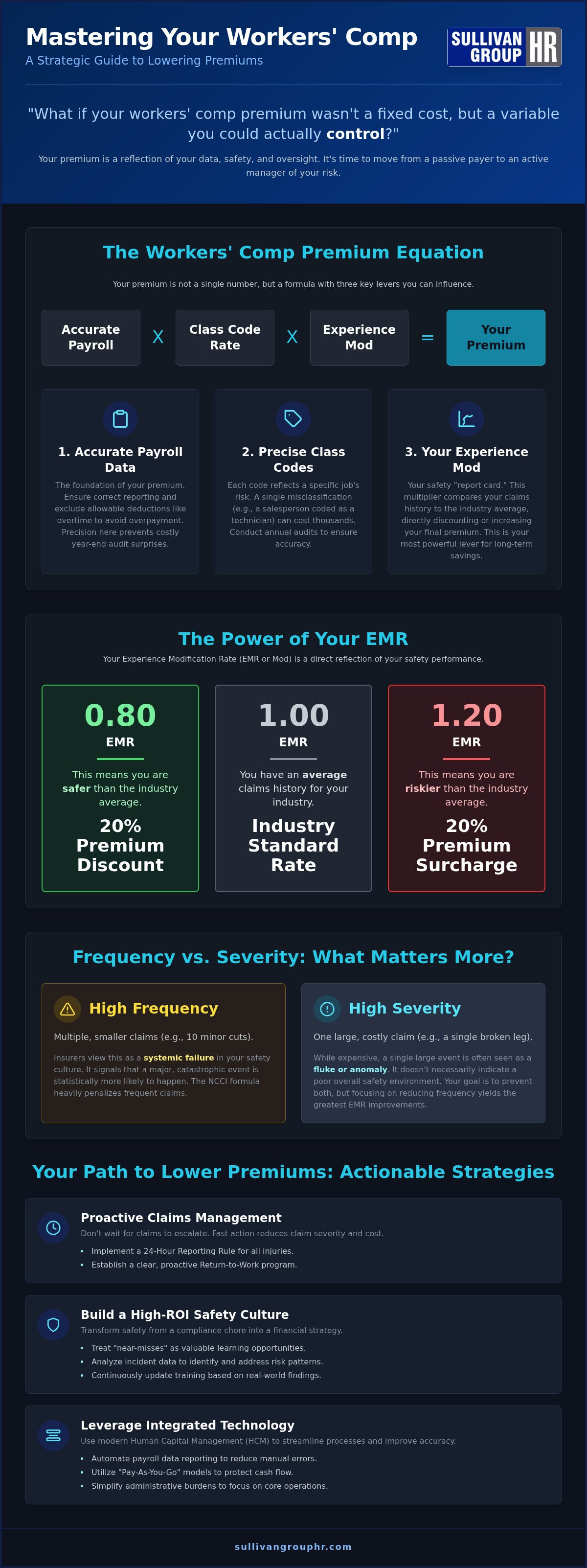
Do you view your insurance bill as an unavoidable tax? Many business owners do. However, Understanding Workers' Compensation reveals it's actually a variable business expense. It's one of the few costs you can actively influence through better data and safer practices. If you want to know how to lower workers comp premiums, you must first master the math behind the bill. Your premium isn't a random number pulled from thin air. It's a reflection of your business's risk profile and administrative accuracy.
The premium equation relies on three specific levers: payroll, classification codes, and your experience modification rating. While you can't change the base rates set by the state, you have full authority over how your team is classified and how safely they work. Think of it as a three-part strategy: accuracy, safety, and oversight. By focusing on what you can control, you move from a passive payer to an active manager of your risk. This shift in mindset transforms a sterile bureaucratic requirement into a tool for financial growth.
The Role of Payroll Classification Codes
Classification codes are the foundation of your premium. Each code represents the statistical risk of a specific job function. Do you know the difference between a code for clerical work and one for outside sales? These small numbers dictate your overhead. If your salesperson is accidentally coded as a technician, you're losing money every single pay period. This isn't just a paperwork issue; it's a direct leak in your profit margin.
Misclassification often happens during rapid growth or when job roles shift. A single digit error on a form can cost thousands. Regular payroll audits ensure every employee sits in the correct bucket. This precision protects your cash flow and ensures you aren't subsidizing higher-risk industries with your hard-earned revenue. We recommend reviewing these codes annually to catch discrepancies before they become expensive liabilities.
Annual Payroll: The Base of Your Premium
Your total remuneration serves as the base for your entire premium calculation. It's a simple volume game: the more you pay out, the higher the base. However, not all dollars are equal. In many jurisdictions, overtime pay and specific bonuses can be excluded or handled differently to prevent inflating your costs. If you report gross totals without stripping out these allowable deductions, you're overpaying.
Are you reporting your payroll correctly? Errors here lead to the dreaded year-end audit surprise where you owe a lump sum you didn't budget for. Consistent and accurate payroll reporting prevents year-end audit surprises and keeps your financial planning on track. When you align your payroll data with your insurance reporting, you gain a clearer picture of how to lower workers comp premiums through pure administrative efficiency. This level of detail ensures your insurance reflects the reality of your workforce, not an inflated estimate.
The Power of the Experience Modification Rate (EMR)
Is your business carrying a hidden tax? Your Experience Modification Rate, or "Mod," is essentially your safety report card. It's the multiplier that either discounts or inflates your premium based on your claims history. An average score is 1.0. If your Mod is 1.2, you're paying 20% more than your competitors. If it's 0.8, you're enjoying a 20% discount. This single number often dictates your ability to bid on contracts and grow your team. Understanding how to lower workers comp premiums requires a deep dive into this specific metric.
The math of the Mod compares your actual losses to the industry average for companies of your size. It isn't just about the total dollar amount spent on claims. It's about the patterns those claims reveal. High Mods act as a weight on your financial momentum, draining resources that could otherwise fund new equipment or better benefits. Managing this number is the most direct way to secure long-term savings.
Frequency vs. Severity: What Matters More?
Why does the insurance carrier care more about ten small cuts than one broken leg? Frequency signals a systemic failure in your safety culture. One large, fluke accident is seen as an anomaly. Ten small injuries suggest that a major catastrophe is just around the corner. The NCCI formula heavily penalizes frequent claims to encourage better oversight. According to Massachusetts government guidance, proactive education and return-to-work strategies are vital for controlling these recurring incidents.
- Identify near-misses: Treat every close call as a learning opportunity.
- Analyze patterns: Look for specific times, locations, or tasks where injuries occur.
- Update training: Refine your safety protocols based on real-world data.
Lowering Your Mod Over Time
Your Mod is calculated on a three-year rolling window. This means an injury today will follow your premium for three full years. It's a marathon, not a sprint. The safety decisions you make in 2026 will directly impact your overhead in 2028 and 2029. There's no quick fix, but there is a clear path forward. Consistent monitoring and HR risk management allow you to spot trends before they bake into your permanent rating.
Are you ready to stop overpaying? By integrating safety into your daily culture, you protect your people and your profits. If you need help deciphering your current rating, a partner in Workers’ Compensation Insurance can provide the clarity you need to move the needle. Start today, and you'll see the rewards in your future renewals.
Proactive Claims Management and Return-to-Work
Did you know the first 24 hours after an injury determine the trajectory of your entire claim? This "Golden Hour" is your best opportunity to contain costs and protect your employees. When you report an incident immediately, you set a professional tone and ensure the worker receives the right care at the right time. This speed is a foundational step in learning how to lower workers comp premiums. Delaying a report by even a week can lead to complications, higher medical bills, and increased administrative friction.
Establishing a relationship with a preferred occupational health clinic is another vital move. These specialized clinics understand the nuances of workplace injuries and prioritize recovery and return-to-work over open-ended treatment. Without this proactive oversight, claims can linger indefinitely. This often leads to "litigation creep," where confused or frustrated employees seek outside legal counsel. Clear, fast, and supportive action keeps the process in-house and under your control.
Implementing a Return-to-Work (RTW) Program
Transitional duty is a major financial win for any organization. By creating a library of light-duty job descriptions before an injury occurs, you keep your employees productive. This reduces "indemnity" costs, which are the payments made for lost wages that drive up your Mod rating. Beyond the numbers, keeping a worker connected to the team prevents the psychological isolation that often delays recovery. It's about maintaining a sense of purpose while they heal.
Effective Communication with Injured Workers
Silence is the biggest driver of attorney involvement in workers' compensation. If an employee feels ignored or discarded, they're significantly more likely to call a lawyer. You must train your supervisors to handle injury reports with empathy, professionalism, and speed. A standardized reporting process ensures no steps are missed and that the employee feels supported throughout their recovery. Using strategies for reducing workers' compensation costs helps you build a framework that minimizes friction. A standardized reporting process ensures care begins instantly, which can reduce the total duration of a claim by up to 30% according to industry benchmarks.
Unlike traditional insurance models, we believe claims management shouldn't exist in a silo. By integrating your safety efforts with your isolved HCM platform, you can document incidents in real-time. This ensures your payroll administration and insurance data remain perfectly synced. This level of visibility is essential for any business owner serious about how to lower workers comp premiums through better administrative control and empathetic leadership.
Safety Culture as a Financial Strategy
Is safety a box you check or a value you live? For many business owners, safety feels like a burden of rules and regulations. If you want to know how to lower workers comp premiums, you must view safety as a core financial strategy. Investing in a safety-first mindset isn't just about avoiding fines. It's about protecting your most valuable asset: your people. This shift reduces the frequency of claims, which is the primary driver of high Mod ratings. When safety becomes part of your DNA, your premium naturally reflects that stability.
The ROI of safety training is undeniable. You spend pennies on training today to save thousands on premiums tomorrow. Regular safety audits serve as your early warning system. They identify trip hazards, faulty equipment, or poor ergonomics before an injury occurs. With the NCCI moving to three decimal places for rating values in 2026, even minor improvements in your safety data can lead to measurable savings. Many states also offer specific financial incentives for proactive programs. For example, implementing a certified drug-free workplace program can secure state-mandated premium discounts, directly padding your bottom line.
The Role of Professional HR Consulting
Building a culture of safety requires more than just a poster in the breakroom. It requires structure and expertise. This is where human resources management services become indispensable. Experts help you build robust safety handbooks that are actually readable and relevant to your specific industry. They help you standardize "toolbox talks," which are short, focused safety meetings that keep risk top-of-mind for every department. With OSHA 2026 requirements becoming more precise, having an ally to monitor new regulations keeps you ahead of the curve and out of the penalty box.
Incentivizing Safety at the Employee Level
How do you get your team to care as much as you do? You celebrate the wins. Designing reward programs for accident-free milestones creates a collective sense of pride and accountability. However, these programs must be handled with care. Employees should feel empowered to report hazards or near-misses without fear of retribution. When workers are engaged and feel their safety is a priority, accident rates naturally drop. High engagement leads to fewer distractions and more careful work, which is exactly how to lower workers comp premiums over the long term.
Ready to build a safer, more profitable business? Our team provides the expert Human Resources Consulting you need to turn compliance into a competitive advantage.
The Sullivan Group Advantage: Integrating HCM and Risk
Why should your insurance and your payroll live in two different worlds? Many business owners struggle with disconnected systems that lead to data gaps, missed reporting, and inflated costs. If you've been searching for how to lower workers comp premiums, the answer often lies in the synergy between your technology and your risk strategy. By integrating these functions, you move from a reactive stance to a position of total administrative control. This unified approach transforms your back-office operations into a shield for your bottom line.
The isolved HCM platform serves as the bridge between your daily operations and your workers' comp reporting. It ensures that every dollar of payroll is matched accurately to the correct classification codes in real time. This level of precision is vital for maintaining a healthy cash flow. Through a "Pay-As-You-Go" model, your premium payments are calculated based on actual payroll rather than annual estimates. This eliminates the need for large upfront deposits and keeps your capital where it belongs: working for your business.
Choosing payroll administration outsourcing with a risk-management focus provides a level of security that automated, tech-only firms can't match. We don't just process checks; we act as your protective partner. This collaboration ensures that your safety culture, claims management, and payroll data work in harmony to drive down your Experience Mod over time.
Eliminating Audit Surprises with isolved
Does the annual insurance audit fill you with dread? It shouldn't. Real-time data tracking through isolved prevents the painful year-end "catch-up" payments that catch so many entrepreneurs off guard. Because your data is always current, the audit becomes a simple verification rather than a financial crisis. Additionally, integrated time and attendance data provides a concrete paper trail. This documentation is essential for defending against fraudulent claims and ensuring your human capital management strategy is backed by verifiable facts. Precision, clarity, and reliability are the hallmarks of a well-managed risk profile.
Customized Risk Consulting
Every business faces a unique set of challenges. We provide personalized Mod analysis to identify the specific cost drivers behind your premiums. Are your costs rising due to claim frequency, or is a single large event the culprit? We help you peel back the layers of your data to find the truth. This support isn't a one-time service; it's an ongoing partnership that evolves as your workforce grows. We stay by your side to navigate the shifting NCCI regulations of 2026 and beyond, ensuring you always know exactly how to lower workers comp premiums through smarter management.
Ready to take the next step toward a more secure future? Protect your business and lower your premiums with Sullivan Group HR. Let's build a strategy that values your people and protects your profits.
Take Control of Your Workers’ Comp Future
You now have the roadmap to move from administrative uncertainty to total financial control. Realizing how to lower workers comp premiums is about more than just finding a cheaper policy. It requires a commitment to data accuracy, a proactive safety culture, and a streamlined claims process. By mastering these three pillars, you protect your most valuable asset: your people. You also secure the long-term health of your bottom line.
We believe in a protective partnership that balances professional rigor with empathetic support. Our team brings decades of experience in workforce risk management to every client relationship. We combine expert HR consulting with access to the industry-leading isolved HCM platform to ensure your payroll and insurance data remain perfectly synchronized. This integration eliminates audit stress and provides the clarity you need to grow with confidence.
Ready to see where your business stands? Get a Comprehensive Risk Assessment from Sullivan Group HR today. You have the potential to transform your workplace safety and your profitability. We're here to help you lead the way.
Frequently Asked Questions
What is the Experience Modification Rate (EMR) and how does it affect my premium?
The Experience Modification Rate (EMR) is a multiplier that adjusts your premium based on your specific claims history. If your business has fewer accidents than the industry average, your Mod drops below 1.0, resulting in a discount. Conversely, a higher than average accident rate pushes the Mod above 1.0, acting as a surcharge. It essentially functions as a financial report card that rewards or penalizes your safety performance.
Can I really lower my workers’ comp costs if I am in a high-risk industry?
You can absolutely reduce costs even in high-risk sectors by outperforming your industry peers. Since premiums are calculated relative to others in your classification, maintaining a superior safety record gives you a competitive edge. Implementing rigorous training and return-to-work programs is a proven method for how to lower workers comp premiums. It's about being the safest operator in your specific field to earn the lowest possible rates.
How often should I review my employee classification codes?
You should review your employee classification codes at least once a year or whenever a job description changes significantly. Misclassification is a common administrative error that leads to substantial overpayment. For instance, if an office worker is accidentally coded as a field technician, your premium will be unnecessarily high. Regular reviews ensure your insurance costs accurately reflect the actual risk levels of your current workforce.
What are the benefits of a Pay-As-You-Go workers’ comp plan?
A Pay-As-You-Go plan bases your premium payments on actual, real-time payroll data rather than annual estimates. This model eliminates the need for large upfront deposits and protects your business from the sticker shock of year-end audit adjustments. It creates a more predictable cash flow and ensures you only pay for the coverage you're currently using. This is especially helpful for businesses with seasonal or fluctuating staff levels.
Does having a safety manual actually lower my insurance rates?
A safety manual serves as the structural foundation for reducing your insurance costs over time. While the manual itself might not trigger an immediate discount, the safer behaviors it enforces lead to fewer claims and a lower Experience Mod. Some states also offer specific premium credits for businesses that maintain a formal, written safety program. It's a proactive investment that pays dividends through long-term premium reductions.
How long does a workplace injury stay on my company’s record?
Workplace injuries typically remain on your Experience Mod record for a three-year rolling window. The NCCI and most state bureaus look at your claims from the three previous years, excluding the most recent year, to calculate your current rating. This means a claim filed in 2026 will generally influence your premiums until 2030. Consistent safety efforts are required to maintain a low rating as older claims eventually drop off.
What is the most common mistake businesses make during a workers’ comp audit?
The most frequent mistake is failing to separate overtime pay and specific bonuses from regular wages. Many businesses report gross payroll figures, but insurance carriers often allow you to exclude the overtime premium portion of pay. If you don't provide a clear breakdown during the audit, you'll end up paying insurance premiums on dollars that shouldn't be counted. Proper record-keeping is the only way to prevent these expensive oversights.
How does an HCM platform like isolved help with workers’ comp management?
An HCM platform like isolved synchronizes your payroll administration with your workers' comp reporting to ensure total data accuracy. This integration is a powerful tool for how to lower workers comp premiums because it automates the classification process and tracks employee changes in real time. It provides a single source of truth for both HR and insurance, making audits faster and significantly reducing the risk of administrative errors.


