
What if the greatest risk to your business isn't a market shift, but the manual "copy-paste" happening between your time clocks and your bank files? You likely started your company to build something meaningful, not to spend your nights untangling double data entry or stressing over overtime math. It's frustrating when fragmented systems create friction, and we agree that your time is better spent on strategy than on spreadsheets. Integrating time tracking with payroll isn't just a technical upgrade; it's a strategic shield for your organization.
In this guide, you'll discover how a unified approach eliminates manual errors, ensures absolute compliance with 2026 labor laws, and empowers your workforce to reach its full potential. We will walk through the steps to protect your business from audits, empower your HR team by reducing administrative burdens, and grow your professional potential through seamless data flow. From the first punch-in to the final paycheck, it's time to make your payroll process work as hard as you do.
Key Takeaways
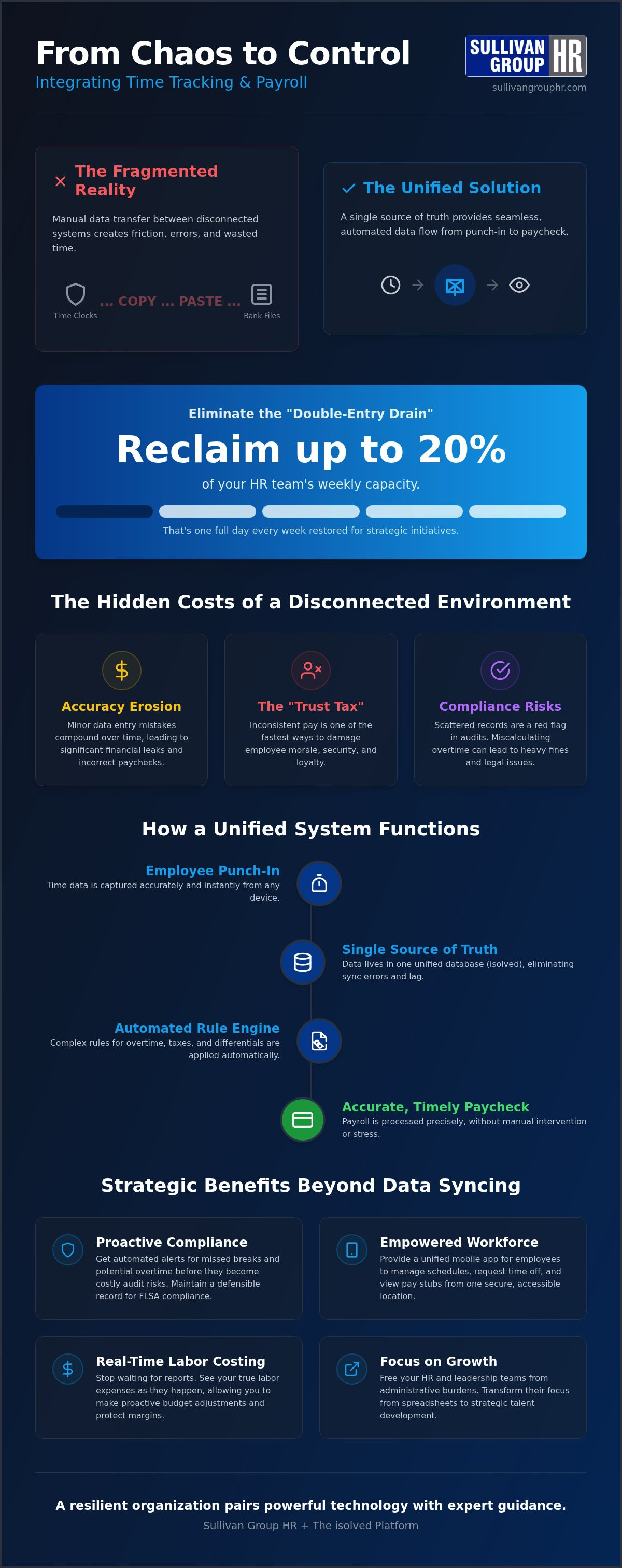
- Reclaim up to 20% of your HR team’s weekly capacity by eliminating the "Double-Entry Drain" caused by fragmented data systems.
- Transition from disconnected apps to a single source of truth by integrating time tracking with payroll through a unified HCM platform.
- Protect your organization with proactive compliance alerts that flag missing breaks and potential overtime before they become costly audit risks.
- Empower your workforce with unified mobile access, allowing team members to manage schedules and view pay stubs in one secure, accessible location.
- Discover why pairing the industry-leading isolved platform with expert HR consulting creates a more resilient and human-centric organization.
The Hidden Costs of Fragmented Time and Payroll Systems
Running a business shouldn't feel like a constant battle against your own data. When your timekeeping and payroll systems don't talk to each other, you're stuck in the "Double-Entry Drain." Industry reports suggest that manual data transfer can waste up to 20% of your HR team's weekly capacity. That's one full day every week lost to typing numbers from one screen to another. This isn't just an administrative annoyance; it's a barrier to growth that keeps your leaders anchored to spreadsheets instead of strategy.
Beyond the wasted time, there's the compounding impact of "Accuracy Erosion." A small error of ten minutes here or a missed decimal there might seem minor in isolation. However, these discrepancies add up over a fiscal year, leading to significant financial leaks. Even worse is the "Trust Tax." When an employee's paycheck is wrong, even by a few dollars, it damages their sense of security. Inconsistent pay is one of the fastest ways to lose your best talent to a competitor who has their systems in order.
The Administrative Burden of Manual Entry
Does your HR manager dread "Payroll Tuesday"? The psychological impact of payroll day stress is real. Verifying paper timesheets and chasing down managers for missing signatures takes hours that should be spent on talent development. Manual systems often work when you have ten employees, but they fail to scale once you cross the 50-employee mark. Integrating time tracking with payroll removes this bottleneck, allowing your team to focus on people instead of punch cards. It transforms a high-stress chore into a background process that runs with precision.
Compliance Risks in a Disconnected Environment
Disconnected systems are a massive red flag for Department of Labor audits. If your records are scattered across spreadsheets and paper logs, you lack a defensible trail for FLSA compliance. Miscalculating overtime across different pay periods is a common trap that leads to heavy fines and legal headaches. By implementing payroll automation, you create a permanent digital record that protects your legacy. Managing these details is a core part of HR Risk Management: A Comprehensive Guide for any business looking to stay secure in 2026. Integrating time tracking with payroll ensures that every hour worked is accounted for, taxed correctly, and documented for any potential inquiry. This unified approach doesn't just save time; it provides the peace of mind that comes from knowing your business is protected, your employees are empowered, and your organization is ready to grow.
How Unified Time Tracking and Payroll Integration Functions
What does it actually mean to have a unified system? True integration isn't just a technical handshake between two different software vendors. It is the automated, real-time flow of labor data directly into your gross-to-net payroll engine. Integrating time tracking with payroll removes the "hand-off" between systems that often leads to errors. When you stop "linking apps" and start using a single source of truth, you eliminate the friction that slows your business down. This unified approach transforms raw hours into finished paychecks without a single manual touchpoint.
Think about the precision required for tax compliance. As an employee clocks in, the system already knows their specific tax jurisdiction. This data triggers precise local, state, and federal withholdings instantly. You also gain the power of real-time labor costing. Why wait until the end of the month to see if you went over budget? You can see your true expenses before the pay period even closes. This allows you to make proactive adjustments that protect your margins and your peace of mind.
The Architecture of a Single Database
The secret to this efficiency is the underlying architecture. We leverage the isolved platform because it utilizes a single database for all your human capital management needs. Many multi-vendor setups rely on APIs that often experience "sync errors" or data lag. With isolved, there is no lag because the data lives in one place. Employee profiles connect time, pay, and benefits automatically. When a new hire is onboarded, their time tracking profile is ready to go. This ensures you meet federal recordkeeping requirements without ever having to audit two separate lists or reconcile conflicting records.
Automating Complex Pay Rules
Complexity shouldn't be a hurdle for your professional potential. A unified system handles shift differentials and holiday pay without manual overrides. If your team works across state lines, the system manages multi-state payroll requirements based on exactly where the work was performed. Integrating time tracking with payroll creates a flow that is built to protect, empower, and grow. You protect your compliance, empower your managers with data, and grow your bottom line by reducing waste. This level of automation is why many businesses choose payroll administration outsourcing to ensure every detail is handled by experts. If you're ready to see how this looks for your company, we can help you tailor a solution for your workforce.
Strategic Benefits: Beyond Simple Data Syncing
What if your payroll system did more than just cut checks? What if it actually fueled your company culture? While the technical sync is vital, the true power of integrating time tracking with payroll lies in the strategic advantages it offers your leadership team. It moves your business from a defensive posture to a proactive one. When data flows without friction, you gain the clarity needed to protect your margins, empower your people, and grow your legacy.
Financial precision becomes a reality when labor data is accurate to the minute. Since labor is often a business owner's largest expense, seeing these costs in real-time allows for sharper cash flow forecasting. You stop guessing and start knowing. Additionally, the system provides a layer of proactive compliance. Instead of discovering a violation weeks later, system alerts flag potential overtime or missing breaks as they happen. This real-time visibility turns audit readiness from a high-stress crisis into a three-minute report. It simplifies the complex, secures the vulnerable, and strengthens the entire organization.
Empowering Your Workforce through Self-Service
Trust is the foundation of a high-performing team. By providing mobile punch-ins and digital timesheet approvals, you increase individual accountability and transparency. Employees appreciate having instant access to their own time and pay history without waiting for an HR response. This shift significantly reduces administrative inquiries, allowing your team to focus on higher-value work. For a deeper look at balancing these tools with a human touch, explore The 2026 Guide to Workforce Management Solutions. It's about giving your people the tools they need to succeed.
The Strategic Value of Labor Analytics
When you unify your data, payroll evolves from a cost center into a data center. You can identify "burnout zones" where specific departments are consistently overextended. Are your actual labor hours aligning with your project budgets? Integrated analytics allow you to compare these figures in real-time rather than waiting for a post-mortem analysis. This level of insight helps you identify understaffed areas before they impact your client experience. It's about using your history to protect your future. By integrating time tracking with payroll, you aren't just moving numbers; you're gaining the wisdom to lead your team with confidence and care.
Key Features to Look for in an Integrated HCM Platform
How do you choose a technology platform that grows alongside your ambition? Selecting the right tools isn't just about checking boxes; it's about securing your organization's future. When you're integrating time tracking with payroll, the goal is to create a frictionless experience that protects your margins and empowers your team. A platform that is too complex will be ignored, while one that is too simple will leave you vulnerable to compliance gaps. You need a solution that balances functional power with human-centric design.
The following features are essential for any growth-minded business in 2026:
- Unified Mobile Access: Your team should be able to clock in, request time off, and view their pay stubs within a single, secure application. This eliminates the "app fatigue" that often leads to missing data.
- Advanced Scheduling: Look for systems that automatically flag scheduling conflicts or potential overtime before the shift even begins. This allows for proactive adjustments rather than reactive corrections.
- Geofencing and GPS: With over 52% of remote-capable employees working in a hybrid model as of 2026, location-aware tracking ensures accuracy for your field-based or remote staff.
- Scalability: Your platform must be as ambitious as you are. Ensure it can support your journey from 20 employees to 200 without requiring a total system overhaul or data migration.
Essential Compliance and Security Features
Security is the bedrock of professional trust. A robust system must provide comprehensive audit trails that track every single change made to a timesheet. You need to know exactly who made an adjustment, when it happened, and why. This level of transparency is vital for protecting your business during a Department of Labor inquiry. Additionally, your sensitive payroll information should be housed in a secure cloud environment with high-level encryption. Since labor laws are shifting rapidly, your platform should provide automated updates for new tax codes and state-level minimum wage requirements. This ensures you never fall behind as regulations evolve.
User Experience for Managers and Staff
A tool is only effective if your people actually use it. This is where intuitive design meets functional power. Managers need clean dashboards that highlight "actions needed" immediately, such as pending time-off requests or unapproved hours. One-click approvals for weekly timesheets can save hours of administrative frustration every month. A "clean" interface ensures high adoption rates across your entire workforce, from the front office to the warehouse. Integrating time tracking with payroll should feel like a natural extension of your workday, not an extra burden. If you're ready to see how these features can transform your operations, you can explore our isolved HCM solutions today.
Why a Partnered Approach to Integration Outperforms Software Alone
Have you ever bought a piece of high-end equipment only to realize you didn't have the training to use it effectively? This is the "Software Trap." Many business owners believe that simply purchasing a platform for integrating time tracking with payroll will solve their administrative headaches overnight. However, even the best tools fail without proper configuration. Technology is a powerful engine, but it still needs a skilled driver to navigate the specific regulatory turns of your industry. A "set it and forget it" mentality often leads to compliance gaps that only surface during a costly audit.
We believe in the Sullivan Advantage. This means pairing the industry-leading isolved platform with our deep bench of human expertise. We don't just hand you a login and walk away. We act as your professional advocates. We understand your business goals, your local territory, and your team's specific needs. This isn't just about a one-time setup; it's about continuous optimization. As labor laws change and your company evolves, your integration must adapt to keep you safe and efficient. We ensure your technology reflects your actual operations, not just a generic template.
The Human Element in Human Capital Management
Tech-only solutions often lead to high frustration and low utilization. When a system flags an error, you don't need a chatbot; you need a partner who understands the nuances of your payroll. A dedicated HR consultant provides a second set of eyes, reviewing your data for red flags before they become liabilities. This level of support is a core component of What is HR Outsourcing? The 2026 Strategic Guide. We bridge the gap between automated efficiency and human wisdom, ensuring your employees feel valued and your records remain defensible.
Your Roadmap to Integration Success
Transitioning from manual processes to automated systems shouldn't cost you a single hour of productivity. Our approach is built on a reliable framework: Assess, Implement, Support, and Protect. We start by understanding your current workflow. Then, we implement a tailored version of isolved that fits your culture. We stay by your side with ongoing support to ensure you are always protected. Integrating time tracking with payroll is the final step in securing your organizational security. It allows you to move away from the "Double-Entry Drain" and toward your true professional potential.
Ready to stop wrestling with spreadsheets and start leading with confidence? Secure your business today with a unified solution that values your people as much as your profits. Let's build a future where your administrative burden is replaced by strategic growth. Reach out to see how a partnered approach can transform your payroll from a chore into a competitive advantage.
Secure Your Business and Empower Your Growth
Are you ready to move from administrative friction to strategic flow? We've explored how the "Double-Entry Drain" stalls your progress and why unified data acts as a shield against regulatory risk. By integrating time tracking with payroll, you aren't just buying software; you're building a foundation for sustainable growth. You protect your margins, empower your managers, and grow your workforce's true potential. This unified approach ensures that your team stays focused on what matters most: your mission.
Technology is the tool, but partnership is the solution. As an authorized isolved HCM provider with over 25 years of HR expertise, we understand that your business is more than just a series of data points. We apply our comprehensive Protect, Empower, Grow framework to ensure your systems work for your people, not the other way around. Our regional expertise serves as a localized handshake, providing the personalized touch that national firms simply cannot replicate.
It's time to reclaim your schedule and lead your company with the confidence you deserve. We're here to help you every step of the way.
Frequently Asked Questions
What are the main benefits of integrating time tracking with payroll?
The primary benefits are the elimination of manual errors, enhanced compliance, and real-time visibility into labor costs. When these systems work together, you protect your business from financial leaks and empower your leadership with accurate data. This unified approach allows you to grow your professional potential by shifting your focus from administrative chores to strategic business goals.
Does integrating time tracking reduce payroll processing time?
Yes, integration slashes processing time by removing the need for manual data transfer and reconciliation. Instead of spending hours on double-entry and chasing down missing timesheets, your HR team can finalize payroll in a fraction of the time. This efficiency reduces the administrative burden on your staff and ensures that your team stays productive and focused on growth.
How does time and payroll integration help with compliance?
Integration safeguards your business by creating a single, defensible digital record for every hour worked. Integrating time tracking with payroll ensures that overtime is calculated automatically and accurately based on actual hours, which is vital for FLSA compliance. This proactive approach protects your organization from costly Department of Labor audits and provides the security of knowing your records are audit-ready.
Can integrated systems handle remote or multi-state employees?
Yes, unified platforms are built to manage the complexities of a hybrid or multi-state workforce. Advanced systems use GPS and geofencing to track location-aware time for remote teams, ensuring that the correct local and state tax withholdings are applied automatically. This level of precision is essential for modern businesses navigating the diverse regulatory landscape of 2026 across different geographic territories.
Is it difficult to switch from manual time tracking to an integrated HCM platform?
Switching is a straightforward process when you work with a partner who handles the technical heavy lifting. We follow a structured approach to assess your needs, implement the technology, and support your team through the transition. Most business owners find that the temporary adjustment period is quickly outweighed by the long-term reduction in stress, errors, and administrative friction.
What should I look for in a time tracking and payroll provider?
You should prioritize a provider that offers a single source of truth rather than a patchwork of different vendors. Look for a partner who provides both the industry-leading technology and the human expertise needed to configure it correctly. A reliable authority who understands your local nuances can offer a level of protective advocacy that automated, tech-only firms simply cannot match.
How does integrated time tracking prevent 'time theft'?
Integrated systems stop time theft by replacing honor-system paper logs with secure, location-verified digital punches. Integrating time tracking with payroll ensures that compensation is tied directly to verified data, which prevents "buddy punching" and inaccurate reporting. This transparency protects your financial health while ensuring that every employee is paid fairly and accurately for the work they actually perform.
Will my employees find it difficult to use an integrated time tracking app?
Most employees find modern time tracking apps very intuitive and easy to navigate. They can typically clock in, request time off, and view their pay stubs with just a few taps on their smartphones. This self-service model empowers your workforce by providing instant access to their own information, which leads to higher engagement and significantly fewer basic inquiries for your HR team.


