
Is your business prepared for a $20,000 penalty for a single AI compliance error? With the Colorado AI Act taking effect on June 30, 2026, the cost of "business as usual" has never been higher. You've likely felt the weight of shifting multi-state labor laws and the exhaustion of manual administrative tasks. It's overwhelming to keep pace with New York's $17.00 minimum wage or the sunsetting "right to cure" periods in Delaware and Montana. Conducting a thorough hr risk assessment is the first step toward reclaiming your peace of mind and protecting your professional potential.
We believe that navigating these complexities shouldn't feel like a solo mission. This guide will show you how to identify hidden workforce liabilities and implement a protective framework that secures your business growth. We'll preview the "Identify. Assess. Protect." framework to help you achieve total regulatory compliance, reduce litigation risk, and streamline your administrative workflows. It's time to move from reactive fixes to a proactive strategy that values your people over systems.
Key Takeaways
- Understand why a "wait and see" approach to compliance is a dangerous gamble that invites costly DOL audits and legal penalties.
- Learn how to execute a strategic hr risk assessment by auditing your current policies and mapping every stage of the employee lifecycle.
- Identify the four critical zones of workforce risk, from shifting regulatory requirements to the operational dangers of fragmented data systems.
- Strengthen your defense by standardizing disciplinary procedures and implementing automated workforce management solutions to eliminate manual errors.
- Discover how the "Identify. Assess. Protect." framework uses the isolved HCM platform to provide a unified source of truth for your business security.
Defining the Stakes: Why HR Risk Assessment Matters in 2026
What if your most valuable asset is also your greatest liability? An hr risk assessment is more than just a defensive audit. It's a proactive evaluation of people-related vulnerabilities that could stall your momentum. In its simplest form, a Risk assessment identifies where your business is exposed, evaluates the potential impact, and creates a roadmap for safety. Right now, a "wait and see" approach is a high-stakes gamble that few businesses can afford to lose.
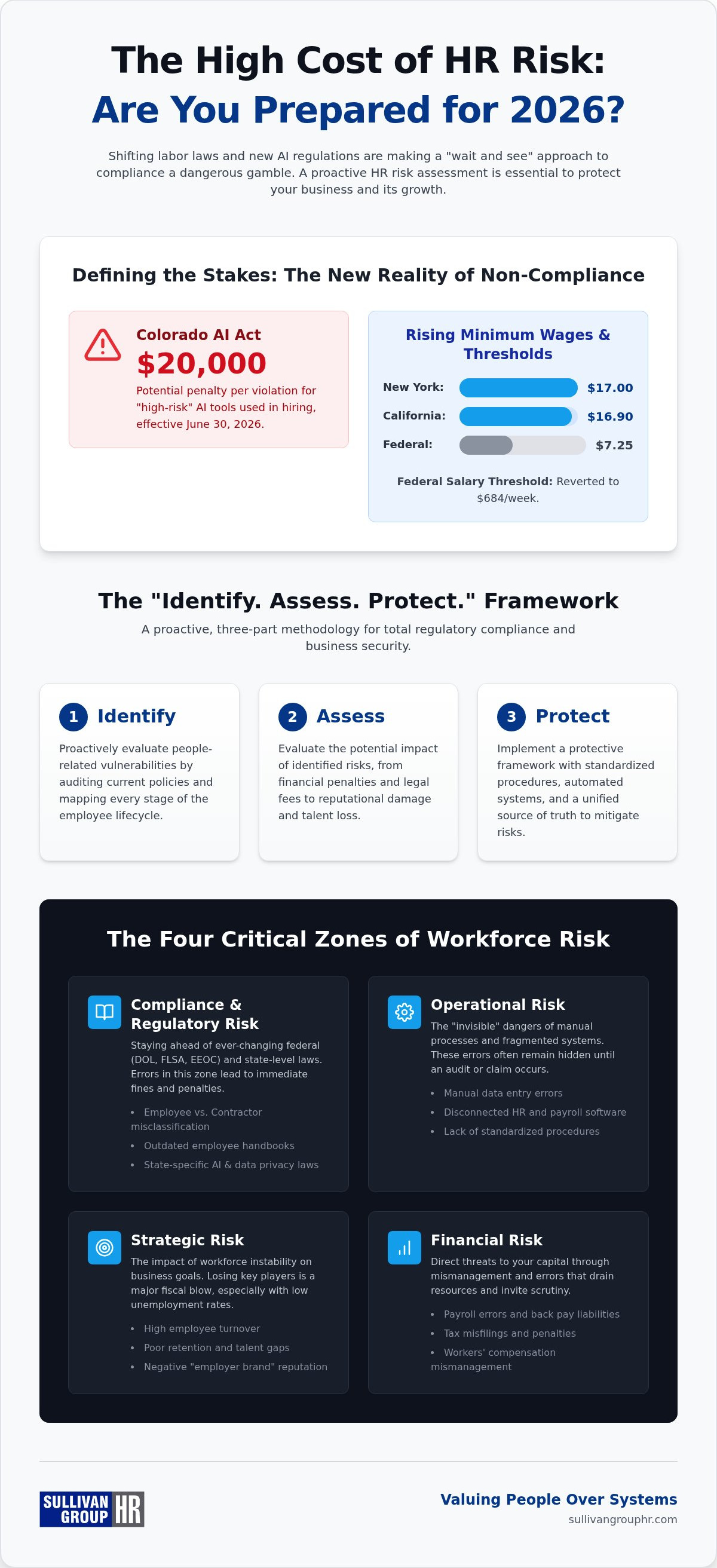
2026 marks a major turning point for employers. Federal salary thresholds have reverted to $684 per week, while states like California and New York have pushed minimum wages to $16.90 and $17.00 respectively. Simultaneously, new regulations like the Colorado AI Act impose steep penalties of up to $20,000 per violation for "high-risk" AI tools used in hiring. To manage this complexity, we utilize a signature three-part framework: Identify, Assess, and Protect. This methodology ensures your business model is built on a foundation of stability rather than shifting sand.
The Financial Reality of Non-Compliance
The cost of non-compliance is rarely a single number. It's a compounding debt of legal fees, back pay, and regulatory fines. Wage and hour violations are particularly punishing in 2026, as enforcement agencies focus on misclassification and overtime errors. Beyond the immediate check you write to the Department of Labor, there's the hidden cost of reputational damage. A poor "employer brand" makes talent acquisition more expensive and drives up turnover rates. Investing in robust human capital management isn't just an administrative choice; it's a commitment to fiscal security. It ensures every dollar spent on your workforce is protected from avoidable litigation.
Aspirational Growth vs. Administrative Burden
Is your HR infrastructure scaling as fast as your sales? Many entrepreneurs find that as their revenue climbs, their manual processes become a bottleneck. Fragmented systems and manual data entry are the leading causes of "invisible" risk. These errors often remain hidden until a DOL audit or a wrongful discharge claim brings them to light. Transitioning from a transactional vendor to a strategic HR partner allows you to offload these burdens. We help you move away from reactive fixes toward a streamlined, automated approach. This shift protects your growth and allows you to focus on your professional potential without the constant fear of a compliance oversight. We value people over systems, and a proper assessment ensures your systems finally support your people.
Identifying the Four Critical Zones of Workforce Risk
Categorizing your vulnerabilities is the only way to build a reliable defense. When we conduct an hr risk assessment, we look at four distinct zones that determine your business's health. By grouping these vulnerabilities, we turn a mountain of administrative worry into a manageable checklist. This focused approach ensures that no detail, from a missing I-9 signature to a misapplied overtime rule, slips through the cracks. It's about creating a "source of truth" that protects your growth and your people simultaneously.
- Compliance and Regulatory Risk: This involves staying ahead of the FLSA and Department of Labor. It's the most visible zone, where errors lead to immediate fines.
- Operational Risk: These are the dangers of manual data entry and fragmented HR systems. When your software doesn't talk to your payroll, mistakes are inevitable.
- Strategic Risk: This covers the impact of talent gaps and poor retention. With a 4.4% national unemployment rate in early 2026, losing a key player is a major fiscal blow.
- Financial Risk: This zone includes payroll errors, tax misfilings, and workers compensation mismanagement that drain your capital.
Compliance: The Ever-Moving Target
In 2026, the regulatory landscape is shifting under your feet. One of the most common pitfalls is independent contractor vs employee misclassification. Federal agencies are cracking down on this, and a single mistake can trigger years of back-tax liabilities. Furthermore, "standard" employee handbooks often fail the 2026 test because they don't account for new state-level AI transparency laws in Illinois or data privacy rights in California. Beyond the paperwork, your culture matters too. Following EEOC guidance on preventing workplace harassment is a critical component of your hr risk assessment that protects your reputation and your bottom line.
Operational and Financial Vulnerabilities
Manual processes are the leading cause of "invisible" risk. If you're still using spreadsheets to track hours, you're inviting wage-theft claims and payroll inaccuracies. Utilizing payroll administration outsourcing eliminates the risk of tax penalties by ensuring every filing is accurate and on time. This operational efficiency extends to employee benefits compliance, where the ACA affordability threshold has hit 9.96% for 2026. When these systems are integrated, your financial risk drops significantly. If you're feeling overwhelmed by these moving parts, our team offers expert HR consulting to help you audit these zones and build a proactive defense.
How to Execute a Strategic HR Risk Assessment Framework
How do you turn a list of potential fears into a concrete plan of action? Executing a strategic hr risk assessment requires a disciplined, five-step approach that moves your business from chaos to clarity. It isn't enough to simply know that risks exist. You must understand their weight, their likelihood, and their specific path to your bottom line. We use a systematic process to help you identify, assess, and protect your professional potential.
- Step 1: Audit Policies. Conduct a comprehensive review of every handbook, offer letter, and internal policy to ensure they meet 2026 standards.
- Step 2: Map the Lifecycle. Trace the employee journey from recruitment to exit to find friction points where data might leak or compliance might fail.
- Step 3: Quantify the Risk. Assign a score to each vulnerability based on its probability and potential financial impact.
- Step 4: Evaluate Tech. Determine if your current HCM technology is acting as a shield or a sieve for your sensitive data.
- Step 5: Prioritize Remediation. Focus your resources on "high-impact" vulnerabilities that pose the greatest threat to your stability.
Auditing Your Administrative Infrastructure
Your "Hire to Retire" workflow is the backbone of your organization. When we audit this infrastructure, we look for gaps in documentation that invite litigation. This includes assessing the security of your applicant tracking and onboarding data to prevent breaches. We also verify the accuracy of your workers compensation classifications. Misclassifying even a few employees can lead to significant premium adjustments and penalties during an audit. A clean administrative trail is your best defense against the unexpected.
The Probability vs. Impact Matrix
Not every risk deserves equal attention. By using a probability versus impact matrix, you can score risks to focus your limited resources effectively. This allows you to identify "low-hanging fruit," such as updating an outdated poster or fixing a payroll rounding error, for immediate risk reduction. High-probability, high-impact risks like wage-theft allegations or data privacy violations must be addressed first. By presenting a quantified risk report to your leadership, you can demonstrate the exact ROI of compliance and secure the budget needed to modernize your HR operations. This data-driven approach transforms HR from a cost center into a guardian of business growth.
Mitigation and Beyond: Building a Proactive Defense Strategy
What happens after you've uncovered your vulnerabilities? Identifying a problem is only the beginning. To truly secure your business, you must move from awareness to action. Building a proactive defense strategy ensures that your hr risk assessment results in lasting protection rather than just a dusty report. We focus on three pillars of mitigation: technology, process, and people. By strengthening these areas, you transform your organization from a target into a fortress. This is the "Protect" phase of our framework, where we turn insights into operational security.
Automation as a Risk Mitigator
Why take chances with manual data entry? Implementing automated workforce management solutions is the most effective way to eliminate human error. "All-in-one" platforms are inherently safer than "best-of-breed" silos because they remove the need for risky data transfers between disconnected software. When your payroll, time-tracking, and benefits live in one house, your risk profile drops instantly. Shifting data accuracy to the source through employee self-service ensures that personal information is correct from day one. You can also automate compliance alerts for certification and training expirations, so you're never caught off guard during an audit.
Beyond digital data, physical security is a key component of operational risk management; if you are looking to budget for modernizing your facility's access control, you can explore Project-based installation and deployment fees options from Sullivan Tech Solutions to ensure your onsite hardware is as secure as your digital records.
Cultivating a Culture of Compliance
Standardizing termination and disciplinary procedures is your primary defense against wrongful discharge claims. A clear, documented path for employee relations protects your business from inconsistent decision-making. Enhancing your broader HR risk management strategy requires continuous training for your leadership team. Moving beyond the handbook is essential; active policy communication ensures everyone knows the rules of the road. Training managers to recognize and report risks before they escalate is vital for a healthy culture. Additionally, leveraging strategic benefits management helps improve retention, which lowers the strategic risk of losing your best talent. Remember that insurance like workers compensation and EPLI serve as essential safety nets, but they shouldn't be your only line of defense.
Ready to build your proactive defense? Partner with Sullivan Group HR to implement the isolved HCM platform and secure your business growth today.
Scaling with Security: The Sullivan Group HR Advantage
Are you ready to stop worrying about what you might have missed? A one-time hr risk assessment is a great start, but true security comes from a continuous, technology-driven strategy. Most guides treat risk management as a single event on a calendar. We view it as a living process that evolves alongside your company. By partnering with Sullivan Group HR, you gain more than just a service provider. You gain an advocate that combines hard-earned regional wisdom with the industry's most powerful workforce technology. We help you move from a state of constant caution to a position of confident growth.
The Power of the isolved Platform
In a landscape defined by shifting multi-state laws and strict data privacy requirements, fragmented systems are your biggest liability. Our integrated approach centers on the isolved HCM platform, which serves as your unified "source of truth" for all risk data. This isn't just about storing files; it's about active protection. The platform provides real-time analytics that allow you to spot turnover trends and compliance red flags before they become crises. It offers:
- Audit-Ready Records: Secure, cloud-based document storage ensures your I-9s, payroll data, and training logs are always ready for inspection.
- Financial Precision: By streamlining payroll and benefits into a single system, we eliminate the manual hand-offs that lead to tax penalties and misfilings.
- Proactive Alerts: Automated workflows notify your team of expiring certifications or upcoming regulatory deadlines, keeping you one step ahead of the Department of Labor.
Your Strategic Partner in Growth
Technology is a powerful tool, but it's most effective when guided by human expertise. Our partnership provides you with access to fractional HR experts who understand the specific nuances of your industry and territory. Whether you're navigating the complexities of New York's minimum wage hikes or Illinois's AI transparency laws, we provide the national expertise needed to scale across state lines with ease. We take the "no-nonsense" approach to compliance, handling the dense administrative burden so you can focus on your professional potential. Sullivan Group HR acts as the protective shield that allows your business to grow without the constant fear of regulatory or administrative failure. We believe in a legacy of stability, ensuring that as your headcount rises, your risk profile stays low. Together, we can build an organization that is secure, compliant, and ready for whatever 2026 brings.
Secure Your Future: Moving From Vulnerability to Growth
Protecting your business in 2026 requires more than just checking boxes. It's about building a foundation that handles the weight of your aspirations. By identifying your critical risk zones and implementing a proactive hr risk assessment, you've already taken the first step toward long-term security. You've seen how manual errors and fragmented systems can stall your momentum. Now, it's time to replace those "invisible" risks with a unified strategy that values your people over administrative systems.
Our integrated approach combines national compliance expertise with the industry-leading isolved HCM platform. This provides a total source of truth for your HR, payroll, and benefits, ensuring you're always audit-ready. You don't have to navigate these complexities alone. We're here to act as your ally and shield, allowing you to focus on building your legacy with confidence.
Ready to secure your business? Schedule your HR risk assessment with Sullivan Group HR today.
Your professional potential is limitless when you have the right partner by your side. We look forward to helping you grow with peace of mind.
Frequently Asked Questions
What is an HR risk assessment?
An hr risk assessment is a proactive evaluation of your organization's people-related vulnerabilities. This process identifies potential legal, operational, and financial threats before they escalate into costly crises. By examining everything from hiring practices to data security, you create a protective shield for your growth. It's about moving from a reactive stance to one of confident stability and reliable advocacy for your workforce.
How often should my business perform an HR risk audit?
You should perform a comprehensive review at least once a year. However, with the rapid pace of regulatory changes in 2026, quarterly "pulse checks" are becoming the industry standard for high-growth firms. Significant events like expanding into a new state or implementing AI in hiring should trigger an immediate assessment. Staying current ensures your administrative infrastructure remains a foundation for success, not a bottleneck.
What are the most common HR risks for businesses in 2026?
The top risks include AI compliance errors, wage and hour misclassifications, and data privacy violations. New laws like the Colorado AI Act have created steep penalties of up to $20,000 for transparency failures. Additionally, navigating the $17.00 minimum wage in New York or the $16.90 rate in California requires precise payroll management. Are your current systems ready to handle these localized handshake requirements without failing?
Can an HCM platform like isolved help reduce my legal liability?
Yes, the isolved HCM platform acts as your primary defense against data breaches and compliance errors. It provides a unified "source of truth" that eliminates the manual data entry errors found in fragmented systems. By automating tax filings, certification tracking, and I-9 storage, the platform ensures you are always audit-ready. It turns administrative burdens into organized, secure workflows that protect your professional potential.
What is the difference between an HR audit and an HR risk assessment?
An HR audit typically looks backward to ensure current compliance with existing laws. In contrast, an hr risk assessment is a strategic, forward-looking evaluation of potential future threats. While an audit checks the boxes, an assessment evaluates the probability and impact of risks like talent gaps or shifting labor laws. It's the difference between reviewing a map and predicting the weather to ensure safe passage.
How does an HR risk assessment impact workers compensation premiums?
A thorough assessment identifies employee misclassifications that lead to premium overpayments or audit penalties. By reviewing your safety protocols and incident reporting, you can lower your experience modifier (MOD) score over time. Accurate data management ensures you aren't paying for risks you don't actually have. This process is a direct way to protect your capital while securing your workforce through integrated payroll and insurance management.
What legal regulations are typically covered in a comprehensive HR assessment?
A comprehensive assessment covers federal standards like the FLSA, EEOC, and ACA, along with a complex patchwork of state-specific mandates. In 2026, this includes the California Delete Act, Colorado's high-risk AI tool obligations, and the federal EAP salary threshold. We examine your policies against these requirements to ensure total regulatory compliance. This protective approach fosters a sense of security for business owners who feel overwhelmed by administrative burdens.
How do I start an HR risk assessment if we do not have an in-house HR team?
You don't need an internal department to secure your business. You can start by partnering with an established regional expert for human resources consulting. We provide the fractional expertise and industry-leading technology needed to identify your vulnerabilities. This collaborative approach gives you the protection of a large-firm HR team without the overhead. It allows you to focus on your core business goals while we handle the rigor of compliance.


