
What if the biggest threat to your workers' comp costs isn't the injury itself, but what happens in the first 24 hours after it occurs? That's a question most employers never ask until they're staring down an OSHA audit, a ballooning premium, or a lawsuit that could have been avoided with better documentation.
You already know workplace injuries are stressful. The chaos in those first moments, the fear of doing something wrong, the confusion over which form goes where and which deadline applies to your state versus federal requirements, it's a lot to manage when someone on your team is hurting. Those feelings are completely valid, and you're far from alone in feeling them.
This guide exists to cut through that confusion. By mastering workers comp incident reporting best practices, you'll walk away with a clear, repeatable response plan that protects your employees, reduces your litigation exposure, and keeps your documentation tight enough to withstand regulatory scrutiny. We'll cover the critical steps to take immediately after an incident, how to navigate reporting timelines, and how integrating your incident data with your HR and payroll systems can transform a reactive headache into a proactive advantage.
Key Takeaways
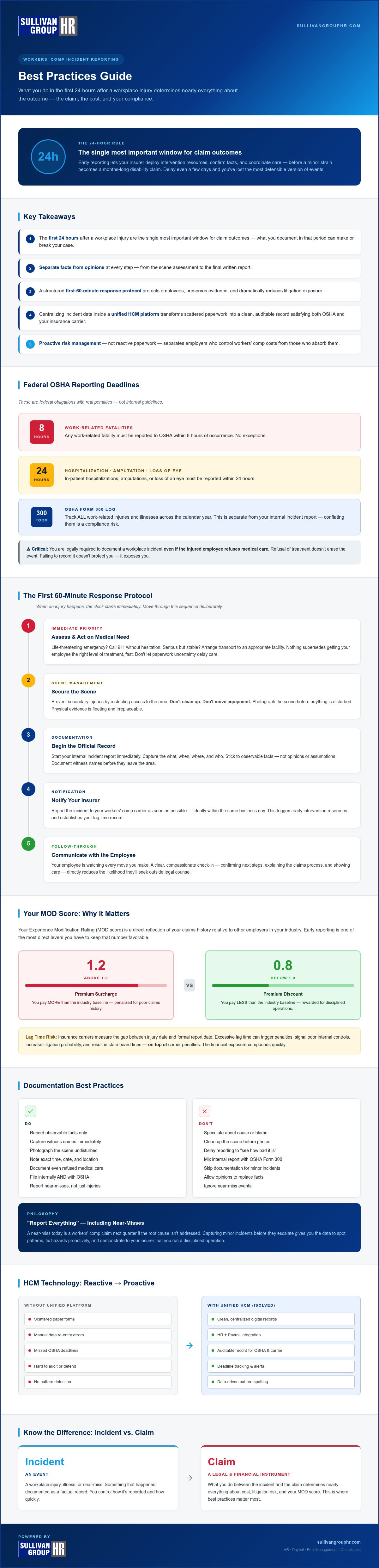
- The first 24 hours after a workplace injury are the single most important window for claim outcomes — what you do (and document) in that period can make or break your case.
- Following workers comp incident reporting best practices means separating facts from opinions at every step, from the scene assessment to the final written report.
- A structured first-60-minute response protocol protects your employees, preserves critical evidence, and dramatically reduces your litigation exposure.
- Centralizing incident data inside a unified HCM platform like isolved transforms scattered paperwork into a clean, auditable record that satisfies both OSHA and your insurance carrier.
- Proactive risk management — not reactive paperwork — is what separates employers who control their workers' comp costs from those who don't.
The Strategic Importance of Prompt Incident Reporting
Incident reporting is the formal process of documenting any workplace injury, illness, or near-miss event through an official record that captures what happened, when, where, and who was involved. That definition sounds straightforward. In practice, most employers blur a critical line: the difference between an incident and a claim. An incident is an event. A claim is a legal and financial instrument. What you do between those two moments determines nearly everything about the outcome.
The 24-Hour Rule exists because of that gap. Evidence degrades fast. Witness memories shift. Injury severity gets reframed. When a report is filed within the first day, your insurer can deploy early intervention resources, confirm the facts on the ground, and begin coordinating care before a minor strain becomes a months-long disability claim. Delay that report by even a few days, and you've already lost the most defensible version of events.
This is where workers comp incident reporting best practices separate employers who control their costs from those who absorb them.
Protecting Your Bottom Line and MOD Score
Your Experience Modification Rating (MOD score) is a direct reflection of your claims history relative to other employers in your industry. Every claim that drags on longer than necessary, because of a late report, missing documentation, or a delayed treatment referral, pushes that number higher. A MOD score above 1.0 means you're paying a surcharge on your workers' comp premium. Below 1.0, you earn a discount. Early reporting is one of the most direct levers you have to keep that number favorable.
Insurance carriers also assess what's called "lag time," the gap between the injury date and the date your organization formally reported it. Excessive lag time can trigger penalties, signal poor internal controls to your carrier, and increase the likelihood that a claim escalates to litigation. Some state boards impose their own late-filing consequences on top of carrier penalties. The financial exposure compounds quickly.
Adopt a "Report Everything" philosophy. A near-miss today is a workers' comp claim next quarter if the root cause isn't addressed. Capturing minor incidents before they escalate gives you the data to spot patterns, fix hazards proactively, and demonstrate to your insurer that you run a disciplined operation.
Legal Compliance and OSHA Requirements
Internal documentation and OSHA recordkeeping are not the same thing, and conflating them is a compliance risk. Your internal incident report is your operational record. OSHA's Form 300 log is a regulatory requirement for covered employers, tracking work-related injuries and illnesses across the calendar year.
For serious incidents, federal timelines are strict. Work-related fatalities must be reported to OSHA within 8 hours. In-patient hospitalizations, amputations, or loss of an eye must be reported within 24 hours. These aren't internal deadlines; they're federal obligations with real penalties for non-compliance.
One point that trips up many employers: you are legally required to document a workplace incident even if the injured employee refuses medical care. Refusal of treatment doesn't erase the event, and failing to record it doesn't protect you. It exposes you.
Following workers comp incident reporting best practices means treating documentation as a protective act, not a punitive one. Your records are your defense, your data, and your roadmap for doing better.
Immediate Response Protocols: The First 60 Minutes
When an injury happens, the clock starts immediately. Not the OSHA clock. Not the insurance clock. The human clock. Your employee is scared, possibly in pain, and watching every move you make. How your team responds in the next 60 minutes shapes everything that follows: the medical outcome, the claim trajectory, and whether that employee ever considers calling an attorney.
The sequence matters. Move through it deliberately.
First: assess and act on medical need. Is this a life-threatening emergency? Call 911 without hesitation. Is it serious but stable? Arrange transport to an appropriate facility. Don't let uncertainty about paperwork delay care. Nothing in workers comp incident reporting best practices supersedes getting your employee the right level of treatment, fast.
Second: secure the scene. Once emergency care is underway, prevent secondary injuries by restricting access to the area. Don't clean up. Don't move equipment. Photograph the scene before anything changes. Physical evidence degrades within hours, and a clear photo taken at 9:14 a.m. is worth more in a dispute than a dozen witness statements taken a week later.
Third: start your internal notification chain. Within the first hour, the supervisor should contact HR, a safety officer if your organization has one, and your workers' compensation insurance carrier or third-party administrator. Waiting until the end of the shift isn't a minor oversight; it's the kind of lag time that triggers carrier scrutiny and inflates claim costs.
Empathy-First Communication Strategies
Here's where most incident response protocols fall completely flat: they skip the human part. Train your supervisors to ask "Are you okay?" before they ask "What happened?" That sequence isn't just compassionate; it's strategic. Employees who feel genuinely supported in the immediate aftermath of an injury are significantly less likely to seek outside legal counsel. Attorney involvement typically increases claim costs and duration. Empathy is a risk management tool.
Provide the injured employee with a simple "Next Steps" one-sheet before they leave the scene or the facility. It should outline what to expect from the claims process, who their point of contact is, and how to reach someone with questions. Anxiety about the unknown drives employees toward attorneys. Clear communication closes that gap before it opens.
Managing Medical Triage and Care
For non-emergency situations, telephonic nurse triage services offer a fast, cost-effective first assessment. A registered nurse can evaluate the injury by phone, recommend the appropriate level of care, and document that initial clinical interaction, all before the employee ever reaches a facility. This step alone can prevent unnecessary emergency room visits for injuries that are better handled at an urgent care clinic.
Where state law permits, direct employees to your network's preferred providers. Make sure the treating provider knows upfront that this is a workers' compensation case; it affects billing, documentation, and the return-to-work planning that starts on day one of treatment. Providers who aren't informed of the workers' comp context sometimes create documentation gaps that complicate claims later.
Getting these protocols right is exactly the kind of operational detail that separates employers who manage their risk from those who react to it. If your team needs a structured framework for building this response plan, Sullivan Group HR's workers' compensation consulting services can help you build one that holds up under pressure.
Documentation and Investigation Best Practices
The incident report you file today is the evidence you'll defend tomorrow. Whether you're facing a carrier audit, an OSHA inspection, or a disputed claim, that document will either protect you or expose you. The difference comes down to one discipline: recording what happened, not what you think caused it.
This is the Fact-Only Rule, and it's the foundation of workers comp incident reporting best practices. Train every manager to write observations, not interpretations. "Employee was found on the floor near the loading dock" is a fact. "Employee slipped because he was rushing" is an opinion. Opinions invite arguments. Facts build cases. The moment a supervisor editorializes in a report, they've handed opposing counsel a gift.
Witness statements carry the same risk. Collect them within the first two hours while accounts are still independent and unfiltered. Separate witnesses before they speak to each other. Give each person a blank statement form and ask them to describe only what they personally saw or heard. When accounts conflict, document both versions without reconciling them. Your job isn't to decide who's right at the reporting stage; it's to capture the full picture accurately. A report that acknowledges conflicting accounts looks thorough. One that ignores them looks manipulated.
Photo and video documentation should be systematic, not random. At the scene, capture:
- Wide-angle shots establishing the full environment and layout
- Close-ups of any equipment, tools, or surfaces directly involved
- Any warning signs present, or their absence
- Lighting conditions, floor surfaces, and any environmental factors
- Timestamps embedded in the file metadata, which are more defensible than handwritten notes
The Anatomy of a Bulletproof Incident Report
A complete incident report captures the exact time and date, precise location within the facility, equipment or materials involved, the specific body part affected, and the sequence of events as described by the injured employee in their own words. Vague entries like "back injury in warehouse" create gaps that adjusters and attorneys will fill with assumptions. Specificity closes those gaps before they form. Every field on that form is a data point that either strengthens your position or weakens it. A clean, timestamped digital record stored inside a unified HCM platform like isolved creates the kind of auditable paper trail that satisfies both your insurance carrier and OSHA's recordkeeping requirements simultaneously.
Post-Incident Accident Investigation
Filing the report is step one. Understanding why the incident happened is what separates reactive employers from those building a genuine HR risk management strategy. The 5 Whys method is a practical tool for any investigation. Start with the injury event and ask "why" five times in sequence, with each answer prompting the next question. An employee strained their shoulder. Why? They were lifting a heavy box alone. Why? No team-lift protocol was in place. Why? The procedure hadn't been updated after a workflow change. That's your root cause, and it's fixable.
Distinguish between unsafe acts and unsafe conditions. An unsafe act is a behavior choice; an unsafe condition is a systemic failure. Most serious injuries involve both. Corrective actions should address both layers. Document what you changed, when you changed it, and who is accountable for verifying the fix. That documentation signals to your insurer and your workforce that safety is a practice here, not a poster on the wall.
Leveraging HCM Technology for Seamless Reporting
Paper-based incident reporting has a reliability problem. Forms get lost. Fields get skipped. The FROI lands on someone's desk three days late because it traveled through four sets of hands before reaching HR. Every gap in that chain is a liability. Centralizing your workers comp incident reporting best practices inside a unified Human Capital Management platform eliminates that chain entirely.
When incident data lives in the same system as your payroll, scheduling, and HR records, something powerful happens: the information stops being siloed. A single submission triggers simultaneous notifications to HR, your insurance carrier, and your safety manager. No forwarding emails. No missed handoffs. The right people know within minutes, not days.
That speed matters beyond compliance. It matters because every hour of lag time between an injury and carrier notification is an hour where costs can quietly compound.
The Power of the isolved Platform
The isolved platform addresses one of the most persistent failure points in incident documentation: incomplete forms. Digital FROI submissions built inside isolved use required-field logic, meaning a report simply can't be submitted with critical information missing. No more blank body-part fields. No more ambiguous injury descriptions. The form enforces completeness before the data ever reaches your carrier.
Medical notes, return-to-work restrictions, and physician documentation are stored in a secure, compliant cloud environment rather than a physical file that walks out the door or gets misfiled. When an adjuster requests documentation six months after the incident, you're pulling a clean digital record in seconds rather than excavating a filing cabinet.
The integration with workforce management solutions adds another layer of practical value. Return-to-work restrictions automatically inform scheduling decisions. Modified duty assignments get reflected in time and attendance records without a separate manual entry. Payroll handles the recovery period accurately because the incident data and the compensation data are connected from the start.
Data-Driven Safety Improvements
Individual incidents tell you what happened. Aggregated incident data tells you why it keeps happening. A unified platform lets you ask questions you couldn't answer before: Are injuries clustering on Monday morning shifts? Is the warehouse generating claims at a higher rate than other departments? Are certain job roles disproportionately represented in your claim history?
Those patterns are invisible in a spreadsheet. They're obvious in a dashboard. Building customized safety dashboards for executive review transforms workers' comp from a finance line item into a strategic conversation. Leadership can see exposure in real time and allocate resources to the right places before the next incident occurs.
At year-end, the OSHA 300A summary, which typically requires manually reconciling months of records, becomes a single-click export. The data is already there, already organized, already accurate.
If your current system can't do any of that, it's not a reporting tool; it's a filing cabinet. Talk to Sullivan Group HR about how the isolved platform can unify your incident reporting, payroll, and workforce data into one auditable system.
Partnering for Protection: The Sullivan Group HR Advantage
Software alone doesn't manage risk. People do. The isolved platform gives you the infrastructure, but what happens when a claim gets complicated, a carrier pushes back, or a compliance question lands in your inbox with a deadline attached? That's where a true partnership earns its value, and where Sullivan Group HR steps in as your coach, your advocate, and your operational backbone.
The goal of every workers comp incident reporting best practice covered in this guide is to move you from reactive to proactive. Sullivan Group HR is built to make that shift permanent, not just during a crisis, but as a sustained operational posture.
Beyond the Software: Expert Claims Advocacy
Return-to-work planning is one of the highest-leverage tools in workers' comp cost management, and one of the most mishandled. Every day an employee remains off work past medical necessity adds cost to a claim and distance to the employment relationship. Sullivan Group HR helps you build modified duty programs that keep injured employees engaged, productive, and connected to your team while their recovery progresses. That's not just good for your MOD score. It's good for morale.
Managing the carrier relationship is a skill most employers never develop because they rarely need it until they really need it. Sullivan Group HR handles that relationship directly, advocating for fair claim assessments, pushing back on unnecessary delays, and making sure your documentation is presented in the strongest possible light. When a compliance question doesn't have a clean answer, you get straight talk, not hedged language designed to protect someone else's liability.
Pairing that advocacy with payroll administration outsourcing closes another gap most employers overlook. When workers' comp benefits, modified duty pay rates, and recovery-period compensation are managed inside the same system handling your regular payroll, errors don't compound. Compliance stays clean. Your people get paid accurately, on time, without manual reconciliation creating new problems mid-claim.
Next Steps: Building Your Incident Response Kit
Before you close this guide, take three concrete actions:
- Audit your current reporting timeline. Pull your last five incident reports and check the gap between injury date and carrier notification. If any exceed 24 hours, you have a process problem worth fixing now.
- Update your employee handbook. Clear, written reporting instructions remove ambiguity for supervisors and employees alike. If your handbook doesn't specify who to call, in what order, and within what timeframe, it's not doing its job.
- Schedule a risk management audit. A fresh set of expert eyes on your current incident response protocols, documentation practices, and claims history can surface exposure you didn't know you had.
Applying workers comp incident reporting best practices consistently is what separates employers who absorb risk from those who actively manage it. Sullivan Group HR gives you the platform, the expertise, and the partnership to do exactly that. Contact Sullivan Group HR today for a risk management audit and find out where your biggest gaps are before an incident exposes them for you.
Your Next Incident Doesn't Have to Cost You
Workers comp incident reporting best practices aren't just about staying compliant. They're about staying in control. The employers who manage their costs, protect their people, and come out of audits clean are the ones who built a system before they needed it.
Three things make that system work: speed in the first 24 hours, disciplined fact-based documentation, and technology that connects your incident data to the rest of your HR and payroll operations. Get those three right, and you've closed the gaps where most claims quietly escalate into serious financial exposure.
Sullivan Group HR brings all of it together. Industry-leading access to the isolved HCM platform. Decades of HR expertise across regional and national employers. Comprehensive workers' compensation insurance and claims management that goes beyond software and into real advocacy when it matters most.
You don't have to figure this out alone. Protect your business and your people with Sullivan Group HR and build the kind of incident response program that holds up under pressure.
Frequently Asked Questions About Workers' Comp Incident Reporting
What is the legal deadline for reporting a workers' comp incident?
Deadlines vary by state for internal and carrier reporting, so checking your specific jurisdiction is essential. At the federal level, OSHA requires employers to report work-related fatalities within 8 hours and in-patient hospitalizations, amputations, or loss of an eye within 24 hours. Most workers' comp carriers expect notification within 24 hours of the incident as well. Missing those windows creates compounding exposure: carrier penalties, OSHA fines, and a weakened legal position.
State workers' comp boards often layer their own filing deadlines on top of federal requirements. Some states require the First Report of Injury to reach the board within 3 to 10 days of the incident. Don't assume federal timelines cover everything. Your state's requirements may be stricter.
Do I need to report an incident if the employee says they aren't hurt?
Yes. Document the incident regardless of whether the employee reports pain or refuses medical care. An employee who feels fine on Monday may develop symptoms by Thursday, and without a contemporaneous incident report, connecting that injury to the workplace becomes significantly harder. You're protecting yourself and the employee by creating a record that captures what happened and when.
Failing to document because an employee seemed uninjured is one of the most common gaps in workers comp incident reporting best practices. Symptoms from soft tissue injuries, repetitive strain, or concussions often surface days after the event. A report filed at the time of the incident is your clearest evidence that the event occurred at work.
What is the difference between an incident report and a workers' comp claim?
An incident report is your internal operational record of what happened: the facts, the scene, the people involved, and the sequence of events. A workers' comp claim is a formal legal and financial instrument filed with your insurance carrier that initiates the benefits process. Every claim should be preceded by an incident report, but not every incident report results in a claim. That distinction matters because it means you should document everything, even minor events that never become claims.
Treating incident reports and claims as the same thing causes employers to under-report minor incidents, which eliminates the early data needed to spot hazard patterns. Document the incident first. The claim process follows if and when it becomes necessary.
Can an employer be fined for late reporting of a workplace injury?
Yes, from multiple directions simultaneously. OSHA can issue citations for missed federal reporting deadlines, with penalties that scale based on the severity of the violation and your compliance history. Your workers' comp carrier may impose its own financial consequences for excessive lag time between the injury date and notification. State workers' comp boards can add separate penalties for late First Report of Injury submissions.
Beyond direct fines, late reporting signals poor internal controls to your insurer, which can affect your carrier relationship and claims handling going forward. The financial exposure from a single late report can far exceed the cost of building a faster internal notification process.
How does prompt incident reporting affect my insurance premiums?
Prompt reporting directly influences your Experience Modification Rating, the MOD score that determines whether you pay a surcharge or earn a discount on your workers' comp premium. Claims that are reported quickly allow your carrier to deploy early intervention resources, coordinate appropriate care, and close the claim faster. Faster claim closure means lower total claim costs, which keeps your MOD score favorable over time.
Carriers also track lag time as an internal signal of how well-managed your operation is. Employers with consistently short lag times tend to receive better claims handling and more cooperative adjuster relationships. That operational reputation has real financial value when it's time to renew your policy.
Should I provide a copy of the incident report to the injured employee?
This depends on your state's laws, and you should verify the specific requirements in your jurisdiction before establishing a policy. Some states give injured workers a statutory right to receive a copy of their incident report. Even where it isn't legally required, sharing a copy can support transparency and reduce the anxiety that often drives employees toward legal counsel. Clear communication about what was documented and what happens next builds trust during a stressful moment.
If you do share the report, make sure it contains only factual observations, no editorializing, no opinions about fault, and no speculative language. A fact-based report shared with the employee reinforces that your process is fair and thorough, not adversarial.
What should be included in a standard witness statement for workers' comp?
A solid witness statement captures the witness's name, job title, and relationship to the incident, followed by a first-person account of exactly what they saw or heard. It should be limited to direct sensory observations: what they personally witnessed, not what they assumed, heard secondhand, or concluded afterward. The statement should include the time and location where the witness was standing when the event occurred, and it should be collected and signed as close to the incident as possible.
Keep statements independent. Collect them before witnesses have a chance to compare notes with each other, because shared narratives tend to converge artificially and lose their individual evidentiary value. If accounts conflict, document both without attempting to reconcile them at the reporting stage.
How does an HCM platform like isolved help with OSHA compliance?
The isolved platform centralizes incident data in a single, auditable system that connects directly to your HR and payroll records. For OSHA compliance specifically, this means your Form 300 log entries are built from the same data as your internal incident reports, eliminating the manual reconciliation that creates errors in paper-based systems. At year-end, generating the OSHA 300A summary becomes a reporting function rather than a reconstruction project.
Required-field logic in digital FROI submissions prevents incomplete records from entering the system in the first place. Medical documentation, return-to-work restrictions, and physician notes are stored in a secure, compliant environment that's retrievable in seconds when an OSHA inspection or carrier audit requires documentation. That's the practical difference between a filing cabinet and a true risk management infrastructure.


