
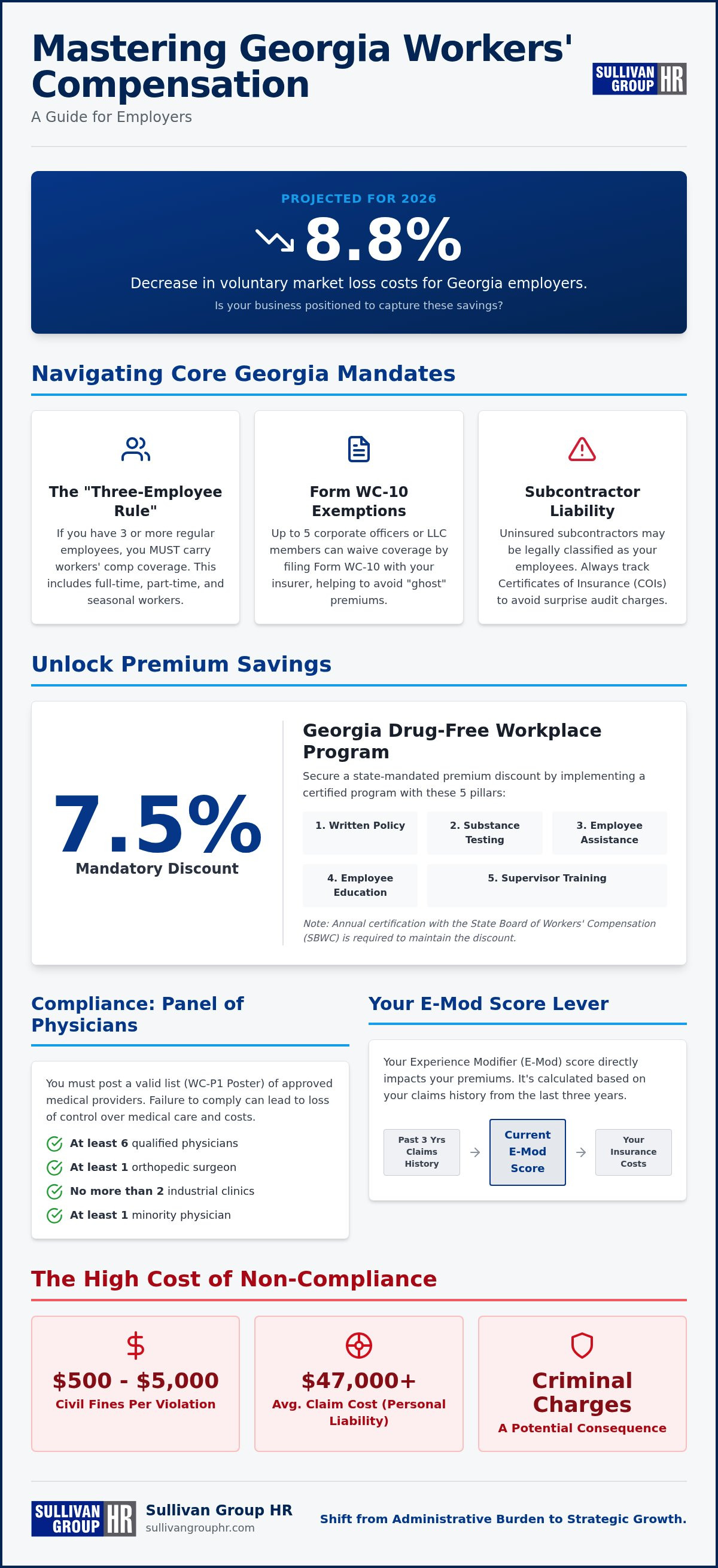
Did you know that despite rising medical costs, Georgia employers might see an 8.8% decrease in voluntary market loss costs in 2026? It sounds like a relief, but the real question is whether your business is actually positioned to capture those savings or if administrative leaks are draining your budget anyway. Staying ahead of georgia workers compensation laws for employers requires more than just meeting the three-employee coverage threshold. It demands a proactive strategy that balances regulatory compliance, workplace safety, and financial management.
We understand that managing SBWC forms and deciphering classification codes feels like a heavy burden on your daily operations. You want to protect your team, secure your assets, and grow your legacy without being anchored by paperwork. This guide promises to help you master the complexities of Georgia’s regulations while discovering how to leverage integrated HR technology to lower your premiums. We will explore the 2026 benefit caps, the cash-flow advantages of pay-as-you-go models, and the specific steps you can take to lower your Experience Modifier (E-Mod) score today.
Key Takeaways
- Learn how to navigate the "Three-Employee Rule" and use Form WC-10 to properly manage coverage exemptions for your leadership team.
- Discover the specific steps to secure a 7.5% premium discount by implementing a certified Georgia Drug-Free Workplace Program.
- Understand how your claims history from the last three years dictates your current E-Mod score and overall insurance costs.
- Master georgia workers compensation laws for employers by using integrated HCM technology to automate compliance and enable pay-as-you-go billing.
- Shift from administrative burden to strategic growth by leveraging expert risk management and real-time OSHA reporting.
Navigating Core Georgia Workers’ Compensation Mandates
Understanding the baseline requirements of georgia workers compensation laws for employers is the first step toward protecting your business and your people. In Georgia, the mandate is clear: if you have three or more regular employees, you must carry coverage. This isn't just a suggestion; it's a legal cornerstone designed to stabilize the workforce. Whether you're a burgeoning startup or an established enterprise, failing to meet this threshold leaves your personal assets vulnerable.
Defining the Georgia "Employee" in 2026
What exactly counts as an employee? The State Board of Workers' Compensation (SBWC) focuses on the "contract of hire." This can be a formal written agreement or a simple verbal handshake. If you utilize part-time or seasonal workers, they count toward that three-person threshold just as much as full-time staff. Many owners don't realize that corporate officers and LLC members are automatically included in this count unless they take specific action to opt out.
To manage these inclusions, you'll need to master Form WC-10. This document allows up to five corporate officers or LLC members to waive their right to benefits, effectively removing them from the coverage requirements. Simply signing the form isn't enough. It must be filed correctly with your insurer to prevent premium overages. Mismanaging this form often leads to "ghost" premiums where you pay for coverage that your leadership team doesn't actually want or need.
The situation becomes even more complex with contractors. If you sublet work to a subcontractor who doesn't carry their own insurance, they may be legally classified as your employee in the event of an injury. This makes certificate of insurance (COI) tracking a vital administrative task. Without a valid COI on file, your year-end audit could result in massive, unexpected premium charges for every dollar paid to that uninsured contractor.
The Panel of Physicians: A Mandatory Compliance Step
Compliance extends beyond just buying a policy. You must maintain a valid "Panel of Physicians" to direct medical care after an injury. This list must include at least six qualified physicians. To remain compliant, the panel must feature at least one orthopedic surgeon and no more than two industrial clinics. Additionally, the SBWC requires the inclusion of at least one minority physician.
Displaying this list on the WC-P1 poster in a prominent location is non-negotiable. If you fail to post this or if the panel is "invalid" because of outdated info or missing specialties, the injured worker may gain the right to choose any doctor they want at your expense. This loss of control can cause medical costs to spiral.
The U.S. workers' compensation system functions as a "no-fault" bargain, but that bargain breaks if you don't secure coverage. In 2026, the penalties for non-compliance are severe. You could face civil fines ranging from $500 to $5,000 per violation, along with potential criminal charges. More importantly, without insurance, your business is personally liable for all medical bills and lost wages, which average over $47,000 per claim nationally.
Maximizing Georgia-Specific Premium Discounts and Safety Programs
Are you leaving money on the table every time you pay your insurance premium? Many business owners view workers' comp as a fixed, unavoidable tax. In reality, Georgia provides specific legal pathways to reduce your costs significantly. By taking a proactive stance on safety, you don't just protect your team; you protect your profit margins. Leveraging georgia workers compensation laws for employers means moving beyond basic compliance and into the territory of strategic cost-saving.
The Georgia Drug-Free Workplace Certification
The most immediate financial win for Georgia employers is the Drug-Free Workplace Program. This state-sponsored initiative rewards your commitment to a sober workplace with a mandatory 7.5% discount on your workers' compensation premiums. To secure this credit, you must satisfy five specific pillars: a comprehensive written policy, substance abuse testing, employee assistance resources, annual employee education, and supervisor training.
Applying for this credit requires annual certification through the SBWC. It is not a "set it and forget it" program. If you fail to maintain these standards or miss your renewal window, your insurer can retroactively charge you for the lost discount. This is where a partnership with Sullivan Group HR becomes invaluable. We help you simplify the documentation, protect your certification status, and grow your savings year over year. You can find more details on these and other Georgia's workers' compensation mandates for employers directly through the state board's portal.
Conducting Georgia-Specific Risk Audits
How do you stop a claim before it happens? You start with a rigorous risk audit. Georgia-based industries, from Savannah’s busy ports to regional manufacturing hubs, face unique physical hazards. A generic safety manual isn't enough. You need to identify, analyze, and mitigate the specific risks present on your floor or job site. This process is a core component of effective HR risk management, ensuring that your safety protocols are defensible during an audit.
- Review Loss Run Reports: Look at your last three years of data to identify recurring injury patterns.
- Form a Safety Committee: The SBWC views active committees as a sign of proactive management, which can favorably influence your standing during inspections.
- Document Everything: In the eyes of the law, if safety training wasn't documented, it didn't happen. Maintain digital records of every toolbox talk and safety seminar.
By connecting these safety efforts to your broader georgia workers compensation laws for employers strategy, you create a culture of accountability. When you utilize expert consulting to prepare for potential SBWC enforcement inspections, you eliminate the guesswork. This disciplined approach ensures that your business remains a safe harbor for your employees and a high-performing asset for you.
Strategic Claims Management: The Experience Modifier (E-Mod) Lever
Is your Experience Modifier (E-Mod) score working for you or against you? In the world of georgia workers compensation laws for employers, this single number is the ultimate lever for financial control. An E-Mod of 1.0 represents the industry average. If your score climbs to 1.1 or 1.2, you're essentially paying a 10% to 20% surcharge on every dollar of premium. This score isn't a snapshot of today; it's a reflection of your past performance. For your 2026 policy, the NCCI looks at your claims history from 2022, 2023, and 2024. This three-year window means a single mismanaged claim from years ago can haunt your cash flow today.
If you're confused about how these scores are calculated, the state provides frequently asked questions about Georgia's workers' compensation laws to help clarify the basics. Beyond the basics, you must implement the "24-Hour Rule." Reporting an injury within one day of occurrence significantly reduces the final claim severity. It allows for immediate medical intervention and prevents minor incidents from ballooning into expensive legal battles. You should also regularly audit your loss runs. Insurance carriers sometimes leave claims open longer than necessary or fail to update reserves after a settlement. These errors artificially inflate your E-Mod, costing you money for risks that no longer exist.
Implementing Effective Return-to-Work Programs
One of the most effective ways to lower your E-Mod is to reduce indemnity payments through a light-duty program. Georgia law encourages employers to offer "suitable employment" to injured workers. This keeps the employee engaged and slashes the amount of disability benefits paid out. It's a delicate balance. You must ensure these roles comply with both workers' comp regulations and the Americans with Disabilities Act (ADA). Staying connected to your team during recovery isn't just good management. It's a proven strategy to improve recovery outcomes and get your people back to full strength faster.
Closing Claims Promptly
An open claim is a financial liability. When an adjuster sets an "open reserve," that estimated future cost is counted against your E-Mod immediately. If a claim sits idle, your business valuation suffers. We work closely with adjusters to move claims toward final settlement as quickly as possible. For long-term disability cases in Georgia, proactive management is essential. Don't let claims drift. By settling cases and closing reserves, you reclaim your financial standing and ensure your 2026 premiums reflect your current safety reality rather than past mistakes. This disciplined approach is how you simplify the complex and protect your organization's future.
Integrating HCM Technology for Real-Time Risk Mitigation
Why do so many businesses treat insurance as a siloed, manual chore? In a modern workplace, your insurance strategy should live where your data lives: in your Human Capital Management (HCM) system. Adhering to georgia workers compensation laws for employers is far simpler when you stop chasing paper and start leveraging real-time insights. By integrating your workers' comp with technology like isolved, you transform a reactive burden into a proactive shield. This shift allows you to move from guessing your risks to managing them with precision.
The Benefits of Pay-As-You-Go Workers’ Comp
Traditional insurance models often demand massive up-front premium deposits. For mid-sized firms in Georgia, this ties up vital capital that could be used for growth. The pay-as-you-go model changes that dynamic. Instead of estimated payments, your premiums are calculated based on actual, real-time payroll data. This eliminates the "sticker shock" of year-end audits because you've already paid exactly what you owe throughout the year. It's a cleaner, more predictable way to manage your cash flow while staying perfectly aligned with state requirements.
This seamless connection is best achieved through payroll administration outsourcing. When your payroll and insurance billing talk to each other, administrative friction disappears. You no longer need to manually reconcile hours or worry about misclassification errors that lead to audit penalties. It's about creating a system that works for you, not the other way around. You gain the security of knowing your billing is accurate every single pay cycle.
Data-Driven Safety Decisions
Beyond billing, technology helps you spot trouble before it starts. Are certain departments seeing a spike in injuries during high-overtime weeks? Real-time data analytics can identify fatigue-related trends that a manual log would miss. Using isolved, you can also track safety training completion across your entire workforce. If an inspector from the SBWC arrives, you don't have to dig through filing cabinets. You can pull a digital record of every completed training module in seconds. This speed and accuracy are vital for maintaining your standing with state regulators.
This digital record-keeping isn't just a convenience; it's a defense. It proves you are meeting georgia workers compensation laws for employers with precision and intent. If you're ready to modernize your risk strategy, you can explore our integrated workers’ comp solutions to see how we simplify compliance for Georgia business owners. Streamlining your annual insurance audit becomes a byproduct of good technology rather than a stressful seasonal event. You gain the clarity to identify high-risk departments and the agility to intervene before small risks become large claims.
Beyond Insurance: The Sullivan Group HR Strategic Partnership
How much of your professional potential is currently sidelined by administrative static? Mastering georgia workers compensation laws for employers is a continuous journey that requires more than just a standard insurance policy. It requires a partner who acts as both a shield and a coach. At Sullivan Group HR, we move beyond transactional services to provide a "Simplify, Protect, Grow" framework. This approach ensures you aren't just compliant; you're competitive. We take on the expert advocacy required for difficult SBWC claims, allowing you to offload the compliance burden and return your focus to what you do best: running your business.
Reducing Administrative Friction
Growth often brings new complexities, especially if your operations expand into neighboring states. Managing multi-state workers' comp requirements can quickly become a full-time job. We simplify this transition by ensuring your coverage and reporting remain seamless across borders. A critical part of this protection is your employee handbook. We work with you to ensure your internal policies align perfectly with Georgia safety mandates and state-specific legal requirements. This level of detail is a core component of modern Human Capital Management. When your HR data and safety protocols live in the same ecosystem, long-term risk reduction becomes a natural byproduct of your daily workflow.
Sustainable Cost Stabilization
Lowering your E-Mod score isn't a quick fix; it's a multi-year strategic play. Because the NCCI looks at a three-year window of data, you need a partner who stays the course with you. We act as your localized ally, providing the hard-earned wisdom that only comes from decades of experience in the Georgia market. You don't have to choose between a personal relationship and high-end technology. We provide a localized "handshake" and personalized service, backed by the national-scale power of the isolved platform. This combination provides the stability your cash flow needs to thrive in 2026 and beyond.
Compliance shouldn't feel like a weight around your neck. It should be the foundation upon which you build your legacy. By leveraging our expertise in georgia workers compensation laws for employers, you gain a team that is as invested in your success as you are. We help you navigate the paperwork, contest inaccurate loss runs, and implement safety programs that actually move the needle on your premiums. It's time to stop reacting to the SBWC and start leading your industry with confidence. If you're ready to secure your organization's future, take the first step and Request a Georgia Risk Management Consultation today.
Transform Your Risk into a Strategic Advantage
Are you ready to move from reactive compliance to proactive leadership? Navigating georgia workers compensation laws for employers doesn't have to be a source of stress. By securing your Drug-Free Workplace certification and utilizing a valid Panel of Physicians, you've already laid the groundwork for significant savings. The real breakthrough happens when you integrate your payroll and insurance through a pay-as-you-go model. This shift eliminates audit surprises and keeps your cash flow predictable during every pay cycle.
We are here to act as your coach and advocate. With access to the industry-leading isolved HCM platform, you can automate your OSHA logs and focus on your operations while we handle the administrative heavy lifting. Our expertise in Georgia-specific premium reduction programs ensures you never pay more than necessary for coverage. You deserve a partner who values your people as much as your profit. By aligning your technology with your risk strategy, you create a safer, more resilient organization.
Protect your Georgia business with Sullivan Group HR’s integrated risk solutions. Let's work together to simplify your workload, protect your assets, and grow your legacy in the year ahead.
Frequently Asked Questions
Does every business in Georgia need workers’ compensation insurance?
No, only businesses with three or more regular employees are required to carry coverage. This threshold includes full-time, part-time, and seasonal workers. It's important to remember that corporate officers and LLC members count toward this total unless they've filed a specific exemption. Even if your contract of hire was a simple verbal agreement, those individuals still trigger the state mandate once you reach the three-person mark.
What is the Georgia Drug-Free Workplace premium discount?
The Georgia Drug-Free Workplace program is a state-certified initiative that grants employers a mandatory 7.5% discount on their workers' compensation premiums. To secure this credit, you must implement five pillars: a written policy, substance abuse testing, employee assistance resources, education, and supervisor training. You must renew this certification annually with the State Board of Workers’ Compensation to keep the discount active and avoid retroactive charges.
How do I choose the six doctors for my Georgia Panel of Physicians?
You must select at least six qualified physicians who are reasonably accessible to your employees' place of work. The law requires your panel to include at least one orthopedic surgeon and no more than two industrial clinics. Additionally, you must include at least one minority physician. This list must be posted prominently on the WC-P1 poster to ensure your right to direct medical care remains valid.
Can corporate officers in Georgia exempt themselves from workers’ comp?
Yes, up to five corporate officers or LLC members can choose to exempt themselves from coverage by filing Form WC-10. While these individuals waive their right to receive benefits, they still count toward the three-employee threshold that mandates coverage for the rest of your workforce. Correctly filing this form is essential to ensure you aren't paying "ghost" premiums for executives who don't want or need the coverage.
What happens if I don’t have workers’ comp in Georgia and an employee gets injured?
Failing to secure coverage leaves your business personally liable for all medical bills and lost wages, which average over $47,000 per claim nationally. You also face civil penalties ranging from $500 to $5,000 per violation. Beyond financial loss, the state can pursue criminal charges for non-compliance. Without the protection of the no-fault bargain, an injured worker could also pursue a direct civil lawsuit against your company.
How does pay-as-you-go workers’ comp work with my payroll?
Pay-as-you-go billing integrates directly with your payroll system to calculate premiums based on actual wages paid during each cycle. This modern approach eliminates the need for large, up-front premium deposits that strain your cash flow. It's a primary way to manage georgia workers compensation laws for employers with precision. By using technology like isolved, your data flows automatically to the insurer, which significantly reduces the risk of year-end audit "sticker shock."
What is a good Experience Modifier (E-Mod) score for a Georgia employer?
A good E-Mod score is anything below 1.0, as this indicates your safety record is better than the industry average. A score of 1.0 is the neutral baseline. If your score climbs above this, it acts as a surcharge, making georgia workers compensation laws for employers more expensive for your specific firm. Maintaining a low score requires a multi-year strategy focused on safety training and prompt claims management to protect your bottom line.
How long does a Georgia employer have to report an injury to the SBWC?
You have 21 days to report an injury to the State Board of Workers’ Compensation once you've been notified of the accident. While employees have a 30-day window to report an injury to you, waiting to file with your insurer is a mistake. We recommend the "24-Hour Rule" for internal reporting. Getting a claim into the system within one day allows for faster medical intervention and helps prevent minor incidents from turning into costly, long-term disability cases.


