

Would you bet your business's stability on a software algorithm that doesn't know your name? With the 2026 Social Security wage base reaching $184,500 and new reporting requirements for overtime income, the margin for error has disappeared. You likely feel the constant pressure of manual data entry and the fear of an IRS audit. It's a heavy burden to carry alone. Finding the right partner starts with knowing the specific questions to ask a potential payroll provider to ensure they offer more than just a transaction.
We're here to help you move from administrative overwhelm to organizational security. This guide equips you with the tools to identify a partner that protects your compliance, integrates your systems, and empowers your workforce. We will walk through 21 critical questions covering modern agentic AI technology, responsive expert support, and the regional expertise needed to manage a multi-state team in 2026. Let's find a partner that puts the "human" back into your human capital management and turns your payroll from a source of stress into a foundation for growth.
Key Takeaways
- Learn how to vet a partner’s ability to handle complex 2026 tax regulations and multi-state compliance to avoid costly IRS penalties.
- Discover why a unified HCM platform is superior to fragmented systems for creating a seamless, error-free employee experience.
- Master the specific questions to ask a potential payroll provider to distinguish between a distant call center and a dedicated, responsive expert.
- Understand how accurate, timely paychecks serve as the essential foundation for employee trust and long-term workforce empowerment.
- Secure total peace of mind by aligning your business with a provider that offers both industry-leading technology and a protective, human-centric shield.
Why Asking the Right Questions Prevents Costly Payroll Pitfalls
Payroll is more than a simple line item on a balance sheet. It is the most frequent and vital touchpoint between you and your workforce. Every pay period, you make a concrete promise to your employees. When that check is accurate and on time, you build a culture of trust. When it fails, that trust erodes faster than almost any other administrative breakdown. In 2026, the stakes are higher than ever. With the Social Security wage base rising to $184,500 and new reporting requirements for overtime income, the margin for error has vanished. You need a bulletproof process that works every single time.
Selecting a partner is a high-stakes decision for any business owner. Many entrepreneurs fall into the trap of choosing the cheapest software without considering the heavy hidden costs. These costs often appear as manual workarounds, late-night data entry, and unexpected tax penalties. Knowing the right questions to ask a potential payroll provider can save you thousands in administrative waste and legal headaches. You aren't just looking for a digital calculator. You are looking for a protective shield that empowers your growth while keeping your business safe.
The High Cost of Compliance Failures
IRS penalties don't just happen; they compound. If a provider misses a filing deadline or miscalculates a state-specific tax, the interest can grow quietly in the background for months. By the time you receive a notice, the financial damage is often severe. This is where payroll administration outsourcing becomes a vital risk mitigation strategy. It shifts the burden of accuracy from your shoulders to an expert advocate. We focus on proactive compliance, ensuring you stay ahead of federal and state changes before they become liabilities. Are you prepared to handle a surprise audit alone?
Moving from Vendor to Strategic Partner
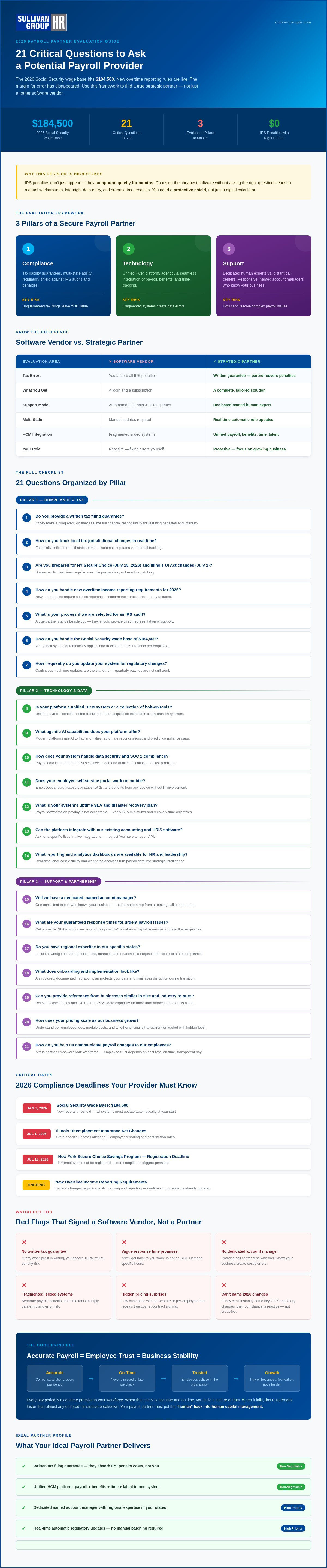
A software vendor sells you a login. A strategic partner sells you a solution. In a world of automated help bots, the value of a human expert is your greatest competitive advantage. You need a partner who understands the entire lifecycle of human capital management. This means your payroll must integrate seamlessly with your benefits, your time-tracking, and your talent acquisition. As you evaluate your options, use our three-part framework: Compliance, Technology, and Support. These are the pillars of a secure organization. Asking the specific questions to ask a potential payroll provider will reveal whether they are a transactional vendor or a long-term ally in your success.
Core Competency: Questions on Compliance and Tax Administration
Who carries the risk when the IRS knocks on your door? In the complex landscape of 2026, compliance is not a luxury. It is your business's lifeline. When assessing your options, the first set of questions to ask a potential payroll provider must center on their ability to act as your regulatory shield. You need more than a calculator. You need an advocate who stands between you and the mounting complexity of federal and state mandates. This starts with demanding total transparency regarding their tax filing processes and accountability standards.
Tax Liability and Accountability
Demand clarity on the chain of responsibility. If your provider makes a filing error, do they assume the full financial burden of the resulting penalties and interest? You should ask exactly how they handle tax filing and what their specific guarantee looks like. A partner who refuses to back their work with a written guarantee is simply a software vendor, leaving you to face the IRS alone. Full-service tax filing is a non-negotiable standard in 2026. We believe a true partner protects your capital, preserves your reputation, and provides peace of mind through every filing cycle.
Multi-State and Regulatory Agility
With the rise of the borderless office, managing multi-state payroll has become a daily reality for even small firms. You must ask how your provider tracks local tax jurisdictional changes in real-time. For example, are they prepared for the New York Secure Choice Savings Program registration deadline on July 15, 2026, or the Illinois Unemployment Insurance Act changes effective July 1? Your system should update automatically, ensuring you never miss a beat as laws evolve. Beyond basic taxes, ask about the "messy" administrative tasks:
- How are wage garnishments and unemployment claims managed?
- Does the system automatically update for changing federal and state labor laws?
- Will the provider handle W-2 and 1099 distribution without your manual intervention?
A high-performing provider handles these complexities behind the scenes, allowing you to focus on leading your people. Finding a partner that understands these local nuances is the first step toward total security. You might find that exploring a localized HCM approach provides the regional expertise and stability your team deserves. These specific questions to ask a potential payroll provider will help you separate the automated platforms from the genuine partners who value your success as much as you do.
The Digital Handshake: Evaluating Technology and Data Security
Is your payroll data talking to your benefits platform? If the answer is no, you're inviting "data rot" into your organization. When systems don't communicate, manual entry becomes a necessity, and errors follow closely behind. In 2026, 47% of HR professionals identify the integration of payroll, HR, and attendance systems as the top trend shaping the industry. This shift isn't just about convenience; it's about accuracy, safety, and results. This is why one of the most vital questions to ask a potential payroll provider is whether their technology acts as a bridge or a barrier to your success.
Your technology choices serve as a digital handshake between your leadership and your workforce. To ensure this handshake is firm and secure, you must vet the infrastructure supporting your team. We recommend focusing your evaluation on these four critical areas:
- Is your payroll system part of a unified HCM platform?
- What does the employee self-service experience look like?
- How is our sensitive employee data encrypted and protected?
- Does the system integrate with time, attendance, and benefits?
The Power of a Unified HCM Platform
Siloing your payroll from the rest of your HR functions leads to fragmented records and double-entry frustration. We utilize the isolved platform because it provides a single source of truth for your entire employee lifecycle. This unified approach ensures that workforce management solutions function at their peak, aligning your talent strategy with your compensation reality. When your time-tracking, benefits, and payroll live in one place, you eliminate the gaps where costly compliance errors often hide.
Employee Empowerment and Security
Data security is the #1 priority for payroll providers in the current threat landscape. Your employees trust you with their most sensitive information, from Social Security numbers to bank details. You must ask about their SOC 2 compliance and their use of multi-factor authentication (MFA). A mobile-first employee portal isn't just a perk; it's a necessity. It provides a secure, transparent window into their own professional lives, allowing them to access tax forms and pay stubs with a single, protected tap on their phones. Can your current provider offer that level of security and accessibility? These specific questions to ask a potential payroll provider will reveal if they are truly prepared to protect your people in 2026.
Beyond the Software: Assessing Partnership and Support Models
Software is only as good as the people standing behind it. When a payroll emergency strikes on a Friday afternoon, do you want a ticket number or a direct line to an expert? Many business owners focus solely on the digital interface, but the true value of a provider is revealed during a crisis. This is why your list of questions to ask a potential payroll provider must look past the screen and into the service model. You deserve a partner who values your time, your peace of mind, and your professional potential.
The Dedicated Support Difference
Big-box providers often treat your business like a data point in a queue. You call a general center, explain your history to a stranger, and wait for a resolution. This "ticket number" experience is the opposite of a partnership. We believe in a dedicated point of contact who knows your business, your team, and your history. This level of personalized care is essential for effective HR risk management. When an expert understands your specific nuances, they can spot anomalies before they become liabilities. Ask these questions to gauge the depth of their support:
- Will I have a dedicated point of contact or a general call center?
- What is your typical response time for payroll emergencies?
- How do you support us during a workers’ compensation or payroll audit?
Implementation: The "Make or Break" Phase
The transition to a new system is where most payroll failures begin. A sloppy onboarding process can lead to months of data cleanup and employee frustration. You need a clear, documented roadmap for success. Ask for a specific timeline for data migration and system testing. A reliable partner will insist on a "parallel run." This means running your old and new systems simultaneously to guarantee total accuracy before the final handoff. Does the provider offer hands-on training for your managers and employees? If the answer is no, you're buying a tool without an instruction manual.
Your business deserves more than a transaction; it deserves a protective ally. If you're tired of being just another number, partner with a dedicated payroll expert who puts your success first. These specific questions to ask a potential payroll provider help you identify the organizations that prioritize people over processes. By vetting the support model and implementation strategy, you ensure your organization remains secure, compliant, and empowered for the long term.
Choosing Sullivan Group HR: Where Expertise Meets Integrated HCM
Are you ready to stop managing spreadsheets and start leading your people? You've explored the critical questions to ask a potential payroll provider, and you now understand that the stakes for 2026 are incredibly high. At Sullivan Group HR, we don't just provide a platform; we offer a protective shield. We leverage isolved, the industry-leading platform for unified HCM, to ensure your data is accurate, integrated, and safe. By handling the heavy lifting of payroll administration, we empower you to focus on growth, talent, and your professional potential.
Our model intentionally prioritizes human connection over automated processes. While big-box vendors rely on sterile call centers and ticket numbers, we lean on a legacy of hard-earned wisdom. We strike a balance between professional rigor and empathetic partnership, acting as your coach and ally in a complex regulatory environment. We understand that your business is more than a series of transactions. It's a community that deserves reliable advocacy and a partner who values people over systems.
Authoritative Support for Your National Workforce
We bring decades of regional expertise to a national stage, offering a "no-nonsense" authority that cuts through bureaucratic noise. Our explicit regional signaling acts as a localized handshake, indicating a level of personalized touch that national firms simply cannot replicate. We operate within a proven three-part functional framework: Payroll, Benefits, and Risk. This triad ensures that every aspect of your employee lifecycle is managed with precision. Whether you are navigating the $184,500 Social Security wage base or managing the new Roth catch-up contribution requirements for high earners, we stand as your stable and reliable advocate.
Next Steps: Secure Your Organization’s Future
The right partnership begins with a clear-eyed look at your current state. We invite you to join us for a discovery call to audit your current payroll vulnerabilities and identify opportunities for efficiency. During this session, we provide a personalized walkthrough of the isolved People Cloud. You'll see firsthand how a unified platform eliminates data silos and streamlines your workforce management. Don't leave your compliance to chance in an era of increasing regulatory pressure and shifting labor laws. Schedule your payroll consultation with Sullivan Group HR today. Let us provide the stability, security, and expertise your organization needs to thrive in 2026 and beyond.
Elevate Your Workforce Strategy for 2026 and Beyond
The roadmap to a secure organization begins with clarity. By mastering the questions to ask a potential payroll provider, you've taken the first step toward transforming your administrative burden into a strategic advantage. True partnership requires a balance of bulletproof compliance, unified technology, and responsive human support. You deserve a system that eliminates manual errors while providing a protective shield against ever-changing tax regulations.
Sullivan Group HR stands ready to act as your coach and ally. We provide access to the industry-leading isolved HCM platform and offer deep expertise in multi-state compliance and tax administration. Most importantly, we provide dedicated account managers who value people over automated systems. You don't have to navigate these complexities alone. Our team understands the nuances of your territory and the legacy you're building.
Ready to vet your options with confidence? Download our Payroll Provider Evaluation Checklist to ensure your next partner meets the high standards your business requires. Your professional potential is limitless when your foundation is secure. We look forward to helping you build a legacy of stability and success.
Frequently Asked Questions
How long does it typically take to switch payroll providers?
A standard transition typically takes between four and eight weeks. This timeline allows for secure data migration, system configuration, and at least one "parallel run" to ensure your totals match perfectly before going live. Rushing this process invites errors, so we prioritize a steady, purposeful pace during your onboarding to protect your data integrity. This is one of the most important questions to ask a potential payroll provider to ensure your expectations align with their implementation reality.
Is it better to use a local payroll provider or a national firm?
Regional experts offer a personalized "handshake" and specific jurisdictional wisdom that national firms often cannot replicate. While large firms have scale, they frequently lack the deep, "no-nonsense" authority regarding your specific local territory. A regional partner provides a dedicated advocate who understands your community and values people over automated processes. You gain the stability of an established expert combined with the warmth of an empathetic partnership.
What is the average cost of outsourcing payroll for a small business?
Pricing is generally structured around a base administrative fee combined with a per-employee, per-month charge. Your total investment depends on your filing frequency, the number of states where you operate, and whether you include integrated services like benefits management. We recommend focusing on the value of long-term organizational security and risk mitigation. A provider that prevents a single IRS penalty often pays for itself through compliance peace of mind.
Can a payroll provider help me with I-9 and termination compliance?
Yes, a comprehensive partner supports you through every stage of the employee lifecycle. By utilizing an Applicant Tracking System and integrated HR consulting, you can automate I-9 verification and ensure termination payouts comply with state-specific final pay laws. To further support your international recruitment efforts, you can explore U.S. Immigration Legal Services from the Law Offices of Peg Yang, P.C. to ensure every hire is handled with precision. This proactive approach acts as a protective shield for your business, transforming payroll from a simple transaction into a foundation for total regulatory advocacy and workforce empowerment.
What happens if my payroll provider makes a tax filing error?
Your service agreement should explicitly state that the provider assumes financial liability for any penalties and interest resulting from their filing errors. This accountability is a non-negotiable standard for professional payroll administration in 2026. Knowing who carries the risk is among the vital questions to ask a potential payroll provider during your initial discovery call. Total peace of mind comes from a partner who stands behind their work with authoritative support.
Do I need a separate system for time tracking and payroll?
You don't need separate systems if you choose a unified Human Capital Management platform. Integrating time and attendance with your payroll eliminates the "data rot" and manual entry errors that plague fragmented systems. It creates a seamless, reliable beat from the moment an employee clocks in to the moment they receive their paycheck. This integration simplifies your professional functions and minimizes the cognitive load on your administrative team.
How does an HCM platform differ from simple payroll software?
Simple payroll software is a transactional tool designed for cutting checks. An HCM platform like isolved manages the full lifecycle of your workforce, including talent acquisition, benefits management, and performance tracking. It moves your business away from a transactional vendor identity toward a strategic, long-term relationship. An HCM platform turns your payroll data into actionable intelligence that informs your broader workforce strategy and enhances the overall employee experience.
Can I keep my current bank account when I switch payroll providers?
You can absolutely keep your existing business bank account when you transition. Your provider will simply establish a secure ACH link to fund your payroll, tax liabilities, and any third-party payments like garnishments. This process is designed to be brisk and purposeful, ensuring your daily operations remain stable. It allows you to maintain your established financial relationships while upgrading to a more supportive and protective payroll administration model.


