
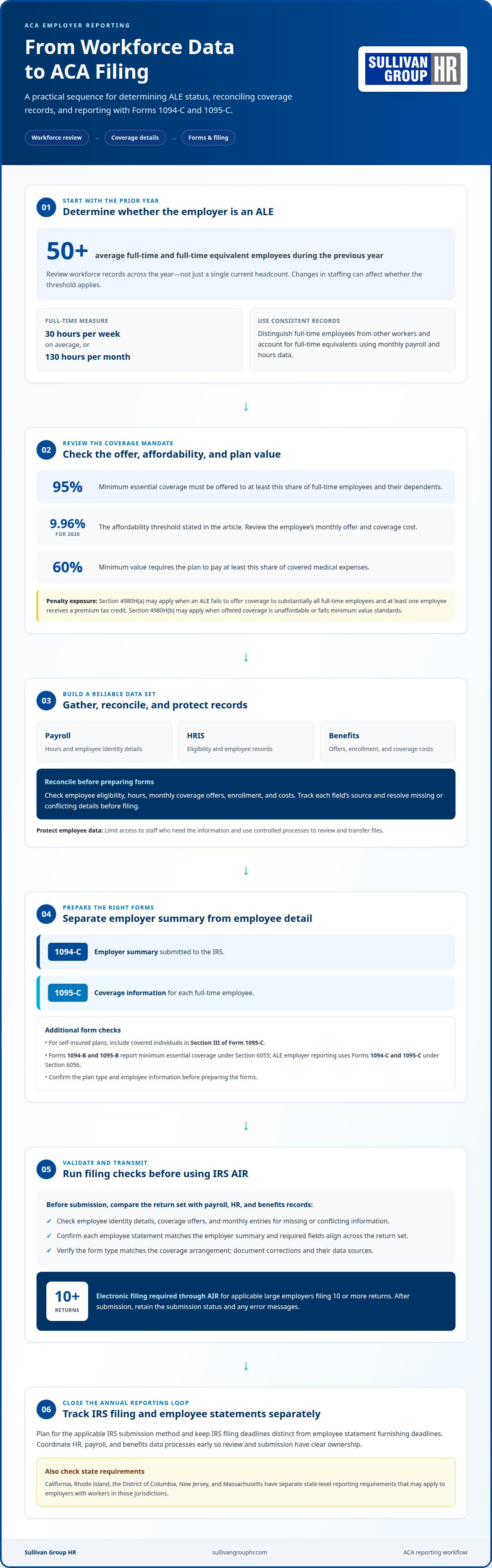
For ACA purposes, a business is an applicable large employer (ALE) if it averaged 50 or more full-time and full-time equivalent employees during the previous year, according to the Internal Revenue Service. ACA compliance reporting service work centers on determining ALE status, tracking coverage information, and filing Forms 1094-C and 1095-C annually with the IRS, as the Internal Revenue Service requires of ALEs.
ACA compliance reporting service requirements can feel like a tangle of employee counts, coverage details, and deadlines. This guide explains how ALE status is determined, what the two forms report, and when filings are due. It also covers how accurate payroll and benefits records support the process, so you can approach ACA reporting with greater clarity.
Key Takeaways
- Review workforce records from the previous year to determine whether your organization meets the ALE threshold.
- Reconcile payroll, employee eligibility, and coverage details before preparing individual statements and the IRS transmittal.
- Plan for the applicable electronic filing method and track IRS submission and employee furnishing deadlines separately.
- Coordinate HR and payroll data processes early to make annual reporting more organized and manageable.
Applicable Large Employer (ALE) determination
ALE status determines which employers are subject to the ACA employer mandate and related reporting requirements. Start by calculating the prior-year workforce count, then review coverage offers and affordability.
ALE Status and Workforce Thresholds
According to the Internal Revenue Service, a business is an applicable large employer under the ACA if it averaged 50 or more full-time and full-time equivalent employees during the previous year. Employers should review workforce records across the year, rather than relying on a single current headcount. Changes in staffing can affect whether the threshold applies.
Full-Time and Full-Time-Equivalent Calculations
According to the Internal Revenue Service, for ACA purposes, a full-time employee in the United States works an average of at least 30 hours per week or 130 hours per month. To determine status, employers need to distinguish full-time employees from other workers and account for full-time equivalents. Use consistent payroll and hours data when reviewing each month’s workforce.
ALE status also connects to the coverage mandate. Applicable large employers must offer minimum essential coverage to at least 95% of full-time employees and their dependents. The coverage must meet affordability and minimum value standards. For 2026, the affordability threshold is 9.96%; minimum value requires the plan to pay at least 60% of covered medical expenses.
Employer shared responsibility penalties may apply under Section 4980H. Section 4980H(a) can apply when an ALE fails to offer coverage to substantially all full-time employees and at least one employee receives a premium tax credit. Section 4980H(b) can apply when offered coverage is unaffordable or fails minimum value standards.
State ACA reporting requirements may add obligations beyond federal reporting. California, Rhode Island, the District of Columbia, New Jersey, and Massachusetts have separate state-level requirements, so employers with workers in those jurisdictions may need to account for both systems.
Which employers must file Forms 1094-C and 1095-C with the IRS annually? Applicable large employers must file both forms with the IRS annually. A reporting workflow should reconcile payroll, HR, and benefits data, then restrict employee information to staff who need it and protect it during handling.
Forms 1094-C and 1095-C
Under the Affordable Care Act, applicable large employers must file Forms 1094-C and 1095-C with the IRS annually, and the forms serve different reporting roles. Applicable large employers must file Forms 1094-C and 1095-C with the IRS annually, according to the Internal Revenue Service.
Forms 1095 and 1094 Preparation
Applicable large employers must file Forms 1094-C and 1095-C with the IRS annually; Form 1094-C summarizes employer information for the IRS, while Form 1095-C reports coverage information for each full-time employee. Review each employee’s monthly offer, coverage cost, and applicable safe-harbor information for accuracy. Employers with self-insured plans report covered individuals in Section III of Form 1095-C. These details help distinguish the employer summary from individual coverage statements.
Form choice also depends on the plan and reporting obligation. Forms 1094-B and 1095-B report minimum essential coverage information under Section 6055, while applicable large employers must file Forms 1094-C and 1095-C with the IRS annually for employer reporting under Section 6056, so confirm the plan type and employee information before preparing forms.
Information and Documents for Reporting
Gather records from payroll, HRIS, and benefits administration systems, since each may contain different details. Reconcile employee eligibility, hours, coverage offers, enrollment, and coverage costs before preparing forms. For self-insured coverage, include the covered-individual information required for Section III. Track the source of each data field so you can resolve discrepancies before filing.
How do ACA reporting services handle employee data and privacy? They collect and reconcile workforce and coverage records, then prepare information for reporting. Limit access to people who need the data, and use controlled processes to review and transfer files.
ACA Reporting Service Costs
The cost depends on the case and is provided after a quote request; factors include workforce size, plan type, data readiness, and the amount of form preparation required. Compare the work covered, such as data reconciliation, form preparation, filing support, and employee statements. An ACA compliance reporting service should make its scope clear before work begins, so employers understand which steps remain in-house.
What documents are needed? Start with payroll, HRIS, and benefits records, then reconcile employee eligibility and monthly coverage details. Employers remain responsible for accurate reporting even when outside vendors help prepare forms. Errors or missed filings can create penalty exposure, so assign ownership for review and submission. Coordinating benefits record management with payroll data can support a more consistent reporting process.
ACA Information Returns (AIR) electronic filing
The IRS AIR system handles electronic ACA information returns. Applicable large employers filing 10 or more returns must file electronically through AIR.
Data Validation and Filing Checks
Before uploading, compare the completed return data with payroll, HR, and benefits records. Check employee identity details, coverage offers, and monthly entries for missing or conflicting information. For example, if payroll shows an employee as full-time but the coverage record says otherwise, resolve the discrepancy before submission. Document corrections and their data sources.
Filing Review and Error Reduction
A review step can help catch issues before transmission. Confirm that each employee statement matches the employer’s summary and that required fields align across the return set. Check that the form type matches the coverage arrangement, including whether the plan reports minimum essential coverage. After submitting through AIR, retain the submission status and any error messages for follow-up.
Electronic filing does not remove the employer’s responsibility for accurate information. Applicable large employers should assign a reviewer to compare final forms with underlying health coverage records. This final review can identify mismatched employee data or incomplete entries before filing.
Correcting an ACA Filing
What should employers do if they need to correct an ACA filing? Identify the affected return, compare it with source records, and prepare the correction using the applicable IRS form instructions. Submit the corrected information through the required process and retain the updated filing confirmation.
For example, if an employee’s coverage entry was reported incorrectly, trace it to the benefits or payroll record before changing the return. Correct related employee statements and employer summary information as needed, rather than changing one field without checking connected records. Keep the original submission and correction documentation together.
A practical AIR workflow has three stages: reconcile the data, review the forms, and confirm transmission status. Organize files by reporting year and form type, and document who reviewed each submission. If AIR returns an error, use its message to locate the affected record, correct the underlying data, and resubmit according to IRS procedures. Keep employee health coverage information secure throughout preparation and filing.
ACA reporting deadlines
ACA reporting has separate deadlines for sending employee statements and filing returns with the IRS. Track both dates against the reporting year and schedule time for review.
Filing Deadlines
For the 2025 tax year, the stated electronic filing deadline for Forms 1094-C and 1095-C is March 31, 2026, according to the Internal Revenue Service, and applicable large employers must file those forms with the IRS annually. Employers should record this date separately from the employee furnishing deadline. Before submission, confirm each return’s reporting year, employee details, and coverage entries, then retain the filing confirmation.
Filing method also matters. Applicable large employers filing 10 or more returns must file electronically through the IRS AIR system. Employers filing fewer than 10 returns for the 2025 reporting year have a stated paper filing deadline of March 2, 2026. Build the workflow around the applicable method, not one shared calendar reminder.
Furnishing Deadlines
For the 2025 tax year, the stated deadline to furnish Form 1095-C to employees is March 2, 2026, according to the Internal Revenue Service. Furnishing means delivering the individual statement to the employee, while filing sends returns to the IRS. Keep separate records for employee delivery and IRS submission.
To prepare, map the steps backward from each deadline. Allow time to reconcile payroll and coverage records, review the forms, resolve errors, and complete delivery or submission. For example, a delayed employee record can affect both a Form 1095-C and the employer’s filing package.
Use a reporting calendar that identifies the tax year, responsible staff member, filing method, and completion status for each task. Save proof of employee furnishing and IRS acceptance with the related forms. If employee coverage records need coordination, coordinate employee benefits records as part of your reporting process.
Sullivan Group HR: HCM
Sullivan Group HR provides HCM, Payroll Outsourcing, Payroll Administration, and an Applicant Tracking System. These services can support employers coordinating workforce and payroll processes alongside ACA reporting.
Consider HCM or payroll administration when employee records and payroll workflows need better coordination. Organized processes can help your team maintain the workforce information used in reporting, while keeping responsibility for reviewing and filing forms clear.
The right next step depends on where your process needs support, whether that is payroll administration, outsourced payroll, applicant tracking, or broader HCM. Contact Sullivan Group HR to discuss which offering fits your organization’s needs.
Build a More Connected Workforce Process
ACA reporting can prompt a broader look at how workforce information moves through your organization. Clear ownership of employee and payroll records supports consistent administration throughout the year, not just during filing season. Reporting support can also help organize tasks and coordinate information from different sources.
Sullivan Group HR offers HCM, Payroll Outsourcing, and Payroll Administration to support workforce and payroll operations. These services can help connect related processes while keeping internal review and filing responsibilities clear.
Choose a next step that matches the work your team wants to strengthen. Explore Sullivan Group HR’s services and consider how HCM or payroll support could fit your organization’s needs. A thoughtful process starts with a clear view of what your team handles today and where it wants practical support. Your next reporting cycle can be a chance to build that clarity.
Frequently Asked Questions
What is ACA compliance?
ACA compliance is the employer’s process for meeting health coverage responsibilities under the Affordable Care Act. In practice, it connects workforce, enrollment, and plan-offer records so changes are reflected consistently. For example, when an employee changes roles or coverage elections, keep the related records aligned for administration and reporting.
What are Safe Harbor calculations?
Safe Harbor calculations are methods for assessing whether employee coverage meets ACA affordability standards. The three calculations use the federal poverty line, rate of pay, or W-2 Box 1 earnings. Each uses a different income reference, so employers should apply their chosen method consistently and retain supporting wage or payroll records. That makes the affordability review easier to explain later.
How can I simplify my ACA management?
To simplify ACA management, assign clear ownership of employee status changes, benefit elections, and payroll updates. Use a shared calendar and consistent handoffs among HR, payroll, and benefits teams. For example, a hire or termination can trigger a review of related employee records instead of relying on separate teams to notice the change later. A steady routine helps prevent work from piling up.
What does ACA stand for?
ACA stands for the Affordable Care Act, the common name for the federal health reform law. The acronym appears in employer discussions about health coverage, workforce eligibility, and tax reporting. Knowing the full name helps distinguish ACA-related forms and processes from other benefits paperwork, particularly when HR, payroll, and plan documents use different labels for related information.
What does a dedicated ACA specialist do?
An ACA specialist coordinates reporting tasks and helps organize the records used for them. The role may include reviewing workforce and coverage information, identifying inconsistencies, and guiding form preparation and filing. For example, a specialist can help connect a payroll change with the corresponding employee record, making it clearer what needs attention.
What is an ACA compliance reporting service?
An ACA compliance reporting service helps employers organize information and prepare required health coverage reports. Depending on its scope, support may include gathering data from HR, payroll, and benefits records, preparing forms, and coordinating filing workflows. This support can help create a more organized reporting process and clarify which tasks remain internal.


